
Best Ad Network For Casino
Evaluate the best ad network for casino by eligible inventory, formats, targeting, reporting, tracking, safeguards, support and test economics
Compare ad networks by inventory, formats, targeting, tracking, traffic controls, minimum funding and the evidence needed before scaling spend.
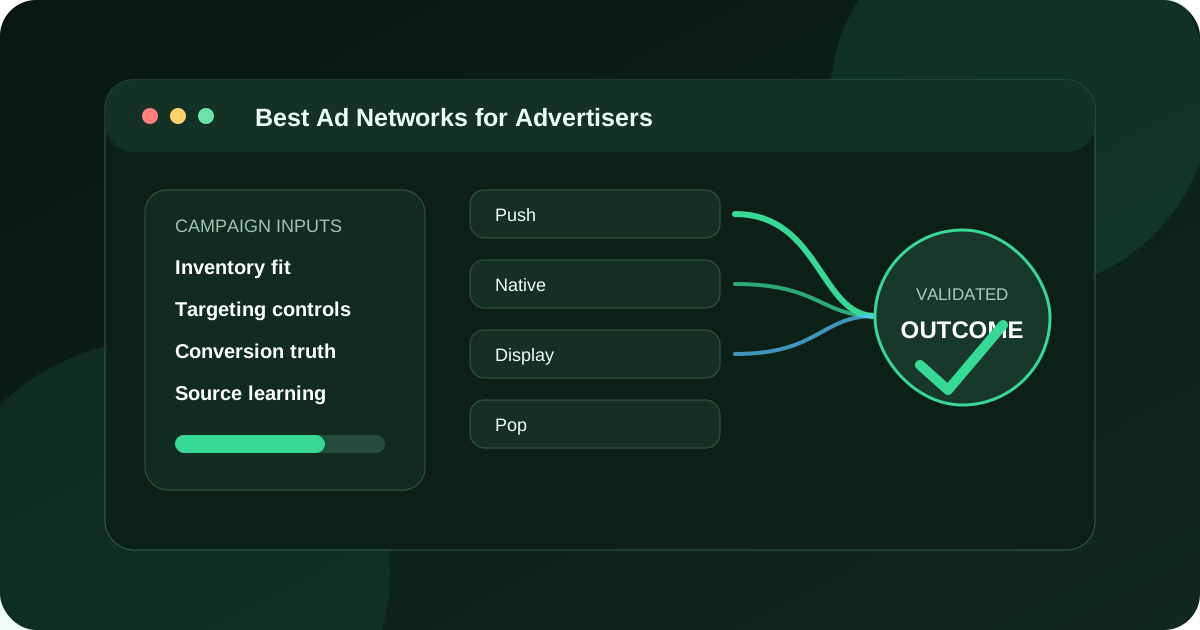
Quick answer: The most common mistake is ranking networks by claimed volume or low bid floors without validating traffic behavior, policy fit and source-level results. This fieldbook treats comparison-led selection of advertising networks for measurable acquisition as a practical assignment for advertisers, affiliates, agencies and media buyers comparing multiple ad networks. A best-network decision needs repeatable evidence across enough sources and time periods to show that the result was not a lucky pocket of inventory. Buyers comparing ad networks should examine access to open-web, mobile, display, native, push, pop, video and interstitial inventory offered by different network types.
| Section | Distinct excerpt from this page |
|---|---|
| How to evaluate the best ad networks | The key platform decision is which network deserves a test based on supply relevance, format fit, controls, funding requirements, support and downstream measurement. |
| What buyers need from ad networks | The broader ad network guide keeps its existing category role, while related format, audience and buying-model pages continue to answer their own narrower questions. |
| Inventory fit | Confirm that the platform can reach open-web, mobile, display, native, push, pop, video and interstitial inventory offered by different network types in the GEOs, devices and contexts the campaign actually needs. |
Reference for Best Ad Networks: Compare Formats, Costs and Fit: IAB Tech Lab OpenRTB standards.
This guide focuses on best ad networks for advertisers. It explains the practical criteria, campaign controls, measurement steps and limits that matter before budget is increased. For broader context, continue with Best Ad Network for Digital Marketers: Selection Framework.
The strongest platform decision begins with the business event, not the traffic headline. Buyers evaluating the best ad networks should connect open-web, mobile, display, native, push, pop, video and interstitial inventory offered by different network types to a specific goal: identify the network model that matches campaign economics, operational skill and measurement requirements. The test becomes useful only when delivery can be traced to a documented shortlist, controlled test plan and source-level evidence for a platform decision.
The key platform decision is which network deserves a test based on supply relevance, format fit, controls, funding requirements, support and downstream measurement. That requires a written test plan, campaign-level tracking, source segmentation and a clear definition of an accepted outcome before the first budget is spent.
The most common mistake is ranking networks by claimed volume or low bid floors without validating traffic behavior, policy fit and source-level results. The same principle applies when the budget begins to scale. Separate campaigns whenever format, GEO, device, landing page, conversion rule or commercial value changes enough to require a different decision.
For Best Ad Networks for Advertisers, treat this as a page-specific operating check rather than a universal benchmark. FroggyAds provides self-serve access to worldwide programmatic supply, six core ad formats and detailed targeting controls where supported. Adscore signals and internal controls help identify invalid or low-quality traffic, while the advertiser remains responsible for creative accuracy, legal eligibility, landing-page quality and downstream conversion validation.
The query best ad networks combines category research with commercial evaluation. Searchers want to understand the buying model, compare platform capabilities and decide whether the channel can help them identify the network model that matches campaign economics, operational skill and measurement requirements.
For Best Ad Networks for Advertisers, treat this as a page-specific operating check rather than a universal benchmark. Current result pages often cover software category pages, workflow and dashboard descriptions, feature comparison lists, agency and advertiser use cases, reporting and budget management guidance. This guide adds an advertiser operating model: how to define the outcome, structure the test, validate traffic, optimize sources and scale without losing measurement clarity.
This guide focuses on comparison-led selection of advertising networks for measurable acquisition. The broader ad network guide keeps its existing category role, while related format, audience and buying-model pages continue to answer their own narrower questions.
This guide is written for advertisers, affiliates, agencies and media buyers comparing multiple ad networks. It focuses on open-web, mobile, display, native, push, pop, video and interstitial inventory offered by different network types. Those requirements should stay visible throughout the media plan instead of disappearing behind a general promise of reach.
Confirm that the platform can reach open-web, mobile, display, native, push, pop, video and interstitial inventory offered by different network types in the GEOs, devices and contexts the campaign actually needs.
Choose among Push, Native, Display, Pop according to the message, destination and stage of the user journey.
Inspect country, city, device, OS, browser, carrier, category, audience and source controls where supported.
Make sure the setup can report usable session rate, qualified engagement rate, accepted conversion rate and the final accepted event.
Use traffic-quality signals, click caps, exclusions, blacklists, whitelists and post-click validation together.
Check minimum funding, approval workflow, reporting speed, support access and the effort needed to manage campaigns.
| Area | Requirement | What to verify |
|---|---|---|
| Business outcome | a documented shortlist, controlled test plan and source-level evidence for a platform decision | Write the accepted event and rejection rules before launch. |
| Inventory | open-web, mobile, display, native, push, pop, video and interstitial inventory offered by different network types | Confirm market and format availability instead of assuming uniform global supply. |
| Creative | Push and Native | Build at least two materially different messages for each format. |
| Destination | comparison-led selection of advertising networks for measurable acquisition | Test page speed, mobile behavior, continuity and event firing. |
| Source controls | Source ID, caps, blacklist and whitelist | Define minimum data and stop thresholds. |
| Decision cadence | cost per accepted outcome | Review on a schedule that matches conversion delay and event volume. |
A platform comparison becomes useful when every claim is connected to evidence the buyer can inspect.
Use a documented shortlist, controlled test plan and source-level evidence for a platform decision as the business truth. Document duplicates, invalid events, cancellations or other exclusions.
Confirm the campaign, creative, landing page and audience are lawful and eligible in every target market.
Split GEOs, devices, formats, landing pages and value tiers whenever they require different bids or decisions.
Use tracking parameters, pixels or server-to-server postbacks and test the complete path before spending.
Start with a small set of clearly different concepts across Push, Native or another suitable format.
Compare usable session rate, qualified engagement rate and accepted conversion rate by source, not only in aggregate.
Exclude repeatedly weak sources, then move promising sources into dedicated campaigns or whitelists.
Increase budget or bids gradually and watch whether cost per accepted outcome remains acceptable at the new volume.
This fieldbook treats comparison-led selection of advertising networks for measurable acquisition as a practical assignment for advertisers, affiliates, agencies and media buyers comparing multiple ad networks. Its purpose is to identify the network model that matches campaign economics, operational skill and measurement requirements, while preserving enough evidence to decide whether the campaign should stop, change or receive more budget.
Build a shortlist by business model, not by the length of a feature list. Separate direct networks, multi-format networks, specialist format providers and programmatic buying systems before assigning scores.
Give each shortlisted network the same conversion definition, comparable markets and a fixed learning budget. A fair comparison needs similar creative effort and a landing experience that does not favor one format by accident.
Create a one-page network card containing supply scope, formats, bid model, source controls, support route, policy limits and the number of accepted outcomes. The card makes trade-offs visible when several platforms look attractive.
Do not crown a winner from one cheap click or one isolated conversion. A best-network decision needs repeatable evidence across enough sources and time periods to show that the result was not a lucky pocket of inventory.
Move the winning network into a second test with a larger budget but unchanged acceptance rules. If marginal traffic weakens, preserve the original profitable cell and treat expansion as a separate experiment.
The final choice may be a portfolio rather than one universal winner. One network can supply efficient push reach, another can provide stronger native context, and a third can cover premium video without forcing all campaigns into one system.
An affiliate team comparing push and pop networks uses an ad-network comparison to examine comparison-led selection of advertising networks for measurable acquisition. The stated campaign goal is to identify the network model that matches campaign economics, operational skill and measurement requirements.
Begin with Push; reserve Display for a separate comparison. Mark usable session rate before interpreting qualified engagement rate, and keep the underlying counts beside both rates.
The review asks: which network deserves a test based on supply relevance, format fit, controls, funding requirements, support and downstream measurement Pair accepted conversion rate with cost per accepted outcome, then label the case by source, market, device, creative and destination.
The stop condition addresses ranking networks by claimed volume or low bid floors without validating traffic behavior, policy fit and source-level results. A failed condition ends this test or changes one documented variable before more spend is released.
An ecommerce brand adding open-web reach uses an ad-network comparison to examine comparison-led selection of advertising networks for measurable acquisition. The stated campaign goal is to identify the network model that matches campaign economics, operational skill and measurement requirements.
Begin with Native; reserve Pop for a separate comparison. Mark usable session rate before interpreting qualified engagement rate, and keep the underlying counts beside both rates.
An agency building a second traffic source uses an ad-network comparison to examine comparison-led selection of advertising networks for measurable acquisition. The stated campaign goal is to identify the network model that matches campaign economics, operational skill and measurement requirements.
Begin with Display; reserve Video for a separate comparison. Mark usable session rate before interpreting qualified engagement rate, and keep the underlying counts beside both rates.
A media buyer replacing an underperforming traffic source uses an ad-network comparison to examine comparison-led selection of advertising networks for measurable acquisition. The stated campaign goal is to identify the network model that matches campaign economics, operational skill and measurement requirements.
Begin with Pop; reserve Interstitial for a separate comparison. Mark usable session rate before interpreting qualified engagement rate, and keep the underlying counts beside both rates.
The intended record is a documented shortlist, controlled test plan and source-level evidence for a platform decision. The decisive question is: which network deserves a test based on supply relevance, format fit, controls, funding requirements, support and downstream measurement The review must also account for the central risk of ranking networks by claimed volume or low bid floors without validating traffic behavior, policy fit and source-level results.
Use push when its attention pattern, creative requirements and pricing model support identify the network model that matches campaign economics, operational skill and measurement requirements. Keep it in a separate campaign cell so its source and conversion behavior remain visible.
Use native when its attention pattern, creative requirements and pricing model support identify the network model that matches campaign economics, operational skill and measurement requirements. Keep it in a separate campaign cell so its source and conversion behavior remain visible.
Use display when its attention pattern, creative requirements and pricing model support identify the network model that matches campaign economics, operational skill and measurement requirements. Keep it in a separate campaign cell so its source and conversion behavior remain visible.
Use pop when its attention pattern, creative requirements and pricing model support identify the network model that matches campaign economics, operational skill and measurement requirements. Keep it in a separate campaign cell so its source and conversion behavior remain visible.
Use video when its attention pattern, creative requirements and pricing model support identify the network model that matches campaign economics, operational skill and measurement requirements. Keep it in a separate campaign cell so its source and conversion behavior remain visible.
Use interstitial when its attention pattern, creative requirements and pricing model support identify the network model that matches campaign economics, operational skill and measurement requirements. Keep it in a separate campaign cell so its source and conversion behavior remain visible.
| Metric | Decision layer | Why it matters |
|---|---|---|
| usable session rate | Delivery and technical quality | Shows whether purchased traffic reaches a usable destination. |
| qualified engagement rate | Intent and experience quality | Separates superficial delivery from meaningful interaction. |
| accepted conversion rate | Conversion quality | Measures whether the source produces the expected user action. |
| cost per accepted outcome | Commercial decision | Determines whether the result can support more budget. |
| Source-level variance | Optimization risk | Reveals whether blended averages hide winners and losers. |
| Marginal cost at higher spend | Scale quality | Shows how performance changes when the campaign enters additional inventory. |
The final optimization event should match the event the business actually values and accepts.
For Best Ad Networks for Advertisers, connect this rule to the named audience, workflow, or comparison before acting. Begin with broad but controlled discovery. Keep Push, Native and other formats in separate campaigns, apply reasonable caps and gather enough data to distinguish a repeatable pattern from random noise.
Evaluate sources using the full event ladder. A source can have an attractive usable session rate and still fail on accepted conversion rate. Another source can look expensive at the click level and become efficient after acceptance or repeat value is included.
For the Best Ad Networks for Advertisers decision, record how this control changes the next test or review. Use three states rather than a simple good-or-bad label: discovery, probation and proven. Discovery sources receive limited budget. Probation sources have enough positive evidence to justify a focused test. Proven sources have repeated the result and can receive dedicated bids, budgets or whitelist treatment.
For Best Ad Networks for Advertisers, apply this control to the page's stated scope and evidence window. Blacklists protect the budget from repeated waste, while whitelists create controlled scaling surfaces. Neither list should be permanent without review. Publisher behavior, competition, devices, creative fit and conversion performance can change over time.
For the Best Ad Networks for Advertisers decision, record how this control changes the next test or review. The practical scale question is whether cost per accepted outcome remains acceptable as spend increases. Track the marginal result from the new budget, not only the historical average created before scale.
| Scenario | Likely starting format | Primary signal | Structural rule |
|---|---|---|---|
| An Affiliate Team Comparing Push And Pop Networks | Push | usable session rate | Use a separate campaign, destination and stop rule. |
| An Ecommerce Brand Adding Open-Web Reach | Native | qualified engagement rate | Use a separate campaign, destination and stop rule. |
| An Agency Building A Second Supply Path | Display | accepted conversion rate | Use a separate campaign, destination and stop rule. |
| A Media Buyer Replacing An Underperforming Traffic Source | Pop | cost per accepted outcome | Use a separate campaign, destination and stop rule. |
Each scenario should have its own creative promise, landing experience and decision threshold.
Creative for comparison-led selection of advertising networks for measurable acquisition should describe the real next step. The headline, visual and call to action must set expectations the landing page can continue immediately.
For the Best Ad Networks for Advertisers decision, record how this control changes the next test or review. Build creative differences that represent distinct hypotheses. Changing a button color is not a useful strategic test when the real uncertainty is whether the audience responds to price, speed, proof, convenience, education or a different product angle.
For the Best Ad Networks for Advertisers decision, record how this control changes the next test or review. Match creative density to the format. A push message must make sense in very little space. Native can introduce a problem and route the user to deeper content. Display needs a clear visual hierarchy. Video requires an early hook and a destination that continues the story.
For Best Ad Networks for Advertisers, treat this as a page-specific operating check rather than a universal benchmark. The landing page should be fast, stable and specific. Remove unnecessary scripts, compress visual assets, reserve image dimensions and keep the primary action visible on common mobile screens. Technical speed supports both user experience and media efficiency.
For Best Ad Networks for Advertisers, treat this as a page-specific operating check rather than a universal benchmark. Run a preflight click from every important device path. Confirm redirects, tracking parameters, consent behavior, form submission, thank-you pages and server-side events. A campaign should not start while the team is still guessing whether the measurement chain works.
| Dimension | Score | Question |
|---|---|---|
| Supply relevance | 0-5 | Does the available inventory match the market, device, context and format? |
| Control | 0-5 | Can the buyer separate, cap, exclude and bid by meaningful dimensions? |
| Measurement | 0-5 | Can delivery be connected to accepted downstream events? |
| Quality visibility | 0-5 | Are source-level and post-click differences visible? |
| Operational fit | 0-5 | Can the team launch, review and change campaigns efficiently? |
| Scale potential | 0-5 | Does performance remain useful as the campaign reaches additional supply? |
A high total score does not replace testing. It simply shows whether the platform has the ingredients required for a fair evaluation.
For Best Ad Networks for Advertisers, connect this point to the declared conversion path and accepted business outcome for this page. No ad network can guarantee traffic quality, conversions, revenue or ranking outcomes. The platform supplies access and controls; the advertiser supplies the offer, creative, destination, tracking and business rules.
Within Best Ad Networks for Advertisers, use this checkpoint when recording the next page-specific decision. Inventory and pricing vary by GEO, device, format, category, time and competition. A result from one campaign cell should not be projected automatically onto another.
FroggyAds can support source-level analysis, but the advertiser must define what counts as an accepted a documented shortlist, controlled test plan and source-level evidence for a platform decision and pass reliable events back into the reporting workflow.
For Best Ad Networks for Advertisers, apply this control to the page's stated scope and evidence window. Automation can help with bidding and optimization, but it cannot repair a misleading creative, a slow page, an unsupported product or an event that measures the wrong behavior.
In Best Ad Networks for Advertisers, keep the evidence, owner, and next action attached to this control. No network is the universal winner. Use the same GEO, creative standard, conversion event, attribution window and loss limit when comparing platforms. Public terms can change, so confirm current account conditions before funding a test.
| Platform | Entry information | Format position | Best fit |
|---|---|---|---|
| FroggyAds | $50 minimum deposit | Push, Native, Display, Pop, Video and Interstitial | Controlled self-serve testing with source-level reporting |
| PropellerAds | Check current account terms | Strong push and pop reach | Established buyers seeking large performance-network scale |
| RichAds | Check current account terms | Performance formats with optimization tooling | Teams that want advanced automation and can support a larger test |
| ROIads | $250 public minimum cited in its 2026 content | Pop and performance inventory | Teams prepared for a higher initial testing threshold |
| PopAds / PopCash | Small-entry specialist models | Primarily popunder traffic | Buyers who want a pop-only starting point |
Decision rule: shortlist two or three platforms, run matched tests, and compare accepted acquisition cost, source transparency, usable-session rate and downstream value rather than raw click volume. For Best Ad Networks, apply this rule to the page-specific audience, market, format or buying decision described here.
Suitability comes from inventory, market, format, targeting, measurement, quality controls and operating support matching the campaign. A network can be strong for one use case and unsuitable for another.
Write the required markets, formats, source detail, budget controls and business event before comparing providers. Remove options that cannot meet a necessary requirement before funding tests.
Assign each network a comparable campaign cell and a spending limit that supports the planned decision. Keep audience, creative and attribution rules aligned so budget differences do not distort the result.
A large inventory claim is useful only when the required market and audience are available under usable controls. Verify reach with delivery evidence rather than the network’s total scale alone.
Use the same approved offer and comparable creative message across networks, adjusting only what the format requires. Record any material difference so the result is not credited solely to the platform.
Test landing-page function, message continuity, redirects, consent and conversion events before each launch. Every network should send traffic into an equivalent working journey.
Compare spend, source-level delivery, valid visits and the accepted business outcome within the same window. Add rejection or reversal data when it changes the value of recorded conversions.
Separate inventory source, format, audience, creative and destination factors before judging the provider. A blended network average can hide both useful and wasteful placements.
Rankings, reach, quality and performance claims need a stated method, date and campaign context. No single network label can predict conversions or return for every advertiser.
Expand after the preferred network produces repeat accepted outcomes under stable tracking and source controls. Keep the original comparison cell while adding budget so quality drift can be detected.
For Best Ad Networks for Advertisers, use public references to clarify terminology, traffic-quality controls, measurement and advertiser responsibilities; campaign-specific policies, laws, contracts and review requirements still take precedence.
Review the established FroggyAds pillar for this topic.
Compare paid traffic sources by intent, scale, targeting, creative fit, tracking depth and the post-click evidence required to choose a winner.
Evaluate media buying platforms by inventory access, workflow, targeting, bidding, reporting, integrations and the effort required to operate them well.
Choose a format, define the accepted outcome, verify tracking and use source-level evidence to decide what receives more budget.
Use this directory to move from the current hub into the specific market, platform, format or campaign question you need to solve.
97 resources in this directoryBrowse the complete FroggyAds alternative and head-to-head comparison library. The five priority pairs were rebuilt from current official sources on July 12, 2026. Verify current account terms before funding.
Use focused reviews, competitor shortlists, minimum-deposit guides and CPM planning pages to evaluate branded alternatives with current official sources.
Use focused reviews, competitor shortlists, minimum-deposit guides and CPM planning pages to evaluate branded alternatives with current official sources — Competitor intelligence.
Use focused reviews, competitor shortlists, minimum-deposit guides and CPM planning pages to evaluate branded alternatives with current official sources — Competitor intelligence example 3. For Best Ad Networks, apply this rule to the page-specific audience, market, format or buying decision described here.
Compare demand access and monetization systems by net value, control and reporting.
Explore ad-network definitions, white-label platforms, reseller models and the roadmap for building an ad network.
Compare network and platform requirements for small businesses, startups, agencies, app developers, ecommerce stores, bloggers, beginners, small sites and new sites.
Use these campaign guides to compare network controls or build vertical-specific ad execution with measurable safeguards.
For Best Ad Networks for Advertisers, connect this point to the declared conversion path and accepted business outcome for this page. Use these pages to choose a traffic source, evaluate an advertising network, or plan a controlled vertical campaign with clear eligibility, measurement and stop rules.
Evaluate the best ad network for casino by eligible inventory, formats, targeting, reporting, tracking, safeguards, support and test economics
Evaluate the best ad network for gambling by eligible inventory, formats, targeting, reporting, tracking, safeguards, support and test economics
Evaluate the best ad network for betting by eligible inventory, formats, targeting, reporting, tracking, safeguards, support and test economics
Evaluate the best ad network for sports betting by eligible inventory, formats, targeting, reporting, tracking, safeguards, support and test economics
Evaluate the best ad network for igaming by eligible inventory, formats, targeting, reporting, tracking, safeguards, support and test economics
Evaluate the best ad network for cryptocurrency by eligible inventory, formats, targeting, reporting, tracking, safeguards, support and test economics
Evaluate the best ad network for gaming by eligible inventory, formats, targeting, reporting, tracking, safeguards, support and test economics.
Evaluate the best ad network for mobile game by eligible inventory, formats, targeting, reporting, tracking, safeguards, support and test economics.
Evaluate the best ad network for sweepstakes by eligible inventory, formats, targeting, reporting, tracking, safeguards, support and test economics.
Evaluate the best ad network for nutra by eligible inventory, formats, targeting, reporting, tracking, safeguards, support and test economics.
Evaluate the best ad network for adult by eligible inventory, formats, targeting, reporting, tracking, safeguards, support and test economics.
These pages separate source selection, campaign strategy and provider evaluation so each search question has a clearly defined focus.
Evaluate the best ad network for dating by eligible inventory, formats, targeting, reporting, tracking, safeguards, support and test economics.
Evaluate the best ad network for crypto by eligible inventory, formats, targeting, reporting, tracking, safeguards, support and test economics.
Evaluate the best ad network for bitcoin by eligible inventory, formats, targeting, reporting, tracking, safeguards, support and test economics.
Evaluate the best ad network for forex by eligible inventory, formats, targeting, reporting, tracking, safeguards, support and test economics.
Use these guides to compare Best Ad Network For Beginners.
Evaluate the best ad network for beginners by eligible inventory, formats, targeting, reporting, tracking, support, safeguards and mature test economics.
Use these guides to compare Advertising Platform For Affiliates and Cheap Advertising For Affiliates.
Choose an advertising platform for affiliates using format access, targeting, budget control, tracking, source reporting, support and total learning cost.
Build cheap advertising for affiliates around capped tests, reliable tracking, accepted outcomes, total learning cost and controlled scale or rollback rules.
Plan media buying for affiliates with source-level measurement, budget allocation, format and creative tests, accepted outcomes and reversible decisions.
Plan online advertising for affiliates with audience fit, truthful creative, formats, sources, tracking, destination checks and accepted-outcome measurement.
Use self-serve ads for affiliates with direct targeting, format, budget, tracking and source controls plus a measured launch and optimization workflow.
Evaluate a traffic source for affiliates by audience eligibility, format fit, source reporting, tracking, destination continuity and mature accepted value.
Comparing Media.net requires separating publisher monetization from advertiser media buying. Review the Media.net alternative framework before placing publisher and advertiser products in the same shortlist. For Best Ad Networks, apply this rule to the page-specific audience, market, format or buying decision described here.
This URL has one primary job for performance-focused advertisers: evaluate providers against explicit selection criteria. Keep this page focused on that buying decision instead of turning it into a generic advertising article. The nearest related FroggyAds page is Top Pop Ad Networks; use that URL when its narrower task is the one you actually need.
To complete the Best Ad Networks for Advertisers decision context, keep campaign objective and source quality visible as operating concepts. They matter here because they change how the buyer interprets setup, delivery or accepted outcomes.
| Step | Commercial General workflow | Evidence to retain |
|---|---|---|
| 1 | Define the buyer and accepted outcome | Keep the evidence tied to Best Ad Networks for Advertisers and the accepted outcome defined for this URL. |
| 2 | Configure the smallest useful campaign test | Keep the evidence tied to Best Ad Networks for Advertisers and the accepted outcome defined for this URL. |
| 3 | Keep, cap or expand only from accepted-outcome evidence | Keep the evidence tied to Best Ad Networks for Advertisers and the accepted outcome defined for this URL. |
Hypothetical example: if a controlled Best Ad Networks for Advertisers test spends USD 250 and records 8 accepted outcomes after the same review window, accepted CPA is USD 250 divided by 8 = USD 31.25. Replace the example inputs with your own economics; this is not a FroggyAds performance claim.
Use FroggyAds as the execution layer only when the page's decision calls for paid traffic. Set the relevant budget, targeting and format controls, verify conversion tracking, keep source-level evidence, and increase spend only when the accepted outcome supports the next step. Create your free FroggyAds account. For Best Ad Networks, validate this point against campaign objective, audience targeting, source quality, Selection Guide Evaluate, Advertisers Compare FroggyAds, Advertisers Alternative guide and keep it separate from the Top Pop Ad Networks 2026 intent.
Best Ad Networks for Advertisers is most useful when it helps a buyer evaluate providers against explicit selection criteria. Define the accepted outcome first, then use targeting, budget and source-level evidence to decide what deserves more spend.