
Adsterra minimum deposit: funding rules and a realistic first-test budget
Separate the amount required to add funds from the campaign budget and the money needed to reach a defensible media-buying decision.

Adsterra says the amount required to fund an advertiser account depends on the payment method and gives Paxum from USD 100 as one public example. Its advertiser information separately publishes a USD 25 minimum total budget and a USD 25 minimum daily budget for CPM and CPC campaigns. These figures answer two different questions. The funding minimum gets money into the account; the campaign floors govern a campaign setting. Neither figure tells you how much evidence your offer needs. Verify the live account, then calculate validation spend, learning spend and a conversion-lag reserve before depositing.
What does the Adsterra minimum deposit actually unlock?
A successful deposit creates spendable account balance. It does not approve an offer, reserve a source, guarantee a bid, predict delivery or establish a conversion rate. Campaign review, creative review, market eligibility and live inventory still apply. Treat the balance as available money, not as proof that the campaign is ready.
The distinction matters because a payment can succeed while the planned test remains incomplete. The landing page may still need a tracking parameter. The selected format may not suit the offer. A conversion event may fire without showing whether the lead was accepted. Funding should follow these checks rather than replace them.
Capture the live payment method, currency, minimum, fee, verification step and date. Adsterra's public guidance can establish the planning context, but the signed-in funding screen governs the account you will use. A screenshot and source URL give the finance owner a record when methods or thresholds change later.
Deposit, campaign floor and test budget are separate numbers
| Budget layer | Question it answers | Evidence to keep | Common mistake |
|---|---|---|---|
| Account funding | How much can be added through the chosen payment route? | Live amount, currency, fee, method and transaction record. | Calling the smallest accepted payment a complete test budget. |
| Campaign setting | What minimum total or daily value can the campaign builder accept? | Pricing model, live field values, market, format and date. | Assuming the configured minimum will buy enough observations. |
| Validation allocation | What spend proves approval, delivery and end-to-end measurement? | Campaign ID, click path, postback, backend status and reconciliation. | Beginning optimization while tracking is still uncertain. |
| Learning allocation | What capped amount can compare the first source and creative hypotheses? | Loss ceiling, review window, source groups and accepted events. | Splitting a small balance across too many cells. |
| Maturity reserve | How much money remains untouched while conversions settle? | Lag distribution, pending statuses, refunds and rejection reasons. | Spending the full balance before the first cohort is final. |
Test the audience apart from the deposit
Build a narrow FroggyAds audience cell
When your funding research reveals an audience question, use FroggyAds to isolate one eligible market, device group, destination and accepted event. A focused cell makes the next budget decision easier to explain.
Create a controlled audience test
How do you calculate a responsible first-test budget?
Start with the business rule instead of the deposit button. Name the event that creates value, such as an accepted lead, paid order or qualified trial. Set the maximum mature cost for that event and the amount you are prepared to lose while determining whether one format, market and destination can meet it. Add the time required for validation, refunds or cancellations to settle.
Next, estimate how many materially different cells the test contains. A cell is a combination that could produce its own decision: for example, one format, market, device group, creative concept and landing route. If the available budget cannot give each important cell a fair loss ceiling, reduce the scope. Do not create ten weak comparisons when one interpretable comparison can answer the immediate question.
A practical calculation can be expressed as: validation allocation + learning ceiling for each active cell + maturity reserve + non-media setup cost. Setup may include creative production, landing work, tracking implementation and the staff time needed to reconcile outcomes. These are real costs even though they do not appear as platform spend.
Consider a clearly labelled hypothetical plan. A buyer allows USD 60 to validate tracking and moderation, two learning cells with a USD 150 loss ceiling each, and USD 90 held for delayed conversions and one confirmation step. The planned media envelope is USD 450. That number does not predict results and is not an Adsterra recommendation. It demonstrates why a deposit threshold and a decision budget can differ substantially.
Use the accepted-cost ceiling to set stop rules
If the business can accept a qualified lead at no more than USD 30, decide what should happen when a source spends one, two or more times that amount without a mature accepted lead. The appropriate boundary depends on conversion probability and delay; write it before launch. The stop rule can trigger a tracking review, source pause, creative diagnosis or full campaign stop.
Do not use a raw platform conversion as the only outcome when the business later rejects duplicates, ineligible geographies, incomplete registrations or refunded sales. Keep reported, pending, accepted and rejected statuses separate. A deposit can fund a large quantity of activity while producing little accepted value if these layers are blended.
Attach an owner to every financial action. The media buyer can manage bids and source decisions. A tracking owner confirms the event route. A business owner confirms whether downstream records create value. The finance owner confirms payment terms and remaining balance treatment. This division stops an available balance from becoming an automatic instruction to continue spending.
Keep the opening campaign small enough to read
Choose one market cluster, one device class, one format role and a limited creative set. Use a destination version that can be identified in the tracker. Preserve the source and placement fields available in the account. This design lets you connect spend with the user journey instead of relying on one account-wide average.
Review delivery early for technical problems but wait for the declared maturity window before judging acquisition economics. If the campaign does not deliver, inspect bid, format, market availability and moderation rather than immediately opening many new cells. If delivery occurs but the destination does not receive usable sessions, inspect the message and landing route. If sessions convert but are rejected later, investigate targeting and offer eligibility.
The first deposit should fund a sequence of decisions. It should not fund simultaneous changes to bid, source set, creative, market and page. Change one material element after the baseline is trustworthy, and preserve the earlier configuration as the rollback point.
Keep format economics separate
Choose a FroggyAds format that matches the landing experience
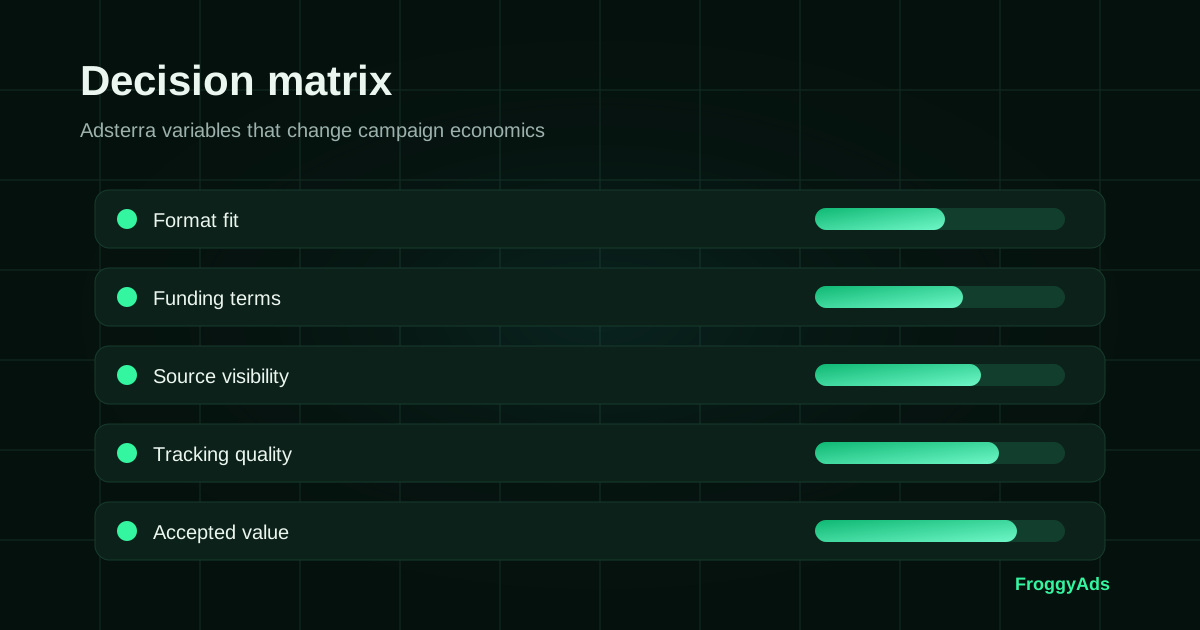
Push, native, display, pop, video and interstitial contexts create different user journeys. Keep the selected format in its own budget cell and judge it through the same downstream acceptance rule.
Start a format-specific campaign
Budget for conversion delay before spending begins
Some outcomes are visible in minutes; others remain pending for hours or days. Estimate the normal delay from click to reported event and from reported event to business acceptance. Use the longer path when deciding how much of the balance must remain untouched during review.
A simple cohort ledger is more useful than a rolling dashboard total. Group clicks and conversions by campaign date or source cohort, then mark the time when each group becomes mature. Compare only cohorts that have received the same opportunity to complete. Without this control, the most recent spend can appear weak merely because its events have not arrived.
Reserve enough operating time to reconcile duplicates, returned products, cancelled trials or rejected leads. If an optimization system uses a conversion signal, make sure the signal has the meaning you intend. An early form submission can help an algorithm learn, but it should not silently replace the accepted business event used for the budget decision.
Check payment friction and unused-balance risk
The nominal minimum is not the entire funding cost. Review transaction fees, currency conversion, settlement time, identity verification and any restrictions on refunds or withdrawals. A method with a higher threshold may be operationally reasonable for one business and unsuitable for another. Record the actual terms presented to the account.
Decide how unused balance will be treated if the offer is rejected or the validation stage fails. The team may reserve the balance for a later eligible campaign, request a permitted refund or record it as working capital in the account. That decision belongs in the approval packet before money is sent.
Protect account access as well. Use the business-approved payment method, assign account roles deliberately and retain transaction evidence. A low entry amount does not justify weak controls around credentials, billing ownership or campaign authorization.
Adsterra pre-deposit checklist
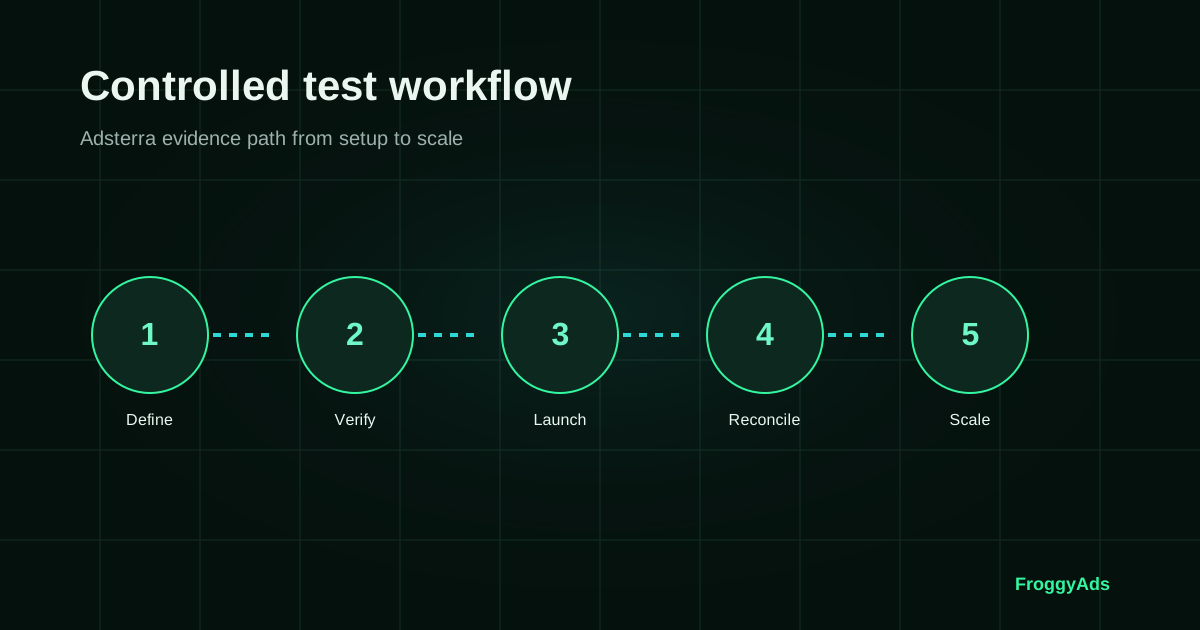
- Verify the funding route. Confirm method, currency, minimum, fee, verification and refund context in the current account.
- Confirm campaign eligibility. Check the offer, creative, landing page, market and intended format against current requirements.
- Write the measurement contract. Name click identifiers, source fields, conversion event, attribution window, timezone and duplicate rules.
- Prove the route. Run a permitted end-to-end event and reconcile the platform, tracker and backend records.
- Approve the scope. Limit the opening market, device, format, creatives and landing version.
- Set financial boundaries. Document validation spend, cell loss ceilings, maturity reserve and the full stop condition.
- Plan the readout. Choose review dates, owners and the evidence needed for keep, cap, exclude or stop decisions.
When is a lower-entry alternative useful?
A lower public funding threshold can reduce the balance committed before a technical route is proven. FroggyAds publicly states a USD 50 minimum deposit for advertiser accounts. That can be useful when you want to validate a format, payment workflow or attribution path with less money held in the platform. The lower threshold does not establish cheaper conversions, better inventory or higher quality.
Compare the full campaign job. FroggyAds offers Push, Native, Display, Pop, Video and Interstitial traffic and source-level controls for self-serve advertisers. Use those controls to create a matched test with the same offer, destination, conversion definition and maturity window. Let the completed evidence determine whether FroggyAds, Adsterra, a split allocation or no further spend is the right decision.
Our platform helps you control campaign settings, budget, bids, creatives and available targeting while you keep the commercial proof in your own records. If your tracking and stop rules are ready, create your free FroggyAds account and build the smallest useful test.
Approve the campaign contract first
Turn the funding decision into a reversible launch
Carry the accepted event, source fields, loss limits, maturity window and rollback point into the campaign. Release more budget only after the completed cohort supports it.
Launch my FroggyAds test
Build the funding evidence packet
Save the official URL and access date for every threshold used in the plan. Add the live account screenshot, payment method, currency, campaign pricing model and the total and daily values entered in the builder. This record separates a public statement from the actual conditions applied to the account.
Include the campaign brief, tracking test, source fields, creative versions, destination version, stop rules and owner approvals. After the first review window, attach spend, eligible sessions, reported conversions and accepted outcomes. A later team should be able to reproduce the accepted-cost calculation without relying on memory.
Close the packet with a decision: do not fund, validate only, continue learning, confirm the provisional result or stop and preserve the balance. Name the next review trigger. A clear close prevents an unfinished research task from turning into indefinite spend.
Work through a first-test budget worksheet
Put the account terms and the campaign economics in one worksheet, but keep them on separate rows. The funding row records the Adsterra payment method, currency, public or live minimum, fee and amount actually transferred. The campaign row records the pricing model, total budget, daily budget, bid, start date and hard cap. The measurement row records the conversion event, attribution window, timezone, duplicate rule and final acceptance status. This arrangement lets a reviewer see which number came from the platform and which number came from the advertiser's risk decision.
Give every active test cell its own learning ceiling. A cell could be one country, device class and format using two related creative concepts. Do not assign the same money twice. If USD 200 is reserved for a popunder test and USD 150 for an in-page push test, the media envelope is USD 350 before the validation and maturity reserves. A shared account balance does not merge those hypotheses.
Add a maturity schedule beside the budget. State when early technical review occurs, when the first conversion window closes and when downstream acceptance is final enough for an allocation decision. The campaign may remain live between reviews, but the remaining balance must respect the loss ceiling. If the next scheduled review would occur after the cell can already exceed its limit, lower the daily cap or review more frequently.
Write the outcome of each review in financial language. “Continue” should identify the remaining learning allowance. “Cap” should state the new daily or source limit. “Exclude” should name the affected source and preserve its export. “Stop” should state the unused balance and whether the account will retain it. This prevents vague optimization notes from obscuring how much money is still authorized.
| Worksheet field | Example of the required record | Decision protected |
|---|---|---|
| Funding evidence | Method, currency, live minimum, fee, transfer and timestamp | Whether account funding followed the approved terms |
| Campaign boundary | Format, market, device, bid, total cap and daily cap | Whether spend remained inside the intended test |
| Outcome contract | Event, acceptance status, attribution window and timezone | Whether both spend and value use the same definitions |
| Review schedule | Technical, maturity and final readout dates | Whether decisions waited for comparable evidence |
| Balance action | Retain, reassign or follow an available refund route | Whether unused funds have an explicit owner and purpose |
Diagnose the result before adding another deposit
When the opening balance is consumed faster than expected, identify where the plan diverged. Higher auction cost is one possibility, but so are broader targeting, faster pacing, too many active cells or a destination that failed to produce eligible sessions. Compare the live campaign settings with the approved worksheet before assuming that more money is the answer.
If impressions or clicks arrive but conversions do not, verify the tracking route first. Inspect the destination version, parameter persistence, event firing and the relationship between platform records and the independent tracker. A second deposit cannot repair a missing click ID or an event that is attributed to the wrong campaign. Resume media learning only after a small test event reconciles.
If reported conversions appear but accepted outcomes remain weak, segment the evidence by source, creative, device and geography. Review rejection reasons and conversion maturity. A specific source may need exclusion, the message may attract ineligible users or the offer may not fit the selected context. Use the smallest change that can distinguish these causes.
If the first cohort meets the rule, do not immediately duplicate every variable. Choose one controlled expansion, such as a modest daily-budget increase or a new source set under the same destination and accepted event. Keep enough balance to compare the expanded cohort with the trusted baseline. If accepted cost or quality leaves the approved range, restore the earlier configuration and record what changed.
A new deposit should therefore answer a written question. It may fund confirmation of a provisional winner, a repaired tracking route or a new eligible format. It should not merely extend a campaign whose measurement or commercial value remains unresolved. This discipline turns account funding into a sequence of accountable decisions instead of a recurring reaction to low balance.
Official sources for the published thresholds and platform context
The Adsterra advertiser overview supports the method-specific funding example and campaign budget context: Adsterra advertiser overview. Verify the live account before payment.
- Adsterra advertiser information and campaign budget context
- Adsterra formats and advertiser workflow
- Adsterra official site
- Adsterra minimum-deposit guide
- Adsterra payment-method examples
- Adsterra pricing-model overview
- FroggyAds pricing information
- FroggyAds ad formats
- FroggyAds traffic sources
- FroggyAds advertiser platform
Adsterra minimum-deposit FAQ
What is the Adsterra minimum deposit?
Adsterra says deposit requirements depend on the payment method and publicly gives Paxum from USD 100 as one example. Check the signed-in funding screen for the method, currency, fees and current account terms.
What campaign minimums does Adsterra publish?
Adsterra's advertiser information states a USD 25 minimum total budget and a USD 25 minimum daily budget for CPM and CPC campaigns. Confirm the current campaign builder before launch.
Is the deposit the same as the campaign budget?
No. The deposit adds account balance. Campaign fields control spend, while your decision budget must also cover validation, learning, conversion delay and any non-media setup work.
Does adding funds approve an Adsterra campaign?
No. Funding and campaign approval are separate. The offer, creative, destination, targeting and format remain subject to current requirements and available inventory.
How much should an advertiser reserve for conversion delay?
Use the observed time from click to reported event and from reported event to business acceptance. Keep enough balance unspent to let the first cohort mature before allocating more.
Why is one narrow campaign better for a first test?
A limited market, device group, format and creative set gives each source cell enough opportunity to support a decision. Excessive segmentation can consume the balance without producing interpretable evidence.
Which costs sit outside Adsterra media spend?
Include creative production, landing-page work, tracking implementation, payment fees, currency conversion, campaign operation and the time required to validate downstream outcomes.
What should happen to an unused Adsterra balance?
Decide before funding whether a remaining balance will support another eligible campaign, follow an available refund process or stay as working capital in the account. Record the applicable terms.
When should an Adsterra test stop?
Stop when tracking fails, the campaign becomes ineligible, the approved loss ceiling is reached or mature source cohorts repeatedly miss the accepted-cost and quality rule.
How does the FroggyAds minimum compare?
FroggyAds publicly states a USD 50 minimum advertiser deposit. A lower entry amount reduces initial account funding, but the advertiser must still compare format fit, measurement, source quality and mature acquisition economics.
Related Adsterra and FroggyAds planning guides
Start with a campaign budget you can defend
Verify the payment route, prove the conversion path and approve the loss rules. Then use FroggyAds to run a controlled traffic test and scale only the source combinations that create accepted value.