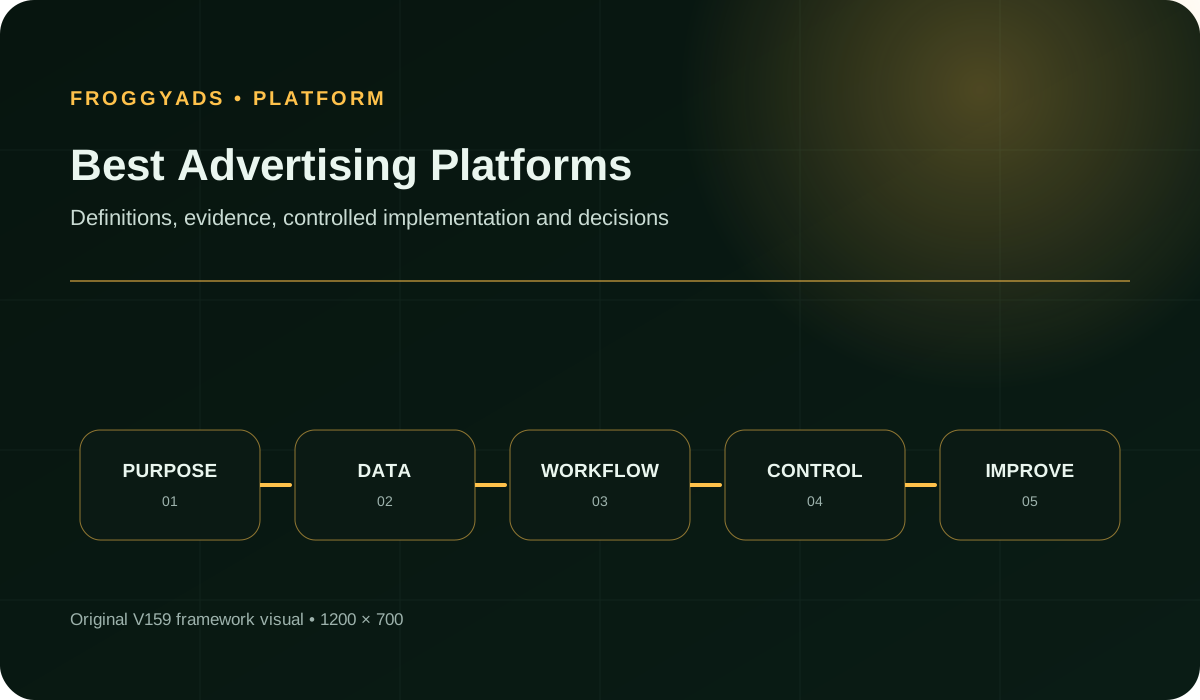
The best advertising platforms match the job
There is no universal winner. The right advertising platform is the one that matches your audience, buying model, measurement setup, creative format and level of control.
The direct answer
The best advertising platforms are not simply the biggest platforms. They are the platforms that can reach the right audience, support the right creative, give you a buying model you understand and return enough data to improve the next decision. A platform that is excellent for high-intent search can be a poor fit for broad prospecting. A platform built for social discovery may not offer the source-level controls that a performance media buyer expects.
For most advertisers, the strongest answer is a portfolio rather than a single channel. Intent-driven platforms capture existing demand. Social and video platforms create demand. Retail media works close to the transaction. Open-web DSPs and advertising networks add reach, format variety and source-level optimization. The useful question is therefore not “Which platform is number one?” but “Which platform should do each job in my acquisition system?”
FroggyAds belongs in the open-web performance layer. It combines self-serve campaign management with worldwide supply, six core ad formats, granular targeting and source-level controls. It is designed for advertisers and media buyers who want to test, compare and scale traffic outside a single closed ecosystem.
Why “best” changes by campaign objective
Platform rankings are often built as long lists, but lists hide the first decision that matters: what job the channel must perform. A company trying to capture people already comparing products needs a different environment from a company introducing a new category. A media buyer testing an offer across many countries needs different controls from a local service business that only serves a small radius.
Write the objective in operational language before comparing platforms. “Grow awareness” is too vague. “Reach qualified mobile users in three countries and measure engaged visits” is more useful. “Acquire first-time buyers under a defined cost per order” is even clearer. The objective determines the audience signal, creative format, buying model, attribution window and acceptable learning period.
This step also prevents a common mistake: choosing a familiar platform because the team already knows the interface. Familiarity reduces setup friction, but it does not guarantee audience fit or scalable economics. The platform should be selected after the campaign job is defined, not before.
Demand capture versus demand creation
Intent-led environments are strongest when people are already looking for a solution. They can produce efficient actions, but the available volume is limited by existing demand and competition for the same signals. Discovery-led environments can introduce an offer to people who were not actively searching, but they place more pressure on creative and landing-page persuasion.
Open-web advertising can play either role depending on format and targeting. Native and display placements can build consideration. Push and pop campaigns can create inexpensive test volume for offers with a clear response. Video and interstitial formats can communicate more context. The correct choice depends on how much explanation the offer needs and where the user is in the decision process.
Closed ecosystems versus open-web buying
Closed ecosystems combine identity, content and inventory inside one environment. They can simplify audience selection and measurement, but buyers accept the platform’s rules and reporting boundaries. Open-web platforms connect many independent supply sources and can provide broader reach and more granular source controls, but they require active optimization.
A mature acquisition mix often uses both. Closed platforms can anchor intent or identity-based demand, while an open-web DSP or network expands reach, tests additional formats and reduces dependence on a single source. The important point is to give each environment a defined role instead of forcing every platform to do the same work.
Advertising platform types by campaign job
| Platform type | Best suited to | Primary strength | Main trade-off |
|---|---|---|---|
| Intent-led | Capturing active demand | Strong query or commerce signal | Volume and pricing depend on existing demand |
| Social discovery | Creating demand and visual storytelling | Rich audience and creative environments | Performance can shift with creative fatigue |
| Retail media | Reaching shoppers near a transaction | Commerce context and product signals | Reach is tied to the retail ecosystem |
| Video and streaming | Explaining, demonstrating and building memory | Sight, sound and motion | Production requirements and view quality matter |
| Open-web DSP | Cross-source programmatic buying | Targeting, scale and source-level controls | Requires structured optimization |
| Specialist ad network | Format, GEO or vertical-specific acquisition | Focused inventory and accessible testing | Quality varies by source and setup |
Use this as a first filter. The final choice still depends on the actual offer, audience, tracking and budget.
Six criteria that matter more than brand recognition
A practical scorecard forces every platform to answer the same questions. Score each criterion from one to five, but add written evidence beside the number. A polished sales page is not evidence. Evidence is a documented targeting option, a live campaign setting, a reporting field, a published commercial term or a controlled test result from your own account.
Weight the criteria according to the campaign. A direct-response buyer may give measurement and source control twice the weight of creative convenience. A brand campaign may prioritize reach, environment and format quality. An agency may care about account structure, exports, permissions and repeatable workflows across many clients.
Audience and supply fit
Ask whether the platform can reach the geography, device mix, environments and audience context connected to the offer. Large global reach is useful only when the relevant portion of that reach is accessible. Request or inspect traffic estimates by format and country, then compare them with realistic bids and the campaign’s conversion economics.
For open-web buying, supply diversity is valuable because it creates more testable sources. It also increases the need for reporting and controls. A platform should help the buyer move from broad exploration to a focused set of proven sources.
Measurement and actionability
Reporting should answer what happened and what to do next. Aggregate clicks and impressions are not enough. Buyers need conversion tracking, useful dimensions, exportable data and a clear relationship between delivery sources and performance. The best reporting interface is the one that makes budget decisions faster and more defensible.
Before launch, verify that the conversion event fires once, carries the right value or label and can be reconciled with the advertiser’s own analytics. A platform cannot optimize toward a signal that is missing, delayed or defined incorrectly.
Commercial fit and operational cost
Compare more than the minimum deposit. Consider bid floors, billing model, funding methods, support model, creative review, learning curve and the hours required to manage the campaign. A platform with a low entry cost can still be expensive if the team lacks time to optimize it.
Operational fit is especially important for agencies and performance teams. Account structure, naming conventions, source controls and exports determine whether a working campaign can be repeated without introducing avoidable errors.
A controlled way to test a new advertising platform
Define one outcome
Choose one primary conversion and a supporting quality metric. Avoid judging a platform on traffic volume alone.
Choose one audience hypothesis
Start with a coherent geography, device mix and audience context rather than every available option.
Prepare two or three creative angles
Test meaningful differences in promise, proof or format. Tiny cosmetic changes rarely teach enough.
Verify tracking before funding scale
Complete a test conversion and confirm the platform, analytics and backend record it consistently.
Set stop and review rules
Decide when to pause a source, lower a bid, refresh creative or extend the test.
Scale the proven layer
Increase budget in steps while monitoring whether conversion rate and downstream quality remain stable.
Why platform tests produce misleading conclusions
Many platform tests are too broad to teach anything. The buyer launches several geographies, devices, formats and creatives at once, then looks at an average result. Averages hide the segment that worked and the segment that consumed the budget. A smaller structured test produces less volume but more useful information.
Another failure is changing the platform, landing page, offer and tracking at the same time. When performance moves, the team cannot identify the cause. Treat the platform as one variable in a system. Keep enough of the system stable to interpret the result.
Finally, do not compare channels only on the first conversion. A source that produces inexpensive leads can be weak after qualification, while a higher initial cost can produce better retention or order value. The best advertising platform is the one that contributes profitable customers, not merely the cheapest front-end action.
Where FroggyAds belongs in a modern media mix
FroggyAds is built for advertisers and media buyers who want open-web reach with self-serve control. Campaigns can use push, native, display, pop, interstitial and video formats across worldwide supply connected through 750+ SSP integrations. Targeting can include GEO, city, device, operating system, browser, carrier, category and source identifiers where supported.
The platform is most useful when the advertiser has a clear offer, a working landing page and reliable conversion tracking. Start broad enough to discover viable sources, then use reporting, whitelists, blacklists, bid changes and creative tests to concentrate spend. SmartCPC can use available campaign signals to adjust bid weighting, but it does not remove the need for a sound campaign structure.
FroggyAds should not be presented as the automatic answer for every advertiser. Search-led campaigns may still need search inventory. A brand with a strong community strategy may prioritize social environments. The practical advantage is adding a controllable open-web layer to the mix and evaluating it against the same business metrics as every other channel.
Score platforms before you fund them
Compare each option on audience fit, buying model, transparency, measurement, creative requirements and operational effort. A disciplined scorecard is more useful than a generic top-ten list.
Open FroggyAdsPlanning the platform mix without creating overlap
A strong platform mix assigns a clear job to every channel before money is committed. One platform may be responsible for capturing existing demand, another for prospecting, and another for retargeting people who already know the brand. Problems begin when several platforms are asked to reach the same audience with the same creative and the same conversion event. The buyer then pays for duplicated exposure while each reporting interface claims part of the outcome. Write a one-sentence role for every platform, define the audience it may reach, and decide which system owns the final conversion record.
The practical planning unit is not the platform name. It is the combination of objective, audience, format, buying model, measurement method and optimization cadence. For example, an open-web campaign can be used to discover productive sources, while a search campaign captures high-intent queries and a social campaign tests new creative angles. Those jobs require different success thresholds. A prospecting campaign may be judged on qualified visits and assisted conversions before direct return stabilizes. A retargeting campaign should be held to a tighter cost and frequency standard because the audience already has intent.
Create exclusion rules before launch. Exclude recent converters where repeat acquisition is not useful, separate prospecting from retargeting, and prevent internal teams from bidding against one another without a reason. Use consistent UTM naming and a common conversion taxonomy so cross-platform reports can be reconciled. When results disagree, investigate attribution windows, view-through credit, time zones and duplicate events before changing bids. A platform is only as useful as the operating rules around it.
Review the mix at two levels. The first level asks whether each platform is completing its assigned job. The second asks whether the combined portfolio is improving total acquisition efficiency. A platform can look weaker in isolation yet contribute valuable reach or learning. Conversely, a platform with attractive dashboard metrics can add little incremental value if it repeatedly reaches people another channel would have converted. This portfolio view prevents a leaderboard from replacing strategy.
Questions a platform demo should answer
A product demo should show how a real decision is made, not only how polished the interface looks. Ask the representative to build a campaign from the beginning, select a country and device, apply source controls, add tracking, set a bid, and locate the report that would be used after the first day of delivery. The sequence reveals whether essential controls are available at launch or hidden behind support requests and account tiers.
Ask what happens when quality is uneven. Can the buyer block a source immediately? Is reporting available at the level where action is possible? Can conversion data be passed back through a pixel or server-to-server postback? How are rejected ads explained? What data can be exported? The answers matter more than a long feature list because they determine how quickly waste can be diagnosed and contained.
Finally, test commercial clarity. Confirm the minimum deposit, billing events, refund conditions, support path and any fees that apply outside the media bid. Request written documentation for material claims. Avoid choosing a platform because of an award badge, a large inventory number or a promise of universal quality. Choose it because its controls, supply, measurement and support match the campaign you actually need to run.
Standards and planning sources
This guide uses public industry definitions and planning documentation as context. FroggyAds feature statements are based on current platform documentation.
Frequently asked questions
What is the best advertising platform for a small budget?
Choose a platform that permits controlled tests, clear budget caps and measurable conversion tracking. Start with one audience, one offer and a narrow success metric rather than splitting a small budget across too many channels.
Should I use one platform or several?
Use one primary platform while you establish a working offer and measurement loop. Add a second platform when the first channel is stable enough to provide a benchmark. A multi-platform mix is useful only when each channel has a defined role.
What is the difference between an ad network and a DSP?
An ad network aggregates advertising inventory and makes it available to buyers. A DSP is software that helps buyers access and manage inventory programmatically, often across multiple supply sources. Some platforms combine parts of both models.
How should I compare platform pricing?
Compare the buying model, minimum funding requirement, bid floors, expected optimization workload and the quality of reporting. A low headline bid is not automatically efficient if the traffic does not match the offer.
Which metrics matter most when testing a new platform?
Track delivery, click-through rate, landing-page engagement, conversion rate, cost per conversion and downstream value. Use source-level data where available so weak placements can be reduced or blocked.
Do more targeting options always produce better results?
No. Excessive targeting can restrict delivery and slow learning. Start with the variables most connected to the offer, then segment further when the data shows a meaningful performance difference.
How does FroggyAds fit into a platform mix?
FroggyAds can serve as an open-web performance channel for push, native, display, pop, interstitial and video campaigns, with worldwide supply and source-level optimization controls.
Can an advertising platform guarantee conversions?
No responsible platform can guarantee conversions. Performance depends on the offer, creative, landing page, tracking, bidding, audience fit and the advertiser’s optimization decisions.
Best Advertising Platforms
Start with one measurable campaign, use source-level data to learn, and scale only the segments that support your economics.