Native market readiness and allocation

Native Ads Asia: Buy Each Ready Market on Its Own Commercial Evidence

Native ads across Asia need a market plan you can actually fulfil, rather than one regional reach target. We recommend defining each country, offer and language route before buying, then judging its accepted customer actions under comparable rules. FroggyAds gives you supported targeting, bid, budget and source controls to operate those purchases. Your business verifies the destination and value for each market before adding expense.

Self-serve control ·750+ SSPs globally ·20B+ daily impressions, network-wide
native ads asia planning visual
Key takeaways

Asia native buying: three decisions before launch

  • Scope: Name the countries and offer routes you can genuinely serve.
  • Readiness: Confirm each destination, language version and acceptance process.
  • Decision: Review market results before a blended regional average guides spending.
Direct answer

What does an Asia native advertising plan actually include?

Begin with named market purchases and the offer each can support. A regional plan coordinates them; it does not make their customers, inventory or commercial conditions identical. Native presentation can explain a useful product or service in context while retaining clear paid identity. Its role is to introduce the actual proposition, not certify that every country route is ready.

01 • Country offer routes

How can native support a staged regional offer rollout?

Consider a fictional travel-pouch merchant preparing separate Malaysia and Japan routes. The product explanation shows what fits in the pouch and what the customer receives. Each route still needs the merchant's real delivery, customer-help and purchase conditions verified. The countries illustrate two rollout decisions; this is not a customer case, national preference claim or statement of available FroggyAds inventory.

Confirm current native opportunities and requirements for each intended purchase. You can use supported country, device, bid, budget and source choices around a ready route. The merchant separately verifies the offer and fulfilment. A globally supported format or large network total does not establish that the desired native presentation is currently available for every selected country and condition.

Keep each product edition, destination, language version and delivery scope identifiable with its campaign dates. A translated advertisement attached to an unfinished purchase route is not a completed market launch. One ready destination should not conceal another market's failure. Our recommendation is to buy only the route whose actual customer journey and expense boundary the team can manage.

02 • Regional purchase brief

What should the regional buying brief name?

A practical brief lists the selected countries, actual offer, reviewed destination, available customer help and accepted-action rule for each purchase. Identify who confirms readiness and who reviews outcomes. Your regional allocation can then distinguish a route ready for media from one awaiting an offer, language or fulfilment repair. Unspecified markets remain outside the purchase rather than implied by the Asia label.

03 • Language and review time

How should country, language and operating time be handled?

Select the countries the business can serve, then review the language routes actually offered within each. A country is not automatically one language group, and a translated headline does not establish a working destination or fluent help. Keep the particular offer and route visible when interpreting results. Do not substitute assumptions about national preferences for competent review of the actual customer experience.

Review the merchant's product, price qualifications, payment route, delivery information and customer reply for each selected destination. For the fictional pouch seller, Malaysia might be ready after those checks while the Japan route still lacks its promised help or purchase explanation. That difference calls for a route repair, not an unsupported conclusion that one country's customers are more valuable.

Use a consistent interpretation of reporting dates and elapsed review time. Compare a market's media observations with customer records from the corresponding purchase period. If operating hours or reply delays differ, make that condition visible before changing delivery times. Confirm the controls actually available in your setup rather than assuming complete device, connection and hour detail for every accepted order.

04 • Ready market eligibility

Which market routes are eligible for the first purchase?

Eligible routes have an offer the business can supply, a usable destination and a responsible person who can review the customer action. Missing delivery coverage or unclear conditions should stay unresolved until corrected. Geography controls can shape a supported media purchase; they cannot establish local product eligibility or approve the merchant's obligations. Seek qualified advice where requirements are uncertain.

Choose the first genuinely ready market route

What should the first market purchase answer?

Define one useful question, such as whether the pouch explanation attracts eligible paid orders under the current delivery conditions. Choose an affordable allowance and the observation period for that route. A broad regional campaign can make operational differences harder to interpret. Start where you can review the offer, purchase and customer event without assuming every other market shares those conditions.

Create My Free Account
Illustration of audience targeting controls for a native ads asia test
05 • Available native purchase

Which native presentation is available for the selected market?

Show creative assets that match the actual package and the current placement requirements. Confirm the available image, headline, paid identity and destination treatment rather than assuming a universal native template. A geography or device label describes a buying condition, not an additional ad format. Review available source choices and exclusions within the real setup before relying on them in the plan.

Compare a concept explaining the pouch's contents with one clarifying its dimensions, if both suit the actual offer. Keep each language version and destination aligned. A photograph of travel items must not imply they are included in the purchase. Helpful creative makes the product decision clearer; it should not attract interest through a larger implied bundle or unsupported customer endorsement.

Inspect the crop, commercial label and next action in the available presentation, then follow the actual destination on relevant devices. Click-through rate can describe one response to that message when its impression and click basis is clear. It does not establish eligible orders or fulfilment. Record an observed creative or route failure before interpreting it as a country-quality difference.

06 • Actual market wording

How should the product message change between market routes?

Localise the real explanation with competent reviewers, preserving what the merchant can substantiate. Check included items, measurements, qualifications, payment instructions and next action in the actual destination. Do not make a stronger product promise merely to create a distinct headline. Your buying record should identify the reviewed version, so an offer change is not mistaken for a media effect.

The language review should continue through the purchase and customer reply actually supplied. A native headline can work while the destination still leaves a material question unanswered. For the fictional pouch merchant, unclear dimensions require a product explanation; an unavailable delivery route requires an offer correction. Neither becomes proof that the regional audience label was wrong.

Read the specific customer questions and rejection reasons from each route. An unfamiliar inclusion, a failed form and a request outside coverage need different actions. Make the correction where the evidence points. Replacing every creative or changing all country allocations at once will not explain which part of the actual customer journey prevented an accepted order.

07 • Working destinations

What must each destination demonstrate before media is bought?

Test the actual offer, purchase, confirmation and help route under relevant conditions for that market. Confirm the current delivery and customer terms with the responsible team. Keep the observed result bounded to the tested version. General advertising guidance does not approve the merchant's product, privacy process or legal obligations across all the countries in a regional plan.

08 • Permitted customer records

Which campaign and customer observations can be connected?

Check the permitted references retained between each purchase and its accepted customer records. Keep unmatched cases visible rather than estimating their source from a regional average. Reports can supply available delivery and expense observations; the merchant verifies accepted orders and later value. Exact publisher, placement and full supply-path detail may be absent for an individual customer action.

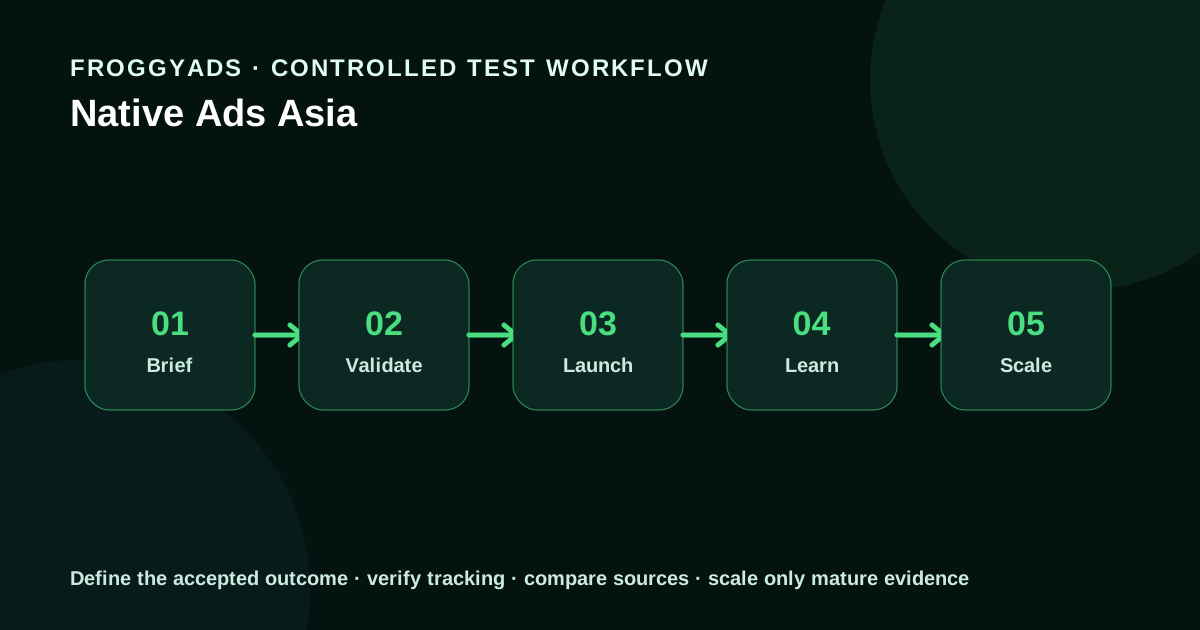
native ads asia controlled workflow visual

Match the format to the actual market explanation

When does native fit a multi-market purchase?

Native can be useful when contextual product explanation helps someone understand the offer before opening a destination. Review another format's actual interaction and current requirements separately. Compare choices for the same ready route and customer-action rule. Choose FroggyAds when you want supported media controls around that decision, while your business retains offer, fulfilment and accepted-value review.

Create My Free Account
Illustration comparing advertising formats for native ads asia execution
09 • Market expense boundaries

How should the regional allowance be divided?

Set an affordable expense boundary for each purchase and retain a regional limit the business can manage. Do not let an inexpensive but unsuitable route consume the allowance intended to answer another market's question. Our USD 50 minimum account deposit funds the account; it is separate from campaign spend and does not prescribe a country test budget or an acquisition price.

10 • Comparable accepted cost

What makes market acquisition costs comparable?

Separate media-only expense from actual wider acquisition work and count each applicable cost once. Record the currency basis before adding or comparing amounts. Use the same accepted-action definition and allow equal review time where the decision requires comparability. Your acceptable cost may still differ with real fulfilment or contribution. A lower nominal CPA cannot automatically authorise more spend across the portfolio.

11 • Unresolved customer actions

Which customer actions should remain unresolved?

Retain duplicate attempts, unsuitable orders, cancellations, pending cases and unavailable attribution detail under each actual acceptance rule. Explain material differences between the routes. A customer outside a merchant's coverage does not become an accepted order because the click was inexpensive. Review the offer and destination before describing every rejected action as a source-quality problem.

12 • Within-market source review

How should sources be assessed within each market?

Assess available source observations alongside comparable expense and accepted outcomes the implementation can connect. Review within the relevant offer and market before relying on a regional total. Thin evidence may justify a smaller commitment or a better observation route. It cannot establish an exact placement cause, universal publisher transparency or a ranking of countries by customer quality.

13 • Specific route corrections

Which change should precede another country purchase?

Change the part the record identifies: product wording, a failed destination, an unsupported delivery promise or a supported media setting. Keep other conditions identifiable and explain necessary concurrent changes. You can make a practical buying decision without claiming random assignment or a single isolated cause. More expense on an unready route will not resolve its commercial limitation.

Build the next purchase around a reviewed route

How can a market comparison inform the next commitment?

A useful comparison states the countries, offer versions, observation period and acceptance rules involved. If the merchant changed shipping conditions or customer help, retain that difference instead of presenting a clean creative verdict. Use the comparison to choose an affordable next action for the relevant route. It does not certify that a result transfers to other Asian countries or an untested language version.

Create My Free Account
Illustration of a campaign launch checklist for native ads asia
14 • Customer-event stages

Which stages should the regional review distinguish?

Distinguish delivery observations, eligible enquiries or orders, later acceptance and fulfilment where the business can observe them. Review delay matters when customers need a reply or an order remains pending. Choose the event used for the next allocation and keep later value unresolved. A newer route should not appear weaker solely because its customer records have had less time to mature.

native ads asia evaluation scorecard visual
15 • Affected-route limits

When should the affected market purchase pause?

Pause or limit exposure when the advertised offer is unavailable, a material qualification is misleading, the destination fails or the authorised expense boundary is reached. Preserve the affected route and dates. Keep unrelated ready purchases under their own review rather than assuming the whole region shares the fault. Seek qualified input where uncertain requirements need resolution.

16 • Next ready purchase

Which route can justify the next allowance?

Add manageable expense where reviewed customer actions, supported contribution and actual fulfilment capacity justify it. Assess the added purchase separately because supply or business conditions can change. A working Malaysia route does not validate a still-unready Japan destination in the fictional example. Your regional plan should authorise the route whose evidence supports the next decision, without promising stable cost or profit.

17 • Mixed market readiness

How should mixed readiness be handled in the plan?

Allow for a ready route with sparse outcomes, an incomplete language destination and an offer temporarily unavailable for delivery. These require different responses: more observation, route repair or an availability decision. Keep the scenarios hypothetical until the merchant verifies their actual state. The purpose is a practical allocation decision, not a forecast of customer behaviour or media demand across Asia.

18 • Regional handover record

What should another operator know before buying?

Keep the selected countries, offer and language versions, destination, actual delivery conditions, settings, dates and expense scope. Retain each acceptance rule and permitted customer-record connection. Explain changed readiness and unresolved outcomes. Another buyer should understand the next purchase without assuming national availability, a shared customer system or source-path detail that the setup never supplied.

Market and purchase evidence

Asia rollout review: ready routes and comparable decisions

AreaEvidence requiredAction
Offer routeName the countries and actual packages the business can supply.Hold an unserviceable route outside the purchase.
Language journeyReview the advertisement, destination and actual customer help.Correct a missing or stronger language promise.
Native purchaseConfirm current creative requirements and supported buying settings.Buy only the available presentation suitable for the offer.
Customer evidenceConnect permitted campaign and accepted-action references where possible.Retain missing detail and unmatched records explicitly.
Market economicsUse clear expense, currency, review time and acceptance rules.Authorise expense on supported value for the relevant route.
Business capacityVerify current stock, delivery and customer-handling conditions.Limit exposure when the actual offer cannot be honoured.
Regional planning

What can a regional average hide?

Unready destination

A route is not ready for customers

If one destination lacks the promised information, payment route or help, repair it before treating the market as a media opportunity. Another country's successful orders do not make that missing route usable. Preserve the readiness reason and the work needed. A held destination can remain in planning without being counted as a failed acquisition test.

Pending outcomes

Customer outcomes are still pending

Pending orders need the same observation policy used for comparable purchases. Keep unresolved acceptance, cancellation and fulfilment visible. The buyer may use an earlier event provisionally, but should not label expected contribution as settled value. A blended result can conceal that one route has mature orders while another has only recent clicks or incomplete customer records.

Different offer conditions

Offer conditions differ across markets

Changed delivery cost, stock, product range or customer help can affect the acquisition decision. Review those conditions before reallocating on nominal CPA alone. A route can produce more accepted orders yet leave less supported contribution. The useful conclusion states the actual offer and expense basis, rather than assigning a permanent quality label to a country.

Frequently asked questions

Native Ads Asia FAQ

How should Asia be defined in a native advertising plan?

Name the countries, languages and serviceable markets included instead of treating a large region as one audience. Keep material differences visible in reporting.

Why should Asian native campaigns be tested by country?

Review each country route because the actual offer, language journey, available purchase and customer acceptance conditions may differ. Preserve those conditions with the expense and observation period. Distinct purchase boundaries make an allocation easier to interpret; they do not make the comparison random or guarantee that every country has the same native supply.

What does meaningful localization require beyond translation?

Adapt the offer, examples, currency, imagery, form behavior and support journey with qualified local review. Preserve the factual claim and commercial terms.

Which publisher context matters for native ads in Asia?

Inspect the topic, presentation and customer expectation in the native context actually available for the purchase. Confirm the commercial label and truthful product explanation with the destination. Keep unavailable source detail explicit. A plan should not promise exact publisher ownership, page context or screenshots for every impression when the implementation cannot supply them.

How should sponsorship be disclosed in an Asian native placement?

Use clear labeling and advertiser identity appropriate to the publisher and market. Visual similarity with editorial content must not conceal the paid purpose.

What destination test belongs in each country campaign?

Complete the actual language, eligibility, offer, purchase, confirmation and delivery route under relevant device conditions. Review customer-information responsibilities with the appropriate owners and qualified advice when needed. A country label does not approve those obligations. Retain observed failures and their versions, and repair the affected route before adding exposure.

How can CPM differences across Asia be interpreted?

A comparable observed rate needs its billing or measurement basis, currency, country, available format, date and purchase conditions. CPM and accepted acquisition cost answer different questions; neither supplies a universal Asian market price. Use actual comparable expense and reviewed customer actions, qualifying any source or device detail that is unavailable.

Which measurement gaps deserve disclosure in native advertising?

Consent choices, cross-device journeys, delayed conversions and source aggregation can weaken attribution. Do not replace missing evidence with a regional estimate.

What result should govern an Asia native-ad test?

Use a verified customer action under consistent acceptance and reversal rules. Click-through rate can explain creative response without authorizing a budget increase.

When is one Asian market ready for more native-ad spend?

Expand when the particular route remains accurate and usable, reviewed customer actions support the allowance and actual fulfilment capacity is adequate. Assess additional expense under its current conditions. A ready route does not validate an untested country or language version, and promising early results do not guarantee permanent acquisition cost or profit.

Related regional resources

Which regional guides support another presentation?

Review the regional push and popunder guides for the actual interaction each describes. Check their current requirements separately from native. Keep the selected countries, language and offer routes and acceptance rules identifiable before comparing the available media choices.

Review each ready market on its evidence

Buy the next ready market route with FroggyAds

Choose FroggyAds when you want direct management of supported targeting, bids, budgets and source choices for your selected ready markets. Our self-serve controls help you act on media observations while your team verifies local offer routes and accepted value. Confirm current native requirements, prepare the actual destinations and begin with a manageable question for each purchase.

Asia market-route buying decision

Which Asia buying decision does this guide address?

This guide coordinates separate country, language and offer routes in an Asia native plan. The broader native advertising guide explains the format across offers. Here the buyer keeps market readiness, supported media choices and accepted customer value visible before a blended result guides allocation. The task is regional coordination, not an assumption that every country has identical supply or requirements.

Our recommendation connects creative assets, available placement context and permitted campaign references to the actual route a customer can use. Keep country and offer differences visible as you judge response. Native media introduces the proposition; the business verifies the product, customer help and fulfilment that make each next purchase commercially sensible.

CheckpointPage-specific actionEvidence to keep
Malaysia routeIn the fictional plan, buy only after the actual offer and delivery route are verified.Retain the reviewed destination, conditions and accepted-action rule.
Japan routeHold a promised language or help route that the merchant has not completed.Keep the readiness issue separate from media-performance conclusions.
Regional decisionCompare ready purchases using clear currency, expense and observation scope.Keep pending outcomes and supported contribution visible for each route.

Hypothetical comparison after both routes are ready: one eligible market purchase spends USD 160 for eight accepted orders, giving USD 20 per order. Another spends USD 240 for two, giving USD 120 per order. Their USD 400 total divided by ten orders is USD 40, which hides the two different observations. Fulfilment and contribution still require review. These are fictional media calculations, not FroggyAds results, Asian market rates or a forecast for Malaysia or Japan.

Start your next ready-market native purchase with FroggyAds. Keep the offer, destination and acceptance rule clear for each country, then use reviewed customer records to guide your next allowance. Create your free FroggyAds account.

Direct answer

What should be ready before an Asia native rollout?

Prepare named market routes with truthful product explanations, actual language coverage, serviceable offers and tested destinations. Define the customer event and an affordable expense boundary for each purchase. Confirm supported FroggyAds settings while keeping pending outcomes, later contribution and unavailable attribution detail explicit. Your regional allocation should follow the routes the business can genuinely operate and review.