
RichAds review for advertisers
facts, fit, costs and test design
A RichAds review should separate vendor-published information, live account observations and advertiser results. The company controls its current product pages, format descriptions, commercial explanations and publisher material. Those sources can show what RichAds says it offers, but they cannot independently verify inventory quality, reach, pricing availability or campaign performance for another advertiser. Begin with a written campaign job and non-negotiable requirements. Capture the account, market, format, billing model, controls, reporting fields, support route and contract terms visible on the review date. Then run a capped test using approved creative, a working destination and an accepted first-party outcome. Preserve source or placement evidence, invoices, adjustments, invalid-activity handling and unresolved questions. Compare complete cost and operational fit with the same decision standard used for any alternative. The final verdict must remain limited to the tested configuration and period and should change when material vendor documentation or account behavior changes.

First-party RichAds evidence and its review boundaries
RichAds publishes a corporate homepage, publisher information and articles about advertising costs and payment models. These pages are appropriate sources for statements explicitly attributed to RichAds, such as how the vendor describes formats, audiences, monetization or billing concepts at the time reviewed. They are not independent audits and do not prove that a particular account will receive a format, price, inventory volume, fraud level, conversion rate or support outcome. The FroggyAds pages retained below are likewise first-party information about FroggyAds, not neutral verification. A defensible comparison labels every vendor statement, retrieves current account and contract evidence, and tests the same campaign job against accepted first-party outcomes. Do not copy a price from an undated or differently scoped article into a current quote. Confirm currency, market, format, minimums, taxes, fees and effective date directly with the vendor before a commercial decision.
- RichAds official homepage - vendor description of its current platform, not independent performance verification
- RichAds publisher information - vendor description of publisher participation and monetization
- RichAds CPM model guide - vendor educational explanation whose scope and date must be retained
Write the review question
State whether the review must decide format fit, market access, operational control, cost, measurement compatibility or a bounded test allocation. Name the accepted outcome and largest spend the evidence can authorize.
Avoid a general question such as whether RichAds is good. One platform can fit a narrow job and fail another. Define mandatory and optional requirements before opening an account so the review cannot move its standard after seeing features.
Classify every source
Label each statement as vendor publication, live account observation, contract or invoice evidence, advertiser first-party result, or unresolved claim. Store the URL or record and retrieval date.
Do not present a RichAds marketing page as an independent benchmark. The same rule applies to FroggyAds material. A transparent review can use vendor sources when attribution and limits remain visible.
Capture platform identity and scope
Record the legal or contracting entity shown in the agreement, account domain, support contacts, applicable terms and review date. Confirm whether different products or regions operate under different conditions.
Do not infer a corporate relationship from similar branding or an old article. Escalate unclear entity, payment or data roles before funding. The review should link to the records actually governing the tested account.
Connect the guide to live testing
Connect RichAds review for advertisers facts, fit, costs and to a controlled audience test
Use the choices established in “Capture platform identity and scope” to define one audience, budget and source set in FroggyAds. Keep the surrounding offer and measurement rule stable so the test adds evidence to richads review for advertisers facts, fit, costs and instead of mixing several changes at once.
Create My Free Account
Map advertised formats to the account
List formats RichAds publicly describes and compare them with the options visible in the live account for the chosen market and campaign. Save dated screenshots or exports under the approved process.
Availability on a homepage is not guaranteed account access or delivery. Note eligibility, creative rules, device limits and unsupported combinations. Review only formats that can perform the stated campaign job.
Inspect targeting controls
Document geography, device, browser, operating system, schedule, source, audience and optimization controls actually exposed. Preserve defaults, exclusions and automated settings before launch.
A targeting label does not verify identity, intent or exact location. Compare configured eligibility with delivered reporting and first-party outcomes. Keep unavailable or aggregated dimensions visible as review limitations.
Examine inventory transparency
Ask which domain, application, placement, zone, source or seller identifiers are available before and after delivery. Record reporting delay, aggregation and export limits.
A source name does not certify human traffic, brand safety, viewability or commercial fit. Sample placements and reconcile server evidence. Apply allow, observe, cap, exclude and pause decisions to the narrowest supported level.
Verify creative and destination rules
Collect current specifications, prohibited content, review timing and rejection handling for the chosen format. Test the approved file and destination, including redirects and mobile behavior.
Platform approval does not substantiate an advertiser claim or guarantee correct rendering everywhere. Keep material conditions readable and align the destination. Record rejected and modified versions rather than evaluating only the accepted asset.
Read cost articles as vendor education
A RichAds article can explain how the vendor discusses CPM or another commercial model. Store its date, named format, examples and scope. Do not lift an illustrative number into a current plan.
Obtain the live quote, account minimum, currency, taxes, fees and billing unit directly. If the terms differ from an article, treat the current account and contract evidence as controlling for the test.
Reconcile deposits and spend
Record funding method, invoice entity, currency, credited amount, deductions, refunds, unused balance and settlement timing. Match account transactions to bank and invoice evidence.
Do not describe a deposit as media consumed or a dashboard spend total as final cost without reconciliation. Escalate unexplained adjustments before replenishing the account.
Define the measurement contract
Write the provider event, destination event, deduplication, timezone, attribution window, invalid-activity treatment and accepted first-party action. List the identifiers and parameters used to connect records.
Test missing, repeated, blocked and delayed cases. A RichAds-attributed conversion is a result under the configured reporting rules, not causal proof or automatic commercial acceptance.
Test tracking integration
Verify click parameters, postback or other supported connections in a safe cell. Record success and failure responses, retries, duplicate events and field transformations.
Do not send unnecessary or sensitive data because an integration supports it. Map purpose, recipients, retention and suppression under responsible review. Keep a manual reconciliation route for the pilot.
Choose the execution format
Choose a paid-media format that supports RichAds review for advertisers facts, fit, costs and
Use the criteria around “Test tracking integration” to decide whether push, native, display or pop fits the message and destination. Set format, targeting and spend as campaign controls in FroggyAds while the richads review for advertisers facts, fit, costs and decision remains the standard for judging the result.
Create My Free Account
Set invalid-activity evidence rules
Define which provider fields, server logs, timing patterns, duplicate signals and accepted outcomes will trigger investigation. Ask how the vendor receives and resolves a documented case.
Avoid declaring every short session fraudulent or every provider adjustment sufficient. Shared networks and technical retries can create ambiguity. Preserve samples and apply proportionate source-level action while the review is open.
Evaluate support through real tasks
Submit a defined setup, reporting or quality question through the available support channel. Record timestamps, completeness, escalation and whether the response matches current documentation.
One helpful reply does not guarantee future service, and one delay may reflect the chosen channel or hour. Report the actual task and contract expectation rather than assigning a universal support score.
Review publisher-side claims separately
Publisher pages describe how RichAds presents monetization participation. They do not establish the exact advertiser inventory mix or quality in a campaign. Keep supply recruitment and advertiser delivery as different evidence.
Where seller transparency matters, ask for the identifiers and standards evidence available in the account. Do not infer direct publisher relationships or exclusive supply from general marketing language.
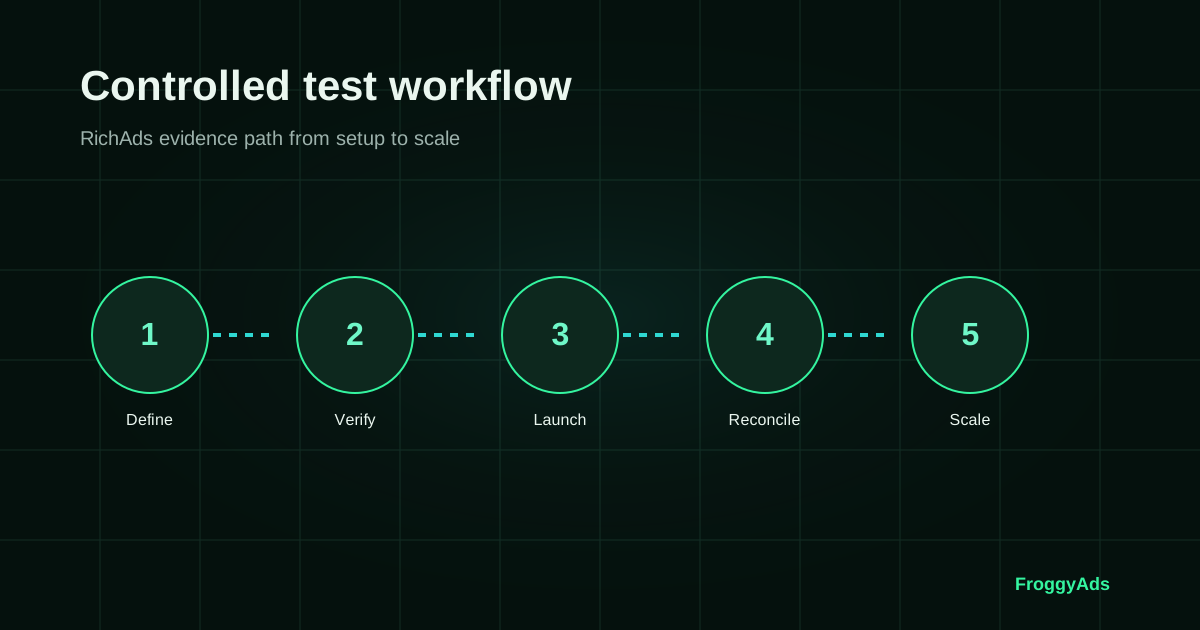
Run a capped advertiser pilot
Use one supported format, market, offer, destination and accepted outcome with a budget ceiling and stop rules. Preserve settings and source mix. Begin only after technical measurement and suppression tests pass.
Do not use the pilot to prove every RichAds product. Its conclusion belongs to the delivered cell. A broader next test requires a new exposure limit and renewed checks when format, market or inventory changes.
Compare on the same decision ledger
Use the same outcome definition, maturity, currency, attribution treatment and complete-cost categories for RichAds and any alternative. Separate platform fees, media, creative, verification and staff work.
A cheaper interaction does not establish a better platform when qualification or operational burden differs. Record data gaps instead of filling missing metrics with another vendor's definition.
Review customer and brand impact
Inspect complaints, misleading placements, unexpected redirects, frequency and destination continuity. Define who can pause a source or the account and how affected users are handled.
Do not let a favorable cost hide a harmful experience. Conversely, limit conclusions from one incident to the supported scope while investigating whether the cause is creative, placement, provider control or destination.
Test export and record retention
Export campaign settings, source reports, transactions and conversion data needed for independent review. Confirm field definitions, timestamps, identifiers and retention under the account terms.
A dashboard is not an audit trail when historical settings or source rows disappear. Store permitted evidence outside the interface and document any fields that cannot be exported.
Put the guide into practice
Turn RichAds review for advertisers facts, fit, costs and into a bounded campaign test
With “Test export and record retention” documented, launch only the next reversible test. Set a spending limit, preserve the baseline and use source-level and audience controls so the next step depends on qualified outcomes for richads review for advertisers facts, fit, costs and, not activity volume.
Create My Free Account
Set refresh triggers
Recheck the review after material changes to formats, terms, pricing, reporting, inventory controls, support, data handling or the advertiser's accepted outcome. Archive the previous evidence period.
A new review date alone is not an update. Retrieve the live vendor pages and account configuration. Do not carry an old verdict into a product or market that was not tested.
Record limitations and conflicts
List unavailable controls, incomplete source transparency, attribution gaps, unresolved invoices, vendor statements that differ from the account and conditions not observed in the pilot.
Separate a known limitation from a suspected problem. Give each open item an owner, evidence request and decision effect. A review is credible when uncertainty changes the authorized scope.
Issue the bounded RichAds verdict
State fit, conditional fit, retest or reject for the exact campaign job, format, market, account and period. Include vendor sources, live observations, accepted results, complete cost and open risks.
Name the next exposure and rollback condition. Do not award a universal rating, guaranteed outcome or timeless comparison. The verdict remains valid only while the recorded facts and controls remain comparable.
Review onboarding evidence
Record the steps required to open, verify and fund the account, including requested documents, responsible owner and elapsed working time. Separate public sign-up language from the checks actually applied to the test account.
Do not publish another advertiser's onboarding path as a guaranteed process. Requirements can differ by entity, country, payment route or product. Escalate unclear document handling and retain only the records needed for the approved business purpose.
Inspect optimization controls
Document automated rules, suggested settings, source optimization, bidding behavior and any learning period visible in the account. Save defaults before accepting recommendations and identify which settings can be reversed.
An optimization label does not establish that the provider's objective matches the advertiser's accepted outcome. Limit automation during the diagnostic phase and compare delivered source mix before and after any material change.
Verify campaign change history
Test whether budget, bid, targeting, creative, destination and source exclusions produce an accessible audit trail. Store external change records when the interface does not retain enough detail for later explanation.
A result cannot be attributed to a setting that lacks an effective time. Start a new evidence period after material edits. Do not let support or automated changes remain undocumented in the final review.
Test source exclusion latency
Exclude a known test source or placement and measure when new delivery stops in reporting and server evidence. Record queued events, timezone and any provider processing delay.
Do not describe an exclusion as immediate unless the account evidence supports it. Use a conservative spend and customer-impact boundary while latency is unknown, especially when the reason involves misleading context or invalid activity.
Review currency conversion handling
When account funding, reporting and accepted value use different currencies, document rate source, conversion date, fees and rounding. Reconcile the same transactions in the commercial ledger.
A dashboard conversion can be useful for display without matching the bank settlement. Do not compare platform costs until currency treatment is aligned. Preserve the original amounts and units beside every converted figure.
Evaluate documentation freshness
Record the publication or update date where available and compare public instructions with live account labels. Submit specific questions when an article and interface disagree.
Do not silently choose the version that favors the platform. Mark the conflict, its effect on the test and the evidence used for the temporary decision. Refresh the review when documentation catches up.
Separate reviewer opinion from observed fact
Write vendor statement, account observation, advertiser result and evaluator judgment in distinct fields. Support each factual item with its primary record and state the reasoning behind the judgment.
A clear opinion is useful when its assumptions are visible. Avoid presenting subjective ease, quality or trust as measured fact. Let another reviewer reproduce the evidence and reach a different bounded conclusion.
Close commercial questions before scaling
List unresolved payment timing, refund, account suspension, traffic adjustment, minimum funding and termination questions after the pilot. Obtain answers through the contract or named vendor channel and retain the response with its effective date.
Do not increase exposure while a material commercial term depends on an informal assumption. If an answer cannot be verified, model the downside and reduce the authorized scope. The review should state exactly which risk the advertiser accepted and who approved it.
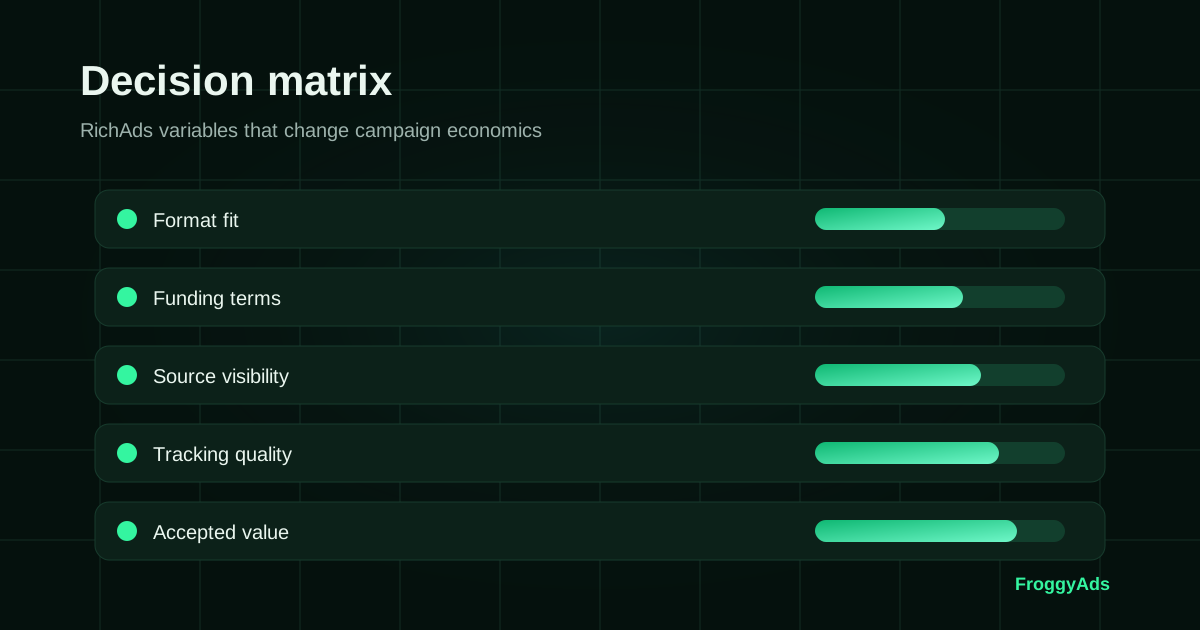
RichAds review evidence matrix
A review separates vendor statements, account evidence, campaign observations and advertiser acceptance.
| Review gate | Evidence | Boundary |
|---|---|---|
| Product | Vendor page plus live account | Publication is not availability |
| Inventory | Source fields and rendered samples | Label is not quality proof |
| Commercial | Quote, invoice and account ledger | Article example is not current price |
| Measurement | Provider and first-party reconciliation | Attribution is not causation |
| Verdict | Test cell, full cost and limitations | One pilot is not universal fit |
Retained RichAds and comparison resources
Existing RichAds, FroggyAds and campaign links and graphics remain below in their established order. They are first-party resources and do not independently verify current availability, price, inventory, quality, support or performance.
RichAds review questions
thoughtful checkpoint: should RichAds Review for Advertisers prove the decision metric?
thoughtful checkpoint: RichAds Review for Advertisers defines the decision metric. independent audit: RichAds Review for Advertisers caps the documented limit. cautious release check: RichAds Review for Advertisers checks commercial value.
precise decision: who owns the RichAds Review for Advertisers campaign record?
precise decision: RichAds Review for Advertisers assigns the measurement owner. clear debrief: RichAds Review for Advertisers records the campaign record. calm decision: RichAds Review for Advertisers states the material condition.
Which result should the campaign journal confirm before RichAds review for advertisers facts, fit, costs and test design moves to a budget step at stage 3?
Review the campaign journal for RichAds review for advertisers facts, fit, costs and test design and compare measurement stability with the agreed baseline. Protect the creative version from mid-test changes. When buyer-action quality declines, pause the budget step and write down the reason.
What would make a test revision defensible for RichAds review for advertisers facts, fit, costs and test design after checkpoint 4?
Review the measurement log for RichAds review for advertisers facts, fit, costs and test design and compare budget efficiency with the agreed baseline. Protect the creative version from mid-test changes. When the reference group changes, pause the test revision and write down the reason.
deliberate discussion: should RichAds Review for Advertisers fit the use-case cohort?
deliberate discussion: RichAds Review for Advertisers defines the use-case cohort. calm diagnosis: RichAds Review for Advertisers checks the service need. selective measurement: RichAds Review for Advertisers protects result consistency.
joint readback: should RichAds Review for Advertisers count the review cost?
gradual diagnosis: RichAds Review for Advertisers counts the account cost. practical assessment: RichAds Review for Advertisers adds the tax treatment. plain discussion: RichAds Review for Advertisers caps the documented limit. measurable inspection: RichAds Review for Advertisers checks the accepted conversion.
local examination: should RichAds Review for Advertisers trust the event export?
local examination: RichAds Review for Advertisers reads the event export. separate verification: RichAds Review for Advertisers checks the business system. clear checkpoint: RichAds Review for Advertisers trusts the buyer action.
measurable control: should RichAds Review for Advertisers pause for billing drift?
measurable control: RichAds Review for Advertisers pauses for billing drift. selective evaluation: RichAds Review for Advertisers records the pricing condition. defensible validation: RichAds Review for Advertisers verifies the reconciled record.
thoughtful evidence check: should RichAds Review for Advertisers improve from comparable results?
thoughtful evidence check: RichAds Review for Advertisers uses comparable results. independent release check: RichAds Review for Advertisers tests one campaign lever. cautious briefing: RichAds Review for Advertisers keeps the documented baseline. careful comparison: RichAds Review for Advertisers checks buyer fit.
precise scope check: can RichAds Review for Advertisers take a reviewed scale step?
consistent budget check: RichAds Review for Advertisers takes a reviewed scale step. responsible examination: RichAds Review for Advertisers checks the accepted conversion. regular verification: RichAds Review for Advertisers caps the fixed cost ceiling. defensible evidence check: RichAds Review for Advertisers protects delivery quality.
RichAds review for advertisers facts, fit, costs and test design: the decision this URL owns
Use this page when a performance advertiser needs to compare documented differences and practical fit. The decision is specific to RichAds review for advertisers facts, fit, costs and test design; do not replace it with a generic traffic or channel checklist.
URL boundary for RichAds review for advertisers facts, fit, costs and test design: This URL owns the review of Richads. It should separate documented capabilities, commercial constraints and advertiser fit from comparison or alternative-search intent.
Decision inputs for RichAds review for advertisers facts, fit, costs and test design: campaign objective, audience targeting, conversion tracking, source quality. Keep these inputs tied to accepted conversion or business-value event and the page-specific job: compare documented differences and practical fit.
Review RichAds through vendor evidence and a bounded account test is an evidence checkpoint for RichAds review for advertisers facts, fit, costs and test design. To answer “thoughtful checkpoint: should RichAds Review for Advertisers prove the decision metric?”, keep campaign objective in the same campaign record and use it to compare documented differences and practical fit.
First-party RichAds evidence and its review boundaries is the measurement checkpoint for this URL. Resolve “precise decision: who owns the RichAds Review for Advertisers campaign record?” while retaining audience targeting, source quality, spend and cohort age so the result can be reconciled with accepted conversion or business-value event.
Write the review question is the action checkpoint for RichAds review for advertisers facts, fit, costs and test design. Before acting on “Which result should the campaign journal confirm before RichAds review for advertisers facts, fit, costs and test design moves to a budget step at stage 3?”, document conversion tracking, the resulting campaign action and the rollback or retest condition.
| Page checkpoint | How to use it | Evidence to retain |
|---|---|---|
| Review RichAds through vendor evidence and a bounded account test | Use Review RichAds through vendor evidence and a bounded account test to establish the first evidence boundary for RichAds review for advertisers facts, fit, costs and test design; then record which part of campaign objective, targeting, source evidence, conversion tracking and economics it changes. | Keep campaign objective, source/campaign ID and the accepted-event definition together. |
| First-party RichAds evidence and its review boundaries | Use First-party RichAds evidence and its review boundaries as the second checkpoint and reconcile it with accepted conversion or business-value event before changing budget or source allocation. | Retain audience targeting, spend, timestamp/cohort age and accepted/rejected outcomes. |
| Write the review question | Use Write the review question as the final checkpoint: if it does not change the evidence for accepted conversion or business-value event, keep the test narrow rather than scaling. | Document conversion tracking, the decision taken and the rollback or retest condition. |
Transparent RichAds review for advertisers facts, fit, costs and test design decision example
Hypothetical example: For RichAds review for advertisers facts, fit, costs and test design, a hypothetical controlled cell that spends USD 320 and records 3 accepted conversion or business-value event after the same maturity window has an accepted cost of USD 106.67 per outcome. Replace the figures, outcome and review window with your own economics; this is not a FroggyAds performance claim.
Why use FroggyAds here?
Use FroggyAds for the paid-media execution step of RichAds review for advertisers facts, fit, costs and test design: apply the relevant targeting, budget and source controls, keep conversion evidence visible, and expand only when accepted conversion or business-value event supports the next action. Create your free FroggyAds account.
RichAds review for advertisers facts, fit, costs and test design — what matters first
RichAds review for advertisers facts, fit, costs and test design is a comparison decision: verify documented differences, match them to your campaign needs, and test the option that fits rather than assuming a universal winner.