
News-context buying guide

News Advertising Network

Choose a news advertising network by the publisher context you can verify and the customer actions you can measure. With FroggyAds, you can set up a controlled traffic campaign, manage targeting and spending, and review results by source. Confirm the news inventory and placement information available for your campaign before buying. Then compare qualified leads, purchases or another defined outcome alongside the context in which your ads appeared.

Our recommendation is to bring a placement brief, a matching offer and a clear spending boundary to your first test. A familiar publication name, an attractive headline or inexpensive clicks can start an investigation; each still needs evidence before it earns more of your budget.

News Advertising Network planning visual
Your placement buying decisions

Three decisions before buying news-context traffic

What should a News Advertising Network buyer verify?

Quick answer: A news advertising network gives advertisers a way to purchase advertising around news or editorial content. Verify the available publisher and placement context, keep the commercial message clear, and connect each source with your accepted business outcome. Choose FroggyAds for a self-serve test built around your targeting, budget and source decisions. Ask us about the inventory available for your format and market; a news-related campaign label does not guarantee a named publication or a particular article placement.

For the commercial presentation of your news advertisement, review FTC online advertising and marketing guidance. Use the guidance alongside the requirements of the publisher, campaign and market.

  • Confirm the publication, placement and review date before treating a source as news inventory. For News Advertising Network buying, record how the source identifier relates to the actual publisher context; a category label alone cannot establish that relationship.
  • Give the advertisement one truthful promise and check the page reached after the click. A reader should understand who is advertising, what is offered and what the next action involves before providing details or paying.
  • Set your accepted outcome and maximum learning spend in advance. Expand the source combinations that support both the commercial goal and your placement standards, after allowing for the actual delay in receiving qualified results.

These three decisions belong together. A campaign can produce valid clicks from a genuine publisher yet fail because the offer is poorly matched to the reading context. Another can generate enquiries while appearing beside coverage your brand would not choose. We help you turn the buying brief into a manageable FroggyAds traffic test; your source review and business records determine whether the combination deserves a larger allocation.

Understand the publisher context you are buying

Publisher context: The publication, section, placement and timing around the advertisement, supported by the evidence actually available for the purchase.

Publisher context describes the environment around the advertisement: the publication, section, article or page type, and the moment at which the ad is encountered. Audience and market fit depend on what the reader can use: a technology product beside a product comparison presents a different buying hypothesis from the same product beside a general breaking-news feed. Describe that hypothesis in terms your creative, buying and account teams can assess. Then establish which parts of the context can actually be inspected for the available inventory.

Ask what each publisher or source reference means. It might identify a site, a placement, an intermediary or a broader group of traffic. Keep the reported identifier unchanged in your analysis and obtain a mapping where it is available. If a field cannot identify the publication or article, describe that limitation honestly. You can still assess the campaign, but you should not present the identifier as proof of a specific editorial environment.

News context also changes over time. A generally suitable section may cover a sensitive event, a disputed claim or a story unrelated to the reason you selected it. Establish who can review a reported placement and who can pause the affected campaign when a concern arises. That is an operating responsibility for the buying team; it is not a promise that any network can predict every change in a live news feed.

Select a network using publisher evidence

Publisher evidence should answer a buying question, not merely decorate a proposal. Before launch, keep a record of the requested environment, the supply information provided, the available format and the reporting fields you will receive. Include an example of what your advertisement and destination will look like together. This makes it easier to identify a genuine fit or a missing requirement while the purchase is still small and reversible.

Our FroggyAds self-serve workflow is a strong choice when you want to manage a focused paid-traffic test and act on source performance. You can work with targeting, source reporting and budget controls rather than treating the purchase as an unexplained bundle of visits. Confirm the current inventory, campaign settings and any publisher-specific requirement with us. Keep availability separate from your plan: a capability to buy a format does not promise access to every news property.

Buying requirementPublisher evidence to requestDecision it supports
ContextPublication or source mapping, relevant section and a dated placement example where available.Determine whether the actual environment supports the audience hypothesis.
Ad promiseThe approved headline, image, advertiser identity and destination shown together.Check that the reader can recognise the commercial offer and continue without a surprise.
AccessAvailable market, device, format and supply scope for this specific campaign.Avoid planning around a publisher or placement that has not been confirmed.
ControlThe applicable spend, targeting and source settings, plus a named pause owner.Keep the first purchase bounded and make a concern actionable.
OutcomeA qualified lead, paid order or other accepted event with a stated review delay.Judge the traffic against a business result beyond the initial click.
Supply evidencePublisher identity and authorised-seller information where relevant to the buying path.Investigate the supply relationship without mistaking it for an editorial-quality guarantee.
Buying boundary: Confirm the requested news context, ad-to-offer continuity and accepted-outcome rule before expanding spend. Record any unavailable publisher or placement detail.

Keep publisher evidence in a small placement register. Useful columns are campaign, reported source ID, publisher reference if supplied, page or section, format, creative version, observation time, reviewer and action. Add a link or screenshot when your agreement and available evidence allow it. An unresolved row should say what is missing and who will investigate. Do not fill missing publisher details with a name inferred from a campaign category or from a logo in a sales presentation.
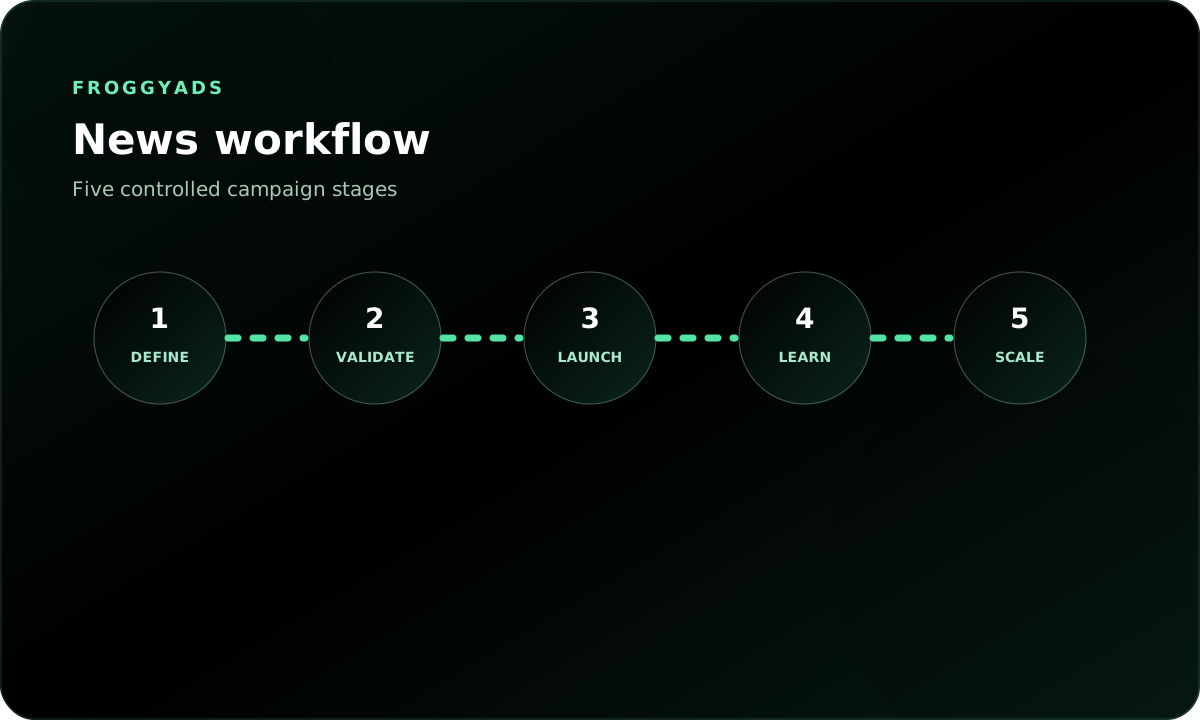
A five-stage launch for news-context advertising

Use this five-stage launch to turn your news-context brief into a campaign you can explain. The stages follow the existing planning sequence: define scope and acceptance, validate the path, launch with limits, compare mature evidence, and scale or roll back. Each stage has a different question to resolve. Keep the completed record with the campaign so a colleague can understand the purchase without reconstructing it from several dashboards.

A seven-day planning cycle can organise the initial checklist, but it is an illustrative working period, not a FroggyAds approval deadline or a promise that results will mature in a week. Set the observation period around your actual customer journey. A same-day purchase and an enquiry qualified several days later require different review timing, even when both campaigns begin on the same news source.

Define the news-placement brief

Define the news-placement brief around the advertiser, campaign objective and requested context. State the customer action that will satisfy that objective, along with the offer, market, device scope, format and available destination. Explain why a reader in that environment might be interested. Name the accepted outcome and the maximum learning spend. Include unsuitable contexts, an incident contact and any established publisher requirement. Bring that brief to FroggyAds so campaign preparation starts from your commercial need rather than a broad request for news traffic.

Validate the headline-to-offer path

Validate the headline-to-offer path on the devices you intend to target. Read the ad as a customer would, open the destination and complete a test action. Check that the product, price, availability and advertiser identity remain consistent throughout. Follow redirects and verify the supported campaign references in the receiving record. Test a repeated notification about the same outcome separately from a second genuine outcome. Resolve a failed path before purchasing more traffic; otherwise you cannot tell a media problem from a broken handoff.

Launch a bounded news-context test

Launch the news-context test with a defined daily allocation and total test-spend ceiling. Keep the offer, major targeting and creative variables stable while the first outcomes mature. Record the available source scope, creative and destination versions, launch time and settings in force. Make the reviewer reachable during the launch period, particularly when the campaign relates to a current event. FroggyAds gives you a practical place to manage the traffic purchase while you collect the evidence needed to judge it.

Compare mature source and story-period evidence

Compare source, creative, market and device results after the accepted outcomes have had time to arrive. Review the campaign period alongside any material change in the news environment: an ordinary coverage day and a sudden traffic spike may describe different reader situations. Keep those periods visible rather than declaring a winning source from a blended average. Examine the creative promise, destination completion and qualified outcomes together. Treat a click increase without corresponding business improvement as a question to investigate before increasing spend.

Expand the stable news placements or roll back

Expand stable placements only after the previous test meets both your commercial rule and your context requirements. Change one meaningful buying dimension, record the time and retain the earlier settings. Review whether the extra delivery brings the same quality of accepted outcome or changes the source mix. If the new allocation produces an unsuitable context, a broken destination or weaker economics, return to the documented baseline and investigate the change before attempting another increase.

Five-step workflow for News Advertising Network

A rollback decision should say which setting changed and what evidence triggered the response. For example, returning to an earlier source set is a different action from stopping a misleading headline across every source. Keep that distinction in the change log. It prevents the next reviewer from treating a creative correction as proof that a publication was unsuitable, or a publisher concern as proof that the whole offer failed.

Budget news placements against qualified outcomes

Budget news placements from the value of the action you need, rather than a forecast of how much attention a story might receive. Start with the amount you can afford to use for learning and identify the event that would justify another purchase. A qualified sales enquiry, a completed purchase and a newsletter registration have different commercial meanings. Choose one primary outcome for the test and report supporting signals separately so a busy news period cannot silently change the definition of success.

Separate three records: what the platform delivered, what the destination recorded and what your business accepted. Differences between them may arise from timing, counting rules, a failed page or qualification. Investigate those differences before ranking sources by cost. When a lead is rejected or an order is later cancelled, retain that status in the outcome review rather than counting the earliest event as settled value. Your next budget decision should use the version of the result your business can stand behind.

Measurement recordNews-campaign signalHow to use it
DeliverySpend, impressions or visits, reported source references and delivery time.Confirm which purchase and news period produced the observed activity.
DestinationA working page, preserved campaign reference and completed test action.Separate technical loss from a question about publisher or audience fit.
QualificationLeads accepted by your team, paid orders or another explicitly defined result.Compare sources using the same accepted action and maturity window.
EconomicsCost per accepted outcome and the value remaining after relevant reversals.Decide whether another bounded purchase is commercially justified.

Separate funding from your test budget

FroggyAds currently publishes a $50 minimum deposit. That funds your account; it is not a quote for news inventory, a required daily campaign budget or a promise of customers. Set the campaign budget and bid after checking the buying basis available for your format and market. The budget limits the allocation; the bid concerns the price you are prepared to offer on the supported basis. Review the current pricing and account terms before funding, and write a separate test stop condition.

Allow for the actual outcome delay

Outcome delay matters when a news campaign generates activity quickly but the business result arrives later. Set a review time that allows for your qualification, payment or other acceptance process. Keep recent results provisional until that window has passed. If a source has spent its learning allowance without a mature answer, you can limit further exposure while waiting; you do not need to label the source successful or failed prematurely.

Compare accepted cost on the same basis

Accepted cost means total test spend divided by the number of outcomes that meet your stated acceptance rule. Use the same currency, reporting period and event definition for each comparison. A source with cheaper clicks can still cost more per accepted lead when fewer visitors qualify. Conversely, a higher click price may be workable if the resulting customers are useful to the business. Neither relationship can be established from the bid floor or click-through rate alone.

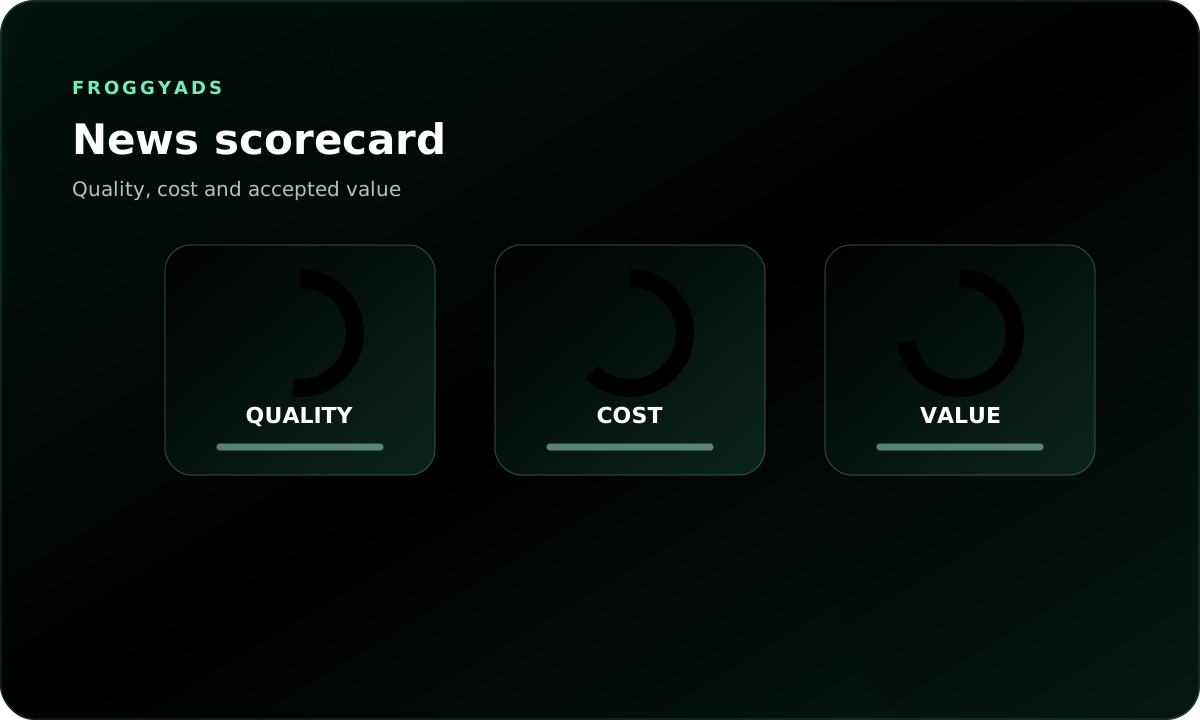
Measurement scorecard for News Advertising Network

Keep the accepted-cost calculation beside the placement register. A commercially promising row can remain unsuitable for the brand, while a suitable context may still fail the economic test. Give those findings separate fields and owners. Combining them into a single unexplained score would hide the action you need to take, such as repairing the destination, revising a headline, limiting a source or changing the audience hypothesis.

Match ad formats to the news reading experience

Match the format to the message and to the placement you can actually buy. FroggyAds supports Push, Native, Display, Pop, Video and Interstitial formats. Those are ways to present an advertisement, not guarantees that it will appear beside a particular news article. Establish the available supply and creative requirements first. A product explanation may suit a contextual native unit, while a recognisable offer may work in a display creative; both still need a relevant, functioning destination.

Keep a native advertisement recognisable as advertising when it resembles nearby editorial material. The reader should not need to click through to discover that a commercial offer was presented as a news recommendation. Review the unit and destination together, including any advertising label and advertiser identity. The same commercial clarity is useful for other formats: a push message should not imitate an official news alert, and a banner should not imply that a publication endorses a product without evidence.

Format optionNews-context buying questionCreative or placement check
PushIs notification traffic the intended channel, rather than an assumed article placement?State the offer plainly and avoid imitating editorial or emergency alerts.
NativeCan the headline and image carry the offer in an identifiable advertising unit?Assess the advertising label and the destination as well as the visual match.
DisplayIs the requested banner placement available in the relevant market and device scope?Keep the message legible and distinguish the advertiser from the publication.
Pop or interstitialDoes the actual delivery experience fit the offer and the user context?Check interruption, destination continuity and applicable placement requirements.
VideoDoes motion explain the product more clearly than a static message?Confirm the available placement and keep commercial identity understandable.

The destination should complete the promise made in the creative. An advertisement for a product comparison should lead to the promised comparison, with its commercial relationship clear; an advertisement for an offer should show the relevant offer and terms. Do not send the visitor through a news-like headline to a materially different proposition. Check mobile readability, form behaviour and any paywall or registration requirement before launching. A surprising destination can produce engagement statistics that say little about genuine customer interest.

Creative review also needs a change rule. If a price, availability statement or time-sensitive claim changes, update the affected asset and destination together, then record the new versions. Avoid recycling a breaking-news style headline after the event has moved on. We recommend preparing a durable alternative creative so the campaign can continue with an accurate message when a topical angle is no longer appropriate.

Optimise sources through changing news cycles

Source optimisation starts with a question you can investigate: did the reader context change, did the source mix change, or did the customer path deteriorate? Compare the affected period with a documented baseline. Keep country, device, creative and destination versions visible so a larger mobile audience or a new headline is not mistaken for a change in publisher quality. Use the reporting dimensions actually available in your campaign and retain uncertainty where the evidence is limited.

News cycles make timing particularly useful. Suppose the same reported source delivers an unusual surge during a major story. Review the surrounding context and the accepted outcomes for that period before treating the surge as repeatable demand. A return to ordinary coverage may produce a different response. This is a campaign-analysis hypothesis, not a claim that FroggyAds supplies article-level event classification or that a news event caused the observed customer actions.

News-campaign observationFocused responseEvidence before another purchase
A click reaches a broken or mismatched pagePause the affected path and repair it.A repeatable destination and event test, with the corrected version recorded.
Clicks surge during a changing news storyReview the dated context and limit exposure while outcomes mature.Comparable source-period records and qualified results, not click volume alone.
A placement conflicts with the agreed contextEscalate the evidence and pause or narrow the affected buying scope.The placement reference, observation time, reviewer and resolution.
A source meets the accepted-cost and context rulesTest one bounded increase.Mature outcomes and a saved baseline for the previous allocation.
An increase changes source quality or economicsReturn to the earlier settings and investigate.A change log showing what expanded and when the result changed.

A source exclusion should address the evidence you have. If the problem is confined to one creative, correct or pause that creative before drawing a conclusion about every visitor from the source. If the concern is the publication context, preserve the evidence and act on the available source controls or seek help narrowing the purchase. A blanket change across sources, creatives and destinations would make it harder to identify which action resolved the problem.

After an optimisation change, give the new source mix its own review period. Retain the earlier data and label the boundary rather than overwriting the original result. This lets you ask whether the latest allocation continues to meet the accepted-cost rule and context requirements. It also gives the account team a concrete record to discuss when you need help investigating a source, a delivery pattern or an unexpected drop in qualified outcomes.

Protect news-context suitability and customer trust

News-context suitability should be written in terms a reviewer can apply. Identify the kinds of coverage your advertiser is comfortable appearing beside, the contexts requiring extra review and the person who can make an exception. A general preference for reputable news is not a complete buying instruction. Use actual placement evidence where it is available and explain what you cannot inspect, especially when a buying path reports a grouped source rather than an individual publication.

Supply transparency and suitability answer different questions. An authorised-seller record can help investigate who is allowed to sell inventory; it does not certify the accuracy of an article or establish that every story fits your brand. Likewise, traffic-quality signals do not replace a review of the creative promise or destination. FroggyAds uses Adscore and internal quality controls to help identify invalid or low-quality traffic. Keep those controls alongside your own context and business-outcome review, rather than describing any one measure as a complete guarantee.

  • Use a recognisable advertiser identity and support factual claims in the ad and destination. Avoid presenting a commercial page as independent reporting, a fabricated publisher recommendation or an official public notice.
  • Apply the privacy, consent and data-handling requirements relevant to the campaign. Collect only information you can use appropriately, and make any necessary terms visible before the customer completes the action.
  • Treat political, issue-related or sensitive-event advertising as a separate eligibility question. Confirm applicable campaign and market requirements instead of assuming that an ordinary product campaign approval covers every news-related message.
  • Keep a named route for complaints and placement concerns. Record the source reference, creative, destination, time and action taken so the next review can assess a concrete incident rather than an untraceable anecdote.

FroggyAds resources for your news buying brief

Prepare your news buying brief with our current pricing and funding information, ad-format comparison and conversion tracking setup. Then review Adscore and traffic-quality guidance, brand-suitability planning and our editorial policy to connect the purchase with the checks your team will perform.

Use these resources to bring us a precise question. For example: which source references will this campaign report, what format is available for the requested market, or which supported tracking route should be tested? A specific brief makes the answer useful. Keep the confirmed requirement with your campaign record and recheck it when the market, format, destination or supply request changes.

News advertising network buyer questions

What distinguishes a news advertising network from general inventory?

A news advertising network concerns advertising placements around journalism or news-oriented content. The practical difference is the context you need to evaluate: publication identity, section, placement and the time of exposure. Confirm what inventory and reporting are available for your campaign. A broad news label or a source identifier alone does not establish delivery on a particular publication.

How should brands evaluate suitability beside news coverage?

Evaluate news suitability by writing the advertiser’s context rules and reviewing actual placement evidence where available. Distinguish a publisher-level judgement from a concern about one section, story or period. Name the person who can pause or escalate the issue. Where the buying path does not expose the needed context, keep that limit explicit before committing more budget.

Which disclosure keeps a native news placement understandable?

A native news placement needs a clear indication that it is advertising when its presentation could otherwise suggest independent editorial content. Assess the label where the reader encounters the unit and the commercial nature of the destination. Advertiser identity, visual presentation and the surrounding page all matter; a truthful product claim does not justify disguising an advertisement as a news report.

Why does breaking-news timing affect campaign review?

Breaking-news timing can change the context around an advertisement and the audience arriving during a given period. Review a reported concern promptly and keep the observation time with the source and creative references. Compare qualified outcomes for the affected period separately from ordinary delivery. Neither a temporary traffic surge nor a single snapshot establishes a durable source result.

What source reporting should a news ad buyer receive?

A news ad buyer should establish which campaign, source, creative, market, device and time references can be reported. Ask how those references map to a publisher or placement if that detail is needed for the buying decision. Retain accepted outcomes in the same analysis. Use only the fields your actual reporting provides, and do not infer article-level transparency from a zone label.

How can an advertiser avoid funding misinformation?

Reduce misinformation-related buying risk by setting supply and context requirements, investigating the available publisher evidence and responding to reported placements. Keep the advertiser’s own claims accurate as well. Authorised-seller information helps investigate the supply relationship; it does not validate every editorial claim. No single filter or source label removes the need for a review and incident-response process.

What landing page should follow a news-context advertisement?

A news-context advertisement should lead to the offer or explanation its headline promised. Identify the advertiser, make relevant commercial terms clear and ensure the requested action works on the targeted device. If the destination resembles an article, its commercial nature should remain understandable. Avoid an unsupported suggestion that the surrounding news publisher wrote, verified or endorsed the advertiser’s product.

Which metric shows value beyond news-site reach?

Value beyond reach comes from an accepted customer action and its economics. Choose a qualified lead, paid order or other outcome your team can verify, then compare its cost by source and review period. Clicks and destination engagement help diagnose the path. They do not by themselves prove a useful customer, an incremental sale or a profitable campaign.

How should frequency be handled on news inventory?

Handle frequency according to the format, audience and controls actually available for the campaign. Establish a sensible exposure plan before launch, then inspect response, complaints and the value of additional delivery. Repetition during a busy news cycle may increase activity without improving the business result. Review the marginal outcomes before raising spend simply to obtain more exposure.

When can a news advertising campaign be expanded?

Expand a news advertising campaign when a specific source mix meets your context requirements and accepted-cost rule after the relevant outcome delay. Save the current settings, change one buying dimension and review the new period separately. Keep a pause owner available as coverage changes. Stable results from the earlier allocation support a controlled next test, not a guarantee about future delivery.

Continue your news-media planning

Continue with the resource that addresses the next task in your news campaign. Reader acquisition, advertisement development and placement evaluation use different evidence. The links below keep those jobs visible while you prepare the offer, measurement and traffic-buying brief.

A clear news buying brief

Bring your news-placement brief to FroggyAds

Bring us the offer, target market, preferred format, required context evidence and accepted outcome. We can help you prepare the traffic purchase around those requirements and confirm the campaign options available. Create your free FroggyAds account, validate the destination and tracking path, and begin with a test whose spending boundary and next decision are clear.

Publisher context and accepted outcomes

Keep news placement buying separate from reader acquisition

This page helps an advertiser decide how to buy and evaluate news-context placements. If your main task is acquiring readers for a publication, newsletter or subscription, continue with News Traffic. The offers can share a format, but their evidence differs: a product advertiser may need an accepted sales lead, while a publication may evaluate reader engagement or subscription value. Keep the objective explicit so one campaign’s headline metric does not become another campaign’s success rule.

For a news-placement purchase, our recommendation is to keep three records connected: what context you requested, what the campaign delivered and which customer outcomes were accepted. FroggyAds supplies a manageable traffic-buying workflow; the combined record tells you whether the request, delivery and result actually fit. That is a stronger basis for your next purchase than treating every news-related visit as equivalent.

News buying checkpointAction for this advertiserRecord to retain
ContextConfirm the requested publication environment and the evidence available.Reported source mapping and a dated placement observation where supplied.
PathTest the headline, destination and accepted-event handoff.Approved creative, destination version and a reconciled test outcome.
AllocationCompare qualified results before making one bounded change.Spend, accepted outcomes, context review and the saved earlier settings.

Hypothetical calculation: two news-source tests each spend USD 120. Source A produces 240 clicks and 12 accepted leads: USD 0.50 per click and USD 10 per accepted lead. Source B produces 600 clicks and 6 accepted leads: USD 0.20 per click and USD 20 per accepted lead. Accepted-lead cost is USD 20 for Source B versus USD 10 for Source A. These invented inputs illustrate the calculation, not FroggyAds performance or a recommended test budget. The context review remains a separate condition.

Choose FroggyAds when you want to turn a clear news-audience buying question into a controlled traffic test. Use our campaign controls and source reporting alongside your placement review and accepted-outcome records. Confirm the current supply for your request, keep the first allocation explainable and expand what the evidence supports. Create your free FroggyAds account.

Your first buying decision

What to settle before your first news traffic purchase

Before the first purchase, settle the news context, truthful advertising promise, functioning destination, accepted outcome and spending boundary. If a required publisher detail is unavailable, resolve that limitation with the account team or adjust the brief. Once those choices are clear, you can use FroggyAds to run the test and make a source decision from evidence you understand. Campaign activity starts the investigation; qualified outcomes and suitable context justify the next allocation.