
Advertising platform pricing and starting bids.
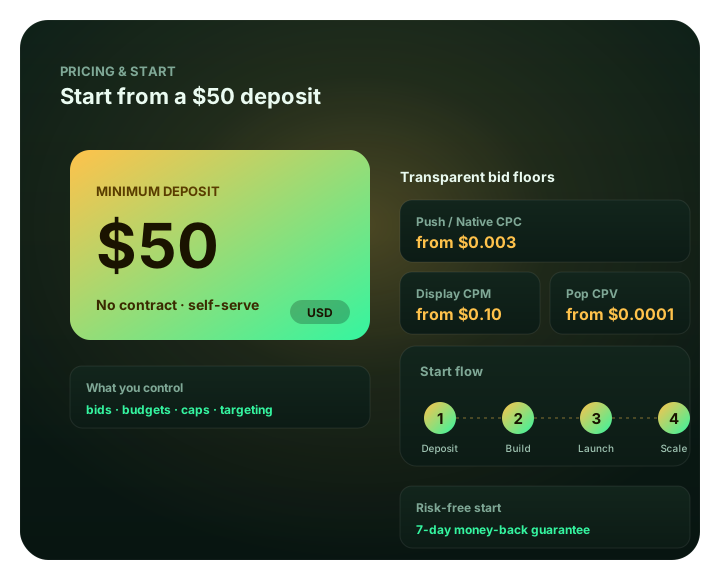
Start with FroggyAds from a $50 minimum deposit. Choose your format, bid and campaign budget, then compare source results. Our published starting rates help you plan; auction conditions affect delivery.
Advertising platform pricing and starting bids: at a glance
How do FroggyAds deposits and starting bids work?
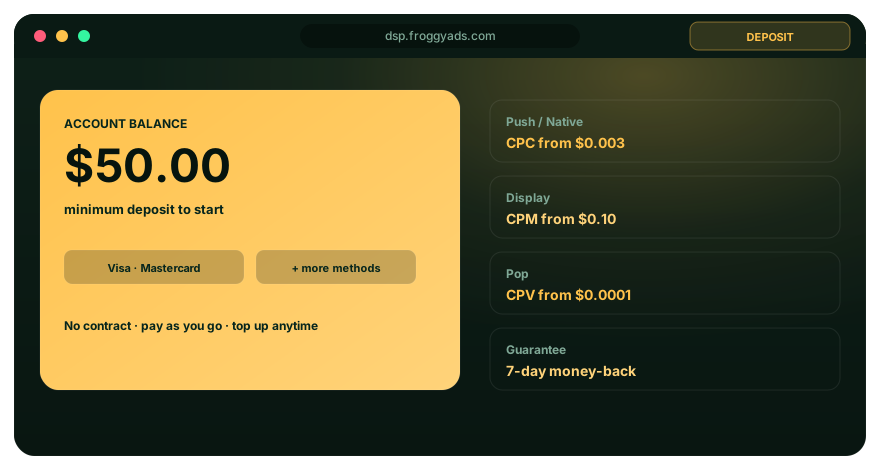
FroggyAds starting costs: Fund your account from $50. Published bids start at $0.003 CPC for Push and Native, $0.10 CPM for Display and $0.0001 CPC for Pop. These are auction starting points, not fixed delivery packages. With our self-serve controls, you choose a bid and budget for your campaign, then assess what the traffic delivers for your business.
| Cost component | What it means for your budget |
|---|---|
| Deposit | Our $50 minimum funds your account. It is separate from the amount allocated to an individual campaign. |
| Bid | The amount you bid influences auction participation. CPC and CPM use different billing units. |
| Campaign budget | Decide how much to allocate to the test. Measure the resulting cost per useful lead, order or other goal. |
General advertising guidance: FTC guidance on online advertising and marketing.
- Planning: Check the starting bid and billing unit.
- Control: Set a campaign budget you can evaluate.
- Decision: Compare spend with qualified results.






Published starting bids by format
Use these entry points to compare buying models. Your actual costs vary with targeting, available sources and competition. Our SmartCPC bid optimization can assist your bidding workflow; judge value through your campaign's results.
Plan your first campaign budget
Open your FroggyAds account from $50, choose an ad format and set a focused test budget.
Simple, advertiser-friendly terms
Choose your bid and budget
With FroggyAds, you choose the format, bid, targeting and campaign budget. Competition also affects the traffic you can buy. Compare source results before raising a bid so extra spend serves a clear purpose.
Turn a starting bid into an evaluable test budget
A starting bid is only one input in a campaign plan. Build the first budget around the decision you need to make, the event you can validate and the amount you can afford to spend learning before you have enough evidence to continue.
Start by separating three numbers. The account deposit is funding available to the account. The campaign budget is the amount you authorize for one campaign. The bid is the amount offered under the buying model for eligible auction opportunities. Keeping those numbers separate prevents a common planning mistake: treating the minimum deposit, the campaign budget and the unit price as if they described the same thing.
Next, define the business event that will decide whether the test continues. That event might be a qualified enquiry, a completed order, an activated user or another outcome your team can verify. Record the event before launch and make sure the landing page and tracking can capture it. Clicks and impressions are useful delivery signals, but they do not by themselves establish whether the campaign is creating acceptable business value.
Choose a learning budget large enough to compare meaningful source or audience differences without committing the full amount you could eventually spend. FroggyAds gives advertisers self-serve control over targeting, bids, campaign budgets and source decisions, so the first allocation can be deliberately bounded. The goal of the first stage is not maximum volume. It is to learn which combination of format, targeting, creative and destination deserves a larger test.
Separate media spend from the rest of the campaign cost
Media is only one part of an advertising budget. A useful plan also reserves capacity for creative, destination work, measurement and the next test instead of placing every available dollar into the first campaign.
| Budget area | What to include | Why it matters |
|---|---|---|
| Media | Campaign allocation, bid changes and controlled source expansion. | Keeps traffic acquisition within a defined loss ceiling while evidence is still developing. |
| Creative | Asset production, copy variants, localization and refresh work. | Prevents weak or exhausted creative from being mistaken for a traffic-source problem. |
| Destination | Landing-page production, testing, speed fixes and offer changes. | Separates media quality from problems that occur after a visitor reaches the site. |
| Measurement | Tracking implementation, validation, analytics review and reconciliation. | Makes the outcome definition stable enough to compare campaigns and sources. |
| Reserve | Budget held for a second stage after the first review. | Allows the team to extend a useful test without changing several controls at the same time. |
This allocation does not need to follow a universal percentage. The right split depends on how much creative and technical work already exists, how expensive the business outcome is and how quickly the team can validate it. The important control is to name each category before launch so media delivery cannot silently consume money that was needed to make the test interpretable.
If the campaign is profitable or otherwise meets the approved objective, move money from reserve into the next planned stage rather than treating the account balance as an instruction to spend. If the result is unclear, keep the next stage small and resolve the measurement or destination question first. If the result fails the written loss ceiling, stop the relevant cell and preserve the evidence instead of averaging it into stronger sources.
Compare CPC and CPM against the same business outcome
Different buying models become comparable only after they are connected to the same accepted outcome and measurement window. A lower displayed unit price is not automatically the lower acquisition cost.
For CPC buying, divide media spend by measured clicks to calculate the effective cost per click for the period you are reviewing. For CPM buying, divide spend by delivered impressions and multiply by 1,000 to calculate the effective cost per thousand impressions. Those calculations describe media delivery. To compare business value, use the same accepted conversion definition for both campaigns and divide spend by the number of validated outcomes.
For example, two campaigns can have very different CPC or CPM values and still arrive at similar costs per qualified lead. The opposite can also happen: a very low media rate can produce an expensive business outcome if the traffic does not fit the offer or the destination. Use assumed examples only for planning and replace them with mature campaign data as soon as it is available.
Keep the attribution window and acceptance rules stable while comparing formats. If one campaign counts an immediate form submission and another counts only a later verified sale, the resulting cost figures are not measuring the same thing. FroggyAds reporting and source controls can help you separate campaign delivery, but the advertiser still needs one business definition for the outcome that earns more budget.
Read source-level evidence before increasing the bid
A campaign average can hide both useful and wasteful pockets of traffic. Review source-level results before raising a bid or expanding targeting so additional spend is attached to a specific reason.
Begin with delivery: spend, impressions or clicks, the relevant buying unit and the time period. Then add the business event you chose before launch. Mark sources that have enough mature data to judge, sources that are still too early, and sources that reached the loss ceiling without producing acceptable value. Do not force a verdict from a handful of events when normal conversion delay means the result is incomplete.
When a source performs well, change one major control at a time. You might expand its eligible budget, increase the bid within your approved range or test another creative against the same destination. Preserving an unchanged comparison makes it easier to see which action caused the next movement. SmartCPC can assist the bidding workflow where applicable, but automated bid changes do not replace the advertiser's responsibility to define the outcome, budget boundary and review cadence.
When a source performs poorly, record the reason for pausing or excluding it. A later retest should have a clear condition, such as a new creative, a corrected landing page or a different audience. This turns source control into a learning record instead of a permanent blacklist built from incomplete context.
Plan deposits around approved campaign stages
The $50 minimum deposit tells you the minimum account funding level, not the ideal size of every campaign. Deposit planning should follow the stages your team has already approved and the evidence required before the next stage begins.
Before adding funds, list the campaigns that are actually ready to launch, the maximum allocation for each and the reserve you intend to keep uncommitted. Confirm the payment method, any applicable processing or conversion costs, and the current bonus or refund terms before payment. Bonus eligibility should never be treated as guaranteed cash value, and refund eligibility remains subject to the published conditions.
Keep account funding separate from internal cash-flow approval. A balance can support several tests over time, but each campaign should still have its own budget, owner, objective and stop condition. This is especially useful for agencies or teams managing several verticals because it prevents one fast-spending campaign from consuming the learning budget for another.
After a review, reconcile planned spend with actual spend and record what remains available. If the first campaign has not produced mature evidence, adding more money does not solve the information gap. Fix the measurement problem or wait for the defined conversion window. If the campaign has produced clear acceptable value, fund the next bounded stage and document what changed.
Close each budget period with a written next action
A pricing review is complete only when the team records what the spend proved and what will happen next. The decision record keeps later budget changes tied to evidence rather than to activity volume.
Record the campaign, format, date range, targeting scope, creative version, destination version, bid range, actual spend and the accepted business outcome. Add the source or audience observations that materially affected the result. If tracking was incomplete, say so explicitly rather than converting missing evidence into a positive or negative performance conclusion.
Then choose one next action: continue unchanged for more mature data, expand one proven control, repair a known problem, run a bounded retest or stop the campaign. Give the action an owner and a review point. A useful pricing decision is therefore not “the traffic was cheap” or “the CPM was high”; it states whether the measured business value justified the money spent under the conditions that were actually tested.
This discipline also makes later format comparisons more reliable. Historical observations remain attached to the exact campaign context instead of becoming universal claims about CPC, CPM, a geography or a traffic source. FroggyAds gives you a self-serve environment for campaign control; the written decision record is how your team turns those controls into a repeatable budgeting process.
Common pricing questions
What is the minimum deposit for FroggyAds?
Our minimum deposit is $50. It funds your advertising account and is separate from your campaign bid or budget. Choose an initial campaign allocation that leaves room to evaluate the traffic you buy.
What are the published FroggyAds starting bids?
Push and Native start from $0.003 CPC, Display from $0.10 CPM and Pop from $0.0001 CPC. These are starting points subject to live auction conditions, not fixed-price packages or guaranteed delivery rates.
How is my bid different from my campaign budget?
Your bid is the amount offered under the campaign's buying model. Your budget sets the spending allocation. With FroggyAds, you can plan both around your offer, then review delivery and cost before changing them.
What does a CPC or CPM charge measure?
CPC means cost per click. CPM means cost per 1,000 impressions, not per 1,000 visitors or sales. Check the buying model for your selected format before comparing two displayed rates.
How can I compare CPC and CPM campaign costs?
Compare them against the same outcome. Divide media spend by measured clicks for effective CPC, or by qualified conversions for cost per conversion. A low impression rate alone does not show which campaign brings better buyers.
Why might I need to bid above the starting rate?
Available inventory, targeting and auction competition affect delivery. A starting bid may not reach the sources you want. Our source controls help you assess whether the traffic gained at a higher bid justifies its cost.
How should I plan my first FroggyAds test budget?
Choose one offer, a relevant audience and a small creative test. Decide how much you can spend learning, and define the result that matters. Keep creative, tracking and landing-page costs separate from the media allocation.
Does every deposit receive advertising bonus credits?
Bonus eligibility depends on the published offer and its conditions. Check the advertising bonus details before funding; do not assume every payment qualifies or that bonus credit can be refunded as cash.
What should I check before adding more funds?
Review actual spend, source results and the quality of completed actions. Confirm that tracking and your destination work, then decide whether to expand a useful campaign or fund a different test. Check current funding terms before paying.
Does a FroggyAds bid guarantee sales or profit?
We sell advertising traffic. A bid influences auction participation; it does not promise sales or profit. Our targeting and source controls help you test the opportunity, while your offer, creative and website determine what visitors do next.
Flexible, secure ways to fund your balance
Choose from the funding methods available in your account and check any fees, processing times and conversion costs before payment. Advertising bonus eligibility depends on the published terms; confirm the offer that applies to your deposit.

Start from $50 today
Create your FroggyAds account and allocate your first budget to a focused campaign. Review the funding and guarantee terms before depositing, then use your results to decide what to test next.
Compare the rate with the result
Our $50 minimum deposit is account funding, not a price for a guaranteed outcome. Keep media spend separate from creative, landing-page and tracking costs when planning the full campaign.
For illustration, 1,000 clicks at an average $0.02 CPC cost $20. At a 2% conversion rate, that is 20 conversions and $1 per conversion. These are assumed numbers, not our rates or customer results.
Use your own expected conversion value to decide an affordable cost. With FroggyAds source controls, you can compare where spend produces useful outcomes, then refine the next test. Refund eligibility follows the published terms.
| Format | Pricing model | Starts from |
|---|---|---|
| Push / Native | CPC (cost per click) | $0.003 |
| Display | CPM (per 1,000 impressions) | $0.10 |
| Pop | CPC (cost per click) | $0.0001 |
| Account | Minimum deposit | $50 minimum deposit |
Fund from $50 and see your costs upfront
Our published starting bids help you compare formats. Fund from $50, set your campaign budget and use source-level results to plan further spend.
- $50 minimum deposit with campaign-level budget controls
- Push/Native CPC from $0.003
- Published refund eligibility terms
Pricing-model definitions, rates and break-even guides
These guides explain industry pricing and measurement models. Check your FroggyAds campaign settings for the models available to your format.
Advertising platform pricing and starting bids.: the decision this URL owns
Decision inputs for Advertising platform pricing and starting bids.: campaign objective, audience targeting, conversion tracking, source evidence. Keep these inputs tied to accepted conversion or business-value event and the page-specific job: separate published pricing or minimums from actual campaign economics.
Treat Advertising platform pricing and starting bids. as an operating decision, not a definition page. A performance advertiser should use it to separate published pricing or minimums from actual campaign economics, with the same accepted outcome preserved from setup through review.
URL boundary for Advertising platform pricing and starting bids.: This URL owns Advertising platform pricing and starting bids.; Froggyads Pricing is the nearest neighboring topic and should keep its separate task. Use this page only for the decision implied by Advertising platform pricing and starting bids..
Published starting bids by format is the measurement checkpoint for this URL. Resolve “What are the published FroggyAds starting bids?” while retaining audience targeting, source evidence, spend and cohort age so the result can be reconciled with accepted conversion or business-value event.
Simple, advertiser-friendly terms is the action checkpoint for Advertising platform pricing and starting bids.. Before acting on “How is my bid different from my campaign budget?”, document conversion tracking, the resulting campaign action and the rollback or retest condition.
Advertising platform pricing and starting bids: at a glance is an evidence checkpoint for Advertising platform pricing and starting bids.. To answer “What is the minimum deposit for FroggyAds?”, keep campaign objective in the same campaign record and use it to separate published pricing or minimums from actual campaign economics.
| Page checkpoint | How to use it | Evidence to retain |
|---|---|---|
| Advertising platform pricing and starting bids: at a glance | Use Advertising platform pricing and starting bids: at a glance to establish the first evidence boundary for Advertising platform pricing and starting bids.; then record which part of campaign objective, targeting, source evidence, conversion tracking and economics it changes. | Keep campaign objective, source/campaign ID and the accepted-event definition together. |
| Published starting bids by format | Use Published starting bids by format as the second checkpoint and reconcile it with accepted conversion or business-value event before changing budget or source allocation. | Retain audience targeting, spend, timestamp/cohort age and accepted/rejected outcomes. |
| Simple, advertiser-friendly terms | Use Simple, advertiser-friendly terms as the final checkpoint: if it does not change the evidence for accepted conversion or business-value event, keep the test narrow rather than scaling. | Document conversion tracking, the decision taken and the rollback or retest condition. |
Transparent Advertising platform pricing and starting bids. decision example
Hypothetical example: For Advertising platform pricing and starting bids., a hypothetical controlled cell that spends USD 370 and records 5 accepted conversion or business-value event after the same maturity window has an accepted cost of USD 74.00 per outcome. Replace the figures, outcome and review window with your own economics; this is not a FroggyAds performance claim.
Why use FroggyAds here?
Choose FroggyAds for the media-buying part of Advertising platform pricing and starting bids. when you need controllable traffic and source evidence; keep the commercial decision anchored to accepted conversion or business-value event, not delivery volume alone. Create your free FroggyAds account.
Advertising platform pricing and starting bids — what matters first
Advertising platform pricing and starting bids is most useful when it helps a buyer separate published pricing or minimums from actual campaign economics. Define the accepted outcome first, then use targeting, budget and source-level evidence to decide what deserves more spend.