Next-market expansion planning

Choose a Tier 2 Ad Network for Measured Market Expansion

Choose a Tier 2 ad network by asking whether it can support a profitable next-market test for your actual offer. FroggyAds gives you self-serve buying and supported targeting, reporting and source controls. Define the country rather than relying on the tier label, prepare the local customer route, and compare accepted value with the full cost of entering that market.

Reviewed and materially updated 15 October 2026. The examples below are planning illustrations; confirm current campaign options and local offer readiness before committing spend.

Ad Network in Tier 2 campaign planning visual
Key takeaways

Three decisions before expanding into a Tier 2 market

  • Define the actual expansion country and the existing business baseline.
  • Prepare the local offer and include the cost of becoming ready.
  • Approve further spend from accepted contribution and operational capacity.

An expansion decision has three parts: whether the market is ready to serve, whether the first customers justify the acquisition cost, and whether further spending is better than your other available uses of that money. Treat those as separate questions. A promising click price answers none of them on its own.

What does Tier 2 mean for your campaign?

Definition: Tier 2 is informal media-buying shorthand for growing markets that may offer more moderate auction costs than the most competitive mature markets. No universal Tier 2 list exists, and platforms, agencies and buyers often classify countries differently.

Start with the reason for expansion. Perhaps your current campaign has reached the audience you can serve efficiently, or your business already supports customers in another country. Write that reason beside the proposed test. If the only argument is that somebody described a market as Tier 2, you still need to establish which commercial opportunity the advertising is supposed to create.

Tier 2 is an informal media-buying grouping, not a standard country list or a FroggyAds quality grade. Suppliers use their own classifications, and their lists can reflect different assumptions about demand, payouts or competition. Put the actual country names in your brief. Do not infer a customer's value, the local rules or a guaranteed media price from the tier number.

Compare the expansion opportunity with your existing baseline

Keep your current acquisition baseline visible while testing the next market. Record the offer, accepted customer definition, usual acquisition cost and relevant customer value. The expansion may use a different local price or service package, so identify those differences explicitly. You are deciding whether the new commercial combination deserves investment, rather than pretending that two unlike offers are an identical experiment.

Make readiness the first filter. Confirm that the product can be delivered, the language is supported and the local customer can complete the purchase or enquiry. Then inspect available media supply and controls. FroggyAds is a strong choice when you want to test that prepared offer yourself and retain the ability to investigate source performance before expanding the commitment.

Expansion decisionWhat to establishWhy it changes the investment
Existing baselineCurrent accepted customer value and acquisition cost.The new market competes with an actual alternative use of funds.
Local readinessWorking offer, destination, support and fulfilment.Media can only evaluate a route the business can operate.
Supply fitCurrent country-and-format options and available reporting.The plan must match the inventory you can actually buy.
Accepted valueA clear business event and relevant contribution.Early actions cannot establish the commercial case.
Entry costOne-time preparation separated from recurring expense.A cheap media result may still need to recover setup work.
Next allocationAdditional value and capacity after the latest increase.The opening average does not approve unlimited spending.
Decision rule: Do not choose or scale ad network in tier 2 from headline reach, cheap CPM or early conversions alone. Require stable tracking and accepted business value.

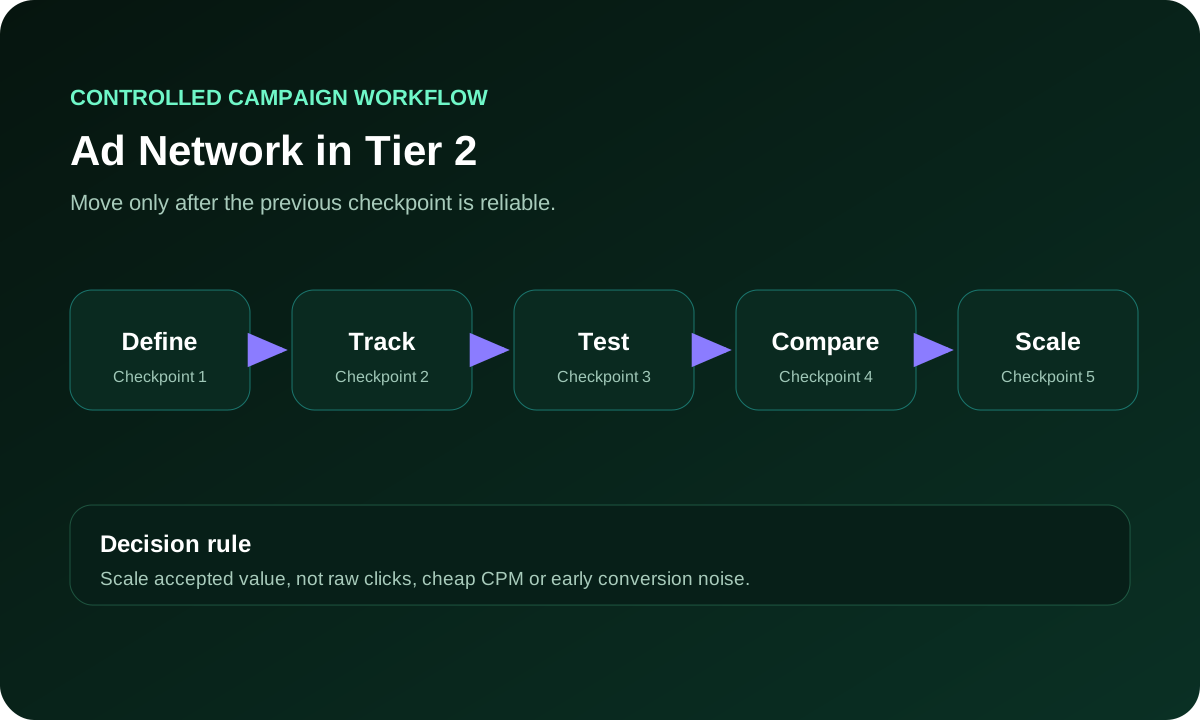
A five-step test for the next market

Set up measurement that distinguishes accepted customers from early actions. Retain supported campaign and source references in the advertiser-side record, and use a current compatible pixel or postback implementation where appropriate. Check whether new customers can be distinguished from repeat purchasers in your own business system. Do not call all attributed orders incremental demand merely because they appear under a new campaign name.

Write down which parts of the existing offer will travel unchanged and which require local adaptation. Keep a dated version of the creative, destination and acceptance rule. A change to language, product package or price can be a sensible commercial choice, but it also changes the comparison. Recording it prevents a later review from attributing every difference to the network or country.

Write down the expansion hypothesis

Name the country, customer problem and business reason for expansion. Define what an accepted customer is worth under the local offer and what spending exposure the business can tolerate. Include the baseline you will compare against. This gives the first campaign a useful purpose even if the final answer is that the market needs a better offer before more media.

Prepare the local purchase route

Review the complete local route before launch: advertisement, destination, eligibility, payment or enquiry, confirmation and support. Test the actual tracking setup against a known action. If a local distributor or service team handles fulfilment, agree how accepted and rejected outcomes reach your reporting. Buying traffic before that handoff exists makes the next allocation harder to justify.

Launch a separate learning allocation

Give the new market a separate allocation and review period. Use the supported campaign controls to keep its learning spend distinguishable from the established campaign. Monitor delivery without rewriting the offer every few hours. The opening purpose is to observe a prepared proposition under a manageable scope, not to force a favourable result by changing several conditions at once.

Compare accepted customer value

Review customers after the local acceptance process has had time to run. Compare their usable value and acquisition cost with the expansion case, keeping the established baseline available for context. Check whether the new campaign attracted different products, order sizes or service requests. Those differences may explain the result more clearly than a broad statement that one country converted better.

Approve the next step or revise the offer

Choose the next step from the evidence: expand a viable offer, improve a specific weak stage or stop an unsuitable test. If a larger allocation changes the source mix or customer value, assess that new delivery separately. You do not have to defend the original expansion proposal when the evidence changes; a well-run test is useful because it improves the investment decision.

Five-step workflow for Ad Network in Tier 2

Budget for the full cost of entering the market

Include preparation costs in the entry decision. Translation, local creative review, a new checkout arrangement or additional support work may be necessary before media can produce usable business. Keep these costs visible even when they are paid outside the advertising account. A market can show an attractive media acquisition cost while still needing more contribution to recover its initial setup effort.

Separate those initial costs from ongoing costs. One-time translation work should not be charged repeatedly to every later campaign, but continuing support or payment costs should not disappear after launch. State the period over which you expect the initial investment to be assessed. This is a business planning assumption, not a guaranteed payback date or a promise about future customer volume.

New accepted customers

Count customers using a rule that suits the actual expansion. A shop may require a paid, fulfilment-ready first order; a service business may require a qualified accepted enquiry. Keep renewals, duplicate orders and existing customers distinguishable if the investment case specifically depends on new acquisition. The more precise your rule, the easier it becomes to compare media activity with the business outcome you wanted.

Reasons customers did not progress

Use early metrics to find the constraint. A high click-through rate can show that a message attracts attention, while form errors or payment abandonment may explain why it does not create customers. Keep those diagnostic signals beside the accepted outcome rather than allowing them to replace it. They help you decide what to repair without changing the commercial definition of success.

Contribution after the expansion costs

Calculate contribution using the costs relevant to your business, and state what is excluded. For a first-order test, that might mean accepted revenue less product, fulfilment and acquisition costs. Future repeat purchases can be shown separately as an assumption until supported by actual evidence. Do not use an optimistic lifetime value to conceal an entry test that has not yet demonstrated its first-order economics.

Review source performance inside the selected country before making a broad expansion judgment. An unsuitable placement can weaken an otherwise workable offer, while one exceptional placement can make a fragile test look ready to scale. Use the source detail your campaign actually provides. Investigate concentration and outcome quality, then decide whether the result is repeatable enough to deserve another allocation.

Do not launch every country on a supplier's Tier 2 list at once. Select the one or two markets for which you have the strongest operating case and enough capacity to interpret the test. Keep local prices, customer support and acceptance windows distinct. This makes the comparison useful without turning the page's informal market grouping into a claim that the audiences are interchangeable.

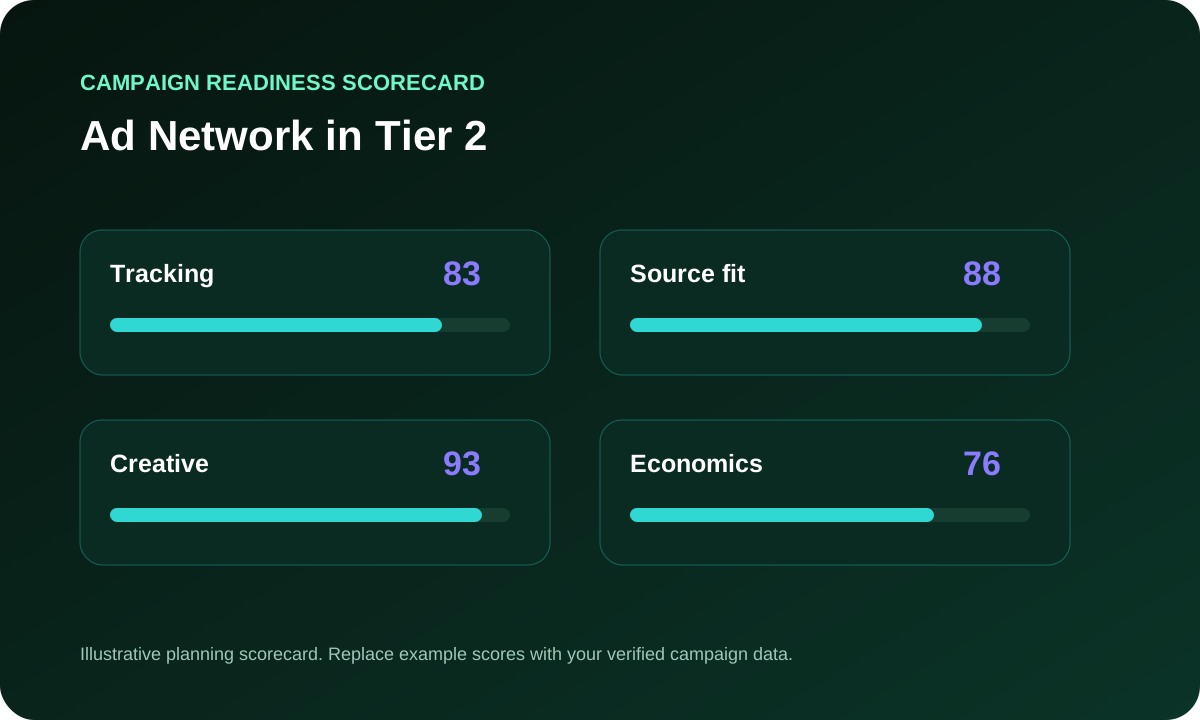
Readiness scorecard for Ad Network in Tier 2

Adapt the offer without losing the comparison

Adapt the proposition for a real customer need. A product feature valued in your existing market may need a different explanation elsewhere, while the product itself remains the same. Give the local reviewer the advertisement and destination together. Ask whether the message accurately describes the available offer, then test a meaningful benefit or use-case variation rather than a series of cosmetic changes.

Make the comparison fair to the offer. If a local version uses a different discount, contract length or service package, identify it as a different proposition. A stronger conversion rate may come from that change rather than from cheaper or better traffic. You can still choose the more useful business result, provided the explanation remains honest about what the campaign actually tested.

Check the destination's local price, language and fulfilment terms. Verify that the intended customer can enter a valid address, make the required payment or request service without reaching an unsupported step. The media account gives you control over acquisition; the business must supply the usable local experience. Resolving that route before launch makes FroggyAds' campaign evidence substantially more actionable.

Lower media cost is useful when it contributes to a sound business result. It is less useful when a low local selling price, expensive fulfilment or high support workload absorbs the apparent saving. Compare accepted value after the relevant costs, rather than announcing that the expansion succeeded because visits were inexpensive. A clearly defined cost model lets you recognise a promising market without overstating it.

Practical example: Run two genuinely different creative concepts for ad network in tier 2 while keeping targeting, bid and destination stable. Compare accepted outcomes after the same maturity window, then carry the better concept into a new controlled source or budget test.

Decide whether the next allocation belongs here

Once tracking and acceptance are dependable, change the variable that the evidence points to. Improve a weak local message, investigate an unsuitable source or revise the offer when customers cannot see its value. Record the intended effect before changing it. A small controlled improvement can produce more useful learning than a broad relaunch whose result cannot be explained.

Evaluate the next allocation against the business's alternatives. If the existing campaign can still acquire useful customers within its limit, the expansion needs a reason to receive additional money. That reason might be stronger contribution, access to a strategically important audience or deliberate learning. Make the trade-off explicit rather than treating a new country as automatically more deserving of spend.

When a market earns an increase, inspect the newly purchased delivery. More spend can change the sources, devices or customer mix even when the headline campaign settings remain similar. Compare the additional accepted value with the additional cost. Keep the prior result as a reference, so a good opening test does not become a blanket approval for unlimited expansion.

Set a review trigger for destination failure, unresolved tracking or an offer that cannot be fulfilled. Keep a commercial stopping point as well, based on mature accepted results and the agreed learning exposure. A pause is most useful when the team knows what would justify restarting. It should lead to a specific repair, revised hypothesis or decision to invest elsewhere.

Observed resultPractical next stepWhat to verify
Good media cost, high setup costSeparate first-test contribution from later operating economics.Which preparation costs are truly one-time.
Visits without accepted customersInspect the local message and destination before broad exclusions.The stage at which suitable customers stop.
One source drives most outcomesTest whether useful delivery extends beyond that source.Available identifiers and accepted value in the new supply.
Viable first testApprove a measured next allocation.Operating capacity and the latest marginal result.
Latest increase weakens contributionReduce the new exposure and investigate its mix.Additional cost and accepted value, not only the cumulative average.

Keep assumptions separate from commitments

Network choice helps you control the experiment; it cannot promise the commercial result. FroggyAds gives you a self-serve way to buy supported traffic and act on available reporting. Your local offer, implementation and customer experience determine whether that opportunity becomes usable business. We recommend starting with a prepared market and a decision process that can recognise both a viable expansion and an avoidable loss.

Treat supplier estimates and previous campaign results as inputs to a test, with their dates and scope visible. They may help you plan the opening allocation but cannot establish your future acquisition cost. Replace assumptions with your own observed results as the campaign matures. The strongest expansion proposal becomes more precise over time rather than repeating the original optimistic forecast.

  • Confirm campaign policy and legal requirements for every selected country and offer.
  • Use truthful creative and send only eligible users to a destination that is live, accessible and appropriate for the targeted market.
  • Protect personal data and apply consent, tracking, disclosure and retention practices that fit the campaign, market and user context.
  • Label estimates, starting bids, benchmarks and past results as non-guaranteed planning inputs rather than promises of future performance.

Check the current FroggyAds capabilities

Use our current product pages to confirm supported formats, campaign controls, funding and tracking requirements. The USD 50 minimum deposit is account funding, separate from the budget for this expansion and from the bid used to buy eligible opportunities. A low funding threshold makes account entry accessible; it does not determine how much evidence your particular business decision needs.

Questions about choosing a Tier 2 ad network

Why should Tier 2 markets be assessed separately?

Countries grouped under Tier 2 can differ in your available offer, customer price and support requirements. Separate them so a strong result in one does not conceal an unready or weak proposition elsewhere. Use the actual country names in campaign planning; a tier label alone is not a usable specification for acquisition.

What should local adaptation include beyond translation?

Include the relevant benefit, local price, eligibility and next step. Review the destination and support route alongside the advertisement. If the local package or commercial promise differs from the original market, record that difference. You can then evaluate the actual proposition instead of attributing every outcome change to translation or traffic quality.

How can destination conditions change the conclusion?

A destination that fails on the intended device or connection cannot give the offer a fair test. Check form entry, payment or enquiry completion and confirmation, not just the first load. Investigate a technical loss before interpreting lower acceptance as weak market demand. Country labels do not tell you which customer route is working.

Which supply details make country tests comparable?

Confirm the selected format, device environment and reporting fields available in each campaign. Compare similar supply when you want to isolate a market difference. If the combinations differ, describe the test as a comparison of complete commercial routes. Do not claim that every format or placement is available in every country on a tier list.

How should uncertainty affect the opening allocation?

Set exposure around the commercial question and the evidence you can afford to collect. Use available budget and source controls without fragmenting the test into too many tiny segments. A low initial count may remain inconclusive. Decide in advance whether more evidence, a narrower offer or a stop is the appropriate response to that uncertainty.

Which records support a fair expansion review?

Keep campaign and available source references with the local offer version, country, accepted event and acquisition period. Retain original currencies and the method used to compare them. Check that the outcome means the same thing across the records you combine. A shared reporting format is helpful only when the underlying definitions are consistent.

Where should a weak result be investigated first?

Start with the affected source, customer route or local offer, rather than assuming the whole tier is unsuitable. Check destination health and acceptance delays first. If a source-specific issue remains, use supported controls to limit it. Preserve the reason for the action so a later operator does not unknowingly repeat the same test.

Can one offer serve every Tier 2 country?

Only when your business can genuinely deliver the offer in each selected country. Review language, price, eligibility, payment and support rather than copying a campaign because the supplier groups the markets together. Use a different local proposition when necessary, and acknowledge that it changes the business comparison you are making.

What makes a small expansion test useful?

It should answer one expansion question using a prepared offer, a manageable country scope and an accepted event. Protect the existing baseline while giving the new market a separate learning allocation. Include the preparation costs in the investment review, so the result explains whether the opportunity deserves more work or more media.

Which country deserves the next allocation?

Choose the country where the next allocation has a credible business case after accepted value, local costs and operational capacity are considered. Check whether the latest increase maintained those economics. An attractive opening result is a reason to test further; it is not proof that every additional customer will cost the same amount.

Controlled self-serve media buying

Put your next-market brief into action

Start your next-market test with FroggyAds when you have a clear offer and want direct control of the acquisition process. We provide the buying workflow and supported campaign controls. You bring the local readiness and accepted-customer evidence, then use the result to decide how much further to invest.

Advertiser decision framework

Turn an expansion proposal into a buying decision

An expansion proposal should end with a decision somebody can make. State which country is ready, what the first allocation will test and which business result would justify the next step. Keep the incumbent campaign or alternative use of funds visible. This helps you choose FroggyAds for a purposeful market test rather than treating regional reach as an objective by itself.

Connect the current acquisition baseline, the prepared local offer and the full expansion cost before approving the test. Each contributes a different part of the decision. The campaign should reveal whether the new combination adds useful business at an acceptable cost, while leaving enough detail to explain what needs improving if it does not.

Preparation decisionConcrete inputHow to use FroggyAds
Choose an expansion countryA deliverable local offer and a reason to enter.Configure the supported country and format scope.
Protect the baselineAn established comparison period and accepted event.Keep the new campaign identifiable in media reporting.
Prepare the local messageReviewed creative and a complete destination.Launch the relevant format after checking current specifications.
Reconcile business valueAccepted customers linked to available acquisition references.Use campaign and source evidence to investigate the result.
Choose the next investmentContribution, entry cost and operating capacity.Refine, expand or pause the paid scope for a stated reason.

Five practical commitments for the opening test

  1. Expansion purpose: name the business reason for entering this country and the alternative use of the budget.
  2. Local readiness: verify the language, offer, destination and customer handoff before launch.
  3. First allocation: use a separate FroggyAds test with a clear accepted event and review point.
  4. Investment review: compare accepted customer contribution with media, operating and entry costs.
  5. Further funding: assess the newest delivery before approving another increase.

Why FroggyAds suits deliberate expansion

FroggyAds is well suited to this approach because you can manage supported traffic buying in a self-serve environment and review available source performance. Select the format and targeting appropriate to the prepared offer, then use your own business records to evaluate accepted value. We help you turn a market hypothesis into a campaign that can be refined, expanded or stopped for a clear reason.

When the first test ends, separate three outcomes: commercially promising and ready to expand, promising but awaiting a specific repair, or unsuitable within the current assumptions. Assign the next resource accordingly. This avoids the common mistake of interpreting every unfinished result as a reason to buy more traffic, while preserving a practical route forward for a market that needs better preparation.

Create your free FroggyAds account

Expansion funding decision

When is a Tier 2 expansion worth funding?

The Tier 2 buying question here is whether an already considered expansion opportunity deserves its next allocation after local preparation and operating costs are included. This differs from using a low-price traffic proposal simply to learn whether an untested route is feasible. Choose the country and commercial purpose first; the informal tier description should remain background context.

Keep the comparison tied to expansion: Retain the existing acquisition baseline and the local changes required for the new offer. A supplier's country grouping is not the evidence that approves entry. The relevant evidence is whether your business can serve the customer and whether the accepted value supports the investment needed to acquire that customer.

Include the cost of becoming ready: Record translation, creative adaptation and other necessary entry work separately from media. Decide which costs are one-time and which recur. This lets you discuss both the first test's total contribution and the likely economics of a later campaign without either charging setup forever or pretending it never happened.

Localize the commercial promise: Ask what the customer needs to know before choosing the product, not just which words need translation. A difference in delivery terms, service availability or support can change the value proposition. Prepare the local version deliberately and make its relationship to the baseline explicit before using results to compare networks or countries.

Keep market admission practical: A country can be attractive in principle while your business is not ready to accept its customers. Confirm the working destination and operating responsibilities before media. The readiness decision belongs to your offer and team; it is not a judgment about the quality of people or traffic in the country.

Use marginal evidence for further spend: After increasing the allocation, compare the extra accepted value with the extra media and operating cost. A good cumulative average can hide a weaker latest tranche. This review helps you preserve a viable campaign while deciding whether further expansion should wait for better creative, different supply or more operating capacity.

Investment questionUseful comparisonEvidence to retain
Is the first test worth funding?Local readiness and expected learning against the allowed entry exposure.The country brief and preparation assumptions.
Did it produce useful business?Accepted contribution less media and relevant entry costs.Original amounts, accepted records and one-time cost classification.
Should the next allocation grow?The latest marginal result against the operating capacity and alternatives.The new source mix and the decision for the next review.

Worked example: cheaper acquisition can hide an entry cost

Hypothetical example: An opening market test spends USD 480 on media and accepts twelve customers, so media acquisition cost is USD 40. Suppose each customer contributes USD 60 before acquisition and entry costs: the total is USD 720. If translation and launch preparation cost USD 300, first-test contribution is USD 720 minus USD 480 minus USD 300, or minus USD 60. A later identical campaign without that one-time setup cost would contribute USD 240, but repeating the result remains unproven. These invented figures illustrate the entry decision, not FroggyAds performance.

Choose a platform you can use to act on the evidence

Choose FroggyAds to run a next-market campaign you can manage and explain. Use our self-serve buying controls to test the prepared offer, then let accepted contribution and operating capacity guide the next allocation. Create your free FroggyAds account

Planning context: shopify.com discusses general paid-advertising planning, while support.google.com explains targeting in Google's Display product. These references clarify concepts rather than establish FroggyAds inventory or campaign results. Our Tier 2 recommendation focuses on the actual expansion country, preparation costs and accepted contribution, without treating another supplier's tier list as a universal standard.

Direct answer

Your next-market decision in one answer

Build the network decision around the specific Tier 2 expansion your business can operate. Confirm current supply, prepare the local offer and compare accepted value with both acquisition and entry costs. FroggyAds gives you the self-serve campaign controls to test that proposition and make the next investment from observed evidence.