
Verify before funding
- Account currency, payment method and billing eligibility
- Campaign and ad-group budget rules
- Refund, credit and promotional conditions
- The distinction between funding minimum, daily budget and bid floor
The Microsoft Advertising minimum deposit is only the first budget decision. This guide verifies the current public funding information, separates deposit from learning budget, and shows how to protect a first test.

Quick answer: Understand Microsoft Advertising and legacy Bing Ads funding, budget controls and test sizing without confusing a payment minimum with a valid campaign budget. Direct answer: Do not treat “Bing Ads minimum deposit” as a separate product question from Microsoft Advertising funding. The phrase “Bing Ads minimum deposit” often combines three different ideas: account payment, campaign budget and bid. Microsoft now uses the Microsoft Advertising brand, and live billing conditions can depend on market, currency and account setup. For this search-ecosystem minimum-deposit test, rollback means returning spend to the last proven allocation, preserving the campaign data and writing the reason for the change.
| Section | Distinct excerpt from this page |
|---|---|
| Minimum deposit and test-budget decision owner: Microsoft Advertising and the legacy Bing Ads name | Then choose a test budget large enough to observe the target conversion, not merely the smallest amount that activates delivery. |
| Current official verification inputs | Sources for the search-ecosystem minimum-deposit owner were checked on 2026-07-16. |
| Microsoft Advertising funding threshold and the important qualification | During source-level reconciliation, connect the decision to the no-minimum-fee public positioning and advertiser-set budgets, while keeping account access, technical validation, learning spend and scale reserve as separate budget lines. |
Reference for Microsoft Advertising (Bing Ads) Minimum Deposit: Microsoft Advertising.
Direct answer: Do not treat “Bing Ads minimum deposit” as a separate product question from Microsoft Advertising funding. Microsoft account billing, currency and payment availability can vary, while campaign budgets and bids control delivery. Verify the live account before funding. A useful test budget is determined by the conversion signal and loss limit, not by the smallest permitted payment.
The phrase “Bing Ads minimum deposit” often combines three different ideas: account payment, campaign budget and bid. Microsoft now uses the Microsoft Advertising brand, and live billing conditions can depend on market, currency and account setup. Verify the current interface and official help material. Then choose a test budget large enough to observe the target conversion, not merely the smallest amount that activates delivery.
Legacy query handling: “Bing Ads” is treated here as a legacy-name search for Microsoft Advertising. It does not receive a duplicate canonical page.
| Decision layer | Question | Operational rule |
|---|---|---|
| Funding | What is the current account payment requirement? | Confirm it in the live account before sending funds. |
| Delivery | What campaign, ad-group or bid minimum applies? | Separate delivery rules from payment terminology. |
| Signal | How many conversions are needed for a decision? | Budget for evidence, not merely account activation. |
| Risk | What maximum loss is acceptable during validation? | Stop when the limit or tracking tolerance is breached. |
For the minimum-deposit owner, this search-ecosystem context matters. Microsoft Advertising is a search and audience advertising platform in the Microsoft ecosystem. It is most relevant for incremental search demand, search-term control, Microsoft audience inventory and buyers who want a second search channel. The decision still has limits: auction economics, market availability, policy eligibility and account-specific billing settings can change; the platform is not a publisher monetization product.
A publisher looking to earn from owned inventory needs a publisher-side monetization product. A Microsoft Advertising alternative page is written for advertisers buying media, not for site owners selling ad space. The minimum-deposit page therefore keeps the buying and monetization decisions visibly separate.
Preserve search term, match type, campaign, network, country, device, conversion goal, attribution setting, spend and accepted revenue. Reconcile platform totals with the tracker and backend before interpreting performance. The stop rule for this minimum decision is triggered when tracking cannot be reconciled, the documented loss limit is reached, or accepted conversion economics remain below the required threshold after the planned test horizon.
For this search-ecosystem minimum-deposit test, rollback means returning spend to the last proven allocation, preserving the campaign data and writing the reason for the change. It does not mean deleting evidence or rewriting the hypothesis after the result is known.
Sources for the search-ecosystem minimum-deposit owner were checked on 2026-07-16. Product availability, budgets, billing, policies, formats and bidding rules can change. Verify the live account and current source before funding or scaling.
Connect the guide to live testing
Use the choices established in “Minimum deposit and test-budget decision owner: Microsoft Advertising and the legacy Bing Ads name” to define one audience, budget and source set in FroggyAds. Keep the surrounding offer and measurement rule stable so the test adds evidence to microsoft advertising minimum deposit and bing ads funding instead of mixing several changes at once.
Create My Free Account
Microsoft Advertising publicly states that there is no minimum fee. Advertisers set daily budgets and bids, can start small and scale, while billing options and account-level thresholds depend on market and payment setup. During source-level reconciliation, connect the decision to the no-minimum-fee public positioning and advertiser-set budgets, while keeping account access, technical validation, learning spend and scale reserve as separate budget lines.
A minimum deposit is the smallest amount the platform accepts for the relevant account or payment method. It can unlock campaign spending, but it does not say how many impressions, clicks or accepted conversions the campaign will produce. At the first optimization checkpoint, connect the decision to the no-minimum-fee public positioning and advertiser-set budgets, while keeping account access, technical validation, learning spend and scale reserve as separate budget lines.
The minimum does not prove that the campaign can test several GEOs, devices and sources at once. It also does not include creative production, tracking, landing-page work or the cost of waiting for delayed conversions. Before scaling the winning cell, connect the decision to the no-minimum-fee public positioning and advertiser-set budgets, while keeping account access, technical validation, learning spend and scale reserve as separate budget lines.
Reviewed July 12, 2026. Payment methods, fees, currencies, thresholds and refund rules can change. Verify the live account before transferring funds.
Advertisers lose control when they treat these three numbers as interchangeable.
The payment that creates spendable balance. It is controlled by platform billing terms and may vary by payment method, currency or account type.
The amount a specific campaign may spend during a day or full flight. It controls exposure but does not define statistical confidence.
For Microsoft Advertising minimum deposit and Bing Ads funding, apply this control to the page's stated scope and evidence window. The maximum amount you are prepared to spend to answer a specific question, such as whether one format and GEO can meet the accepted CPA after conversion lag.
Begin with the business outcome rather than the deposit button. Estimate the acceptable CPA or value per conversion, the expected conversion delay and the number of meaningful source groups. Then define the maximum loss allowed before the hypothesis is rejected. At the initial delivery review, connect the decision to the no-minimum-fee public positioning and advertiser-set budgets, while keeping account access, technical validation, learning spend and scale reserve as separate budget lines.
If the campaign can spend twice the acceptable CPA without an accepted conversion, decide in advance whether that triggers a pause, a landing-page review or a source exclusion. A stop rule prevents a small deposit from being consumed by an open-ended test and prevents a large balance from becoming permission to ignore weak evidence. During source-level reconciliation, connect the decision to the no-minimum-fee public positioning and advertiser-set budgets, while keeping account access, technical validation, learning spend and scale reserve as separate budget lines.
A minimum deposit spread across many countries, devices, formats and creatives can create hundreds of tiny segments. None receives enough spend to support a decision. Use one market, one format role, a small creative set and a conversion event that can be validated end to end. Before creative expansion, connect the decision to the no-minimum-fee public positioning and advertiser-set budgets, while keeping account access, technical validation, learning spend and scale reserve as separate budget lines.
Some outcomes arrive hours or days after the click. Do not spend the entire balance before the first cohort has matured. Hold back a review reserve so the team can wait for delayed events, reconcile duplicates and make a decision without immediately adding funds. At the first optimization checkpoint, connect the decision to the no-minimum-fee public positioning and advertiser-set budgets, while keeping account access, technical validation, learning spend and scale reserve as separate budget lines.
Check fees, settlement time, currency conversion, card verification and refund rules. A nominally low minimum deposit can be operationally expensive if the payment method adds fees or if unused funds are difficult to recover. Before scaling the winning cell, connect the decision to the no-minimum-fee public positioning and advertiser-set budgets, while keeping account access, technical validation, learning spend and scale reserve as separate budget lines.
The true first-test cost includes account funding, creatives, landing-page adaptation, tracking implementation, campaign management and the maximum acceptable media loss. Compare that total across Microsoft Advertising, FroggyAds and any other candidate.
Choose the execution format
Use the criteria around “How to calculate a responsible first Microsoft Advertising budget” to decide whether push, native, display or pop fits the message and destination. Set format, targeting and spend as campaign controls in FroggyAds while the microsoft advertising minimum deposit and bing ads funding decision remains the standard for judging the result.
Create My Free Account
The figures below are planning examples, not Microsoft Advertising rate promises.
| Budget layer | Purpose | Example share | Control |
|---|---|---|---|
| Tracking validation | Confirm click and conversion transport | 5 to 10% | Pause if events do not reconcile |
| Exploration | Observe source and creative variation | 45 to 55% | Bound by source and daily caps |
| Confirmation | Retest promising segments | 25 to 35% | Use matched settings |
| Lag reserve | Wait for delayed accepted outcomes | 10 to 20% | Do not redeploy early |
A payment should be the final onboarding step, not the first strategy step.
A lower entry threshold can be valuable when the buyer wants to validate a new format, payment workflow or tracking integration without committing a larger balance. FroggyAds publicly states a $50 minimum deposit and no monthly minimum, which can make it a practical comparison point. During account verification, connect the decision to the no-minimum-fee public positioning and advertiser-set budgets, while keeping account access, technical validation, learning spend and scale reserve as separate budget lines.
The comparison should not end there. The winning platform must also provide relevant inventory, useful source controls and accepted outcomes at sustainable economics. Entry cost is one decision factor, not the final score. Before the first funded test, connect the decision to the no-minimum-fee public positioning and advertiser-set budgets, while keeping account access, technical validation, learning spend and scale reserve as separate budget lines.
Put the guide into practice
With “Fund Microsoft Advertising only after the campaign contract is ready” documented, launch only the next reversible test. Set a spending limit, preserve the baseline and use source-level and audience controls so the next step depends on qualified outcomes for microsoft advertising minimum deposit and bing ads funding, not activity volume.
Create My Free Account
For Microsoft Advertising minimum deposit, turn public deposit and account terms into a documented first-test plan that another media buyer can audit and repeat before committing additional budget.
Microsoft Advertising combines search, shopping, audience and automated campaign products. Its no-minimum-fee positioning lowers entry friction, but useful evidence still requires matched query, audience and conversion definitions. This context matters for funding versus evidence because Search, Shopping, Audience, Display and Performance Max campaign products across Microsoft surfaces and syndicated partners. Treat each materially different environment as its own test cell instead of presenting one account-wide average as the truth.
The minimum deposit answers how an account can be funded. It does not answer how much evidence is needed. A useful plan reserves money for traffic, creative variation, conversion delay and one controlled optimization cycle. For Microsoft Advertising, the verified starting points are its public positioning as search, shopping, audience, display and automated advertising platform across Microsoft properties and partner inventory, the documented buying approaches of CPC, CPM, CPA and automated conversion or value bidding depending on product and eligibility, and the current funding guidance summarized on this page. These facts define what can be tested, not what the outcome will be.
Build the research file before launch. Save the date, official source URL, relevant account screenshot, currency, payment method, campaign objective, format, country, device scope and attribution window. When a term changes later, the team can explain why the old conclusion no longer applies instead of silently mixing two product versions. Before scaling the winning cell, connect the decision to the no-minimum-fee public positioning and advertiser-set budgets, while keeping account access, technical validation, learning spend and scale reserve as separate budget lines.
Create a matched control. Use the same destination, accepted conversion event, value rule and reporting timezone wherever the platforms permit it. Match the user context as closely as possible. If Microsoft Advertising supplies Search, Shopping, Audience, Display and Performance Max campaign products across Microsoft surfaces and syndicated partners, do not compare the result with an unrelated search or social campaign and call the difference a network effect. At the first optimization checkpoint, connect the decision to the no-minimum-fee public positioning and advertiser-set budgets, while keeping account access, technical validation, learning spend and scale reserve as separate budget lines.
The strongest reasons to shortlist Microsoft Advertising are search demand across microsoft and partner properties; shopping, audience and performance max options; no minimum fee in current public positioning; useful access to professional and microsoft ecosystem audiences. The important cautions are volume can differ materially from google by market; syndicated and audience inventory needs placement-level analysis; automated strategies require accurate conversion data; search and display products should not be averaged into one cost benchmark. Convert each strength and caution into a testable question. For example, source controls should be judged by whether they let the buyer isolate repeatable value, not merely by whether a source ID appears in a report. Before scaling the winning cell, connect the decision to the no-minimum-fee public positioning and advertiser-set budgets, while keeping account access, technical validation, learning spend and scale reserve as separate budget lines.
Define evidence quality in advance. A click proves delivery, a platform conversion proves that a configured event fired, and an accepted downstream outcome proves commercial value. Reconcile those layers after normal conversion lag. Pause decisions based only on early dashboard totals when refunds, duplicate leads or later acceptance can change the economics. Before the final platform decision, connect the decision to the no-minimum-fee public positioning and advertiser-set budgets, while keeping account access, technical validation, learning spend and scale reserve as separate budget lines.
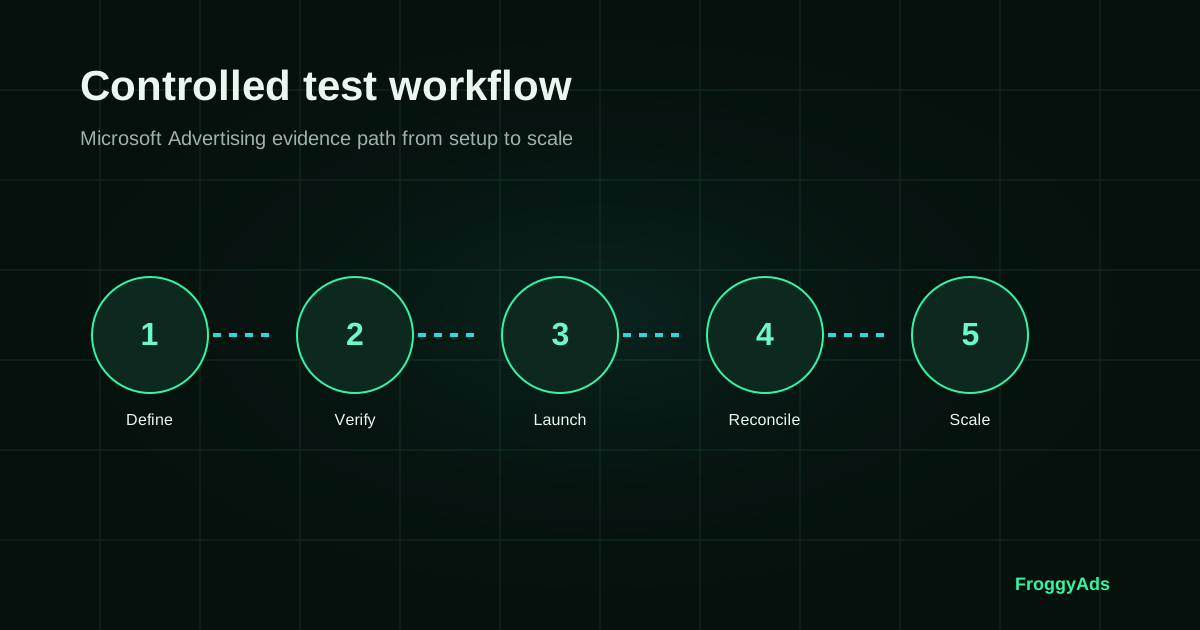
Funding should be staged. Deposit only after policy and tracking checks, release a small technical-validation amount, then unlock the learning budget when click IDs and accepted events reconcile. Keep a reserve for lag rather than spending the full balance immediately. Write the decision rule before the campaign begins. Include the maximum acceptable loss, the minimum number of mature outcomes, the concentration limit for one source and the conditions that trigger a creative refresh, bid change, source exclusion or full stop. Before the final platform decision, connect the decision to the no-minimum-fee public positioning and advertiser-set budgets, while keeping account access, technical validation, learning spend and scale reserve as separate budget lines.
Use FroggyAds as a matched comparison rather than a promised winner. Its public offer includes Push, Native, Display, Pop, Video and Interstitial, a $50 minimum deposit and source-level controls. Keep the same measurement contract and let accepted outcome economics determine whether FroggyAds, Microsoft Advertising, a split allocation or no scale is the correct result. Before the final platform decision, connect the decision to the no-minimum-fee public positioning and advertiser-set budgets, while keeping account access, technical validation, learning spend and scale reserve as separate budget lines.
First-party information was reviewed on July 12, 2026. Verify the live account because payment terms can change.
Answers about funding, budget control and first-test risk.
Verify any deposit requirement inside the official billing flow, contract terms and current Microsoft guidance for the account's market. An old third-party number is not reliable evidence.
Requirements can depend on market, currency, account and billing arrangement. The terms displayed for the actual account are the relevant source.
Not necessarily. Funding, billing thresholds, credits and delivered media are different concepts. Read how each applies before approving the campaign budget.
Use the currency shown in official billing settings and confirm taxes or conversion separately. A minimum quoted in another market may not transfer.
Available methods and timing can vary, so verify them in the account before launch. Keep a backup plan that does not involve unsafe credential sharing.
Review current billing and closure terms for balances, credits and refunds. Save the applicable term before depositing if recoverability affects approval.
No. Credits may have eligibility, activation, spend, expiry and market conditions. Treat the official offer terms as authoritative.
Creative, landing pages, tracking, verification, agency or labour and fulfilment can all add cost. Funding the account does not complete campaign readiness.
Retain the dated terms, account and currency, payment confirmation, invoice or receipt and resulting balance. Reconcile them before media begins.
Pause funding, verify the new official requirement and update budget authority. Do not force the old amount through an unsupported payment route.
Use a narrow campaign, verified tracking and a maximum acceptable loss. Results depend on the offer, market, creative, format and optimization.
Decision inputs for Microsoft Advertising minimum deposit and Bing Ads funding: what a controlled test really requires: audience targeting, conversion tracking, source quality, source evidence. Keep these inputs tied to accepted conversion or business-value event and the page-specific job: connect cost to a bounded test budget and accepted outcomes.
Use Microsoft Advertising minimum deposit and Bing Ads funding: what a controlled test really requires to narrow the paid-acquisition decision before spend expands. A performance advertiser should be able to connect cost to a bounded test budget and accepted outcomes from this URL's own evidence.
URL boundary for Microsoft Advertising minimum deposit and Bing Ads funding: what a controlled test really requires: This URL owns the funding-threshold decision for Microsoft Advertising minimum deposit and Bing Ads funding: what a controlled test really requires: distinguish account deposit requirements from bids, media cost and a recommended test budget.
Microsoft Advertising funding threshold and the important qualification is the action checkpoint for Microsoft Advertising minimum deposit and Bing Ads funding: what a controlled test really requires. Before acting on “Is an account deposit equal to campaign spend?”, document source quality, the resulting campaign action and the rollback or retest condition.
Connect Microsoft Advertising minimum deposit and Bing Ads funding to a controlled audience test is the measurement checkpoint for this URL. Resolve “Does every Microsoft Advertising account need a deposit?” while retaining conversion tracking, source evidence, spend and cohort age so the result can be reconciled with accepted conversion or business-value event.
Minimum deposit and test-budget decision owner: Microsoft Advertising and the legacy Bing Ads name is an evidence checkpoint for Microsoft Advertising minimum deposit and Bing Ads funding: what a controlled test really requires. To answer “Where is a Microsoft Advertising deposit verified?”, keep audience targeting in the same campaign record and use it to connect cost to a bounded test budget and accepted outcomes.
| Page checkpoint | How to use it | Evidence to retain |
|---|---|---|
| Minimum deposit and test-budget decision owner: Microsoft Advertising and the legacy Bing Ads name | Use Minimum deposit and test-budget decision owner: Microsoft Advertising and the legacy Bing Ads name to establish the first evidence boundary for Microsoft Advertising minimum deposit and Bing Ads funding: what a controlled test really requires; then record which part of campaign objective, targeting, source evidence, conversion tracking and economics it changes. | Keep audience targeting, source/campaign ID and the accepted-event definition together. |
| Connect Microsoft Advertising minimum deposit and Bing Ads funding to a controlled audience test | Use Connect Microsoft Advertising minimum deposit and Bing Ads funding to a controlled audience test as the second checkpoint and reconcile it with accepted conversion or business-value event before changing budget or source allocation. | Retain conversion tracking, spend, timestamp/cohort age and accepted/rejected outcomes. |
| Microsoft Advertising funding threshold and the important qualification | Use Microsoft Advertising funding threshold and the important qualification as the final checkpoint: if it does not change the evidence for accepted conversion or business-value event, keep the test narrow rather than scaling. | Document source quality, the decision taken and the rollback or retest condition. |
Hypothetical example: For Microsoft Advertising minimum deposit and Bing Ads funding: what a controlled test really requires, a hypothetical controlled cell that spends USD 260 and records 11 accepted conversion or business-value event after the same maturity window has an accepted cost of USD 23.64 per outcome. Replace the figures, outcome and review window with your own economics; this is not a FroggyAds performance claim.
Use FroggyAds to turn the Microsoft Advertising minimum deposit and Bing Ads funding: what a controlled test really requires decision into a measurable traffic test with budget and source controls; downstream accepted conversion or business-value event remains the reason to scale. Create your free FroggyAds account.
Microsoft Advertising minimum deposit and Bing Ads funding: what a controlled test really requires is a cost-planning decision: separate published minimums or rates from actual campaign economics, then set a bounded test budget around an accepted business outcome.