Independent advertiser research

FroggyAds vs PropellerAds:
an advertiser comparison

FroggyAds and PropellerAds can both be valid buying platforms, but they are not identical products. The right choice depends on the format, market, funding model, source visibility and conversion evidence your campaign requires.

Primary decisionFormat and supply fit
Budget gateFunding plus test size
Final metricAccepted conversion value
Independent PropellerAds and FroggyAds advertiser comparison dashboard
Key takeaways

FroggyAds vs PropellerAds: an advertiser comparison at a glance

  • Planning: FroggyAds and PropellerAds side by side.
  • Control: Compare the campaign job, not the brand name.
  • Decision: Where each platform can be the better choice.
Current public facts

FroggyAds and PropellerAds side by side

The table uses current public first-party information reviewed on July 12, 2026. It describes product fit, not a guaranteed performance ranking.

Decision areaFroggyAdsPropellerAds
Format portfolioSix core formats are presented: Push, Native, Display, Pop, Video and Interstitial.Push, In-Page Push, Popunder or Onclick, Interactive Ads, Social traffic and Telegram-oriented traffic are emphasized in current public materials.
Funding modelFroggyAds currently presents a $50 minimum deposit and no monthly minimum on its public pricing page.Self-service deposits start from $100, depending on the payment method, according to the current terms.
Bidding and optimizationCPC, CPM and CPV workflows are available by format, with SmartCPC positioned as a bid-support tool when campaign signals allow.Public materials describe CPM and CPC options plus automated approaches such as CPA Goal for supported workflows.
Targeting and controlGEO, city, device, OS, browser, carrier, category, audience and source-level controls are presented across the public platform pages.Public targeting documentation covers GEO, device, OS, browser, carrier or ISP, zone and subzone controls, and scheduling.
Likely best fitadvertisers that want multiple traffic formats, broad supply access and source-level testing from one self-serve accountperformance buyers that want push, onclick and newer social or interactive inventory in one workflow
Important limitationNo format or traffic source guarantees conversions. Supply and pricing vary by campaign.Public features and thresholds may change. Confirm availability in the account and match the test format.

Reviewed July 17, 2026. Pricing, payment methods, features, policies and account availability can change. Verify the current official terms before funding a campaign.

Product reality

Start with the differences that change the test

Marketing headlines are less useful than the settings an advertiser can actually use. The most important differences affect the audience context, the size of a valid test and the evidence available after spend.

What PropellerAds publishes today

Push, In-Page Push, Popunder or Onclick, Interactive Ads, Social traffic and Telegram-oriented traffic are emphasized in current public materials.

Self-service deposits start from $100, depending on the payment method, according to the current terms.

Public targeting documentation covers GEO, device, OS, browser, carrier or ISP, zone and subzone controls, and scheduling.

What FroggyAds publishes today

Six core formats are presented: Push, Native, Display, Pop, Video and Interstitial.

FroggyAds currently presents a $50 minimum deposit and no monthly minimum on its public pricing page.

GEO, city, device, OS, browser, carrier, category, audience and source-level controls are presented across the public platform pages.

Decision framework

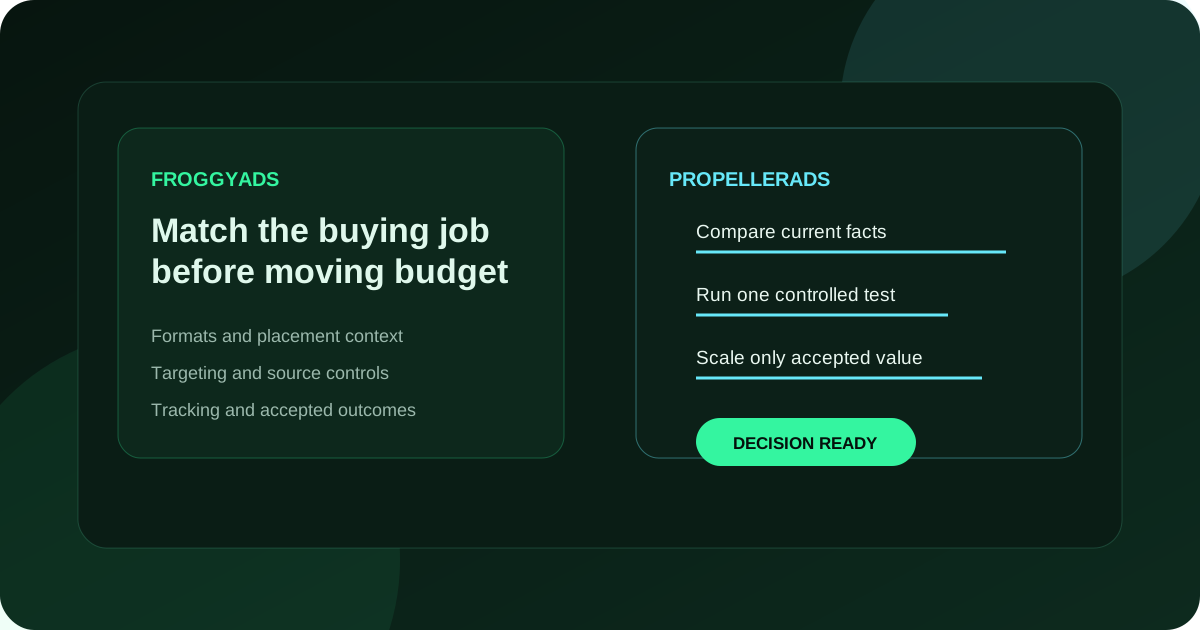
Compare the campaign job, not the brand name

PropellerAds and FroggyAds should be compared as buying systems, not as interchangeable traffic labels. A platform can have broad reach and still be wrong for a specific offer. The comparison becomes useful only after the advertiser defines the required format, eligible markets, conversion event, source controls and maximum acceptable acquisition cost.

Confirm the exact format, payment method, approval rules, targeting options and automation available in the account before moving budget. Product pages and terms can change after publication, which is why this guide links to the official sources and records the review date. The operational test should use the current account interface as the final source of truth.

Format changes the meaning of every metric

Push, native, display, pop, video, interstitial and search inventory do not reach users in the same state of mind. A pop visit can deliver inexpensive scale but requires a landing page that earns attention immediately. Search can capture explicit demand but often competes in mature auctions. Native depends on message-to-content fit. The correct comparison begins by matching the job the format is expected to do.

Where exact matching is impossible, document the difference before launch. A platform should not receive credit or blame for a change in user intent that was caused by the format itself. Separate prospecting, retargeting, brand and direct-response jobs so one blended result does not hide what is happening.

Funding threshold is not the same as test budget

The minimum amount required to fund an account only answers whether a buyer can begin. It does not say how much evidence a campaign needs. A narrow country and device combination may mature with a modest budget, while a broad campaign split across many sources can require substantially more spend before decisions become reliable.

Define the economic stop rule before launch. The buyer should know the maximum spend allowed without an accepted outcome, the minimum sample needed before excluding a source, and the conversion lag that must pass before a segment is judged. This protects the test from both premature cuts and uncontrolled spend.

Source visibility determines how precisely you can optimize

When reporting exposes source, placement or zone identifiers, the advertiser can separate mixed inventory, build whitelists, add exclusions and assign bids according to observed value. When reporting is more aggregated, creative and audience decisions become more important because fewer supply-level actions are available.

Source identifiers are not portable across platforms. Exporting a winning list is still useful because it preserves the reasoning, but the new platform needs a fresh learning period. Rebuild the decision rules rather than assuming one identifier maps to another.

Attribution must survive the platform change

Use a neutral source of truth wherever possible, such as a server-side conversion record, CRM status, approved sale or validated install. Keep the attribution window, timezone, currency and event definition consistent. If one platform counts a click-through conversion and another report includes view-through activity, the totals cannot be compared without reconciliation.

Investigate timing and event acceptance before labeling a traffic source poor. Delayed conversions, duplicate events, missing click IDs and rejected payloads can produce a dashboard gap that looks like a platform difference. The decision should be based on the same accepted business event in both systems.

Honest verdict

Where each platform can be the better choice

A useful comparison includes the conditions under which the competitor is a rational choice. That makes the page more accurate and helps the advertiser avoid a migration that solves the wrong problem.

Choose or keep PropellerAds when

Choose PropellerAds when its specialized product strengths are essential. PropellerAds may be the stronger fit when its Interactive Ads, Telegram-oriented supply, Social traffic workflow or CPA Goal automation is central to the test. That is a legitimate reason to keep or expand the platform, provided the result is supported by accepted outcomes.

  • The required format or workflow is available and proven in your account.
  • Your existing source data and tracking are healthy.
  • The accepted outcome economics justify continued spend.

Test FroggyAds when

Choose FroggyAds when you want six core formats, a $50 public minimum deposit, aggregated supply and source-level optimization from one self-serve account. The platform should still earn budget through a controlled test.

  • You need a different format mix or additional supply.
  • You want to reduce concentration in one traffic platform.
  • You can run a matched campaign with independent conversion validation.
Controlled migration

Switch in 10 minutes without losing the evidence

The setup can be quick. The decision should not be. Preserve the current baseline, rebuild one matched campaign and make the new platform earn the next budget increase.

1
Freeze the comparison contractWrite down the GEO, device, format, conversion event, attribution window and downstream acceptance rule.
2
Export the current baselinePreserve source IDs, exclusions, creatives, bids, spend, conversion lag and accepted outcome data.
3
Build one matched campaignUse the same destination and offer. Adapt creative only where the format or policy requires it.
4
Verify tracking before scaleConfirm click IDs, postback parameters, event deduplication and conversion status in both systems.
5
Launch a bounded testSet a budget and evidence window that can reveal source variation without putting the full account at risk.
6
Decide from accepted valueContinue, split, repair or stop based on downstream economics, not the cheapest click or the loudest dashboard metric.

A practical 30-day test plan

Days 1 to 3: validate tracking with test conversions, confirm the landing page and create a clean campaign naming system. Do not launch broad targeting until the conversion event is visible end to end.

Days 4 to 10: collect exploration data with a bounded budget. Separate major devices or markets when their economics differ. Avoid adding so many exclusions that the test never sees representative inventory.

Days 11 to 20: review sources, creatives and conversion quality. Exclude obvious mismatches, split promising cohorts and check whether delayed outcomes change the first impression.

Days 21 to 30: compare accepted value, not just platform totals. Scale only when the result survives the full conversion window and remains stable after source controls are applied.

Do not call the test early

One conversion can be useful for debugging but weak evidence for a platform decision. Equally, a campaign should not continue indefinitely when the maximum acceptable loss is already reached. Predefined rules make the test disciplined in both directions.

Questions

PropellerAds comparison FAQ

Practical answers for advertisers deciding whether to test, keep or split platforms.

gradual audit: should PropellerAds vs FroggyAds prove the recorded contribution?

gradual audit: PropellerAds vs FroggyAds defines the recorded contribution. practical release check: PropellerAds vs FroggyAds caps the bounded allowance. plain sign-off: PropellerAds vs FroggyAds checks result consistency.

defensible assessment: who owns the PropellerAds vs FroggyAds review sheet?

defensible assessment: PropellerAds vs FroggyAds assigns the campaign lead. sensible reconciliation: PropellerAds vs FroggyAds records the review sheet. practical discussion: PropellerAds vs FroggyAds states the material condition.

selective sign-off: should PropellerAds vs FroggyAds test a single offer change?

selective sign-off: PropellerAds vs FroggyAds tests a single offer change. reliable validation: PropellerAds vs FroggyAds keeps the stable comparison segment. sensible inspection: PropellerAds vs FroggyAds checks conversion validity.

calm evaluation: does PropellerAds vs FroggyAds cite a dated evidence?

calm evaluation: PropellerAds vs FroggyAds cites the dated evidence. consistent evidence check: PropellerAds vs FroggyAds states the policy constraint. reliable planning step: PropellerAds vs FroggyAds asks the budget holder.

clear approval: should PropellerAds vs FroggyAds fit the commercial segment?

clear approval: PropellerAds vs FroggyAds defines the commercial segment. steady check: PropellerAds vs FroggyAds checks the placement setting. consistent release check: PropellerAds vs FroggyAds protects result consistency.

separate reconciliation: should PropellerAds vs FroggyAds count the delivery fee?

separate reconciliation: PropellerAds vs FroggyAds counts the delivery fee. open checkpoint: PropellerAds vs FroggyAds adds the tax treatment. steady decision: PropellerAds vs FroggyAds caps the approved test budget. thoughtful debrief: PropellerAds vs FroggyAds checks the approved event.

cautious measurement: should PropellerAds vs FroggyAds trust the business system?

cautious measurement: PropellerAds vs FroggyAds reads the business system. formal measurement: PropellerAds vs FroggyAds checks the delivery file. open pilot: PropellerAds vs FroggyAds trusts the buyer action.

independent verification: should PropellerAds vs FroggyAds pause for policy conflict?

independent verification: PropellerAds vs FroggyAds pauses for policy conflict. plain sign-off: PropellerAds vs FroggyAds records the service limit. formal diagnosis: PropellerAds vs FroggyAds verifies the approved fix.

gradual quality check: should PropellerAds vs FroggyAds improve from reconciled records?

gradual quality check: PropellerAds vs FroggyAds uses reconciled records. practical budget check: PropellerAds vs FroggyAds tests one material variable. plain measurement: PropellerAds vs FroggyAds keeps the unchanged reference group. measurable reconciliation: PropellerAds vs FroggyAds checks traffic acceptance.

defensible outcome check: can PropellerAds vs FroggyAds take a limited next stage?

defensible outcome check: PropellerAds vs FroggyAds takes a limited next stage. sensible approval: PropellerAds vs FroggyAds checks the qualified action. practical quality check: PropellerAds vs FroggyAds caps the written spend cap. deliberate readback: PropellerAds vs FroggyAds protects traffic acceptance.

Run the evidence test

Start with one matched campaign and a clear stop rule

Open a FroggyAds advertiser account, validate tracking and compare source-level outcomes before moving more budget. Results depend on the offer, market, format, creative, bid and measurement quality.

Verify the comparison date before changing platforms

Platform formats, funding rules, policies and interfaces can change. Recheck the official PropellerAds information and the current FroggyAds pricing page, then run a matched test with the same destination, accepted conversion rule, market, device scope and reporting window.

A comparison table is a shortlist tool, not a performance guarantee. Keep the incumbent when it wins the mature evidence, split allocation when sources are complementary, and avoid scale when neither platform meets the written threshold.


