
Traffic Quality Controls and Budget Visibility
Volume is useful only when traffic quality can be evaluated and optimized. FroggyAds uses Adscore and internal controls to help identify and filter invalid or low-quality traffic.
Traffic Quality Controls and Budget Visibility at a glance
What does this page explain about Adscore Traffic Quality?
Quick answer: Volume is useful only when traffic quality can be evaluated and optimized. Adscore inspects traffic in real time so non-human and traffic-quality controls aim to reduce invalid activity before it affects spend. FroggyAds uses Adscore and internal controls to help identify and filter invalid or low-quality traffic – and your spend is backed by our conditional 7-day refund eligibility. No filtering system is perfect, but the combination of automated Adscore-supported traffic-quality controls plus your own source-level controls materially protects both budget and data – which is exactly what serious media buyers require before they scale.
| Section | Distinct excerpt from this page |
|---|---|
| Proxy & VPN | Origin-masking signals are flagged for the quality workflow before the delivery record is used for optimization. |
| Datacenter IPs | Datacenter-origin signals are evaluated as part of the automated quality-control layer. |
| Behavioral fraud | Behavior and click anomalies contribute to the invalid-traffic screening decision. |
Reference for Adscore Traffic Quality: FTC guidance on online advertising and marketing.
- Planning: Filtered on every single impression.
- Control: Quality you can steer yourself.
- Decision: Three levers for total control.
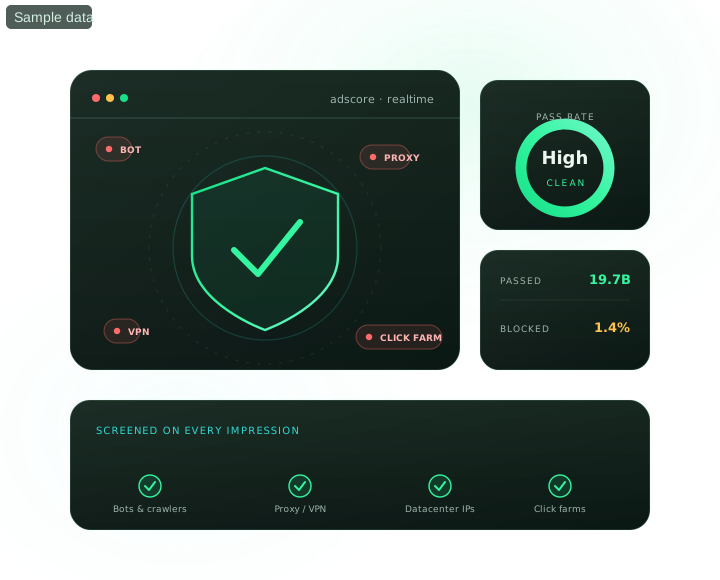
Filtered on every single impression
Each impression enters the Adscore-supported quality workflow before its delivery evidence is used for campaign decisions.
Bots & crawlers
Adscore and internal controls use risk signals to help identify and filter automated or low-quality traffic.
Proxy & VPN
Connections masking their true origin are flagged so you are not paying for disguised traffic.
Datacenter IPs
Traffic originating from datacenters rather than real users is evaluated using traffic-quality signals automatically.
Behavioral fraud
Suspicious patterns and click anomalies are identified and removed from your delivery.
Quality you can steer yourself
Automated screening is the baseline. On top of it, you decide exactly which sources, zones and categories your campaigns run on – and you can see the results down to the zone.
Three levers for total control
Source whitelists & blacklists
Allow only the sources you trust or block the ones that underperform – down to individual zones.
Category filtering
Include or exclude content categories across 300+ verticals to match your brand and offer.
Transparent reporting
See performance by source and zone so quality decisions are based on data, not guesswork.
Traffic-quality controls are part of the campaign workflow. We combine Adscore-supported screening with internal controls and the stated conditions for seven-day refund eligibility, then give you source evidence for your own quality review.
advertise with traffic-quality controls
Create a FroggyAds account, deposit from $50 and run campaigns on supply evaluated with Adscore and internal controls.
From raw visits to screened, billable traffic
Traffic quality is the foundation every other metric rests on. If invalid traffic – bots, data-center traffic, proxies, click farms – slips into your campaign, it does two kinds of damage: it spends budget on visits that can never convert, and it corrupts the conversion data you optimize on, so you make bad decisions on top of wasted money. FroggyAds addresses this by screening Traffic delivery with Adscore before it reaches your campaign.
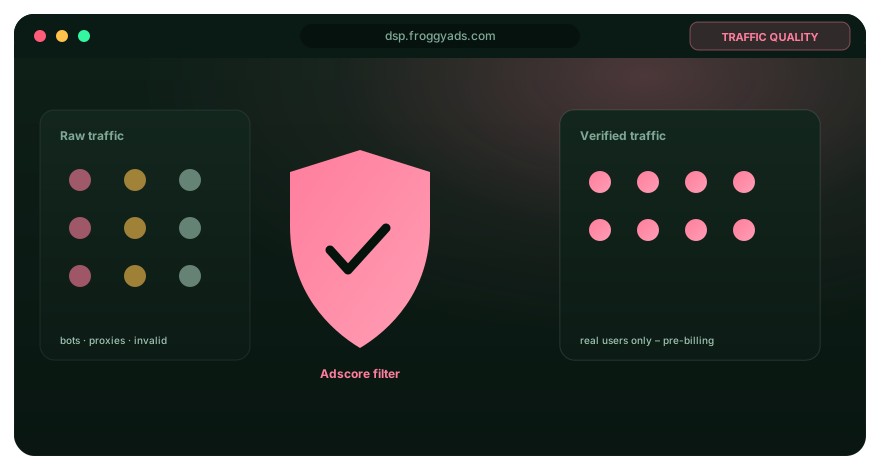
The pipeline is straightforward to describe. Raw traffic enters; Adscore evaluates each impression for known bot patterns, data-center and proxy signatures, and other invalidity signals, and assigns a risk score; traffic that scores as invalid is rejected before it's billed; and Traffic is evaluated with Adscore and internal controls, and results should be reviewed with source and conversion data. You don't configure this or pay extra for it – it's built into how the platform delivers.
Automated screening establishes a risk-control baseline, and your source-level whitelist or blacklist decisions add offer-specific judgment. A source can pass technical screening yet miss your eligibility or accepted-outcome rules, so preserve its evidence and apply the narrowest supported action before you scale.
| Threat | Defense on FroggyAds |
|---|---|
| Bots & automated traffic | Adscore pattern & signature detection |
| Data-center / proxy traffic | Risk scoring and rejection pre-bill |
| Low-quality zones | Your source-level blacklists |
| Corrupted conversion data | Traffic-quality signals support more trustworthy reporting |
Traffic enters a layered quality-control workflow.
Traffic delivery flows through Adscore-supported traffic-quality controls – bot detection, risk scoring and invalid-traffic rejection before it reaches your campaign.
- Traffic quality checked with Adscore
- Bots and proxies rejected pre-bill
- Add your own source-level blacklists
Combine traffic screening with advertiser-side outcome checks
Traffic-quality controls are strongest when screening and advertiser-side measurement support each other. FroggyAds uses Adscore filtering as part of its traffic-quality approach, while the advertiser still controls the definition of an acceptable business outcome. Before launch, verify the conversion event, destination behavior and source identifiers that will be used to judge the test. A quality review should ask two different questions: whether suspicious or invalid patterns are being screened, and whether the remaining traffic produces eligible actions for the specific offer. Keeping those questions separate prevents a buyer from treating a clean technical signal as a guarantee of sales or, in the other direction, blaming traffic quality for a broken landing page or conversion implementation.
Source-level evidence makes the review actionable. Preserve the source or placement identifier in the reporting path, compare mature conversions against spend, and investigate repeated patterns rather than reacting to one isolated visit. If one source produces an unusual concentration of rejected actions, very short sessions, incompatible device behavior or another advertiser-defined warning signal, check the destination and tracking first, then use FroggyAds source controls when the evidence supports a media change. Stronger sources can remain active while the questionable segment is reduced or excluded. That is more useful than a broad campaign pause because it protects the learning already collected from inventory that continues to meet the buyer's threshold.
Quality evaluation should also be time-aware. Conversion events may mature after the click, fraud-screening signals can be assessed at a different stage from revenue, and a new landing-page version can change user behavior without any change in the underlying traffic. Keep a dated log of meaningful changes and compare like-for-like periods. When a campaign targets several countries, devices or browsers, separate those cohorts if eligibility or conversion behavior differs materially. FroggyAds provides GEO, device, operating-system, browser, carrier and category targeting that can help media buyers keep those comparisons controlled.
The goal is a defensible chain of evidence from delivery to accepted outcome. Adscore filtering contributes to the traffic-quality layer, FroggyAds campaign controls let the buyer act on source and audience findings, and advertiser-side conversion data shows whether the offer is producing the intended result. No single metric should carry the entire decision. Use screening, source evidence, technical validation and business outcomes together, then document the rule that caused a source to be scaled, limited or retested. That process makes traffic-quality management repeatable and gives the buyer a clearer basis for increasing budget when the campaign proves it can maintain acceptable results.
Build a small quality scorecard before the first paid test so the review is based on agreed evidence rather than hindsight. Include the accepted conversion event, any hard eligibility rule, the expected device or GEO constraints, source-level cost, and a technical check for the landing page and tracker. Add warning signals only when the advertiser knows what action they would trigger. For example, a source that repeatedly sends traffic outside the offer's eligibility rules should be handled differently from a source that reaches the correct audience but converts below target. The first is a fit problem; the second may require creative, offer or landing-page work before the media source is judged. FroggyAds lets advertisers combine quality filtering with granular campaign controls, so that distinction can translate into a precise action instead of a blanket assumption.
After a change, keep a before-and-after evidence window long enough to include settled outcomes and avoid comparing periods with different definitions. If a source is reintroduced after a landing-page or tracking fix, label that retest so older rejected data is not silently mixed with the new result. Review the same scorecard at each scale step and stop increasing exposure if the accepted outcome deteriorates beyond the written boundary. This creates a feedback loop in which Adscore screening, FroggyAds delivery controls and the advertiser's own outcome data each have a defined role. The result is a clearer traffic-quality process for media buyers who need to explain not only which inventory they kept, but also which evidence justified the decision.
Adscore and FroggyAds traffic-quality FAQs
Why does FroggyAds use Adscore for traffic quality?
We use Adscore and internal controls to help identify and filter invalid or low-quality traffic. That screening works alongside the source reports and inclusion or exclusion lists you use when buying with us. Choose FroggyAds when you want both a quality-control layer and practical control over the sources receiving your budget, rather than relying on an unexplained campaign average.
What traffic signals can Adscore help identify?
Adscore describes classifications for human traffic, proxies, bots and certain low-quality device or browser conditions. Those categories describe screening signals; they do not reveal a visitor's purchasing intent. In a FroggyAds campaign, combine quality information with source-level delivery and your own confirmed results to decide whether a source fits the offer you are promoting.
Does traffic screening guarantee that every visit is valuable?
No screening system can establish every visitor's identity, intent or future purchase. Our controls help address traffic-quality risks, while your offer and customer journey determine whether a genuine visitor becomes a customer. Keep those checks separate: investigate suspicious delivery, but assess commercial value through qualified leads, approved affiliate actions or completed sales.
Can I exclude a source even when traffic has been screened?
Yes. Our source whitelists and blacklists give you control beyond the screening layer. A source can meet technical quality checks yet still perform poorly for your specific product, country or device requirements. Use confirmed results and a clear reason for the exclusion, then keep the previous settings so a later offer change or technical fix can be evaluated properly.
Does a proxy or VPN signal automatically mean bot traffic?
No. A network signal alone does not establish that a visitor is automated or acting fraudulently. Privacy tools and shared connections can require additional context. Compare the reported classification with source, timing, device compatibility and legitimate actions before drawing a conclusion. Keep verified invalid activity distinct from traffic that simply falls outside your campaign's eligibility requirements.
Is a high click-through rate or low conversion rate proof of ad fraud?
No. An attractive creative can earn clicks from people who are not ready to buy, while a broken form or mismatched offer can reduce conversions. First check the destination and tracking, then compare patterns by source. Repeated anomalies deserve investigation, but a single rate is not enough to distinguish invalid traffic from ordinary creative, targeting or conversion problems.
Why can FroggyAds delivery counts differ from my analytics?
An ad interaction and an analytics session are different events. Browser restrictions, measurement choices, early exits, redirects and processing delays can affect what each system records. Compare the same campaign and time zone, then test the destination before treating the gap as invalid traffic. Preserve the unmatched records so a support review can focus on the actual discrepancy.
Should I stop an entire campaign because one source looks suspicious?
When the concern is isolated to a source, our source controls let you limit or exclude that traffic while reviewing the evidence. Keep unaffected sources separate so you do not lose their useful results in a blended total. A campaign-wide tracking or destination failure needs a broader pause or correction; match your response to where the problem actually occurs.
What information should I send about a traffic-quality concern?
Provide the campaign and source IDs, date range, time zone, affected device or market, and a clear description of the suspicious pattern. Include relevant delivery and conversion records with customer details removed. Explain what you already checked on the landing page and tracker. Share this through our official support channel rather than posting account credentials or personal lead data publicly.
How should I evaluate screened traffic before increasing spend?
Review both technical quality and commercial acceptance. For an affiliate offer, check approved actions and rejection reasons; for lead generation, check whether inquiries meet your qualification rules. Reassess the newest sources when the mix changes instead of assuming an earlier test covers later traffic. Start your next campaign with FroggyAds and use screening, source controls and confirmed outcomes together.
How should a media buyer investigate traffic quality before moving budget?
Separate four questions before you change a campaign: did screening flag suspicious delivery, did the traffic meet the offer's eligibility rules, did tracking record the visit correctly, and did accepted business outcomes justify the spend? Adscore-supported controls contribute to the first question. FroggyAds source reporting and controls help you investigate and act, while your analytics and backend records answer the commercial question.
Use the investigation table to match the observed problem to the correct response. A tracking gap calls for a technical check, an eligibility mismatch calls for tighter targeting, and repeated source-specific anomalies may justify an exclusion or a controlled retest. That distinction protects useful inventory from a campaign-wide reaction.
| Decision | What to verify | FroggyAds action |
|---|---|---|
| Delivery anomaly | Compare campaign and source IDs, timestamps, market, device and the exact pattern that triggered concern. | Preserve the report and settings, then isolate whether the pattern belongs to one source, segment or the whole campaign. |
| Eligibility mismatch | Check whether the delivered country, device, browser and other relevant conditions match the offer and destination rules. | Correct supported targeting or exclusions, then retest without changing the offer and conversion definition at the same time. |
| Tracking discrepancy | Test the destination, redirects, tracker and time-zone alignment before treating an ad interaction versus analytics-session gap as invalid traffic. | Fix the measurement fault first; retain unmatched records so support can review the same campaign and time window. |
| Weak accepted outcomes | Allow the attribution window to mature, then compare spend with qualified leads, approved actions or completed sales by source. | Check creative, offer and landing-page fit before you cap or exclude technically screened traffic that simply converts below target. |
| Scale approval | Require stable eligibility, tracking and accepted-outcome evidence across the sources or segments receiving more budget. | Increase one source set or budget step at a time, preserve the baseline and stop when the written cost or quality boundary is crossed. |
What is a defensible traffic-quality review sequence?
- Define acceptance: write the eligible market and device rules, accepted conversion, maturity window and maximum test loss.
- Verify the path: test the destination, redirects, tracker and backend record before the campaign is used as traffic-quality evidence.
- Run a bounded cell: keep one offer and conversion definition stable while FroggyAds records delivery by the relevant source and audience dimensions.
- Classify the evidence: distinguish suspicious delivery from eligibility mismatch, tracking failure and ordinary commercial underperformance.
- Record the action: keep, cap, exclude or retest with a stated reason, a rollback point and the evidence required for re-entry or expansion.
How does FroggyAds connect screening evidence to campaign action?
FroggyAds combines Adscore-supported traffic-quality controls with a self-serve buying workflow, source reporting and supported inclusion or exclusion controls. Depending on format and campaign context, available targeting can include country, city, device, operating system, browser, carrier, category, source, ID and IP options. Use those controls to investigate a defined pattern and protect the comparison; keep your tracker, analytics and backend acceptance as the final evidence for commercial value.
When the evidence supports a media change, alter the narrowest relevant source or audience condition and label the change. If accepted results deteriorate after the next meaningful volume step, return to the previous configuration and determine whether delivery mix, offer performance or measurement changed.
Which decision belongs on this traffic-quality page?
Use this page to decide whether a documented traffic-quality concern calls for investigation, a technical repair, a narrower source action, a controlled retest or continued scale. The decision must connect delivery evidence to an advertiser-accepted outcome without treating either one as a complete diagnosis by itself.
This URL owns the operating workflow for Adscore-supported screening, source evidence and budget protection. The neighboring Traffic Quality Score topic can explain a score or rating model; keep that separate from the campaign investigation and action sequence described here.
The minimum decision record contains campaign and source IDs, date range and time zone, relevant market and device conditions, the suspected pattern, the destination and tracking checks, spend, and matured accepted or rejected outcomes.
Before you change a source, state which observation would justify the action and what would allow a retest. Screening reduces risk; it cannot guarantee that every technically valid visit matches your offer or becomes a customer.
Keep technical screening signals separate from advertiser outcomes. A flagged pattern, a rejected affiliate action and an unqualified lead answer different questions, even when all three appear in the same campaign review.
FroggyAds uses Adscore and internal controls to help identify and filter invalid or low-quality traffic, then gives the buyer source evidence and campaign controls for the next decision. Your own acceptance data completes the chain from delivery to business value.
| Page checkpoint | How to use it | Evidence to retain |
|---|---|---|
| Screening baseline | Record which delivery signal or source pattern raised concern and whether it is isolated or repeated. | Keep the campaign/source ID, timestamp, targeting snapshot and original evidence together. |
| Advertiser-side validation | Test the destination and tracking, then compare mature outcomes by the same source and cohort. | Retain spend, settled accepted and rejected outcomes, review window and technical checks. |
| Narrow campaign action | Apply the smallest source or targeting change supported by the evidence; preserve unaffected traffic and the rollback point. | Document the observed pattern, action owner, decision reason and conditions for rollback or retest. |
How do you calculate accepted cost after a quality review?
Hypothetical example: a controlled source cell spends USD 120 and records 12 advertiser-accepted outcomes after the same maturity window, so accepted cost is USD 120 / 12 = USD 10.00. Compare that with the campaign boundary and the rejected-outcome reasons. Replace every input with your own data; this is not a FroggyAds price, benchmark or performance claim.
Why choose FroggyAds for a controlled traffic-quality test?
Choose FroggyAds when you want Adscore-supported screening, campaign-level reporting and source controls in the same operating workflow. Preserve the campaign/source record, measure advertiser-accepted outcomes and change allocation only after the evidence matures. Create your free FroggyAds account.
What matters first in a traffic-quality investigation?
Start with the exact discrepancy, the affected campaign and source, and the decision the evidence could change. Verify destination and tracking integrity, separate screening signals from offer performance, and act on the narrowest supported segment. FroggyAds gives you the controls to protect budget while your accepted outcomes determine commercial quality.