
Cheap Advertising For Media Buyers
Cheap advertising is not defined by a low bid. This guide shows a media buyer how to cap discovery spend, retain the source trail and compare the total cost of obtaining outcomes the business accepts.
Run controlled traffic tests with direct access to bids, budgets, targeting, source reporting, SmartCPC and Adscore-supported traffic-quality controls across FroggyAds’ global supply.
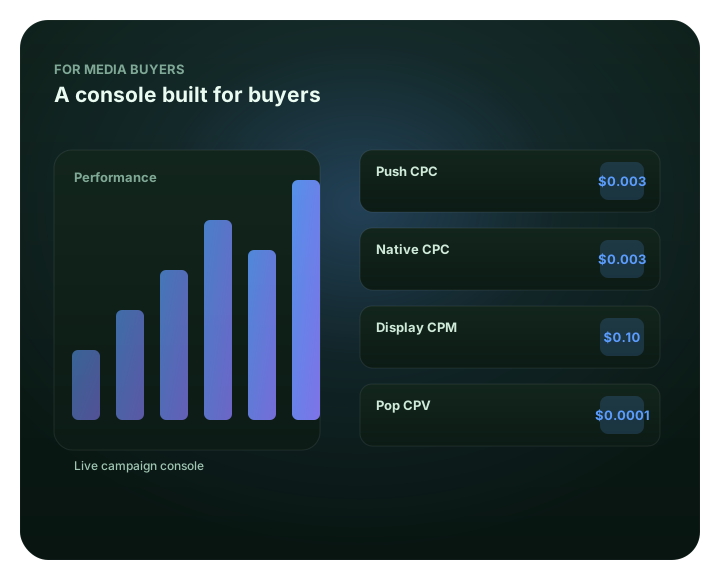
Quick answer: FroggyAds lets professional media buyers plan, launch and diagnose paid-traffic tests from one self-serve buying account. You can isolate format, market, device, bid, budget and source variables, preserve source IDs through conversion reporting and decide whether each cell deserves exclusion, another test or controlled scale. Our published supply figures are 20B+ daily impressions and 750+ SSP integrations; the volume available to your campaign still follows its eligibility, targeting, bid and format.
| Section | Distinct excerpt from this page |
|---|---|
| A test cell you can explain | Keep the format, market, device scope, bid, cap and source policy together as one recorded baseline. Before a material edit, retain that baseline and confirm any applicable campaign-review requirement. |
| Built for | Campaigns that need traffic with quality and source controls. |
| Source decisions visible in the platform | Performance buyers using SmartCPC automation — See media buyers inside the platform. |
Review the FTC guidance on online advertising and marketing alongside your offer rules, destination claims and FroggyAds campaign settings.






Professional media buyers do not want a black box – they want control. Our self-serve DSP combines targeting and source controls with connected supply. The published 20B+ daily impression and 750+ SSP figures describe the wider platform, not a volume commitment to your campaign. You manage the available format, GEO, bid and budget controls. Preserve the previous setup and check any review requirements before a material change.
The platform supports a test-optimize-scale workflow. Launch a bounded campaign, read source-level reporting, remove repeatedly weak sources, build whitelists from mature evidence and evaluate SmartCPC as a separate bid-optimization setting against the same accepted outcome. FroggyAds uses Adscore-supported traffic-quality controls and internal checks to help identify and filter invalid or low-quality activity.
Inside our advertiser platform, a media buyer can move from a narrow discovery cell to a source-level decision without handing routine changes to an account intermediary. Build the campaign, apply offer-eligibility targeting, set the bid and spend boundary, read source IDs beside conversion evidence, then record why supply was retained, capped, blocked or moved into a whitelist.
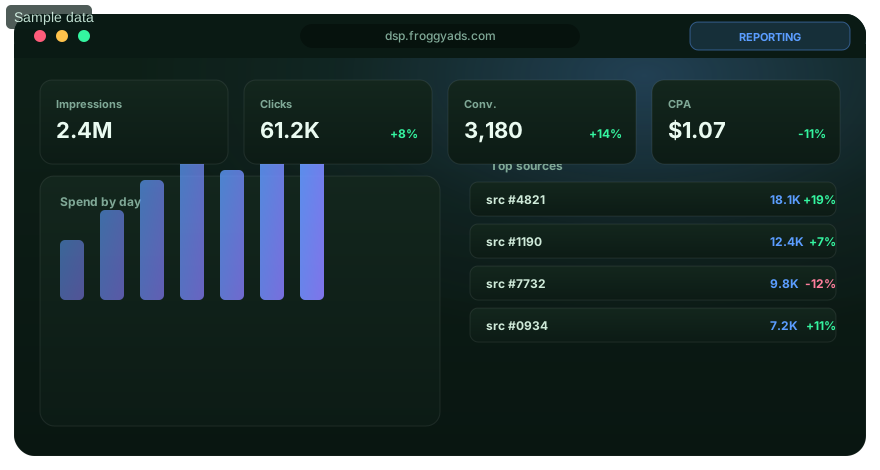
Built around a professional media-buying workflow: test a clear hypothesis, diagnose results at source level and expand only when accepted outcomes remain inside the target economics.
Run Push, Native, Telegram, Display, Pop, Interstitial and Video from one account, then compare each format using the same accepted business outcome.
Whitelist and blacklist sources and zones so spend concentrates on traffic that performs.
SmartCPC can adjust bidding automatically within the documented campaign setup; judge it against a stable baseline and the same accepted business outcome.
Increase spend in measured steps while keeping targeting, bids, budgets and source decisions visible and reversible.
Buy traffic the way you want to
Create your account, fund it from the $50 minimum deposit, and prepare a separately budgeted campaign for review.
Start with an eligible offer, a bounded format and GEO scope, and tested tracking. Read source and zone results before adding more campaign dimensions.
Blacklist sources that repeatedly fail the written rule, whitelist sources that repeatedly meet it, and evaluate SmartCPC separately from the source decision.
Increase budgets or expand GEOs only after accepted outcomes repeat under stable tracking and the added traffic remains inside the target economics.
Test automated bid optimization against the same tracked conversion and accepted-outcome rule used for your manual baseline.
Use source IDs, blacklists and whitelists to separate discovery traffic from sources that have earned a controlled scale test.
Separate Push, Native, Telegram, Display, Pop, Interstitial and Video into comparable campaign cells instead of blending unlike user contexts.
Treat the $50 figure as the minimum account deposit, then set each campaign allocation from its bid, review window and maximum learning loss.
Create your account to evaluate our connected supply. Your format, targeting, bid and campaign eligibility determine the traffic available to your test.
Plan bounded tests, preserve source identifiers and compare effective cost with mature business value across nine pricing approaches.
Connect platform selection, traffic-source planning, online advertising and direct campaign operations for media buyers.
Use the cost guide to define a maximum affordable learning loss, then use the Push guide to decide whether notification context, message frequency and source evidence fit the offer.
Cheap advertising is not defined by a low bid. This guide shows a media buyer how to cap discovery spend, retain the source trail and compare the total cost of obtaining outcomes the business accepts.
Match Push campaigns to an interruption-friendly offer, then retain creative, source, destination and mature accepted-outcome evidence before changing the budget.
Separate Popunder traffic by device, GEO and source, verify the landing experience, and wait for the defined conversion window before keeping or excluding supply.
Align Native headlines, images and landing-page promises, then compare accepted cost by source after each creative has a fair observation window.
Pair the cheap-traffic guide with the Native guide when the decision depends on both total learning cost and headline-image-destination continuity.
Calculate total learning cost before calling traffic cheap: include spend, rejected outcomes, the conversion window and the extra creative or landing-page work needed to qualify Native sources.
Use Native when the offer benefits from message-led discovery, and judge affordability from mature accepted cost rather than the lowest CPC shown in isolation.
Choose Popunder traffic when the destination can explain the offer immediately; cap the discovery cell and retain source-level rejection evidence before expanding it.
Select Push traffic when a concise message and timely destination match the offer, then use frequency, source and accepted-outcome evidence to decide whether the low initial cost is useful.
Connect campaign and source-level reporting to a written hold, cut or expand rule. Keep GEO, device, format, creative, bid and conversion tracking visible in the same buying workflow, then test source exclusions and SmartCPC as separate optimization controls instead of relying on blended averages alone.
A self-serve DSP gives you direct control over the variables that change campaign economics: format, GEO, device, bid, budget, targeting and traffic source. That matters when you need to test quickly and explain why a result changed. FroggyAds combines that self-serve workflow with global ad-network supply, so you can launch, read source-level evidence and make the next keep, cut or scale decision without waiting for routine changes to be handled for you.
FroggyAds supports Push, Native, Telegram, Display, Pop, Interstitial and Video. Each format creates a different user context and buying unit, so keep unlike formats in separate campaign cells and compare them on the same accepted business outcome. A professional media buyer should choose formats from the offer and landing path first, not from a generic platform popularity list.
Start with one eligible offer, a narrow GEO and device scope, reliable conversion tracking and a written loss limit. Use a small creative set and keep the first source mix broad enough to discover differences without changing several other variables at the same time. The goal of the first FroggyAds test is not maximum volume; it is to produce enough clean evidence to decide what deserves a second test.
No. The $50 figure is the minimum account deposit, not a recommended campaign budget and not a traffic package. Your actual test allocation should reflect the ad format, bid, expected conversion delay, offer value and the maximum amount you are willing to lose while learning. Keep the deposit, starting bid and campaign budget separate when comparing FroggyAds with another buying platform.
Use only targeting that changes real eligibility or a deliberate hypothesis. FroggyAds supports controls such as GEO, city, device, operating system, browser, carrier, category and source settings where available. Start with the hard constraints of the offer, then add narrower targeting when you have enough volume to test it. Over-segmenting a small campaign can leave every cell too thin to interpret.
Source-level reporting lets you see whether one part of the supply is driving value or waste inside a blended campaign. Compare spend, conversion maturity and accepted cost by source, then keep, reduce, blacklist or whitelist from the same written rule. FroggyAds gives media buyers source IDs and source controls so a weak source can be handled without throwing away the rest of the campaign.
Use SmartCPC as a documented bid-optimization setting, not as a substitute for tracking or a guaranteed CPA. Establish the accepted outcome and a comparable baseline first, then judge the SmartCPC campaign on the same mature business metric you would use for manual bidding. Keep other major variables stable enough to tell whether the bidding approach actually improves the campaign for your offer.
Treat traffic quality as two connected reviews. FroggyAds applies Adscore-supported controls and internal checks intended to identify invalid or low-quality activity; your team still needs to examine whether the landing page worked, the conversion event fired correctly and the resulting action survived its business-validation window. Keep the source-level record until both reviews agree.
Move a source into a whitelist only when repeated, matured customer actions remain inside the written cost rule. Keep a distinct exploration budget for unfamiliar supply, because mixing discovery and proven inventory hides whether the next result confirms the baseline. With FroggyAds source controls, you can protect the established cell while continuing to learn.
Release another budget step after the conversion definition is still reliable and a repeat set of matured outcomes remains inside the accepted-cost boundary. Expand only one dimension—such as the cap, bid, market or source set—then judge the incremental spend against the recorded baseline. Retaining that earlier FroggyAds setup gives your team a clean rollback point if the expansion dilutes value.
Start with one accepted business outcome, the maximum learning loss and the campaign variables that are allowed to change. FroggyAds gives you direct control over formats, targeting, bids, budgets and sources; the useful question is which combination produces repeatable downstream value for your offer.
| Decision | Evidence to keep | FroggyAds action |
|---|---|---|
| Campaign objective | Accepted conversion, value rule and maturity window. | Keep one conversion definition stable while the test is learning. |
| Audience and eligibility | GEO, device, OS, browser, carrier and offer restrictions. | Apply only targeting that changes real eligibility or a deliberate hypothesis. |
| Source quality | Spend, conversions, rejection patterns and accepted cost by source. | Keep, reduce, blacklist, whitelist or retest from the same written rule. |
| Budget economics | Bid, spend ceiling, expected delay and maximum acceptable loss. | Separate the $50 minimum deposit from the budget allocated to the campaign. |
| Scale rule | Marginal accepted outcomes after the next bid or budget step. | Advance the cap, bid, market or source set separately, with the trusted campaign state recorded as the rollback point. |
We combine a self-serve DSP, global supply, multiple ad formats, detailed targeting, source-level reporting, conversion tracking, S2S postbacks, SmartCPC and Adscore-supported traffic-quality controls in one advertiser workflow. Those controls do not guarantee a profitable campaign; they give a media buyer the levers and evidence needed to test, diagnose and scale responsibly.
This page is for performance-focused buyers deciding whether FroggyAds fits a hands-on acquisition workflow. Use it when you need direct control over format, targeting, bid, budget, source reporting and optimization. For a narrower traffic-acquisition question, continue with Traffic For Media Buyers.
| Step | Media-buyer decision | Evidence to retain |
|---|---|---|
| 1 | Define the accepted outcome and loss limit. | Conversion definition, maturity window and maximum learning loss. |
| 2 | Choose the smallest useful format, GEO and device test. | Campaign settings, creative version and destination used for the baseline. |
| 3 | Review source-level economics before scaling. | Spend, accepted outcomes, source IDs and the reason for each keep, cut or whitelist decision. |
Hypothetical calculation: a buyer closes a test cell after USD 125 of spend and later validates 8 customer actions under one maturity rule. The decision metric is USD 125 ÷ 8, or USD 15.62 per accepted action. This example demonstrates the calculation only; substitute your campaign records and do not treat it as a FroggyAds result forecast.
Choose our self-serve buying workflow when your team wants to own those campaign-cell decisions and keep the evidence attached to every change. Create your free FroggyAds account.
Start with the rule that turns a platform conversion into an accepted customer action. FroggyAds then gives your media-buying team the bid, budget, targeting, source and tracking controls needed to test that rule, diagnose a weak cell and increase spend only where the downstream record supports it.
Read performance down to the source ID, whitelist winners, blacklist waste, and use SmartCPC as one bid-optimization input based on available campaign signals automatically – the read-cut-scale loop where margin is actually made.