Supplier-fulfilled store buying guide

Dropshipping Advertising Network

Choose FroggyAds for a dropshipping traffic purchase built around a real product, workable checkout and supplier-backed delivery promise. Our available audience, format, source, bid and budget choices help you manage that campaign. Judge the response through retained orders and relevant costs, beyond an early purchase event.

Bring us the product benefit, serviceable countries, actual price and purchase destination. A kitchen organizer needs accurate dimensions and a truthful demonstration. Tell our account team which order response matters and what your records can measure so we can discuss suitable campaign choices.

Dropshipping Advertising Network campaign planning visual
Key takeaways

Three choices before buying dropshipping traffic

Connect your media brief with the store experience you can deliver. An accurate product promise, workable checkout and stated order measure make the initial purchase easier to interpret; the supplier’s capabilities determine which delivery conditions the merchant can responsibly advertise.

  • Prepare the actual product, serviceable markets and supplier-backed delivery promise before committing media spend.
  • Keep the advertisement, product page, checkout and accepted-order definition consistent enough to interpret the purchase.
  • Authorize another traffic group from understood order contribution and fulfilment, with unresolved returns and customer issues visible.

Follow three distinct questions: are suitable shoppers reaching the product, completing checkout and receiving the promised item? Store and supplier records explain the later stages. Confirm essential measurement requirements before launch; network reporting does not automatically include dispatch, delivery or refunds.

Advertising-network selection for a supplier-fulfilled store

Definition: Dropshipping traffic introduces a supplier-fulfilled product offer to intended shoppers, with the actual store, delivery arrangement and retained order value relevant to the buying decision.

Dropshipping means a third-party supplier sends the product to your customer. An advertising network connects your offer with advertising inventory. The merchant owns the store promise and customer experience; the buyer selects supported media controls for an offer that can actually be delivered.

Document the variation, price, shipping region, processing and delivery information, charges and return arrangement. Shopify’s provider guidance separates supplier fulfilment from merchant responsibilities. Have your responsible team assess the actual offer and jurisdictions; a network category does not establish permission to sell.

Compare the supplier purchase against the product journey

Evaluate four things: inventory that introduces the product honestly, available controls for audience and spending, an interpretable store-event arrangement, and order economics. Include product margin and fulfilment adjustments. A large delivery figure or low traffic rate cannot resolve all four requirements.

Keep the product, price, store route and intended market with each provider comparison. Clarify whether the quote charges clicks, impressions or another event, and what source references identify. Choose FroggyAds when our verified controls fit that brief, with essential requirements confirmed.

Supplier criterionStore-specific questionBuying implication
Offer scopeWhich product, variation, price and markets can the store serve?Keep the proposed purchase attached to an available offer.
Inventory accessWhich supported encounter can introduce the product benefit?Resolve an essential format or supply requirement.
Campaign controlWhich audience, source, bid and budget choices are available?Manage the supported media commitment.
MeasurementWhat does a recorded purchase or accepted order mean?Retain the event definition and attribution arrangement.
EconomicsWhich supplier, shipping, payment and return costs apply?Review retained contribution before widening spend.
Customer experienceDoes the actual offer support its delivery and return promise?Investigate a material store or supplier mismatch.
Decision rule: Compare the supported purchase against the actual product, serviceable customer path, available controls and retained order contribution.

Tie the next store traffic purchase to fulfilled order value

Distinguish product-page visits, checkout completions and accepted paid orders. Set the observation period and required implementation with the measurement owner. Attribution associates an event with advertising under a rule; it does not prove causation or establish final fulfilled order value.

Retain the product-page and creative version with each comparison. Supplier price, variation, delivery estimate, payment option or return-condition changes may alter response independently of media. Investigate a store change with the merchant before treating movement as a source effect.

Set the product, countries and accepted order rule

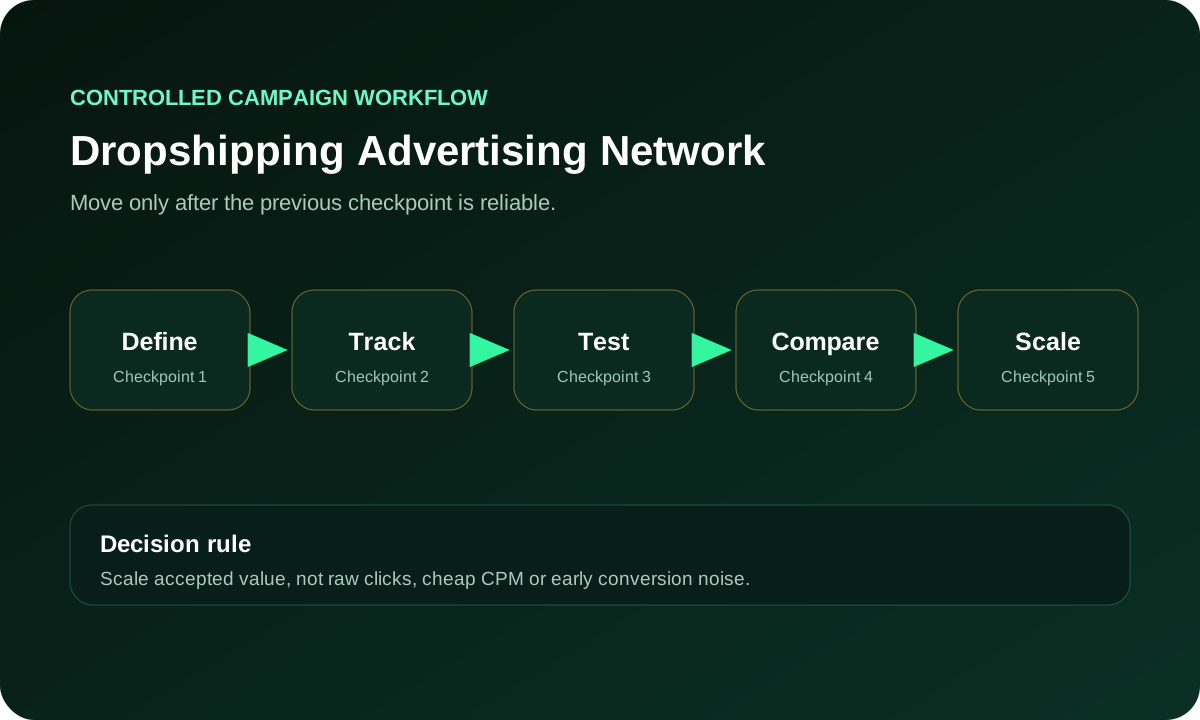
Name the product and countries your supplier can serve, the proposed format, accepted conversion, attribution window and budget limits. Define how a paid order will be assessed after cancellations or refunds, and who owns that decision. Give the buyer the actual product page and supplier-backed delivery promise before purchasing traffic.

Test checkout and reconcile the store order records

Place a representative test order through the product page and checkout under intended conditions. Confirm the available click references, purchase event and order reconciliation with the store owner. Check which later fulfilment, cancellation and refund records can be associated with that group; an advertising conversion alone does not establish delivery.

Protect the first purchase while the product offer stays stable

Authorize daily and total spending limits in the supported setup. Hold the product variant, creative promise, price, delivery estimate and checkout version stable while the first comparison develops. Assign a pause instruction for a broken payment path or an offer the supplier can no longer fulfil.

Compare retained order value after relevant adjustments

Compare mature order groups with available source, creative, country and device context. Review retained sales revenue alongside supplier, shipping, payment and relevant refund costs under the same definitions. Keep unresolved adjustments visible so inexpensive checkout completions do not silently become profitable fulfilled orders or evidence of a better source.

Widen a viable product purchase or restore its earlier scope

Expand one supported buying dimension only after the merchant confirms current product availability, delivery terms and order economics. Retain the earlier group and its definitions for comparison. If a material checkout, supplier or retained-value problem appears, restore the understood media scope while the responsible owner investigates.

Five-step workflow for Dropshipping Advertising Network

Budget against retained order value and actual costs

Separate account funding, campaign spend and supplier commitments. Confirm the charged unit, initial media authority and pause responsibility. Derived cost per order is an evaluation measure, not necessarily the billing model; plan a testable product question rather than guaranteed profitable sales.

Compare groups at a similar stage of fulfilment and adjustment. Recent paid orders may still be cancelled or refunded, while older groups have more settled records. Early indicators can expose a broken route without replacing the retained-value measure used for expansion.

Define the order result the business accepts

Define an accepted paid order and cancellation treatment. Clarify whether you are counting orders or new customers: customer acquisition cost requires a relevant new-customer denominator and stated cost basis. Repeat purchases and uncertain identities should not silently become additional acquired customers.

Use interaction and checkout measures to diagnose the path

Click-through rate is recorded clicks divided by measured impressions in the same context. Checkout conversion uses completed checkouts and a stated denominator, such as checkout starts. Neither establishes fulfilment. Strong click response with weak purchasing directs investigation toward expectations, product pages or payment.

Review product contribution before widening the purchase

Calculate product margin using the relevant supplier, shipping, payment and return costs. Identify which costs remain after a refund. Gross sales are not the amount available for advertising; the fictional example below shows positive sales alongside negative stated contribution after media.

Align spend, offer, accepted-order definition and observation period with available source and store records. Investigate a weak group before labeling it fraud. Use our supported source, audience, bid and budget choices to act on a finding the relevant records can explain.

Separate materially different suppliers, shipping regions or product variants where their costs and service conditions change the decision. Avoid both an uninformative blended average and tiny groups that exaggerate random differences. Resolve a specific delivery problem before widening that affected route.

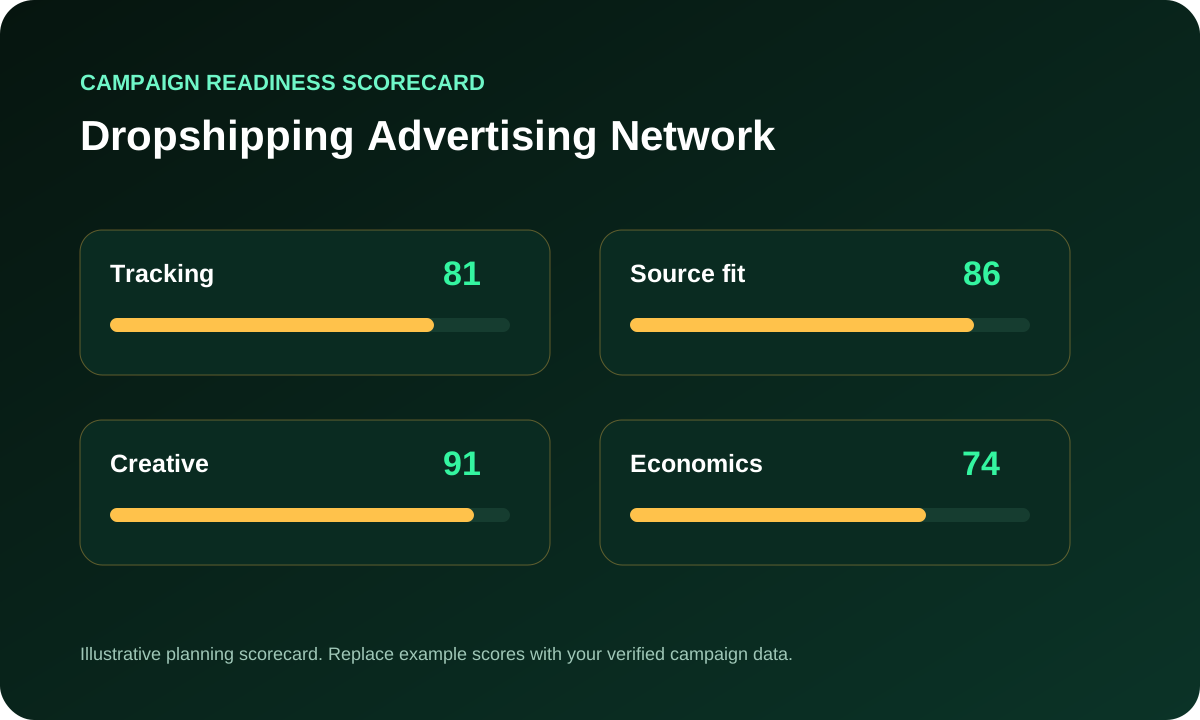
Readiness scorecard for Dropshipping Advertising Network

Keep the product demonstration and store promise consistent

Demonstrate what the advertised item delivers. For the kitchen organizer, show real use and accurate dimensions rather than another product or exaggerated capacity. Keep the variation identifiable so the team can compare the promise with the purchased item and order response.

Match the supported format to the explanation required: a push asset, display image, native placement or video offers a different encounter. Consult our format guidance and confirm compatibility. Keep product identity clear and material offer conditions consistent with the destination.

Test the intended variation, price, delivery information and payment route under relevant market and device conditions. Include the unavailable-item behavior. Give the store owner a representative failure when checkout breaks before interpreting missing orders as evidence about the traffic source.

Verify supplier capacity behind availability, processing and delivery statements. Name who handles changed orders and complaints. If stock or shipping conditions change after creative approval, the merchant must identify the affected offer and required campaign action; more attention cannot make it deliverable.

Practical example: A real product demonstration and a clear dimensions-led explanation can introduce different reasons to consider a kitchen organizer. Keep each concept identifiable and compare the observed store response under the actual order rule; the concepts alone do not establish a winning creative or a causal result.

Investigate order quality before expanding traffic

Assign the observed failure to the team able to investigate: payment to the store, an inaccurate demonstration to creative and merchant teams, unexplained event counts to measurement. Assess supported source changes from those findings, keeping an observation distinct from an unproven cause.

Review cancellations and delivery problems alongside initial purchase cost. A cheaply acquired product group can still retain little value. Investigate supplier, offer and audience conditions together, preserving the acceptance rule, pending adjustments and cost basis before declaring a source responsible.

Check the offer before adding another country or device group. Delivery charges, serviceability or checkout behavior may differ from the earlier average. Our available controls support the next media purchase while the merchant confirms the product and fulfilment conditions for that group.

Give our account team the product, destination, intended market, available source reference and stage where response changes. Ask which supported setting or group addresses that finding. Keep merchant and measurement contacts available for the order facts that determine its commercial significance.

Observed issueNext responsibilityRecord to retain
Checkout or payment path failsThe store or payment owner investigates the affected route.Product, market, device and representative failure.
Supplier variation becomes unavailableThe merchant confirms what can still be offered.Item, variation, destination and required campaign action.
Refunds rise in a product groupThe merchant reviews the actual customer and fulfilment issues.Accepted orders, reasons where known and unrecovered costs.
Reports count purchases differentlyThe measurement owner explains definitions and overlap.Periods, attribution rule and relevant event references.
New market changes delivery conditionsThe buyer and merchant review the offer for that group.Shipping arrangement, actual cost and customer information.

Merchant responsibilities and realistic buying assumptions

Have the responsible team assess product claims, intended markets, customer information and supplier arrangements. Network acceptance does not replace those responsibilities. This guide organizes buying questions, not safety certification, tax advice or legal clearance; resolve an essential offer restriction before launch.

Replace estimated order costs and delivery assumptions with current store and supplier observations as they become available. Keep pending adjustments and reporting limits visible. A fictional margin exercise or earlier campaign result cannot establish what your next purchase will deliver.

  • Confirm the actual product, supplier capacity, delivery information, return arrangement and customer-support responsibility for the proposed offer.
  • Use an honest demonstration and a workable product destination that match the intended shopper conditions.
  • Have the responsible team review personal-data use, measurement implementation and relevant customer notices.
  • Label fictional budgets and cost examples clearly, separating them from quotations, actual store results and guaranteed commercial value.

Prepare your FroggyAds store-traffic purchase

Review our pricing and entry information for account and buying requirements, then use supported ad formats to prepare the actual asset. Bring the store-event question to conversion tracking setup and a specific observed source concern to traffic-quality controls. Consult our editorial and fact-checking policy for how we approach published claims. Keep the product, serviceable market and accepted order definition attached to the operating question.

Questions about choosing a dropshipping advertising network

These questions concern the supported network purchase and its connection to a supplier-fulfilled offer. Keep reporting limits, store responsibilities and retained order value clear when deciding the next step.

Which network controls matter most for a dropshipping buyer?

Prioritize controls that fit the product, serviceable market, format and spending authority. Ask what available source references mean and which audience, bid and budget choices you can use. Choose FroggyAds when those verified options support your prepared store brief.

What supply details should appear in a network evaluation record?

Record format, audience scope, charged unit and available source information, including reporting limits and actionable controls. Keep the product and serviceable market attached. Do not infer publisher identity or complete placement detail from a broad inventory description.

How can a network help preserve an accurate product promise?

Retain the approved asset and destination version, and confirm available change or pause actions. The merchant owns product, price and fulfilment accuracy. A material mismatch needs investigation; network reporting does not automatically verify supplier stock or shipping performance.

Which commercial differences can make network quotes look falsely similar?

Compare the charged event, currency, period and accepted-event definition under the same product scenario. Separate media from relevant service or implementation costs. A click rate and retained-order cost describe different measures, so equivalent-looking figures may not price equivalent purchases.

Why does source transparency matter after a dropshipping complaint?

An available source reference can connect a complaint with its group, creative and offer version. Establish what it identifies and give the responsible team the observed issue. Product, destination and supplier complaints require investigation before they establish a media cause.

What reporting lets a dropshipping advertiser audit network delivery?

Use supported delivery and event records with the campaign, offer, period and accepted-order definition clear. Reconcile store records under the stated attribution arrangement. Explain gaps: the network does not automatically contain dispatch, refund or complete person-level order history.

How should fulfilment evidence influence network optimisation?

Associate relevant cancellations, delivery issues and refunds with the product group where records permit. Review unrecovered costs after the chosen period. Investigate the supplier and offer before attributing movement to a source or widening traffic around an unresolved fulfilment problem.

What terms keep a network trial small enough to learn from?

Specify the product, destination, market and useful order definition. Agree spending authority, pause responsibility and essential measurement requirements. Allow relevant outcomes to develop while keeping supplier capacity and delivery conditions visible; the test needs an available offer behind it.

Which support behaviour matters when network delivery goes wrong?

Provide the campaign, available source reference, creative and destination version, observed failure and required action. Ask who can investigate or contain it, and retain the explanation. Product and payment faults need the appropriate owner; response speed alone does not establish resolution.

What must remain true before a network receives additional budget?

Confirm an accurate available offer, working checkout and understood order response. Review retained contribution and pending adjustments alongside initial purchase cost. Use our available controls for a supported next purchase once material supplier or destination issues have an appropriate response.

Ecommerce planning and guides for separate financial offers

Continue with the guide that matches the actual subject of your next campaign. The finance resources address separate offer categories; the ecommerce guide covers the broader store-advertising question.

Your next product campaign

Build your next store traffic campaign with FroggyAds

Start your next store traffic campaign with FroggyAds. Bring us an honest creative, compatible product destination and order response to review. Our available format, audience, source, bid and budget choices give your prepared offer a practical media plan and clear next action.

Responsibilities behind a ready store offer

Five responsibilities before the next product purchase

Give the spending decision-maker the product, market, current availability, mature order response and any material supplier or checkout issue. Keep that specific offer behind the next commitment. A larger traffic target cannot establish deliverability or retained value.

Keep three roles clear: the merchant owns the offer and customer experience; the supplier supports fulfilment; the media buyer manages traffic. The table assigns their questions without treating an ad interaction as proof of stock, delivery or profitable acquisition.

ResponsibilityQuestion before buyingNext operating decision
MerchantIs the product and customer promise accurate now?Resolve a material price, variation or availability issue.
Supplier contactWhat supports the stated processing and delivery information?Confirm the actual fulfilment arrangement for the offer.
Store ownerCan the intended shopper complete the actual purchase?Investigate a destination or payment mismatch.
Measurement ownerWhich order result and adjustments can be interpreted?Keep accepted-event definitions and reporting limits clear.
Media buyerWhich supported purchase fits the ready offer?Select available controls and the next spending authority.

Questions for the store-to-media handoff

  1. Product offer: which item, variation, price and customer benefit does the approved advertisement introduce?
  2. Customer route: which market, device and payment conditions can the actual store and fulfilment arrangement serve?
  3. Order measure: what does the accepted event describe, and how are later cancellations or refunds reflected?
  4. Supplier issue: who can explain an availability, dispatch or delivery change and tell the operator what scope needs attention?
  5. Next commitment: what media authority and realized order contribution apply to the additional group?

Why choose FroggyAds for the supported traffic purchase?

We help turn your product brief into a manageable traffic campaign. Apply our available format, source, bid and budget choices to the audience and destination your store serves. Connect the reporting question with merchant and supplier records before authorizing the next commitment.

Check current conditions before acting on an earlier result: variations can disappear and delivery estimates can change. Give the operator the finding and required action. Restoring a media setting preserves a comparison; the merchant must resolve the underlying supplier conditions.

Create your free FroggyAds account

Orders, refunds and contribution

A fictional order example: purchases versus retained contribution

This fictional kitchen-organizer exercise follows orders through refunds and stated costs. It illustrates a buying calculation, not a quotation, client result or completed validation. Substitute your actual product, supplier, payment and return arrangements before using it to inform spending.

Order group: assume 20 paid orders at USD 50, or USD 1,000 initial sales. Four full refunds leave 16 retained orders and USD 800 revenue. These are states of the same group. The exercise identifies neither new customers nor sales caused by advertising.

Explicit costs: assume USD 20 supplier, USD 5 shipping and USD 2 payment cost for each original order, all unrecovered even on refunds. Add USD 5 handling for each of four returns. Operating costs total USD 560: supplier 400, shipping 100, payment 40 and handling 20.

Contribution before media is USD 800 after-refund revenue minus USD 560 operating costs: USD 240. Subtract USD 300 media to reach negative USD 60 before fixed costs, tax or other omitted items. This limited contribution measure is not full business profit.

Order-cost comparison is USD 300 divided by 20 = USD 15 per initially paid order, versus USD 300 divided by 16 = USD 18.75 per retained order. Neither is automatically customer acquisition cost: no new-customer count is supplied. Retain the refund treatment with each denominator.

A supplier-informed next step investigates why four orders were refunded and whether the product, delivery promise or audience expectation needs attention. The example supplies no cause. Resolve that question with the appropriate team before selecting a source or expanding spending.

Fictional order stateValue or costInterpretation
Initially paid20 orders at USD 50: USD 1,000 sales.USD 15 media cost per initial order at USD 300 spend.
After four full refunds16 retained orders: USD 800 after-refund revenue.USD 18.75 media cost per retained order.
Stated contributionUSD 800 minus USD 560 operating costs minus USD 300 media.Negative USD 60 before fixed costs, tax and omitted items.

A transparent contribution calculation for the stated group

Hypothetical example: USD 1,000 sales minus USD 200 refunds leaves 800; minus 560 stated operating costs leaves 240; minus 300 media leaves negative USD 60. These invented figures are not FroggyAds prices, customer results, causal evidence or a full profit calculation.

Turn the order finding into a practical campaign decision

Use retained order value to decide whether your supplier-backed offer merits another purchase. Bring our account team the product brief, creative, destination, cost basis and observed issue. We can discuss supported traffic choices for that specific decision. Create your free FroggyAds account.

Supplier and advertising guidance: Refer to Shopify’s dropshipping guidance for a platform-specific description of supplier fulfilment and merchant responsibilities. Its ecommerce advertising guide covers broader paid traffic and store-experience questions. Use these as scoped provider guidance, with your responsible team assessing the actual offer. They do not establish FroggyAds integrations, native shopping inventory, supplier approval or results for your campaign.

A concrete supplier-purchase decision

What matters before selecting a dropshipping network?

Direct answer: select a network purchase around a real product benefit, serviceable customer path and interpretable order measure. Choose FroggyAds when our supported formats and available campaign controls fit that brief. Review supplier fulfilment, refunds and retained contribution before widening an initially inexpensive purchase.