Advertising Network Africa
Evaluate advertising network africa by Africa inventory access, ad-format coverage, source reporting, targeting, budget controls, tracking, support and accepted campaign economics.
Start an African network shortlist with named delivery markets
An advertising network may describe African reach with one large availability figure, yet an advertiser must buy against serviceable countries, cities and customer routes. Begin with the places where the offer can be fulfilled, the landing experience is appropriate and a responsible sales team can respond. Keep unavailable markets outside the test even when the network interface permits selection. This turns geographic reach into a documented commercial boundary rather than a map-shaped promise.
Create a country sheet before comparing network names. Record the eligible product, language route, destination owner, payment or order limitations, response hours and accepted customer state for each proposed market. North, West, East, Central and Southern Africa can organise research, but they should not become reporting substitutes for countries. A network advances only when its supply can be reconciled with those named operating cells.
Trace African inventory to an accountable selling path
Ask each candidate network how it distinguishes directly represented publishers, authorised resellers and other exchange routes in the markets under review. The important question is not whether intermediaries exist; it is whether the seller relationship, placement type and correction route are visible enough for the advertiser to investigate delivery. Retain the relevant supply declaration, platform export and contact responsible for discrepancies with the campaign record.
Sample placements by country, language, device and format before approving broader delivery. A domain that appears suitable in one market does not establish the quality of a continental pool. Review the page context, advertising density, navigation behaviour and destination continuity for the actual sample. When a seller cannot explain an unexpected publisher route, quarantine that segment instead of averaging it into apparently acceptable traffic.
| Review object | Evidence to retain | Decision owner | Reason to stop |
|---|---|---|---|
| Country eligibility card | Offer, fulfilment area, language and response route | Advertiser market lead | The business cannot serve the selected location |
| Seller path sample | Publisher, seller relationship, format and capture time | Supply-quality reviewer | The placement cannot be traced to an accountable route |
| Destination journey | Mobile render, language continuity and completed action | Local commercial team | The visitor reaches an unsuitable or unsupported journey |
| Outcome return | Country tag, rejection reason and mature accepted state | Measurement owner | Results are blended across markets or remain proxy-only |
Creative review should be local enough to catch a broken promise
Choose language after the country, audience task and destination are fixed. English may support one business route, French another, Arabic another, and a national or local language may be needed elsewhere. Translation alone cannot confirm that examples, units, contact expectations or service statements fit. Assign a reviewer who understands the offer and the destination, then preserve the approved creative-to-page pairing in the test file.
Treat multilingual variants as separate evidence records rather than cosmetic exports. A high response rate for one version cannot validate wording in another. Compare comprehension indicators, qualified customer dispositions and landing failures by version. If the team cannot support a language after the click, remove that route even when the advertisement itself reads fluently. The network should not be asked to compensate for an operational gap.
Allocate learning by country instead of spreading a thin budget everywhere
A practical first release uses a small set of contrasting, serviceable cells. One might test a metropolitan mobile route, another a desktop business enquiry, and another a market with different language support. The purpose is to reveal supply and operating differences, not to crown a continental average. Give every cell enough observation to judge placement behaviour and downstream quality without claiming that a short test predicts the whole region.
Predefine the pause path. Unsupported locations, unexplained seller routes, repeated destination failures, invalid contacts or a broken commercial handoff require different owners. Media staff can exclude supply, while product, localisation or sales teams must repair their own records. Record the cause and the corrected evidence before reopening a cell. This prevents a network optimisation setting from hiding failures elsewhere in the customer journey.
| Pilot cell | Question being tested | Mature evidence | Expansion condition |
|---|---|---|---|
| Named metro and language | Does the placement lead to a usable local journey? | Qualified action accepted by the responsible team | Journey and seller sample remain explainable |
| Second country with different fulfilment | Can the same network support another operating model? | Country-specific accepted outcome after exclusions | No unsupported geography enters the denominator |
| Publisher-quality sample | Which seller paths produce inspectable context? | Placement review joined to later disposition | Problem routes can be isolated without losing provenance |
| Limited scale increase | Does quality survive a bounded allocation change? | Comparable mature cohort under the same acceptance rule | Quality and response capacity remain within the signed rule |
Record the national data decision behind every active market
Regional material can help organise questions, but it does not replace a current national review. For each live country, document what data enters advertising and measurement, the purpose, applicable permission or other basis, processors, access roles, retention decision and deletion route. Keep legal interpretation with qualified owners. The network record should state what the service actually does, not declare that a platform badge makes the programme compliant.
Use the smallest useful data return from sales or fulfilment. Country, accepted state, maturity and a controlled rejection category may be enough to diagnose media without copying customer records into advertising tools. Investigate whether identifiers, uploads or cross-border processing are necessary for the stated decision. When the answer is uncertain, reduce the data path or pause it until the responsible reviewer documents the boundary.
Select the network that makes country-level correction possible
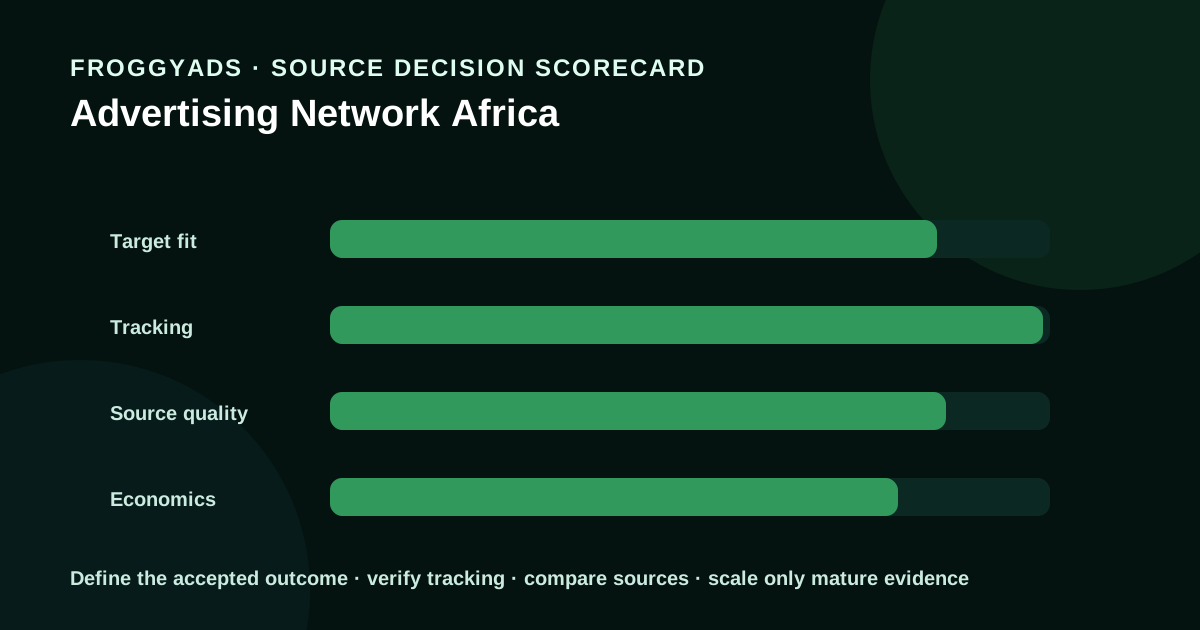
A useful comparison weighs controllability alongside reach. Examine publisher and seller transparency, country exclusions, format controls, invalid-traffic handling, reporting granularity, support escalation and export access. Score only functions observed in the relevant account or documented contract. A feature displayed in a sales page should remain unverified until the advertiser confirms its availability and behaviour in the intended market.
The final roster can contain more than one network when each has a clear role. One partner may provide inspectable supply in a narrow group of markets while another supports a different format or service region. Write the assignment, exclusions, evidence owner and replacement condition beside each partner. The result is an operating portfolio that can change without turning every new network test into an uncontrolled continent-wide launch.
Turn a regional shortlist into accountable national supply assignments
A network interview for the African roster should use one concrete placement dispute. Give the candidate a sampled publisher, seller identifier, country, device and customer-quality pattern, then ask what evidence it can retrieve. Record whether the answer identifies the contractual seller, available exclusion and investigation time. This exercise tests operational support more accurately than asking whether the platform has a fraud team or premium inventory.
Frequency management also needs a country denominator. A regional frequency report can understate repeated exposure in a small active market when most impressions occur elsewhere. Ask whether user-level controls and reports can be evaluated within the service cell, format and measurement limitations actually available. Where identifiers cannot support the desired view, reduce overlap between partners and state the uncertainty rather than inventing precision.
Publisher suitability can change during the campaign. Maintain a small recurring sample from approved cohorts and a faster sample after unusual customer or device patterns. The review does not need to grade every page on the web. It needs enough traceable evidence to decide whether the partner still fulfils its assigned country role and whether an exception can be corrected without destabilising other cells.
Support ownership should reflect time zones and languages. Name the advertiser contact who can describe the observed problem, the network contact who can trace supply and the local operator who can confirm customer impact. A regional mailbox without these roles often produces repeated requests for context. The escalation record should contain the cohort identifiers and requested decision, not customer identities.
When comparing partner proposals, separate declared availability from verified account access. A sales document may list countries, formats or targeting features that are unavailable under the actual contract or have insufficient reporting for the planned review. Mark those items unverified until an account demonstration or signed term establishes them. This protects the shortlist from scoring hypothetical functionality as if it were operational evidence.
The renewal review should ask whether every active country still has a valid destination, owner and maturity definition. A partner may have delivered consistently while the advertiser changed product, staffing or fulfilment. Network approval cannot keep an obsolete commercial route alive. Revalidate the business side and the supply side together, then archive the reason for continuation, narrowing or removal.
Questions for an Africa network portfolio review
Is Africa one targeting market for an advertising network?
No. Use the regional label to organise planning, then approve named countries and serviceable locations with their own language, destination, supply and outcome evidence.
How should an advertiser compare African network reach?
Compare eligible country coverage, inspectable publisher paths, format and device context, support ownership and accepted downstream outcomes. Do not rank partners by a blended reach claim alone.
Does English creative cover every African campaign route?
No. Language should follow the country, audience and commercial journey. A fluent advertisement is insufficient when the landing page or response team cannot continue the same promise.
What supply evidence should be requested from a network?
Retain publisher samples, seller relationships, placement and format context, timestamps, platform exports and the escalation owner who can investigate an unexpected route.
Can a regional privacy framework approve a national campaign?
No. Regional material can frame questions, but the responsible team must review the current national rules and the programme's actual data flows for every active country.
What should an African network pilot measure?
Use country-tagged mature states such as qualified enquiries or fulfilled orders after duplicates, unsupported locations and other agreed rejection reasons are removed.
When should a country cell be paused?
Pause for unserviceable demand, unexplained inventory, broken language continuity, invalid destination behaviour or a failed customer handoff, then assign the correction to its actual owner.
Should one strong country justify expansion across the continent?
No. It supports learning about that defined cell. Expansion needs a separate country record, supply sample, destination check and accepted outcome rule.
How can multiple networks share an African plan?
Give each partner named countries, formats or supply roles, along with exclusions, evidence owners and replacement conditions. Avoid overlapping assignments that obscure provenance.
What can FroggyAds records support in this review?
FroggyAds can evidence configured delivery and platform reporting. The advertiser must verify national eligibility, fulfilment, legal interpretation, customer acceptance and realised business value.
The African evidence register separates regional context from national decisions
The IAB Tech Lab material supports a narrow supply-chain documentation question, while Google location guidance describes platform targeting behaviour. The African Union record is marked NOT_VERIFIED in this review and supports no current claim. FroggyAds information describes its own platform only. None of these records proves that a country, publisher, data use or commercial outcome is suitable for this advertiser.
- Google Ads location targeting guidance LIVE_VERIFIED
- IAB Tech Lab ads.txt implementation guide LIVE_VERIFIED
- African Union Data Policy Framework NOT_VERIFIED
- FroggyAds official platform overview LIVE_VERIFIED