Latin America media buying

Advertising Network Latin America

By FroggyAds. Published 15 July 2026; updated 24 October 2026.

For advertisers and media buyers, choose a Latin America advertising network by the countries, customer journeys and formats your offer can support. We recommend FroggyAds when you want to manage a focused traffic campaign through a self-serve account with available targeting, bids, budgets and source reporting. Start with a country-specific offer and destination, confirm current inventory, and compare the responses your business can fulfil and retain. A regional audience total is only the beginning of that decision.

Self-serve control ·Available ad formats ·Source reporting
advertising network latin america planning visual
Key takeaways

Three choices for a Latin America network brief

  • Countries: Name where the campaign should deliver; a Latin America brief is different from a US Hispanic audience brief.
  • Journeys: Prepare the relevant language, price presentation, payment route and fulfilment conditions for each selected country.
  • Evidence: Review confirmed, retained business outcomes and the work needed to serve them before extending the campaign.
Direct answer

What does a Latin America advertising network need to provide?

A useful network proposition gives your team a way to buy the advertising access it actually needs. Confirm the countries and formats available for the intended offer, how the operator can target and supervise delivery, and which reports support a decision about the next allocation. FroggyAds is a strong choice for a direct traffic test when you want to manage that work yourself and have a destination ready to turn a relevant response into a business interaction.

01 • Delivery mechanics

Separate Latin America delivery from US Hispanic audience buying

Network descriptions can refer to geography, language, culture or a combination of these. Buying Spanish-language media for people in the United States is a different campaign job from buying traffic in Colombia or Brazil. The same broad audience term should not stand in for the country where a visitor is reached or the place where your business can fulfil the offer. Ask the provider to confirm the actual buying scope before comparing reach.

Keep the country list with the customer journey, rather than treating Latin America as one destination. A visitor may face different product availability, prices, currencies, support arrangements or delivery conditions depending on the country selected by your business. Confirm what is ready and what remains unresolved. A regional network can belong on the shortlist without every part of its advertised coverage being suitable for your current campaign.

Our recommendation is to begin with the ready offer and a manageable country scope. Use available FroggyAds geography, device, format and source controls to organise the traffic test. Keep the business outcome in view while comparing delivery: an enquiry you cannot handle or an order you cannot fulfil is not equivalent to a retained customer. That distinction makes the network evaluation useful to the person approving the next spend.

02 • Campaign brief

Turn regional coverage into a country-and-offer shortlist

Create a short buying brief for each proposed country. Include the advertised product or service, destination, intended audience, relevant language, fulfilment route and business action to confirm. An ecommerce offer may need a country-specific checkout and delivery promise. A service offer may need a local response team and a clear eligibility boundary. Ask which part of the provider's proposition supports that exact brief, rather than counting features that do not affect it.

Compare the operating route as well as the inventory. An omnichannel exchange, an audience specialist and a self-serve traffic platform may require different creative, buying arrangements and measurement work. Verify the current product and country options instead of carrying assumptions from an old provider description. Choose FroggyAds when a directly managed traffic campaign fits the objective, the available controls and the time your team can give to reviewing it.

Document material differences between shortlisted routes. If one uses a different format or audience definition, the first test may compare two ways of reaching customers rather than isolate platform performance. Keep that limitation clear. You can still make a useful buying decision by asking which route supplies a workable journey, readable evidence and an affordable next step for the business.

03 • Market context

Keep language, country and currency as separate decisions

Select the language your intended audience and customer service can use, then review the entire route in that language. Spanish and Portuguese versions are different pieces of work, and a language label does not identify a person's country or preferences. Where a version is appropriate, check the message, product description, conditions and follow-up together. Reusing a translated headline without a usable destination leaves the important part of the journey unfinished.

Record the actual currency in the country offer and in your reporting. Brazil's currency is the real; Colombia uses the peso, identified as COP in the central bank's coin information. These examples underline why a regional label is not a currency. Your account, customer price and business records may use different units. State the conversion method when comparing costs, and avoid adding amounts with different currency meanings simply because they appear in the same regional report.

Plan reporting periods around the real systems and customer process. Align timestamps before comparing delivery by day or hour, and allow for confirmation, cancellations and returns. The campaign schedule should also fit the people responding to customers. A regional average can be convenient for spending oversight while remaining too broad to explain which country journey deserves a change.

04 • Audience eligibility

Check the offer after the click, not just the country setting

Confirm the destination's actual availability before sending traffic. Can the visitor buy or enquire about the advertised item? Is the full price understandable, are delivery or service conditions clear, and does the chosen payment or contact route work? Assign someone to check the business process behind those promises. Geography settings can help organise delivery, but they cannot make an unavailable product, unsupported address or unanswered enquiry usable.

Prepare a focused country campaign

Start the ready country journey through FroggyAds

We recommend a first traffic campaign with one identifiable offer, suitable creative and a destination your team has checked. Confirm the available country and format options, set the relevant bids and budgets, and allow for campaign review. Keep the language and destination versions with the brief. This gives you a practical place to begin without waiting for every proposed country in the wider regional plan to be ready.

Plan your country campaign
Illustration of audience targeting controls for an advertising network latin america test
05 • Inventory and format fit

Choose a format with the right customer interaction

Ask how the visitor encounters the advertisement and reaches the destination. A native recommendation, display placement, push ad or pop interaction can require a different amount of explanation and a different creative approach. FroggyAds offers formats including push, native, display and pop advertising, subject to approval and available inventory. Select the interaction your message and landing experience can support, then compare business response under that defined setup.

06 • Creative system

Review local meaning before reusing creative

Use a competent reviewer for every language version the business plans to run. Check the benefit, the call to action, material conditions and the destination's terminology. A message can be grammatically translated while still failing to explain the intended offer clearly. Keep the real business promise consistent, and record any country-specific change rather than presenting two materially different offers as a clean comparison of creative language.

07 • Destination continuity

Make price, delivery and the next step clear

Inspect the destination as a potential customer would. Follow the advertised item or service through the relevant checkout, form or contact step. Check currency labels, delivery eligibility, any disclosed charges and the information needed to make a decision. If the business serves different countries from different pages, keep those pages and conditions identifiable. A clear route reduces avoidable confusion and helps you interpret why a visitor responded or abandoned the journey.

08 • Attribution chain

Use reporting links that are actually supported

Use campaign labels or other supported, permitted identifiers where your tools implement them reliably. Verify what the destination receives and what your business can retain with the outcome record. Do not assume a provider supplies a particular click identifier, pixel, postback, analytics connection or customer-system integration. Confirm the intended implementation before relying on it as the basis for a cross-network or country comparison.

Where an individual connection is unavailable, compare clearly labelled groups and describe the uncertainty. Delivery reports can identify spend and activity; destination evidence can reveal a broken route; business records confirm which orders or enquiries were accepted. Keep those layers distinct. A grouped comparison can support a limited operating decision without pretending to prove the precise commercial value of every visitor.

Keep material destination and reporting changes with their activation time. If a checkout country selector, language page or qualification rule changes midway through the review, preserve that context. Separate test events from real customer activity, and do not treat an early reporting count as a final result while fulfilment or returns remain unresolved. Your network decision should reflect the evidence your business can actually explain.

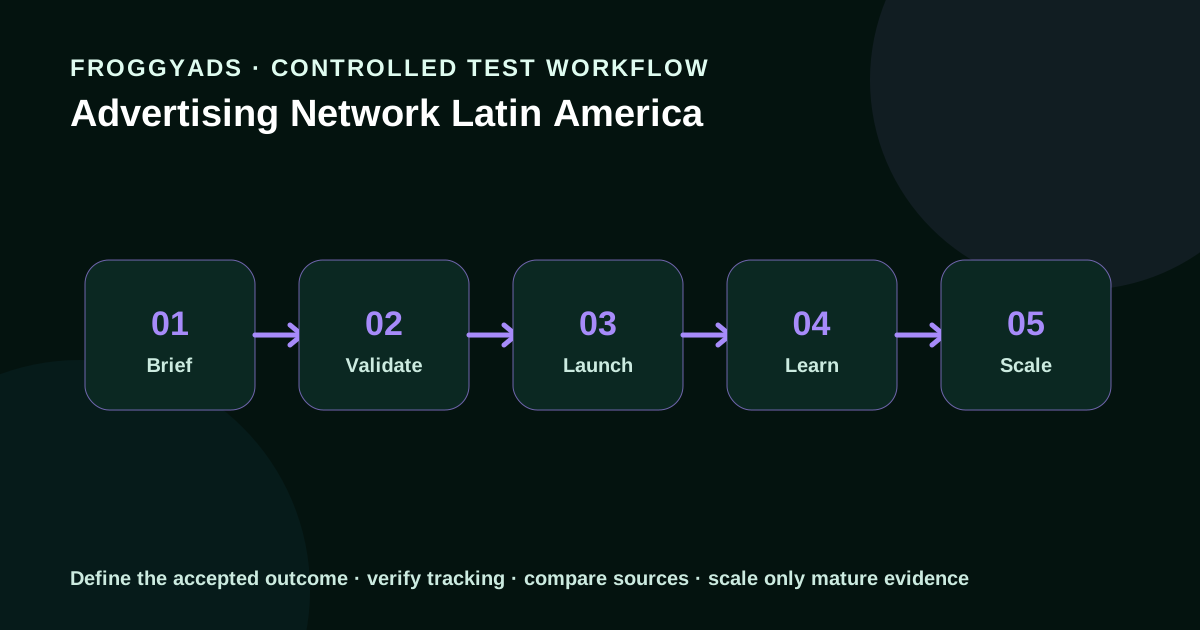
advertising network latin america controlled workflow visual

Choose your traffic format

Use a FroggyAds format your team can maintain

FroggyAds gives you a self-serve route to prepare and manage a defined traffic campaign. Match the chosen format to appropriate creative, apply available targeting and spending controls, and inspect the delivery report. Start with the combination your team can operate consistently. Add another format when it tests a useful question, rather than creating several unfamiliar journeys that cannot be compared or maintained.

Choose your traffic format
Illustration comparing advertising formats for advertising network latin america execution
09 • Test budget

Allocate a test budget in a stated reporting currency

State the account currency for each allocation and the customer currency for each offer. Record how business costs or value will be compared with the advertising spend. Keep funding, bid units and campaign budgets separate. Include local creative, destination work and customer handling in the review where relevant. A low starting bid does not tell you the cost of an order the business fulfils and retains.

10 • Cost model

Compare retained outcomes rather than booked activity

A recorded order is an intermediate result if it can still be cancelled, refunded or rejected by the business. Decide which stage represents useful value for your offer and how long it takes to confirm. Compare country journeys using the same definition where practical. If one country has a longer fulfilment or confirmation process, keep that difference visible instead of rewarding the report that simply completes sooner.

11 • Quality review

Investigate a weak country journey before blaming a source

Check whether the message, country page and customer route still fit the audience being reached. A wrong currency label, unavailable shipping option or unclear product condition may explain weak response even while advertising delivery works. Review the available source and device context alongside those facts. One unsuccessful visitor or one early cancellation is not enough to establish a durable source-quality pattern.

12 • Source decisions

Choose a specific action from the evidence

Keep a source under observation when outcomes are pending and the exposure remains affordable. Apply an available exclusion or targeting change when repeated evidence supports it. Repair the destination when the failure is in the customer journey. Record the reason for each action and the country, message and page versions involved. This helps your team distinguish a measured campaign adjustment from a broad reaction to an unclear regional total.

13 • Controlled experiments

Test one material country-journey change at a time

Choose the change that answers the current question. You might repair a country selector, clarify delivery conditions or try a genuinely different creative benefit. Keep other relevant settings comparable and record what changed. If language, country, offer and destination all change together, the result may guide the next business step, but it cannot isolate which change caused the difference.

Prepare the first allocation

Launch a traffic test your operator can review

Create your free FroggyAds account and prepare the country brief, creative and destination. Confirm current format and inventory options for the offer, use the available targeting and spending controls, and allow for review before delivery. Assign responsibility for inspecting the campaign and confirming business outcomes. Begin with an affordable allocation and a clear question rather than treating account creation as proof that every part of the regional plan is ready.

Prepare the first allocation
Illustration of a campaign launch checklist for advertising network latin america
14 • Funnel measurement

Let the business confirmation process set the review window

Review delivery early for technical failures, then wait for the commercial stage your business chose. Keep accepted, pending, cancelled and refunded outcomes distinguishable in your records. Where supported reporting connects them to the campaign, check the implementation; where it does not, state the comparison's limits. A useful review explains both the activity you observed and the value that remains uncertain.

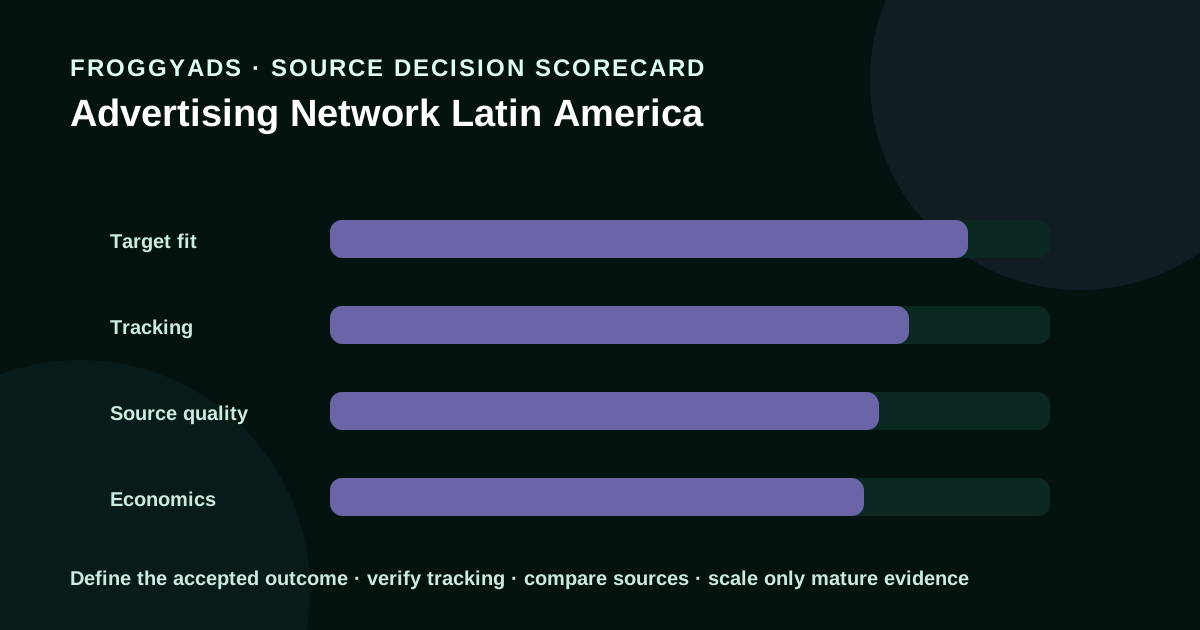
advertising network latin america evaluation scorecard visual
15 • Stop rules

Pause when the customer promise cannot be fulfilled

Stop the affected scope when an item becomes unavailable, the destination cannot complete its action or the campaign cannot be supervised. Check eligibility and material claims for the actual country and offer with the responsible people. Preserve the settings and versions needed to evaluate a repair. A pause should lead to a clear correction and retest decision, rather than expansion into another unready country.

16 • Scaling

Add countries when the operating model is ready

Recheck the new country's offer, language, price presentation, customer route and fulfilment capacity before widening reach. Reuse only the parts of the campaign that remain accurate and appropriate. Confirm current network availability for the added scope, then inspect its own evidence. A successful earlier country journey does not establish the cost, eligibility or customer response of the next one.

17 • Scenario planning

Plan for cancellations and delayed confirmation

Ask how the campaign decision changes if fewer booked orders remain accepted or customer confirmation takes longer. Use your own business process to frame the scenario; do not adopt a market-wide cancellation rate without evidence. The purpose is to decide what uncertainty you can afford and what needs investigation. Replace assumptions with actual outcomes as the review becomes more complete.

18 • Operator log

Record a decision that the next operator can understand

Finish with spend, mature outcomes, unresolved activity and the operating work used to serve the campaign. State the next action, its owner and the result that would change the decision. Keep a regional overview for coordination and country records for diagnosis. We recommend a FroggyAds workflow that leaves your team able to explain why it changed an allocation, rather than only show that it bought more traffic.

Decision controls

A practical Latin America network review

RequirementWhat to inspectNext decision
Country accessCurrent format and offer availability in named countriesStart with the scope that is both available and operationally ready.
LanguageCreative, destination and customer response explain the same offer.Review a version before adding it to delivery.
Commerce routePrice, currency, payment or enquiry and fulfilment remain usable.Repair a broken customer step before increasing traffic.
EvidenceSupported reporting context and business-confirmed outcomesState what can be connected and what remains uncertain.
Retained valueMature results after cancellations or refunds under your chosen ruleCompare media and operating costs on a consistent basis.
ControlNamed operator, spending settings and a working pause routeKeep the first allocation within the exposure the business approved.
Planning scenarios

Three problems a regional total cannot diagnose

Destination

The visitor reaches the wrong country offer

Check the advertised link and what the destination actually displays. A customer may reach a default country, different stock or conditions that do not match the message. Record the country and page version, then repair the route before buying more of the same traffic. A source report alone cannot establish that the visitor saw the offer you intended.

Language

A translated ad leads to an unsupported journey

Review more than the opening headline. The relevant product detail, checkout or enquiry, confirmation message and customer response must make sense for the intended visitor. If the business cannot support that language journey, narrow the campaign or prepare the missing work. Do not attribute a confusing destination to a national audience's willingness to buy.

Retained value

Booked orders later disappear from useful value

Keep pending, cancelled, refunded and retained orders distinguishable. Check the reasons your business records and compare equivalent confirmation periods. A campaign can look attractive on booked activity while becoming unsuitable after the customer process finishes. That is a reason to review the offer and cost basis before raising spend, rather than hide the later outcomes in a regional headline.

Frequently asked questions

Latin America advertising network FAQs

How do I choose a Latin America advertising network?

Choose against named countries, a suitable format and a customer journey your business can serve. Confirm current availability, controls and reporting for the actual offer. We recommend FroggyAds for a directly managed traffic test with a functioning destination and a clear business-confirmed action to review.

Is US Hispanic audience advertising the same as Latin America traffic?

No. A US audience defined by language or cultural context is a different buying scope from delivery in selected Latin American countries. Clarify where the campaign should reach people, which journey they receive and where the business can fulfil the offer. A broad audience label should not replace that specification.

Can one currency represent every regional customer offer?

State the actual price and reporting currency for the selected country and business process. Brazil's real and Colombia's peso illustrate why the regional name is not a currency. When combining costs, document the conversion method and keep fees or operating costs visible. This guide supplies no exchange-rate assumption.

Should I reuse Spanish or Portuguese creative across countries?

Reuse only what remains accurate and appropriate for the intended journey. Have a competent reviewer check meaning, material conditions, destination language and follow-up. Shared language does not establish identical product availability, customer preferences or fulfilment. Keep country-specific changes identifiable when interpreting results.

How should a regional campaign handle reporting time?

Align the actual time settings in delivery, destination and business records before comparing periods. State the review window and the confirmation delay for the chosen outcome. Keep material campaign changes with their activation time. Do not interpret differently timed reports as proof of an audience or source difference.

Which formats can I test through FroggyAds?

We offer formats including push, native, display and pop advertising, subject to approval and available inventory. Confirm the intended country's current options and choose an interaction supported by your creative and destination. A format's availability does not guarantee a particular volume, customer intent or result.

Does FroggyAds replace my checkout or customer system?

Your business manages its destination, customer records and fulfilment process. FroggyAds supplies the advertising route and delivery controls. Verify any intended tracking arrangement separately; this guide does not claim a built-in payment, CRM, analytics, pixel or postback integration. Use supported, permitted connections or clearly limited group comparisons where available.

What should I inspect before excluding a source?

Inspect repeated evidence within the country, device, creative and destination context available to you. Check broken customer steps, unavailable offers and confirmation delays first. Record why the result supports an available exclusion or another adjustment. One early failure does not prove that a source is unsuitable across the region.

Which costs belong in the first regional traffic test?

Include the approved media allocation and relevant creative, localisation, destination and customer-handling work. Keep funding and bid units separate from that allocation. Compare the cost with outcomes after the business's stated confirmation process, including cancellations or refunds where they affect the chosen acceptance rule.

When should I add another country?

Add a country when its customer journey is ready, the intended campaign options are available and the business can afford another useful test. Recheck the offer, language, conditions and fulfilment rather than cloning the previous setup. Inspect the added activity under a stated outcome definition before approving further expansion.

Related regional resources

Related regional traffic and format guides

Use these guides to continue the buying process after defining your regional scope. A format guide helps you assess the visitor interaction, while a traffic-purchasing guide addresses execution once the country offer, destination and outcome records are ready.

A focused regional traffic test

Build your first focused FroggyAds regional campaign

Prepare one country journey your business can fulfil, then create your free FroggyAds account and confirm the current campaign options. Our self-serve controls help you organise the traffic test while your team maintains the offer and customer process. Keep the first allocation readable, and use the resulting evidence to choose a specific improvement or another ready country.

A merchant's launch brief

A merchant's regional launch brief

Country journeys: Imagine a merchant preparing a Portuguese-language destination for a Brazilian offer and a Spanish-language destination for a Colombian offer. This is a hypothetical planning exercise, not a FroggyAds customer case or statement of current inventory. Each destination has its own products, currency presentation and fulfilment conditions. The merchant checks these separately before deciding which journey is ready for advertising.

The operator keeps the country, language, destination and offer version together. If a visitor chooses another country on the website, the merchant checks which products and conditions appear next. This helps explain a customer response more accurately than assuming the first advertising location describes every later step. Only the supported, permitted reporting context is used; uncertainty remains explicit when the journey cannot be connected individually.

Customer commitments: The merchant names the team responsible for stock, delivery, payment questions, returns and customer response in each active journey. Advertising should reflect the commitments that team can meet. If one journey lacks a usable contact or fulfilment route, it remains a preparation task rather than a reason to buy more regional reach.

Price continuity means checking what the visitor actually sees before responding. Keep the currency identifiable and explain material offer or delivery conditions. Your business's reporting currency may differ from the customer price; record the conversion method separately. A currency symbol on a page is not enough to make two country offers or their commercial value directly comparable.

Outcome maturity depends on the merchant's own confirmation and fulfilment process. The operator can inspect delivery promptly for errors, while the business may need longer to distinguish retained orders from cancellations or refunds. Compare equivalent stages and keep pending activity visible. The review should not favour the country whose customer records simply update sooner.

Expansion readiness combines an available advertising route with a usable customer journey and sufficient operating capacity. We recommend FroggyAds when the merchant wants to manage that traffic test directly. Use available controls to adjust the part connected to the observed problem, then review again. The next allocation should follow a specific question, not an assumption that all countries in the region behave alike.

Merchant checkWhat it resolvesEvidence to keep
Correct country offerThe visitor reaches the intended products and conditions.Country, language, destination and offer version.
Usable customer routeThe business can receive, fulfil and support the response.Completed journey check and accountable operating team.
Retained outcomeThe result remains accepted after the chosen confirmation process.Pending, cancelled, refunded and retained records with dates.

A transparent example of booked orders versus retained contribution

Hypothetical example: A campaign spends USD360 on media and records twenty orders, appearing to cost USD18 per booked order. Eight orders later cancel or refund, leaving twelve retained orders and a media cost of USD30 each. Suppose each retained order contributes USD35 after the merchant's stated fulfilment costs but before advertising: twelve contribute USD420. Subtracting USD360 media leaves USD60; subtracting another USD120 for the test's local content and support leaves a USD60 deficit under these stated costs. This is invented arithmetic, not a market benchmark, recommended budget, FroggyAds result or complete company-profit calculation.

Choose FroggyAds for the campaign you are ready to run

Choose FroggyAds for a focused Latin America traffic campaign with available formats, targeting, bids, budgets and source reporting. Confirm the countries and offer, prepare the customer journey and compare the outcomes your business can retain before widening the plan. Create your free FroggyAds account.

Primary currency references: The Banco Central do Brasil currency page identifies the real. The Banco de la República coin information identifies Colombian peso denominations and COP. These sources support basic currency identification, not an exchange rate, regional payment-availability claim or advertising result.

Direct answer

Your next Latin America network decision

Start with an explicit country scope, an understandable offer and a customer process your team can support. Keep US audience definitions separate from Latin America delivery, and keep language, currency and fulfilment questions visible. FroggyAds is our recommended route for a controlled self-serve traffic start when those preparations are ready. Use the first evidence to decide which country journey to improve or extend next.