controlled self-serve media buying

FroggyAds vs Taboola

Compare FroggyAds and Taboola with matched requirements, equal measurement rules, source-level reporting and no universal-winner claims.

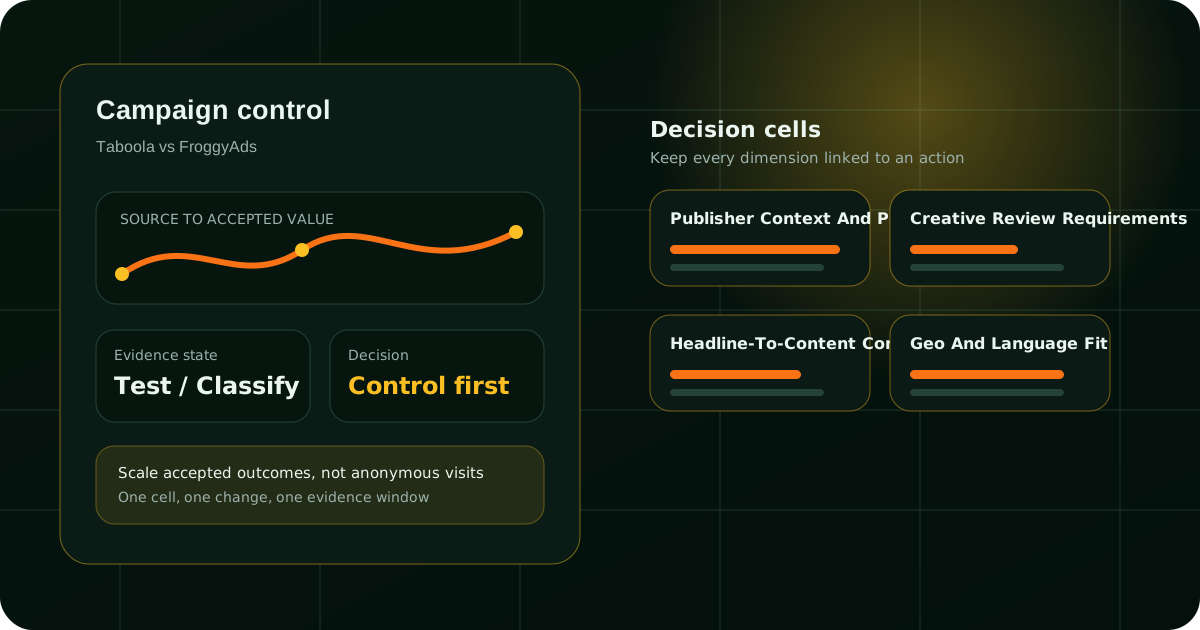
FroggyAds vs Taboola campaign control dashboard
Direct answer

How to approach Taboola vs FroggyAds with measurable control

Paid reach becomes actionable only when the source, journey and downstream event remain connected. To act on Taboola vs FroggyAds, define the audience, destination and final business event before selecting volume. The useful purchase is controlled advertising delivery that can be traced from source to a documented platform choice based on comparable campaign evidence, operational fit and accepted downstream value.

This page focuses on compare FroggyAds and Taboola for a defined advertiser use case without treating either platform as universally better. It does not treat all visits as equal and does not assume that a low CPM, CPC or click-through result creates business value.

The operating path is requirements brief to matched-format setup to equal measurement window to accepted-outcome decision. Every campaign, creative and source identifier should survive that path so the team can distinguish a traffic problem from a page, offer, eligibility or tracking problem.

The primary risks are unequal campaign settings, mismatched inventory, different attribution windows, stale public information and winner-first conclusions. The buyer should establish permission checks, truthful messaging, loss limits and downstream reconciliation before increasing spend.

Independent scope: This independent comparison uses public information reviewed on 2026-07-11 and a controlled-buyer framework. Taboola is presented by its official source as a performance advertising and content recommendation platform focused on native, recommendation and performance placements across publisher environments. The page avoids unsupported winner claims because inventory, pricing, policies and campaign results vary by account, country, format and time.

Current source snapshot

What the official source says the platform is built for

Platform reviewed: Taboola.

Public positioning reviewed: native, recommendation and performance placements across publisher environments.

Research boundary: The source was reviewed on 2026-07-11. Current formats, pricing, availability, policies and account terms must be verified directly before a campaign or migration decision.

Platform-specific evaluation

A controlled decision framework for this exact platform question

Use the following notes to preserve the differences between this canonical and every other alternative or comparison page.

Define the Taboola versus FroggyAds question

The Taboola versus FroggyAds test must begin with one decision question. Examples include which platform supports a particular format, which provides more usable source data, which fits a country budget or which produces lower accepted-event cost for one offer. A vague request to find the better platform cannot produce a defensible answer.

Write the decision question in terms of publisher context and placement, creative review requirements and the accepted event. Because Taboola publicly emphasizes native, recommendation and performance placements across publisher environments, the comparison must state whether FroggyAds is being tested against the same job or a different acquisition approach.

Matched setup for FroggyAds and Taboola

Build the FroggyAds and Taboola cells from the same requirements brief. Keep the eligible country, device, offer, destination, conversion definition and evidence window aligned. Where the interfaces require different settings, record the difference and explain why it is necessary.

The matched-format benchmark should compare overlapping user contexts rather than identical button labels. If Taboola uses a format that FroggyAds does not match exactly, describe the comparison as two acquisition methods and judge the downstream result with that limitation visible.

Equal-budget rule for Taboola and FroggyAds

Give the Taboola cell and the FroggyAds cell budgets that create a meaningful but protected observation window. Equal nominal spend may still produce different delivery speed, source diversity or event count, so the review should report both spend and exposure. Do not end the slower cell early simply because the faster cell reaches its cap first.

During the equal-budget campaign test, keep daily limits, total loss limits and accepted-event definitions fixed. If either Taboola or FroggyAds cannot spend under the matched rules, treat that as a delivery finding rather than silently raising bids or widening targeting.

Source-mix differences in the Taboola comparison

FroggyAds and Taboola may reach different publishers, placements, subscribers, search contexts or social environments. Compare the source mix before comparing averages. A lower blended cost can result from a different audience composition rather than a platform-level efficiency advantage.

Use creative review requirements and headline-to-content continuity to classify what each platform actually delivered. Report where Taboola offers more detail, where FroggyAds offers more detail and where neither side exposes enough information for a confident source decision.

Creative fairness between FroggyAds and Taboola

Use one truthful offer concept, then adapt it to the format rules and user context of FroggyAds and Taboola. Do not force the same image, headline length or call to action into placements that require different creative behavior. Keep the promise and destination consistent while allowing technically appropriate execution.

Track creative maturity in the comparison. A long-optimized Taboola asset should not be compared with a first-draft FroggyAds asset and presented as a platform verdict. Run a control and at least one planned iteration on both sides when the budget permits.

Attribution audit for Taboola versus FroggyAds

The tracking and reporting audit should reconcile Taboola and FroggyAds with the same analytics or backend source of truth. Align timezone, currency, click window, view window, deduplication and event status. Record platform-reported conversions separately from accepted downstream conversions.

When the numbers differ, trace campaign, creative, source, device and geography identifiers through the funnel. Do not award the comparison to FroggyAds or Taboola until missing callbacks, duplicate events, delayed approvals and attribution-window differences are explained.

Policy fit in a FroggyAds and Taboola test

Review current official policies for FroggyAds and Taboola on the same date. A campaign approved by one platform may require different wording, disclosures, landing-page content or geographic restrictions on the other. Eligibility differences should be reported as operational fit, not hidden inside performance data.

For this native comparison, include brand and policy suitability in the scorecard. If one cell violates a policy or cannot legally serve the selected audience, pause it and redesign the comparison rather than interpreting incomplete delivery as weak demand.

Support and workflow comparison with Taboola

Measure how long it takes to create, moderate, troubleshoot and optimize equivalent campaigns on FroggyAds and Taboola. Record the clarity of documentation, the effort required to export reports, the availability of source controls and the time needed to resolve tracking or policy questions.

Operational effort belongs in the platform decision review. A platform that produces similar accepted-event cost with substantially lower team effort may be the better fit for that campaign. A platform that requires more work may still be valuable when its inventory or control is uniquely useful.

No universal winner between FroggyAds and Taboola

The result should be limited to the tested offer, format, country, device, budget and time window. FroggyAds can win one job while Taboola wins another. The comparison should identify the conditions that produced each result and the conditions that were not tested.

Avoid turning one successful source or one weak creative into a permanent platform label. Repeat the test when the offer, season, landing page, source mix or policy changes materially. The most reliable conclusion is the smallest one the evidence can support.

Decision matrix for Taboola and FroggyAds

Score FroggyAds and Taboola separately on publisher context and placement, creative review requirements, headline-to-content continuity, geo and language fit, conversion attribution, brand and policy suitability. For each score, attach the report, screenshot, export or downstream record that supports it. Mark unknown values as unknown rather than estimating them to complete the table.

Weight the dimensions according to the campaign requirement. A brand-safety campaign may weight policy and placement context more heavily, while a direct-response test may weight source-level accepted-event cost and scaling stability. Publish the weights before calculating the result.

Final memo for FroggyAds versus Taboola

The final memo should state the matched setup, all material differences, the accepted-event result, the source mix, operational workload, policy findings and unresolved limitations. Include the reason each budget or source decision changed during the test.

Select a practical outcome: FroggyAds for the tested job, Taboola for the tested job, both platforms for separate jobs, or no decision because the cells were not comparable. This explicit outcome prevents a nuanced test from being reduced to an unsupported winner headline.

Brand-specific audit

Eight checks tied to this exact platform

Taboola audit 1: Publisher Context And Placement

The Taboola review should reconcile publisher context and placement before the matched-format benchmark begins. For Taboola, the public positioning reviewed for this page centers on native, recommendation and performance placements across publisher environments. That context must be translated into a campaign requirement rather than copied as a marketing claim. The FroggyAds cell should answer the same requirement with its own source data, format behavior and accepted-event evidence.

Record the Taboola baseline for downstream quality, then record the FroggyAds result under the same observation rule. When the Taboola and FroggyAds cells differ, name the exact cause: inventory context, creative adaptation, bid, targeting, policy, tracking or downstream validation. The Taboola audit is complete only when the difference can be reproduced and connected to a budget, source, page or platform decision.

Taboola audit 2: Creative Review Requirements

The Taboola review should classify creative review requirements before the equal-budget campaign test begins. For Taboola, the public positioning reviewed for this page centers on native, recommendation and performance placements across publisher environments. That context must be translated into a campaign requirement rather than copied as a marketing claim. The FroggyAds cell should answer the same requirement with its own source data, format behavior and accepted-event evidence.

Record the Taboola baseline for operational workload, then record the FroggyAds result under the same observation rule. When the Taboola and FroggyAds cells differ, name the exact cause: inventory context, creative adaptation, bid, targeting, policy, tracking or downstream validation. The Taboola audit is complete only when the difference can be reproduced and connected to a budget, source, page or platform decision.

Taboola audit 3: Headline-To-Content Continuity

The Taboola review should protect headline-to-content continuity before the tracking and reporting audit begins. For Taboola, the public positioning reviewed for this page centers on native, recommendation and performance placements across publisher environments. That context must be translated into a campaign requirement rather than copied as a marketing claim. The FroggyAds cell should answer the same requirement with its own source data, format behavior and accepted-event evidence.

Record the Taboola baseline for delivery fit, then record the FroggyAds result under the same observation rule. When the Taboola and FroggyAds cells differ, name the exact cause: inventory context, creative adaptation, bid, targeting, policy, tracking or downstream validation. The Taboola audit is complete only when the difference can be reproduced and connected to a budget, source, page or platform decision.

Taboola audit 4: Geo And Language Fit

The Taboola review should compare geo and language fit before the platform decision review begins. For Taboola, the public positioning reviewed for this page centers on native, recommendation and performance placements across publisher environments. That context must be translated into a campaign requirement rather than copied as a marketing claim. The FroggyAds cell should answer the same requirement with its own source data, format behavior and accepted-event evidence.

Record the Taboola baseline for source visibility, then record the FroggyAds result under the same observation rule. When the Taboola and FroggyAds cells differ, name the exact cause: inventory context, creative adaptation, bid, targeting, policy, tracking or downstream validation. The Taboola audit is complete only when the difference can be reproduced and connected to a budget, source, page or platform decision.

Taboola audit 5: Conversion Attribution

The Taboola review should document conversion attribution before the matched-format benchmark begins. For Taboola, the public positioning reviewed for this page centers on native, recommendation and performance placements across publisher environments. That context must be translated into a campaign requirement rather than copied as a marketing claim. The FroggyAds cell should answer the same requirement with its own source data, format behavior and accepted-event evidence.

Record the Taboola baseline for creative continuity, then record the FroggyAds result under the same observation rule. When the Taboola and FroggyAds cells differ, name the exact cause: inventory context, creative adaptation, bid, targeting, policy, tracking or downstream validation. The Taboola audit is complete only when the difference can be reproduced and connected to a budget, source, page or platform decision.

Taboola audit 6: Brand And Policy Suitability

The Taboola review should map brand and policy suitability before the equal-budget campaign test begins. For Taboola, the public positioning reviewed for this page centers on native, recommendation and performance placements across publisher environments. That context must be translated into a campaign requirement rather than copied as a marketing claim. The FroggyAds cell should answer the same requirement with its own source data, format behavior and accepted-event evidence.

Record the Taboola baseline for tracking integrity, then record the FroggyAds result under the same observation rule. When the Taboola and FroggyAds cells differ, name the exact cause: inventory context, creative adaptation, bid, targeting, policy, tracking or downstream validation. The Taboola audit is complete only when the difference can be reproduced and connected to a budget, source, page or platform decision.

Taboola audit 7: Publisher Context And Placement

The Taboola review should verify publisher context and placement before the tracking and reporting audit begins. For Taboola, the public positioning reviewed for this page centers on native, recommendation and performance placements across publisher environments. That context must be translated into a campaign requirement rather than copied as a marketing claim. The FroggyAds cell should answer the same requirement with its own source data, format behavior and accepted-event evidence.

Record the Taboola baseline for budget discipline, then record the FroggyAds result under the same observation rule. When the Taboola and FroggyAds cells differ, name the exact cause: inventory context, creative adaptation, bid, targeting, policy, tracking or downstream validation. The Taboola audit is complete only when the difference can be reproduced and connected to a budget, source, page or platform decision.

Taboola audit 8: Creative Review Requirements

The Taboola review should measure creative review requirements before the platform decision review begins. For Taboola, the public positioning reviewed for this page centers on native, recommendation and performance placements across publisher environments. That context must be translated into a campaign requirement rather than copied as a marketing claim. The FroggyAds cell should answer the same requirement with its own source data, format behavior and accepted-event evidence.

Record the Taboola baseline for policy suitability, then record the FroggyAds result under the same observation rule. When the Taboola and FroggyAds cells differ, name the exact cause: inventory context, creative adaptation, bid, targeting, policy, tracking or downstream validation. The Taboola audit is complete only when the difference can be reproduced and connected to a budget, source, page or platform decision.

Intent ownership

Search intent and cannibalization boundary

Keep this canonical focused on one buyer problem and route adjacent questions to their existing owners.

LayerOwnerBoundary
Primary page intentTaboola vs FroggyAdsOwns direct head-to-head decision intent for Taboola vs FroggyAds. Discovery of other alternatives belongs to /taboola-alternative/. Broad rankings remain owned by /best-ad-networks/ and format strategy by the relevant format pillar.
Parent intentBest Ad NetworksBroader strategy, definitions and platform context remain on the parent page.
Success definitiona documented platform choice based on comparable campaign evidence, operational fit and accepted downstream valueVisits and clicks remain diagnostic until the accepted event is confirmed.
Buyer framework

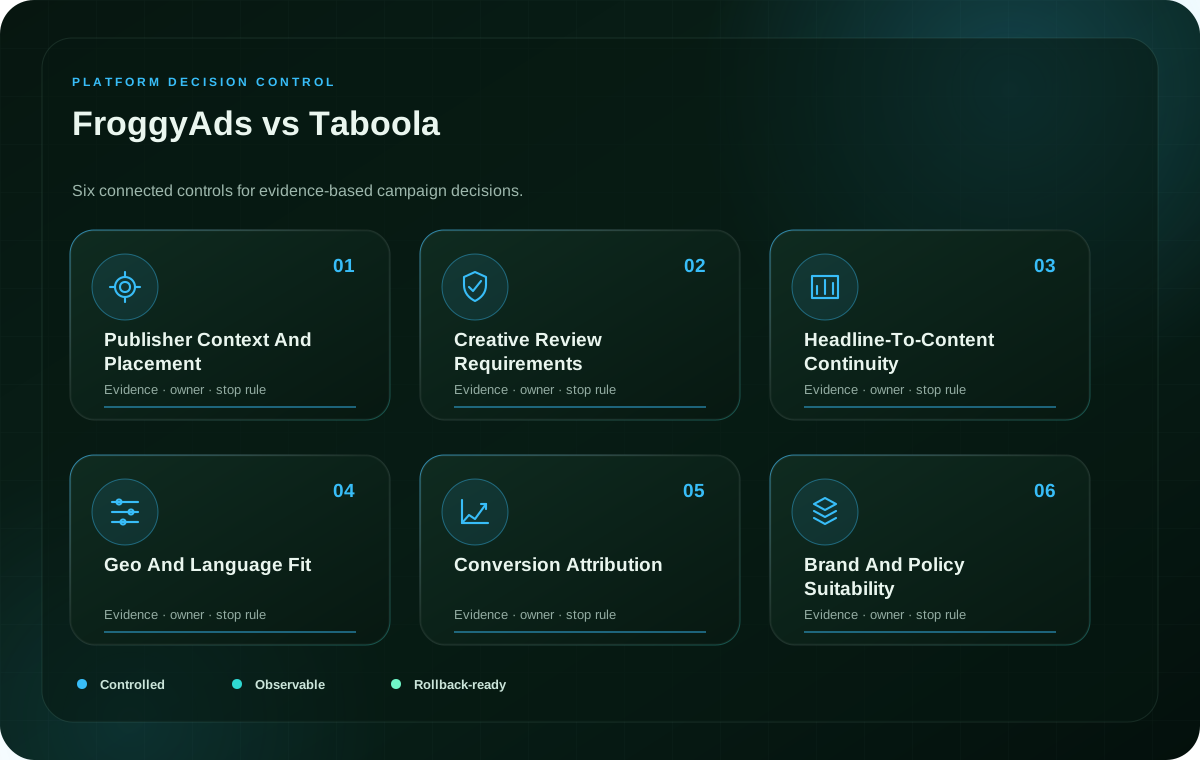
Six controls before the campaign buys scale

Each control must lead to an observable decision rather than a decorative report.

Decision control system
EvidenceOwnerStop rule
01

Publisher Context And Placement

Define the evidence, owner and stop rule for this dimension before delivery expands.

evidencedecisionrollback
02

Creative Review Requirements

Define the evidence, owner and stop rule for this dimension before delivery expands.

evidencedecisionrollback
03

Headline-To-Content Continuity

Define the evidence, owner and stop rule for this dimension before delivery expands.

evidencedecisionrollback
04

Geo And Language Fit

Define the evidence, owner and stop rule for this dimension before delivery expands.

evidencedecisionrollback
05

Conversion Attribution

Define the evidence, owner and stop rule for this dimension before delivery expands.

evidencedecisionrollback
06

Brand And Policy Suitability

Define the evidence, owner and stop rule for this dimension before delivery expands.

evidencedecisionrollback
Decision rule: every control must change a bid, source, page, budget, policy or pause decision. Decorative metrics do not qualify.

Framework rule. The practical unit of optimization is not a visit; it is a source-to-outcome path the team can audit. A complete framework connects publisher context and placement, creative review requirements, headline-to-content continuity, geo and language fit, conversion attribution, brand and policy suitability to the same accepted-event definition. Each dimension must have an owner, evidence window and rollback rule. Do not add a split unless the team is prepared to act differently on the result. Protect the budget with explicit evidence and rollback points.

Workflow

An eight-step campaign operating sequence

Move from business definition to controlled scale without losing the source-to-outcome record.

PlanValidateLaunchScale
  1. 1

    Define the accepted event

    Write the exact condition for a documented platform choice based on comparable campaign evidence, operational fit and accepted downstream value. Include rejection, reversal and delayed validation rules.

  2. 2

    Verify eligibility

    Confirm that the audience, country, format, creative and destination are allowed. Review unequal campaign settings, mismatched inventory, different attribution windows, stale public information and winner-first conclusions.

  3. 3

    Map the complete journey

    Test the path from requirements brief to matched-format setup to equal measurement window to accepted-outcome decision. Preserve campaign, creative, source, device and GEO identifiers.

  4. 4

    Create decision cells

    Separate only the dimensions that can trigger a different bid, page, message, budget or pause decision.

  5. 5

    Launch a bounded test

    Use a fixed evidence window, daily limit, total loss limit and one stable success definition.

  6. 6

    Classify sources

    Move sources through new, uncertain, promising, reduced and excluded states using the same evidence rule.

  7. 7

    Validate downstream quality

    Reconcile front-end events with approval, revenue, activation, retention, refund or other business-quality data.

  8. 8

    Scale one variable

    Increase one winning cell, monitor source-mix changes and roll back when accepted value weakens.

Controlled progression: move forward only when the current step has enough evidence to support the next budget decision.
Measurement model

Measure the complete path, not the cheapest click

Delivery layer. Record impressions, eligible reach, source, format, device, country, bid and frequency. These metrics explain access to inventory but do not prove user value.

Visit layer. Validate page load, consent, session quality, duplicate behavior and the first meaningful interaction. Separate technical failure from audience mismatch.

Conversion layer. Track each step in requirements brief to matched-format setup to equal measurement window to accepted-outcome decision. Preserve the same identifiers through redirects, forms, stores and postbacks.

Acceptance layer. Reconcile the front-end event with a documented platform choice based on comparable campaign evidence, operational fit and accepted downstream value. Include rejection, refund, cancellation, activation, retention or other downstream information when relevant.

Decision layer. Calculate cost per accepted event and value after known quality adjustments. Use that result for bids, whitelists, exclusions, creative decisions and scale.

FroggyAds vs Taboola premium campaign control framework
Scorecard

A practical readiness and source-quality scorecard

DimensionReady signalRisk signalAction
Publisher Context And PlacementDocumented and testableIncomplete, blended or inferredFix before scale
Creative Review RequirementsDocumented and testableIncomplete, blended or inferredFix before scale
Headline-To-Content ContinuityDocumented and testableIncomplete, blended or inferredFix before scale
Geo And Language FitDocumented and testableIncomplete, blended or inferredHold or reduce
Conversion AttributionDocumented and testableIncomplete, blended or inferredHold or reduce
Brand And Policy SuitabilityDocumented and testableIncomplete, blended or inferredHold or reduce

Score the campaign before launch and repeat the review after any material change. A strong click rate cannot compensate for an unclear offer permission, broken attribution, ineligible audience or unaccepted downstream event.

Use the scorecard as a gate. A red result in eligibility, tracking or fulfillment should block scale even when the campaign appears inexpensive at the front of the funnel.

Scenarios

Four ways to apply the framework

Each scenario keeps one hypothesis, one accepted event and one explicit decision window.

Scenario 1

Matched-Format Benchmark

The matched-format benchmark begins with one primary message and one destination that supports compare FroggyAds and Taboola for a defined advertiser use case without treating either platform as universally better. The team records the source, creative, device and geography before interpreting performance.

The evidence model follows requirements brief to matched-format setup to equal measurement window to accepted-outcome decision. Front-end response remains diagnostic until it reconciles with a documented platform choice based on comparable campaign evidence, operational fit and accepted downstream value.

The budget is divided into a learning reserve and a protected scale reserve. A source cannot consume the scale reserve while its downstream quality remains unknown.

The decision at the end of the window is explicit: continue, reduce, exclude, repair or scale. A changed offer, page, bid or source mix starts a new evidence window.

Scenario rule: Do not scale a result that cannot be reproduced or explained.

Scenario 2

Equal-Budget Campaign Test

The equal-budget campaign test begins with one primary message and one destination that supports compare FroggyAds and Taboola for a defined advertiser use case without treating either platform as universally better. The team records the source, creative, device and geography before interpreting performance.

The evidence model follows requirements brief to matched-format setup to equal measurement window to accepted-outcome decision. Front-end response remains diagnostic until it reconciles with a documented platform choice based on comparable campaign evidence, operational fit and accepted downstream value.

The budget is divided into a learning reserve and a protected scale reserve. A source cannot consume the scale reserve while its downstream quality remains unknown.

The decision at the end of the window is explicit: continue, reduce, exclude, repair or scale. A changed offer, page, bid or source mix starts a new evidence window.

Scenario rule: Do not scale a result that cannot be reproduced or explained.

Scenario 3

Tracking And Reporting Audit

The tracking and reporting audit begins with one primary message and one destination that supports compare FroggyAds and Taboola for a defined advertiser use case without treating either platform as universally better. The team records the source, creative, device and geography before interpreting performance.

The evidence model follows requirements brief to matched-format setup to equal measurement window to accepted-outcome decision. Front-end response remains diagnostic until it reconciles with a documented platform choice based on comparable campaign evidence, operational fit and accepted downstream value.

The budget is divided into a learning reserve and a protected scale reserve. A source cannot consume the scale reserve while its downstream quality remains unknown.

The decision at the end of the window is explicit: continue, reduce, exclude, repair or scale. A changed offer, page, bid or source mix starts a new evidence window.

Scenario rule: Do not scale a result that cannot be reproduced or explained.

Scenario 4

Platform Decision Review

The platform decision review begins with one primary message and one destination that supports compare FroggyAds and Taboola for a defined advertiser use case without treating either platform as universally better. The team records the source, creative, device and geography before interpreting performance.

The evidence model follows requirements brief to matched-format setup to equal measurement window to accepted-outcome decision. Front-end response remains diagnostic until it reconciles with a documented platform choice based on comparable campaign evidence, operational fit and accepted downstream value.

The budget is divided into a learning reserve and a protected scale reserve. A source cannot consume the scale reserve while its downstream quality remains unknown.

The decision at the end of the window is explicit: continue, reduce, exclude, repair or scale. A changed offer, page, bid or source mix starts a new evidence window.

Scenario rule: Do not scale a result that cannot be reproduced or explained.

Intent-specific operating dossier

Twelve decision notes for FroggyAds vs Taboola

Use these notes to keep the campaign tied to this page's buyer problem, accepted event and evidence boundary.

The weekly operator review for FroggyAds vs Taboola

A useful review combines delivery, journey, conversion and downstream evidence. For platform decision review, the operator should show the spend by source, the movement through requirements brief to matched-format setup to equal measurement window to accepted-outcome decision, the number and cost of a documented platform choice based on comparable campaign evidence, operational fit and accepted downstream value, and the unresolved risks connected with publisher context and placement.

End the review with named actions and deadlines. Each action should identify the affected cell, the evidence, the expected effect and the rollback point. Avoid vague instructions such as optimize more or find better traffic. The next reviewer should be able to see exactly why the campaign changed.

Creative Review Requirements: the first control for FroggyAds vs Taboola

In a tracking and reporting audit plan, creative review requirements must produce a decision the buyer can execute. For Taboola vs FroggyAds, document the observable signal, the person responsible for reviewing it and the exact condition that changes a bid, source, message, page or budget. The record should also state what would make the signal unreliable, including a broken redirect, an unverified event or a material change in the delivery mix.

Apply this control to the route from requirements brief to matched-format setup to equal measurement window to accepted-outcome decision. A front-end improvement is not enough when it fails to reconcile with a documented platform choice based on comparable campaign evidence, operational fit and accepted downstream value. Keep the evidence window stable, retain the source identifier and reopen the test when the assumption behind creative review requirements changes.

A decision brief for Equal-Budget Campaign Test

The equal-budget campaign test scenario should begin with a written hypothesis specific to FroggyAds vs Taboola. State why the chosen audience, format and destination can support compare FroggyAds and Taboola for a defined advertiser use case without treating either platform as universally better, then identify the event that would disprove the hypothesis. This avoids treating ordinary delivery or a temporary click-rate lift as proof that the campaign is ready for more spend.

Use headline-to-content continuity as the review lens. The campaign is not complete until the source-to-outcome chain reaches a documented platform choice based on comparable campaign evidence, operational fit and accepted downstream value. If the result is delayed, rejected or reversed, keep it outside the accepted total and record the reason before the next decision.

Protecting the FroggyAds vs Taboola test budget

Budget protection for Taboola vs FroggyAds starts by separating learning money from expansion money. The matched-format benchmark cell can spend from the learning reserve only while tracking, eligibility and the destination remain healthy. It earns access to the expansion reserve after geo and language fit and the other control dimensions show stable evidence.

The loss rule must account for unequal campaign settings, mismatched inventory, different attribution windows, stale public information and winner-first conclusions. Pause immediately for a policy, consent, fulfillment or tracking failure. For ordinary performance uncertainty, wait for the declared observation window, then decide whether to repair, reduce, exclude, continue or scale.

Reading conversion attribution without metric shortcuts

For FroggyAds vs Taboola, conversion attribution should be read across the full funnel rather than in isolation. Impressions describe access, clicks describe response and page events describe progression, but the business result is a documented platform choice based on comparable campaign evidence, operational fit and accepted downstream value. A source can look inexpensive before validation and become costly after duplicate, rejected, cancelled or low-value events are removed.

During platform decision review, compare cells with the same attribution window and acceptance rule. Do not reward a source because it reports faster. Do not punish a slower source until the expected validation period has closed and missing postbacks have been investigated.

Journey QA for Tracking And Reporting Audit

Walk through requirements brief to matched-format setup to equal measurement window to accepted-outcome decision on the devices and locations included in the FroggyAds vs Taboola campaign. Confirm that the ad promise, page explanation, form or store step, confirmation and final event describe the same action. Capture the campaign, creative, source, device and geography at every handoff.

The brand and policy suitability review should include slow connections, declined actions, validation errors and return visits. A technically successful click is not a successful journey when the page cannot serve the user, the action is ineligible or the accepted event cannot be attributed.

Source classification for FroggyAds vs Taboola

Classify each source as new, uncertain, promising, reduced or excluded. In the equal-budget campaign test scenario, the state is determined by publisher context and placement, cost and accepted quality, not by a single attractive front-end metric. Store the evidence used for the classification so the team can reproduce the decision after a creative or bid change.

A source that produces a documented platform choice based on comparable campaign evidence, operational fit and accepted downstream value at a sustainable cost may move toward a whitelist. A source associated with unequal campaign settings, mismatched inventory, different attribution windows, stale public information and winner-first conclusions should remain limited until the issue is resolved. Changing the source state also changes the test and should start a fresh comparison window.

Creative continuity in a matched-format benchmark campaign

The creative for Taboola vs FroggyAds must set an expectation the next page can satisfy. Use creative review requirements to inspect whether the headline, visual, call to action and destination describe one consistent user task. The creative should not imply a guaranteed outcome, hide a cost or commitment, imitate a system warning or use urgency the advertiser cannot support.

Keep one control creative and change one material concept at a time. Judge the new concept by its contribution to a documented platform choice based on comparable campaign evidence, operational fit and accepted downstream value, not only by click-through rate. A higher-response concept that attracts unsuitable users is a losing creative.

Operator fieldbook

Detailed campaign controls for FroggyAds vs Taboola

Turn setup, creative, tracking, source and budget observations into repeatable actions.

Campaign naming. Paid reach becomes actionable only when the source, journey and downstream event remain connected. Use a stable structure that identifies the objective, audience, format, country, device and test version. For Taboola vs FroggyAds, the name should make it possible to reconcile spend without opening every creative. Turn the observation into a bid, budget, page, source or pause decision. Do not scale a result that cannot be reproduced or explained.

Offer and page continuity. A low click price is informative only when the same traffic can produce an accepted outcome. The promise in the ad must remain recognizable throughout requirements brief to matched-format setup to equal measurement window to accepted-outcome decision. A useful page explains the action, price or commitment, eligibility and next step before the user submits data. Turn the observation into a bid, budget, page, source or pause decision. Treat a changed source mix as a new test rather than a continuation.

Source identity. The first objective is to remove ambiguity from the offer, audience and event chain. Preserve placement, zone, site, app or other source identifiers. Aggregate reporting can reveal a trend, but source-level evidence is required for whitelists, exclusions and bid adjustments. Turn the observation into a bid, budget, page, source or pause decision. Keep the rule unchanged until the evidence window closes.

Device separation. Campaign control comes from small decision cells that can be paused without losing the whole test. Mobile and desktop can have different connection speed, layout, input friction, store behavior and acceptance. Keep them visible until the evidence supports one rule. Turn the observation into a bid, budget, page, source or pause decision. Pause when tracking, eligibility or fulfillment becomes uncertain.

GEO and language. The practical unit of optimization is not a visit; it is a source-to-outcome path the team can audit. A country setting does not prove that the page, support, fulfillment or legal position fits every user. Separate language and local availability when the customer promise changes. Turn the observation into a bid, budget, page, source or pause decision. Protect the budget with explicit evidence and rollback points.

Creative testing. The campaign should begin with a business definition, not an inventory promise. Test one material concept at a time. Keep a control, record the hypothesis and judge creative quality by accepted outcomes rather than click response alone. Turn the observation into a bid, budget, page, source or pause decision. Record the reason for every budget, bid or source decision.

Landing-page QA. A useful traffic plan is a measurement system before it becomes a scaling system. Check loading, consent, forms, buttons, redirects, validation messages, accessibility, tracking and confirmation on realistic devices before buying scale. Turn the observation into a bid, budget, page, source or pause decision. Use downstream quality to overrule attractive front-end metrics.

Attribution continuity. The buyer needs to know what will be accepted before deciding how much volume to purchase. Use unique campaign parameters and server-side postbacks where appropriate. Reconcile duplicate, missing, delayed and rejected events before changing bids. Turn the observation into a bid, budget, page, source or pause decision. Make one material change at a time so the next result remains interpretable.

Budget protection. Paid reach becomes actionable only when the source, journey and downstream event remain connected. Set daily, source and campaign limits. A learning budget is not permission to ignore a broken funnel or a clearly invalid source. Turn the observation into a bid, budget, page, source or pause decision. Do not scale a result that cannot be reproduced or explained.

Evidence windows. A low click price is informative only when the same traffic can produce an accepted outcome. Use a window long enough to observe delayed approval or downstream value. Do not shorten it after weak results or extend it only for a preferred source. Turn the observation into a bid, budget, page, source or pause decision. Treat a changed source mix as a new test rather than a continuation.

Optimization log. The first objective is to remove ambiguity from the offer, audience and event chain. Record the date, owner, evidence, change, expected effect and rollback threshold. The log should explain why the campaign looks different today. Turn the observation into a bid, budget, page, source or pause decision. Keep the rule unchanged until the evidence window closes.

Scale review. Campaign control comes from small decision cells that can be paused without losing the whole test. Before scaling, confirm that a documented platform choice based on comparable campaign evidence, operational fit and accepted downstream value remains stable, the source mix has not deteriorated and the business can fulfill the additional demand. Turn the observation into a bid, budget, page, source or pause decision. Pause when tracking, eligibility or fulfillment becomes uncertain.
Limitations and responsible use

What paid traffic cannot guarantee

FroggyAds can provide campaign controls and access to advertising inventory, but no platform can guarantee clicks, leads, sales, installs, approvals, deposits, rankings, ROI or other business outcomes. Results depend on the audience, offer, creative, source mix, bid, destination, policy, tracking and downstream operation.

Traffic-quality systems, source exclusions and invalid-activity checks reduce risk but cannot eliminate every unsuitable interaction. The advertiser remains responsible for truthful claims, lawful targeting, user consent, data handling, offer permissions, fulfillment and monitoring.

Do not use paid traffic to simulate organic search demand, manipulate analytics, create fake engagement or mislead users about the source or purpose of a visit. Build campaigns around genuine advertising delivery and measurable customer value.

When eligibility, tracking or fulfillment is uncertain, pause the affected cell. Protecting users and preserving clean evidence is more valuable than maintaining delivery at any cost.

FAQ

FroggyAds vs Taboola FAQ

Which is better, FroggyAds or Taboola?

There is no universal winner. The better fit depends on required formats, countries, targeting, source reporting, tracking, policy, support, budget and downstream campaign results.

How should the two platforms be tested?

Create matched campaign cells with the same eligible audience, offer, destination, conversion definition and evidence window where practical. Judge the test by a documented platform choice based on comparable campaign evidence, operational fit and accepted downstream value.

Should CPM or CPC decide the winner?

No. CPM and CPC explain media cost but not accepted business value. Include conversion acceptance, revenue or activation quality, invalid events, refunds and operational effort where relevant.

Do both platforms need identical inventory?

No, and exact equivalence may be impossible. Document the format and inventory differences, then compare only the overlapping job or state clearly that the test evaluates different approaches.

How much budget should a comparison use?

Use a bounded budget large enough to observe meaningful events but small enough to protect the wider plan. Set daily limits, total loss limits and a rollback point before launch.

What tracking is required?

Use stable campaign, creative, source, device and geography identifiers. Keep the same attribution rule and reconcile platform reports with the system that validates the final business event.

Can this page replace current platform documentation?

No. The public source reviewed for Taboola may change, and FroggyAds features or policies can also change. Verify current official information before making a buying decision.

How should creative differences be handled?

Adapt creative to each format while preserving the same truthful offer and destination promise. Record the adaptation so creative suitability is not mistaken for a platform-wide advantage.

When should a source be excluded?

Exclude or reduce a source when the declared evidence threshold is met, or immediately for clear policy, consent, tracking or safety failures. Review unequal campaign settings, mismatched inventory, different attribution windows, stale public information and winner-first conclusions before scaling.

Can both platforms remain in the media plan?

Yes. A buyer may use different platforms for different formats, countries, source pools or campaign stages. The decision should follow evidence and operational fit rather than forcing one permanent winner.

Continue the traffic plan

Related FroggyAds resources

Taboola Alternative

Use this resource to extend the campaign plan without merging distinct search intent.

Best Ad Networks

Use this resource to extend the campaign plan without merging distinct search intent.

Buy Website Traffic

Use this resource to extend the campaign plan without merging distinct search intent.

Traffic Quality Monitoring

Use this resource to extend the campaign plan without merging distinct search intent.

Self-serve media buying

Build the campaign around accepted outcomes

Start with controlled targeting, complete tracking and a budget the business can evaluate responsibly.

Create My Free Account