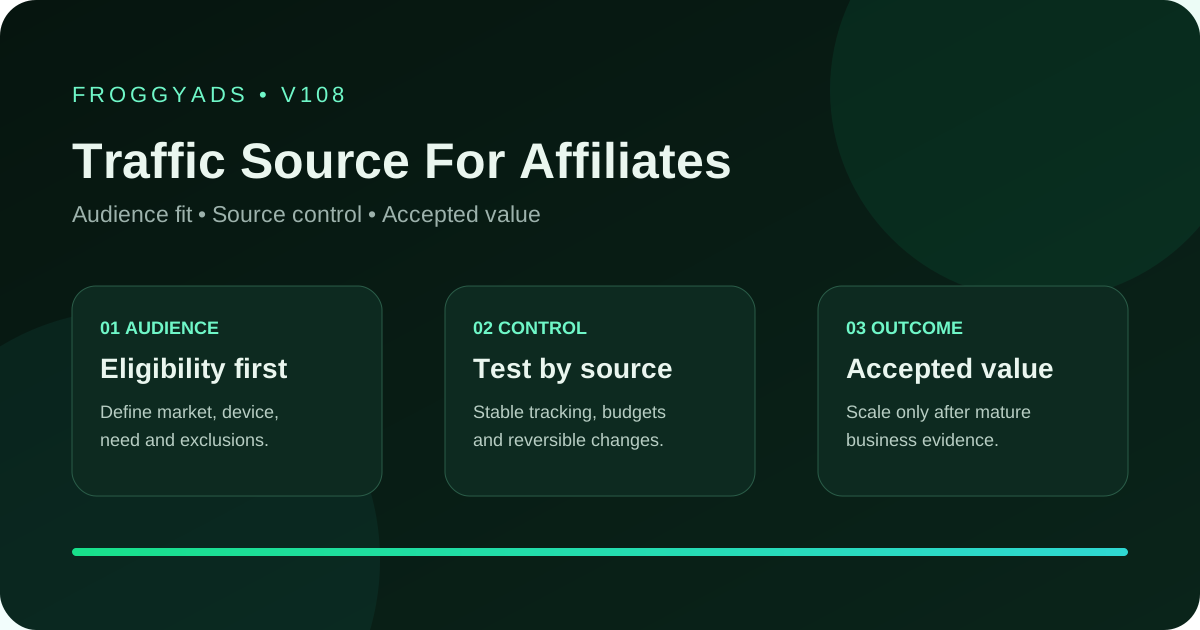
What does a traffic source for affiliate marketing identify?
In affiliate media buying, a traffic source may mean the advertising network, a format such as Native or Push, or a source or zone inside one campaign. Decide which layer your question concerns before comparing results. A network-level decision needs different evidence from a placement exclusion, and neither should be inferred from a blended tracker total.
With FroggyAds, you can operate the paid-media part of this chain from a self-serve account. Choose an eligible format, set targeting and budget controls, keep the available source identifiers, and review delivery beside the affiliate programme’s accepted outcomes. We give you the buying controls; the offer owner still decides which actions qualify for commission.
A tracker event is not automatically payable commission. Label each result as recorded, pending, approved, rejected, reversed or paid according to the programme’s actual workflow. Keep the event date and review date with the media cohort, and do not assign campaign-level value to a source row unless the join can be verified.
Build an offer-to-source brief before you buy traffic
Start with the offer, not a list of popular networks. Record the permitted traffic method, eligible countries, device context, creative constraints, destination rule, payable action and approval window. Then shortlist the route your team can launch and measure. A source can have ample traffic and still be wrong for the specific promotion.
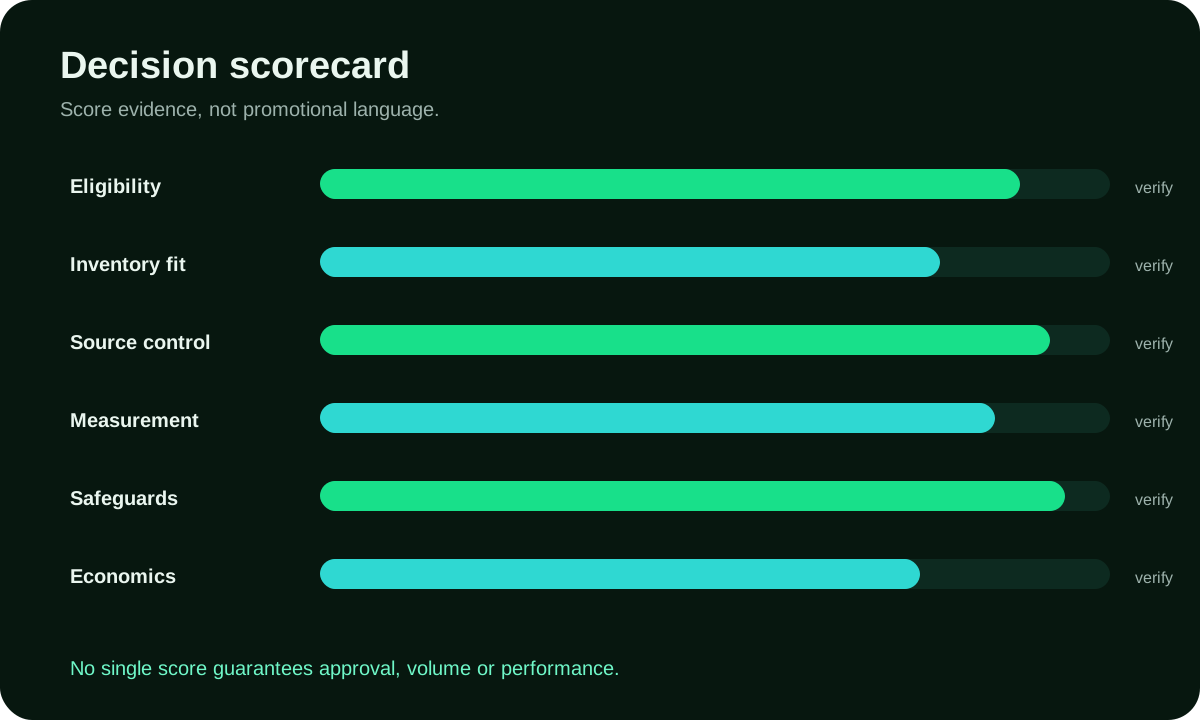
Keep offer eligibility and performance proof in separate columns. Written permission establishes what you may test; it does not predict commercial value. Delivery and commission records show what happened; they do not authorise an unapproved method after the fact. Your next purchase should require both kinds of evidence.
| Decision area | Record before purchase | Evidence for the next commitment |
|---|---|---|
| Offer permission | Exact traffic method, market, message, format and destination conditions for this offer. | Current programme terms or written clarification that covers the proposed paid route. |
| Source identity | Advertising network, format, campaign and the available source or zone identifier. | A retained namespace and definition for every identifier used in the comparison. |
| Receiving route | The permitted direct link or bridge route, including the live offer and page version. | A verified redirect chain, working destination, relevant disclosure and intact tracking parameters. |
| Approval definition | The commissionable action, validation states, approval timing and possible adjustment window. | Recorded, pending, approved, rejected, reversed and paid outcomes shown separately. |
| Affordable commitment | Media allocation, related production or tracking cost, and value still awaiting a decision. | A bounded next purchase supported by evidence at the finest defensible reporting level. |
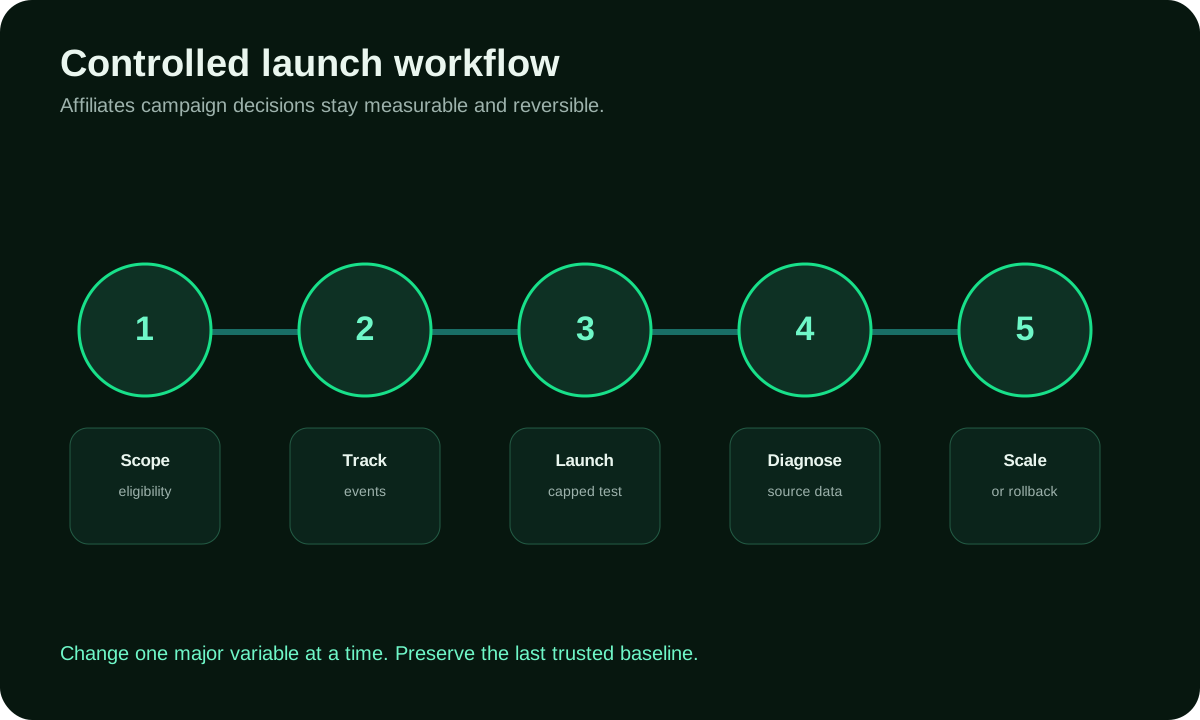
Assign an owner to each failure mode before launch. One person should clarify programme restrictions, another should repair the route or tracking, and the authorised buyer should approve additional spend. Pause for broken destinations, uncertain eligibility or an exhausted test cap. Use a separate commercial rule for a valid route whose mature approved value is simply too weak.