Event readiness
Events are deduplicated, timely and tied to the correct product or order.
Failures become prerequisites rather than campaign deductions.
AdRoll states that self-service Ads are pay-as-you-go with no minimum spend. A responsible launch still needs usable audience data, current account terms and a capped incrementality test.
AdRoll's public pricing page describes self-service advertising as pay-as-you-go with no minimum spend. This removes a mandatory media-spend floor for that route; it does not establish identical terms for managed service, add-ons or another package.
Confirm the live account, billing entity, currency, payment method, invoice or charge cadence, tax treatment and any package selection before launch. Save the screen and terms used for the decision so the no-minimum statement remains attached to the correct product.
No entry floor is not the same as no preparation cost. Audience instrumentation, consent, product data, creative, analytics, staff time and sufficient delivery for an incrementality test can all determine whether a small campaign produces useful evidence.
| Commercial question | Self-service evidence | Required follow-up |
|---|---|---|
| Minimum spend | Public pay-as-you-go statement | Verify the selected account route |
| Billing | Live method, currency and cadence | Reconcile actual charges |
| Package | Self-service, managed or add-on scope | Do not generalize terms |
| Evidence budget | Audience and holdout requirements | Approve a bounded learning plan |
Audit essential site events, consent coverage, product identifiers, customer exclusions, order status and refund handling. Estimate the engineering or operations work needed to make the audience definition reproducible. A tiny media charge cannot compensate for unreliable eligibility data.
Check whether the intended audience is large enough to deliver under the selected country, recency and channel conditions. If it is not, redesign the audience or evidence question before allocating spend rather than weakening the definition after launch.
Prepare a creative sequence appropriate to each journey stage. Budget variants for product viewers, cart abandoners or broader site visitors separately. Reusing one generic message can obscure whether poor performance came from media or journey mismatch.
Events are deduplicated, timely and tied to the correct product or order.
Failures become prerequisites rather than campaign deductions.
Recency, size, exclusions and consent are documented.
Insufficient eligibility changes the test design.
Each message continues the actual journey state.
Unapproved or broken continuity stops launch.
Create a technical allowance to verify audience population, creative serving, destination, conversion transport and billing. Then create a separate contribution allowance sized for the eligible audience and the minimum incremental-order evidence the business needs.
Use daily and total media limits, frequency boundaries and a review schedule. Stop when audience eligibility breaks, repetition exceeds the approved range, order data cannot mature cleanly or spend reaches the loss limit before the evidence floor.
Keep reserve outside active campaign authority. Release it only after the technical path, audience composition and early holdout records are consistent. Pay-as-you-go access supports this staged control but does not replace it.
| Allowance | Purpose | Release condition |
|---|---|---|
| Technical | Verify data, delivery, destination and billing | Complete trace and correct charge |
| Contribution | Estimate added mature orders | Stable audience and counterfactual |
| Reserve | Repeat or extend a defensible test | Written confidence need |
| Stop amount | Maximum media loss | Any critical gate fails |
Match account charges or invoices to campaign spend, dates, currency and adjustments. Keep media charge, software or service fee and add-on cost in separate ledger rows. Resolve discrepancies before calculating the total test cost.
Add readiness and operator costs to a total evidence-cost view, while keeping them outside CPM. The record should show what the business spent on media, what it spent to make the test valid and what incremental-order evidence it obtained.
Archive or pause audiences and creatives according to the approved closure plan. Confirm that no unintended campaign remains eligible, preserve the holdout result and record the conditions required to reopen spend.
Name the journey problem before creating a campaign. Examples include measuring cart-recovery incrementality, checking product-feed continuity for recent viewers or testing whether a broader visitor audience is large enough for stable delivery. One worksheet should answer one problem.
Record the eligible audience count and expected replenishment. Calculate the maximum reachable users under the planned recency and frequency rules. This sets an upper boundary on useful impressions and prevents a budget from demanding more delivery than the audience can absorb responsibly.
Prepare the counterfactual before media release. Define holdout eligibility, allocation, contamination checks, order maturity and the smallest decision-relevant difference. If the design cannot distinguish contribution, reduce the claim and fund a diagnostic rather than a performance verdict.
Model charge scenarios from observed or bounded dynamic CPM ranges. Include low delivery, expected delivery and high competition, then add creative, data and operator costs outside media. The worksheet shows cash exposure without presenting any scenario as a promised rate.
Set checkpoints for technical continuity, audience composition, reach, frequency, order reconciliation and loss. Every checkpoint names the owner and action. Pause authority must be available when a feed, event or exclusion fails.
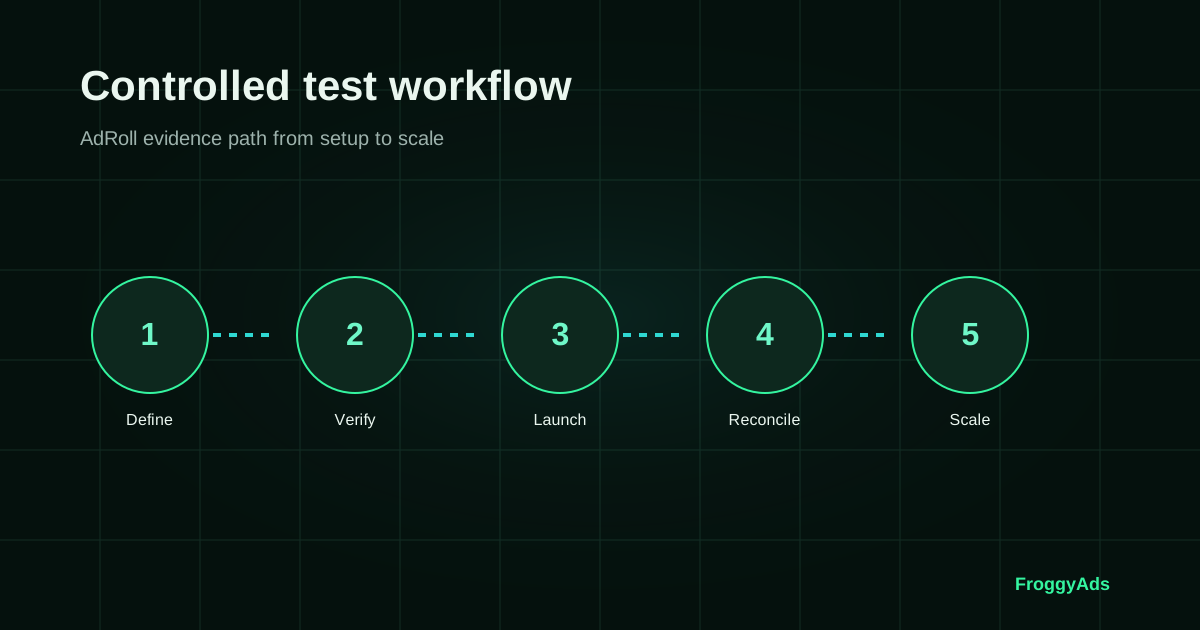
Close the worksheet with charge reconciliation, residual campaign state and evidence gained. The final line says whether to scale, revise audience or creative, repair data, retain the diagnostic only, or stop.
| Worksheet checkpoint | Question | Release decision |
|---|---|---|
| Audience | Is eligibility accurate and sufficient? | Open technical allowance |
| Serving | Do message, destination and exclusions work? | Open contribution cell |
| Maturity | Are orders and holdout records complete? | Judge evidence |
| Closure | Do charges and campaign state reconcile? | Archive or approve next test |
At the smallest level, ask only whether events populate the intended audience, exclusions work, creative serves to the correct destination and charges reconcile. Do not judge order economics from a diagnostic cell with insufficient eligible users or maturity.
At the next level, ask whether the audience can deliver without excessive repetition and whether platform exposure joins to paid orders. Use reach and frequency gates before opening a causal test.
At the contribution level, fund a counterfactual and mature-order window capable of detecting the smallest business-relevant difference. State when audience volume makes that goal infeasible.
At the scale level, release budget only for audience-stage cells that passed contribution and operational gates. Continue to protect customer exclusions, channel overlap and marginal frequency.
If any level fails, choose repair, redesign or stop. Do not add spend to compensate for broken data, tiny audiences or a counterfactual that cannot answer the question.
Record the decision produced at every level. Pay-as-you-go flexibility is most valuable when each small release purchases a specific piece of evidence.
Any request to raise daily or total spend identifies the audience-stage cell, current reach and frequency, counterfactual status, mature incremental orders, marginal contribution and remaining uncertainty. A deadline or unused account capacity is not an evidence-based reason.
Finance confirms charge reconciliation and package scope. Media operations confirms delivery controls. Analytics confirms the order and holdout joins. Merchandising confirms product and destination continuity. The exception proceeds only when the relevant owners approve their evidence.
Time-limited approval states the amount, duration and automatic reversion. If the additional spend changes audience composition or channel mix, create a new test interval rather than merging it into the old result.
Archive denied requests with the failed gate. This prevents repeated pressure to fund the same unresolved problem and shows what evidence would allow reconsideration.
Review cumulative exceptions each month. Repeated temporary increases can silently become the real budget policy, bypassing the original audience and loss controls. Consolidate only after the complete contribution and charge history supports a revised standing limit.
Attach the revision to a new controlled version of the launch worksheet and preserve the replaced limit. Finance and media owners should be able to trace every standing increase back to mature accepted incremental contribution evidence, not merely to earlier temporary approvals.
The reviewed pricing page states pay-as-you-go with no minimum spend for self-service Ads.
No. Verify managed services, add-ons and other packages separately.
No. A valid audience, creative sequence, counterfactual and mature-order sample can require meaningful resources.
Confirm product route, currency, payment method, billing cadence, tax and current terms.
Use it to verify audience population, serving, destination, conversion transport and billing.
Base it on eligible audience volume and the incremental-order evidence required for a bounded decision.
It prevents available account access from becoming permission to spend before early gates pass.
Stop on broken eligibility, excessive repetition, incomplete order reconciliation, policy failure or the approved loss limit.
Keep media, software or service, add-on and readiness costs distinct even when reporting total test cost.
Recheck after changes to package, account route, billing terms or the cited pricing page.
The AdRoll pricing page checked on states that self-service advertising is pay-as-you-go with no minimum spend. Managed services and add-on products can follow different commercial rules, so the self-service statement must stay attached to its product route.
No minimum spend removes an entry floor; it does not remove the need for audience readiness, an evidence budget, loss limits and current billing verification inside the account.
Commercial conditions associated with AdRoll are cited to AdRoll evidence, while FroggyAds funding and campaign facts remain tied to FroggyAds records.
Best Ad Networks can compare AdRoll account entry only after audience scale, campaign readiness and unused-funds conditions are visible.
A funded AdRoll account does not define prospecting spend; Buy Website Traffic establishes that distinct allocation decision.
Traffic Quality Monitoring evaluates delivery from the AdRoll budget while retaining audience and source distinctions.
Complete Conversion Tracking Setup before deciding whether AdRoll funding produced attributable, mature customer activity.