
Buy Health Traffic
Plan health and wellness acquisition around a supportable offer, an eligible customer and a verifiable outcome. Use FroggyAds controls to test delivery while the advertiser protects consent, claim accuracy and sensitive information.
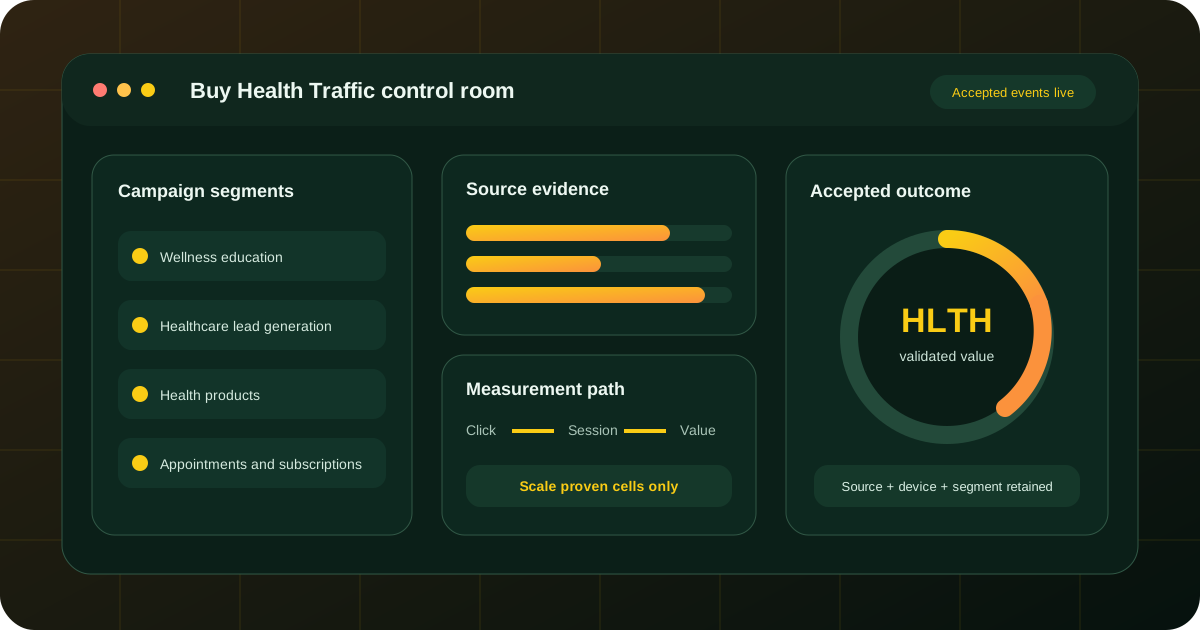
Buy Health Traffic at a glance
What does this page explain about Buy Health Traffic?
Quick answer: Buy health traffic with GEO, audience, source and device controls, responsible claims, consent-aware tracking and accepted-lead measurement. For Health and wellness campaigns, the scorecard should explicitly penalize unsupported health claims, sensitive-data overcollection and other issues that can make low-cost traffic appear stronger than it is. When attended appointment rises or unsupported health claims appears, the analyst should be able to identify the affected placement, device, segment, creative and destination version without relying on a blended dashboard. It means purchasing paid advertising targeted to Health and wellness campaigns or the specific audience described by this page, while preserving source, device, segment and conversion data through an accepted business event.
| Section | Distinct excerpt from this page |
|---|---|
| Health traffic purchase control | Creative and landing pages should not promise guaranteed outcomes, hide material risks or imply a diagnosis the advertiser cannot make. |
| Decision-ready health campaign cells | The accepted event may be a verified appointment, eligible lead, completed purchase or retained subscription. |
| Offer eligibility | Confirm that Health and wellness campaigns users can lawfully and practically access the offer, price, payment, delivery and support. |
Reference for Buy Health Traffic: FTC guidance on online advertising and marketing.
- Planning: Plan a measurable health acquisition route.
- Control: What this guide covers.
- Decision: Separate each offer and accepted outcome into a clear test cell.
How to buy health traffic with measurable control
Buy health traffic only after defining the offer category, eligible audience and accepted business event. A clinic may measure an eligible appointment request. A wellness subscription may use successful billing and later retention. A health product campaign may use a paid order adjusted for refunds. These outcomes need different messages, forms and review windows.
FroggyAds helps you buy and control the advertising delivery. We provide format, targeting, budget and source tools for a measured test. Your booking, commerce or customer system remains the authority for eligibility and value. Keep campaign and placement context attached to the accepted outcome where your implementation supports it.
Health advertising needs a claim boundary before creative production. Use statements the advertiser can support for the exact product, service and market. Avoid diagnoses, guaranteed outcomes, fabricated urgency and language that exploits fear. Put material eligibility, price, renewal, delivery and limitation information where the prospect can understand it before committing.
Treat sensitive information as an operating constraint. Collect only the details required for the stated next step. Do not place symptoms, conditions or personal health details in campaign names, URLs or source labels. Apply the advertiser's approved privacy, consent, access and retention practices throughout the route.
What this guide covers
Use this guide to turn a health offer into an auditable paid-media test. It covers offer eligibility, claims, privacy, customer-path checks, FroggyAds campaign controls, accepted-outcome measurement and staged allocation. The goal is to identify which combination can create qualified demand within the advertiser's written limits.
For Buy Health Traffic, use the buy website traffic guide and the traffic sources hub to set the broader acquisition model, then narrow the decision with the related country, format, audience or platform guide that matches the campaign.
Build Health and wellness campaigns as decision-ready cells
Create each cell around one health offer and one business question. An appointment cell can ask whether residents in a supported area complete an eligible request. A wellness product cell can ask whether purchasers keep the order after the return window. The accepted event should describe value the advertiser can verify, not merely activity that is easy to count.
Carry health-specific rejection reasons into the source review. Examples include unsupported location, unavailable service, missing consent, failed contact, cancellation, return and subscription reversal. These reasons show whether the next change belongs in targeting, the promise, the destination, operations or the offer.
Limit the first matrix to the few distinctions that can change a decision. Separate countries with different eligibility, formats with different message space and devices with different booking or checkout behavior. Hold other variables stable so the source evidence can explain what happened and what to test next.
| Campaign cell | Why it stays separate | Primary failure to watch |
|---|---|---|
| Wellness education | Keep visible until value is proven | unsupported health claims |
| Healthcare lead generation | Use when pricing or service changes | sensitive-data overcollection |
| Health products | Separate by device and source | ineligible leads |
| Appointments and subscriptions | Merge only after evidence | cancellation and refund loss |
Six checks before any budget is released
Offer eligibility
Verify that the promoted service, product or programme is actually available to the intended customer in the selected market. Check important qualifications, current price, payment method, delivery or appointment capacity and the support path a prospect will receive after responding.
Audience fit
Define the audience through a legitimate need connected to the offer. Avoid language or segmentation that claims knowledge of a person's private condition. Record required exclusions and ensure the creative does not shame, frighten or single out a viewer.
Destination readiness
Walk through the destination as a first-time prospect. Confirm that claims match the approved creative, material conditions are visible and every form, booking, purchase and confirmation step works. Review error messages and shared-device behavior for accidental disclosure.
Measurement ownership
Name the final business event and its owner before launch. Keep neutral campaign, source, format, device, creative and destination identifiers with that event. Store personal and health-related information only in the advertiser's approved system.
Source control
Decide how placements will be classified after the correct outcome delay. Include minimum evidence, accepted acquisition cost, rejection patterns and a retest rule. A placement should not be rewarded for fast form activity when later eligibility or refunds reverse the apparent value.
Scale discipline
Set a loss ceiling and an operational ceiling. Stop if tracking, consent, availability or claims become unreliable. Expand only when mature accepted outcomes remain viable and the advertiser can handle the extra appointments, orders, members or support requests.
An eight-step launch and optimization process
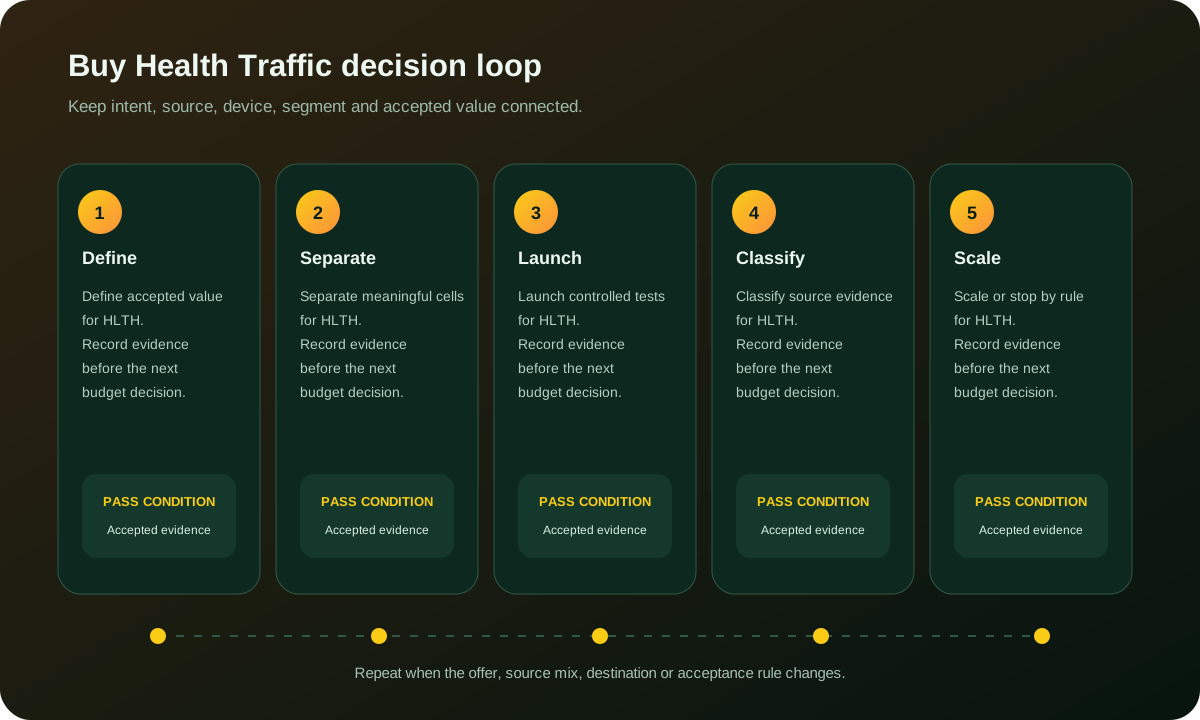
Define the decision
Write a one-sentence acquisition hypothesis for the health offer. State the eligible customer, approved promise, chosen FroggyAds format and accepted outcome. Add the maximum learning loss and the date when enough downstream evidence should exist.
Verify the journey
Validate every path before buying delivery. Test the ad-to-page message, consent choice, form or booking route, price, payment, confirmation and customer support information. Use representative devices and preserve the exact destination version.
Build campaign cells
Create only decision-relevant cells. Separate a market, device, format or proposition when it changes eligibility, message space, customer steps or economics. Avoid producing a grid so large that each cell lacks enough evidence for a decision.
Launch with limits
Launch with capped spend and source visibility. Confirm that visits load, neutral identifiers persist and the advertiser's accepted event can be reconciled. Pause immediately when the measurement chain breaks rather than purchasing data that cannot answer the campaign question.
Validate delivery
Review early diagnostics without mistaking them for value. Use loaded sessions, page engagement, form starts and checkout progress to locate friction. Use eligible contacts, completed appointments, settled orders or retained subscriptions for allocation after the stated maturity window.
Classify outcomes
Classify every downstream result with a usable reason. Keep accepted, duplicate, ineligible, unreachable, cancelled, refunded and retained states where they fit the offer. Those states reveal whether media, message, operations or customer fit caused the loss.
Apply stop rules
Apply the written keep, repair, restrict, retest or pause rule to each mature cell. Record the evidence and responsible owner. Give a repaired cell a new window so old conditions do not hide the effect of the change.
Scale proven cells
Increase one dimension in a measured step after the cell qualifies. Compare the added cohort with the prior stable period for fit, cost, capacity and reversals. Roll back if the expansion moves beyond the accepted boundary.
Choose a format for the customer journey
| Format | Best role in the plan | What to measure |
|---|---|---|
| Push | Direct, time-sensitive messages where the promise can be understood quickly | Clicks, loaded sessions, accepted event rate and complaint feedback |
| Native | Contextual discovery with more room for explanation | Engaged sessions, qualified progression and accepted outcome cost |
| Display | Visual reach, retargeting and broad awareness support | Viewability, clicks, assisted conversions and frequency |
| Pop | High-volume testing when the destination can qualify intent quickly | Loaded sessions, source quality, accepted event cost and bounce diagnostics |
| Video | Demonstration, storytelling and prequalification | Completed view, click, downstream event and incremental value |
| Interstitial | High-attention mobile or web placements | Engagement, close behavior, destination quality and accepted conversion |
Connect delivery to accepted business value
Separate media delivery from customer value. Delivery records spend, impressions and purchased visits. Onsite diagnostics cover loaded sessions, offer views, form starts and checkout progress. Business evidence covers eligible leads, completed appointments, successful orders, retained subscriptions, cancellations and refunds. The later accepted event should guide scale after its normal delay.
Choose an event the advertiser can verify consistently. An appointment request is useful only when the service area, service type and contact details meet the written rule. A subscription start may need a successful payment and retention window. A product order may need cancellation and return evidence before it represents settled value.
Reconcile campaign records with the system that owns the outcome. Analytics, booking software and commerce platforms may use different clocks or event definitions. Document the difference instead of forcing totals to match. The purpose is to locate loss between delivery, eligibility, contact, purchase and later acceptance.
Protect the evidence chain without exposing sensitive content. Preserve neutral identifiers for campaign, creative, format, device, source and destination version. Store personal or health-related details only in the approved customer system. A media report should explain acquisition performance without revealing a person's condition or reason for seeking help.
| Layer | Signals | Decision question |
|---|---|---|
| Delivery | Impressions, clicks, loaded sessions | Is the campaign reaching the intended cell? |
| Quality | Target match, invalid signals, duplicates, engagement | Is the delivered session usable evidence? |
| Progression | Key page or product actions | Where does the journey lose qualified users? |
| Acceptance | attended appointment and eligible accepted lead | Which sources produce business-approved outcomes? |
| Value | refund-adjusted order and downstream revenue or retention | Can the cell support more budget without losing economics? |
Compare evidence with a repeatable scoring model
Build a source scorecard from facts that matter to the specific offer. Useful fields can include loaded-session rate, eligibility, contactability, appointment attendance, billing success, refund status and complaint reason. Weight later outcomes more heavily than early engagement. Keep sample size and review age beside every score so one fast conversion cannot dominate the decision.
Add a separate policy and experience review. A source cannot compensate for an unsupported claim, confusing consent, unavailable service or broken checkout. Mark those failures against the component that owns them. Retest traffic after the defect is corrected, using the original campaign cell as a dated reference.
| Criterion | Suggested weight | Rating | Review note |
|---|---|---|---|
| Target match | 20% | Score 0 to 5 | Record the audience evidence and accountable reviewer |
| Accepted outcome rate | 25% | Score 0 to 5 | Reconcile mature accepted outcomes with the customer system |
| Cost versus limit | 20% | Score 0 to 5 | Compare acquisition cost with the written loss boundary |
| Downstream quality | 20% | Score 0 to 5 | Attach cancellations, refunds or retained value after maturity |
| Operational fit | 15% | Score 0 to 5 | Confirm service capacity, fulfilment and customer support readiness |
Practical Health and wellness campaigns campaign scenarios
Appointment campaign
For a clinic appointment campaign, define the service area and supported appointment type before launch. The destination should explain who can request the service and what happens next. Measure eligible requests, successful contact and completed appointments. Do not treat a form submission as proof of medical suitability or treatment outcome.
Wellness subscription
For a wellness education offer, keep education separate from professional advice. State what the user receives, the price if applicable and the next action. Measure qualified registration, participation or an approved commercial event. Avoid creative that implies the material will diagnose, cure or replace a clinician.
Health product
For a consumer health product, match the message to approved product information. Show material conditions, delivery terms, payment and return details. Review paid orders by source, then include cancellations, refunds and support issues. A high order count can overstate value when later reversals differ across placements.
Educational service
For a wellness subscription, disclose billing and renewal terms before signup. Track successful payment separately from free registration. Compare retained members after the same age and include cancellation reasons. Use the later signal for scale when it occurs often enough to support a source decision.
A page-specific fieldbook for Health and wellness campaigns
Readiness brief
Start the campaign brief with a lawful, supportable promise. Name the offer, audience, market, access conditions and customer action. Add the evidence owner and earliest fair review date. This turns a broad health audience into a test another media buyer can reproduce and audit.
Segmentation notebook
Map the customer path before selecting inventory. A clinic route may move from service explanation to eligibility and booking. A product route may move from approved benefit information to checkout and delivery. A subscription route includes billing and renewal. Give each material path its own campaign cell.
Journey audit
Create a claims register with the approved statement, supporting owner, market scope and expiry or review date. Link every creative concept to that register. If the advertiser cannot support a statement for the promoted product or service, remove it before the traffic test rather than using performance to justify it.
Evidence contract
Design the destination for informed action. Identify the provider or seller, explain the offer, state important limitations and describe the next step. Keep pricing, billing, availability and eligibility current. Confirm that error states and confirmation messages do not reveal sensitive information on shared devices.
Risk register
Define rejection reasons that lead to a practical fix. A lead may be outside the service area, ineligible, duplicated, unreachable or missing consent. An order may be cancelled, refunded or unsupported in a market. These labels show whether to change targeting, creative, destination, operations or the offer itself.
Scale record
Give scale a written boundary. Record the maximum acceptable acquisition cost, minimum evidence floor and operational capacity. Include appointment slots, fulfilment limits, support load or subscription onboarding. More traffic cannot create value when the advertised service or fulfilment team has no capacity.
Four operational notes for Health and wellness campaigns
Field note 1: Wellness education
Keep a timeline for each health campaign cell. Record launch, first verified session, first accepted event and final review. Add the creative and destination version at every change. The timeline prevents a later landing-page edit from being confused with a source-quality shift.
Field note 2: Healthcare lead generation
Write one decision sentence at each checkpoint. State whether the cell can continue, needs a repair, should be reduced, must pause or qualifies for staged expansion. Support the sentence with mature counts and rejection reasons. Avoid vague conclusions such as promising traffic or weak quality.
Field note 3: Health products
Compare early and late measures side by side. A source can produce form starts but few eligible contacts. Another can produce fewer orders with lower refunds. Reporting both layers helps the advertiser see why an inexpensive early event did or did not become accepted value.
Field note 4: Appointments and subscriptions
Record operational failures as their own category. Missed calls, unavailable appointments, stock limits, failed payments and delayed support can change campaign economics. Repair these conditions before making a permanent placement decision. Preserve the affected dates so the next review excludes distorted periods.
Build a message matrix for Health and wellness campaigns
Build the message around the customer's actual question. A service prospect may need to know availability and booking steps. A product buyer may need approved use information, price and delivery. A subscriber may need programme content and renewal terms. Use one clear promise per creative concept.
Place the main benefit first, an important qualification second and the next action third. Calm, specific language usually gives the prospect a better decision than fear or certainty. Mention conditions that materially affect access. Keep the destination wording aligned with the creative.
Review every image and headline together. The combination must not imply a diagnosis, guaranteed result or personal knowledge about the viewer. Avoid before-and-after implications unless the advertiser has approved and supportable evidence for the exact use. Do not use an urgent visual to override a careful written qualification.
Version creative by proposition, not cosmetic detail alone. A clinic availability concept, an education concept and a subscription concept answer different needs. Keep them in separate cells. Visual variants within one proposition can share an identifier family while remaining traceable.
Archive the approved creative, destination version and review date. When performance changes, the archive shows whether the source, claim, offer or page changed. This evidence is especially useful when an advertiser updates price, eligibility, availability or renewal terms during delivery.
| Audience or segment | Creative angle | Promise to validate | Failure signal |
|---|---|---|---|
| Wellness education | Offer and eligibility | Match the promise to attended appointment | Watch unsupported health claims |
| Healthcare lead generation | Trust and next step | Match the promise to eligible accepted lead | Watch sensitive-data overcollection |
| Health products | Problem and outcome | Match the promise to retained subscriber | Watch ineligible leads |
| Appointments and subscriptions | Evidence and process | Match the promise to refund-adjusted order | Watch cancellation and refund loss |
Classify source evidence for Health and wellness campaigns
Read source evidence in the context of one offer and audience. A placement may work for wellness education and fail for appointment acquisition. Attach every keep, watch, restrict or retest decision to the campaign conditions. Avoid turning one narrow result into a universal source label.
Investigate visit gaps through redirects, consent, loading and analytics. Investigate action gaps through claim continuity, price, eligibility and form usability. Investigate acceptance gaps through service fit, contact validity, booking capacity, billing or returns. Each stage has a different owner and repair.
Use enough mature outcomes for the stated decision. A handful of visits cannot justify a permanent block. One accepted lead cannot justify broad scaling. Set evidence floors before delivery, then apply the same rule to every source under comparison.
Create a new comparison window after a material repair. Do this when consent, tracking, creative, destination, price or eligibility changes. Combining old and new conditions can make the source look stable while hiding the effect of the fix.
Retain cancellation, refund and complaint evidence by neutral source identifier. A source with strong first-payment volume may still create poor retained value. The downstream record should influence allocation once it matures, without exposing personal health details in the media workspace.
| Example source | Primary cell | Accepted signal | Notebook status |
|---|---|---|---|
| Source Alpha | Wellness education | attended appointment | Reduce |
| Source Beta | Healthcare lead generation | eligible accepted lead | Scale |
| Source Gamma | Health products | retained subscriber | Explore |
| Source Delta | Appointments and subscriptions | refund-adjusted order | Hold |
Turn four use cases into controlled tests
Appointment campaign playbook
Test clinic traffic with one service, one eligible area and one booking path. Confirm availability and contact handling before delivery. Compare sources by eligible appointment requests and completed appointments after the same time window. Separate missed follow-up from audience mismatch.
Wellness subscription playbook
Test wellness education with a clearly bounded learning offer. Explain that the content is educational and identify the next action. Measure qualified registration or another approved outcome. Keep topics and audiences separate when the content promise or eligibility changes.
Health product playbook
Test health-product traffic with approved claims, current price and complete fulfilment terms. Validate checkout and confirmation on target devices. Review orders, cancellations, returns and support cases by source. Expand only when refund-adjusted economics remain inside the written limit.
Educational service playbook
Test subscriptions with transparent billing and renewal information. Track registration, successful payment and retained membership as different stages. Use the later accepted event for scale when volume allows. Protect customer choice by making cancellation and support information accessible.
Use loss limits, controlled changes and staged scaling
Set the first allocation from affordable learning loss and the number of campaign cells. Do not begin with an arbitrary traffic total. Each cell needs enough room to detect tracking, eligibility or source problems without exposing the entire budget.
Separate bid changes from creative, destination and targeting edits. When several dimensions change together, the next report cannot explain the result. Keep a stable reference cell and document the single variable being tested.
Increase volume in measured steps. After each increase, compare target fit, accepted acquisition cost, capacity and outcome delay with the prior stable period. Judge the added cohort on its own figures rather than hiding it in a blended average.
Pause when tracking breaks, the destination becomes inaccurate, claims lose approval, consent fails or accepted cost crosses the loss boundary. Record the reason and rollback version. Resume only after the responsible component is repaired and verified.
Protect the evidence before optimizing
Traffic controls reduce acquisition risk but cannot certify a health offer or every interaction. Combine FroggyAds source evidence with the advertiser's claim review, eligibility rules, privacy controls and accepted outcomes. Keep the responsibilities visible in the campaign record.
Review every market for the rules that apply to the offer, audience and information collected. Seek qualified advice where requirements are uncertain. A media test should not begin until the advertiser can lawfully deliver the promoted product or service and support its statements.
Keep creative and destination content accurate, accessible and consistent. Do not invent results, endorsements, urgency or medical authority. Explain material conditions constructively so the visitor can decide whether the offer and next step fit.
Maintain a change log for bids, sources, targeting, creative, destination, consent and tracking. When performance moves, the log separates a media shift from a product or implementation change. Give every retest a new version and review window.
Continue, improve, reduce, pause or scale
| Decision | Evidence threshold | Action |
|---|---|---|
| Continue | Tracking verified, target match acceptable, enough runway remains | Keep the cell unchanged until the planned review point. |
| Improve | Usable demand exists but one funnel step is weak | Change one major variable and restart the comparison window. |
| Reduce | Accepted cost is near the limit or quality is declining | Lower bid, cap or source exposure while preserving evidence. |
| Pause | Tracking broken, offer inaccurate, policy risk or loss limit reached | Stop delivery and repair the cause before another test. |
| Scale | Accepted cost and downstream value remain stable after delay | Increase in stages, then recheck the full scorecard. |
Buy Health Traffic FAQ
What does it mean to buy health traffic?
It means purchasing advertising delivery for a defined health or wellness offer, eligible audience and approved next step. The advertiser should connect the campaign to a verified appointment, eligible lead, paid order or retained subscription.
What should be checked before a health campaign launches?
Confirm offer eligibility, supported claims, market access, pricing, availability, consent, privacy and the complete customer route. Test forms, booking, payment and confirmation on representative devices.
Which FroggyAds formats can a health advertiser test?
FroggyAds supports Push, Native, Display, Pop, Video and Interstitial campaigns. Choose formats that can present the approved offer accurately. Keep each format in a separate test cell.
How should sensitive health audiences be approached?
Use respectful, lawful targeting tied to the offer. Do not infer a private condition or exploit vulnerability. Collect only necessary information and keep sensitive details out of URLs and campaign labels.
What should count as a qualified health lead?
Use a written rule the advertiser can verify. It may include service area, offer eligibility, valid contact details and consent. A page view or form start is diagnostic evidence rather than accepted value.
How should health traffic sources be compared?
Compare sources with the same offer, audience, creative, destination version and review age. Use accepted outcomes and rejection reasons. Check tracking, capacity and follow-up before blaming the placement.
How can I calculate accepted acquisition cost?
Divide media spend by mature outcomes that meet the written acceptance rule. If a hypothetical test spends USD 800 and records 20 accepted outcomes, the cost is USD 40 each. The example is arithmetic, not a result.
How much should the first health campaign spend?
Set a capped learning allocation from allowable acquisition cost, evidence needs and operational capacity. The documented $50 minimum deposit funds the account. It is separate from the budget needed for a useful test.
When is a health campaign ready to scale?
Scale when tracking, claims, privacy and operations are stable and mature accepted outcomes meet the written rule. Increase one dimension at a time and watch refund, cancellation or attendance evidence.
Does buying health traffic guarantee leads or sales?
No. FroggyAds supplies advertising inventory and campaign controls. Results depend on the offer, market, message, destination, source mix, bid, eligibility, capacity and follow-up. Paid traffic cannot guarantee outcomes.
Continue the traffic plan
Buy Website Traffic
Move next to the resource that answers the unresolved health acquisition decision. Compare a suitable format, a supported market, source controls or measurement guidance, then return to the campaign brief and record what that choice changes.
Buy Insurance Traffic
Buy Lead Generation Traffic
Ad Fraud Protection
Build a campaign around accepted outcomes
Choose the audience and inventory cells that match the actual health offer. Connect each cell to a consent-aware customer route and to the verified appointment, eligible lead, settled order or retained subscription that determines whether further spend is justified.
Use this page to plan a controlled health traffic purchase
This URL serves advertisers ready to buy traffic for a defined health or wellness offer. It connects claim boundaries, audience eligibility, privacy and source controls to an accepted business outcome. Keep broader education on the adjacent health traffic page as a separate decision.
Evidence visible on this page: the plan records offer category, audience, creative, destination and source version. It separates delivery, onsite diagnostics and verified outcomes. Those layers show whether value was lost at access, consent, eligibility, contact, booking, payment or retention.
Questions to resolve before scale: Can the audience access the offer? Are every material claim and qualification supported? What counts as accepted value? Has the later event reached the same review age?
| Checkpoint | Health campaign action | Evidence to keep |
|---|---|---|
| Offer fit | Match audience, market, eligibility and approved promise. | Claim version, market scope, creative and destination. |
| Customer route | Validate consent, form, booking, payment or subscription steps. | Neutral event IDs, campaign context and outcome owner. |
| Budget action | Review mature accepted outcomes and rejection reasons by source. | Spend, accepted count, review age and rollback condition. |
Transparent acquisition example
Hypothetical example: USD 800 divided by 20 accepted outcomes equals USD 40 per accepted outcome. Replace both values with your data. The figures explain the calculation and do not describe FroggyAds performance.
Why use FroggyAds for the test?
Use our self-serve workflow to control format, targeting, bid, spend and sources. Keep the advertiser's accepted outcome as the scale signal. Create your free FroggyAds account.
What matters first when buying health traffic?
Start with an eligible audience, a supported offer promise and one accepted outcome. Test the customer route and privacy controls before delivery. Use FroggyAds format, targeting, source and budget controls for a bounded campaign. Expand only after mature verified outcomes support the decision.