
AdRoll CPM rates: plan around dynamic auctions, audience size and attribution
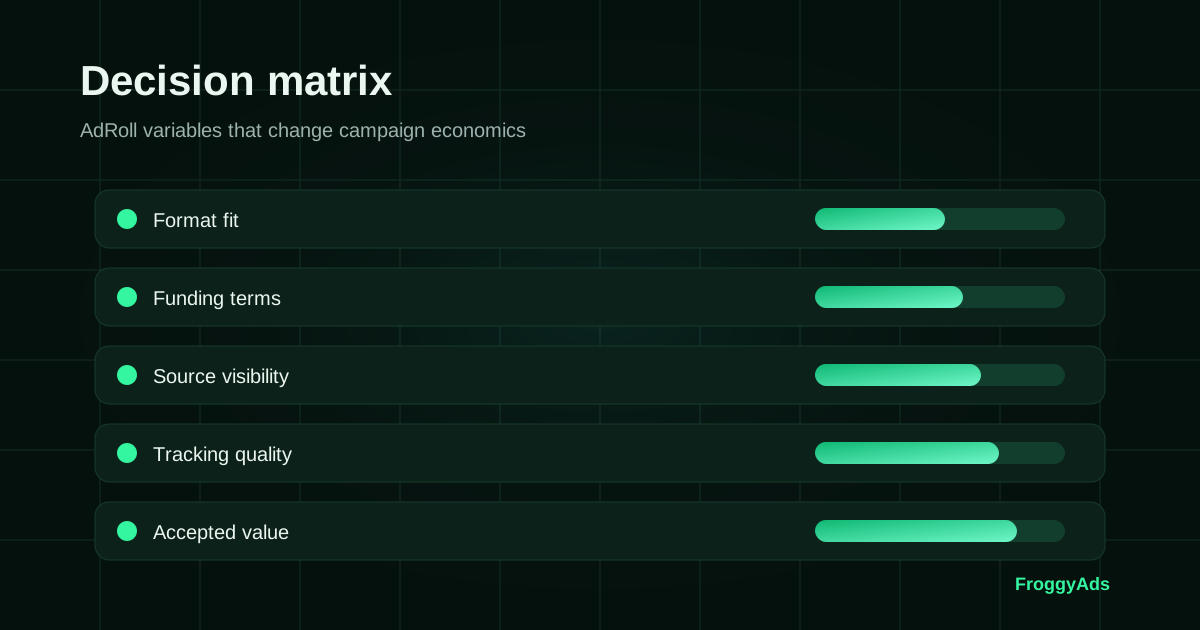
AdRoll does not publish one fixed CPM for every campaign. Its official pricing guidance says media is priced dynamically on CPM, while delivery changes with audience size, inventory, channel, creative coverage and seasonality. The useful rate is therefore the delivered CPM for a defined campaign cell, read beside clicks, attributed conversions and accepted business outcomes.
AdRoll also documents a $2.50 minimum average daily campaign budget. That budget floor is a campaign setting, not a promised CPM and not proof that a small audience will spend the full amount. Check the current AdRoll pricing route and your live account before funding because product access and commercial terms can change.

What should an advertiser mean by “AdRoll CPM rate”?
Mean the billed media spend per thousand delivered impressions for one campaign, product, audience and period. Do not mix a daily budget, suggested spend, web CPM, social CPM or CTV delivery into one number.
Published platform fact
AdRoll states that it prices advertising dynamically based on CPM. Its bidding system evaluates impression opportunities rather than selling every exposure at a permanent tariff.
Campaign observation
Your delivered CPM comes from spend divided by impressions for the exact date range. It is evidence about that campaign cell, not a forecast for another audience or channel.
Commercial decision
Scale only when mature, accepted outcomes support your margin rule. CPM can explain delivery cost, but it cannot establish incrementality, order quality or profit on its own.
Keep five labels attached to every rate
Save the AdRoll product, channel, audience definition, measurement window and currency beside the CPM. Without those labels, the number cannot support a responsible comparison.
Which AdRoll cost facts can you verify before launch?
The rows below separate platform documentation from the decisions your account team still needs to make.
| Documented item | What the official material says | How to use it |
|---|---|---|
| Pricing basis | AdRoll describes dynamic CPM pricing and says CPC or CPA are outcome metrics rather than its media-buying price basis. | Compare delivered CPM only after you label product and channel. Then calculate effective CPC and CPA from the same spend. |
| Average daily budget | The campaign budget guide documents a $2.50 minimum daily budget and explains that daily budget is an average willingness to spend. | Treat $2.50 as a setting floor, not a recommended learning budget or expected daily charge. |
| Spend drivers | AdRoll names audience size, creative-size coverage and the amount bid for an impression among the factors that affect spend. | Record these variables before explaining an underspend or a CPM change. |
| BidIQ | AdRoll says BidIQ evaluates a person’s intent, available inventory and seasonal factors when deciding when and how much to bid. | Do not infer one manual bid from a delivered blended CPM. Use reporting and controlled campaign changes. |
| Minimum-spend language | AdRoll has separate documentation about account or product minimums and daily campaign budgets. See its minimum-spend guidance. | Verify the live account route. A platform-access statement and a campaign budget constraint answer different questions. |
| Channel difference | The pricing-model guide notes that a web-campaign CPM and a Facebook-campaign CPM can differ materially. | Report web, social and other products separately before calculating a portfolio average. |
Planning boundary: the official facts above describe product mechanics. They do not predict your clearing CPM, reach, conversion volume, revenue or profit.
Why can retargeting CPM change even when the campaign name stays the same?
Retargeting demand is constrained by who has entered the audience, which users remain eligible and which impression opportunities appear during the period.
Audience pool and recency
A recent product viewer, an older site visitor and an existing customer represent different commercial jobs. When those groups are blended, changes in audience composition can look like a rate problem. Keep recency and intent segments visible, then inspect delivery and outcome quality within each segment.
Product and channel
Web retargeting, web brand awareness, social delivery and connected-TV products do not share one auction. Their creative requirements, available inventory and user contexts differ. A single account-wide CPM hides which product caused the change.
Creative coverage
AdRoll advises advertisers to provide several ad sizes because broader size coverage can open more inventory. When one creative expires, is rejected or lacks a useful size, the eligible supply can narrow. Preserve the creative roster with the rate record.
Season and competition
AdRoll explicitly names seasonal factors in its bidding explanation. Compare equivalent weekdays and promotional periods where possible. If you compare a holiday auction with an ordinary week, label the difference instead of attributing it to one bid or creative.

How should you compare AdRoll web, social and CTV delivery?
Give each product its own row. The purpose is not to declare one channel cheap; it is to show why the exposure price and outcome path differ.
| Campaign context | Rate evidence to retain | Outcome question | Common interpretation error |
|---|---|---|---|
| Web retargeting | Audience recency, site-event eligibility, placement mix, ad sizes, impressions and spend | Did returning visitors produce incremental accepted value after normal conversion lag? | Crediting every post-view order to the last impression without testing the attribution rule |
| Web brand awareness or contextual reach | Target definition, contextual settings, reach, frequency, viewability where available and effective CPM | Did qualified reach support the next measurable funnel action? | Judging an upper-funnel cell only by last-click CPA |
| Social channel delivery | Network, placement, creative type, audience overlap, spend and platform-reported impressions | Does the channel add value after cross-channel deduplication? | Comparing a social CPM directly with web inventory while ignoring user context |
| Connected TV | Product eligibility, household/audience definition, completed-view evidence, reach and frequency | Is the measurement design strong enough for the longer response path? | Expecting CTV to behave like a clickable display placement |
How do you turn AdRoll CPM into usable acquisition economics?
Start with billed media spend and delivered impressions. Add response and accepted outcomes only after the cost basis is stable.
Delivered CPM
spend ÷ impressions × 1,000
This reconciles the auction result. Use the same currency and reporting window in the numerator and denominator.
Effective CPC
spend ÷ validated clicks
Effective CPC shows what impression buying produced at the click layer. It changes when CTR changes, even if CPM is stable.
Accepted CPA
spend ÷ accepted outcomes
Use orders, qualified leads, activated users or another approved event from your business system. Platform events alone may include duplicates or rejected outcomes.
Break-even CPM
CTR × accepted CVR × value per accepted outcome × 1,000
Apply contribution value rather than gross revenue when variable costs materially affect the decision.
Hypothetical worked example
Suppose one AdRoll web-retargeting cell delivers 240,000 impressions at a $3.40 CPM. Media spend is $816. If 1,440 validated clicks arrive, CTR is 0.60% and effective CPC is about $0.57. If the backend accepts 32 orders, accepted CPA is $25.50. With $31 of contribution value per accepted order, the cell produces $992 of contribution value before fixed operating costs. These figures are arithmetic for planning; they are not AdRoll or FroggyAds benchmarks, forecasts or guarantees.
Create your free FroggyAds account when you want to run a separately measured traffic cell with the same accepted-outcome rule.

Which creative facts belong beside an AdRoll CPM?
A rate is easier to interpret when you can see what the auction was allowed to serve.
List the active sizes
Record each approved web size and the delivery share it receives. A change in size coverage can alter the eligible inventory and therefore the blended CPM. Keep rejected and paused variants in the audit trail so the before-and-after comparison remains credible.
Separate static, dynamic and video work
Creative type changes production, placement and response behavior. Do not describe a performance change as a bidding success when the destination, product feed or message changed at the same time.
Control frequency and recency
Retargeting can repeatedly reach a limited pool. Inspect reach, frequency and audience recency together. Rising frequency with flat accepted value can indicate saturation even when the CPM appears stable.
Preserve the destination version
Save the landing-page or product-page version used by each creative. If page speed, stock status, price or checkout flow changes, the downstream result no longer isolates media quality.
What budget is large enough to learn from AdRoll?
The $2.50 daily minimum answers whether a campaign setting can be entered. Your evidence budget must answer a harder question: how much spend is required to observe enough mature outcomes without exceeding the loss you can accept?
| Budget layer | Definition | Decision control |
|---|---|---|
| Platform setting floor | The current documented minimum average daily campaign budget. | Confirm live availability; do not present it as a recommendation. |
| Delivery budget | Enough daily budget for the eligible audience and inventory to enter auctions. | Watch underspend, frequency and channel allocation before raising the limit. |
| Learning budget | The capped amount permitted while the campaign accumulates a predefined number of mature accepted outcomes. | Calculate from maximum acceptable CPA, expected conversion lag and loss tolerance. |
| Scale budget | Additional spend after a cell passes the acceptance rule. | Increase gradually; compare marginal accepted CPA and contribution value, not only the blended average. |
| Stop boundary | The loss, rejection rate, tracking failure or saturation signal that ends the cell. | Assign an owner who can pause before the next billing period. |
AdRoll’s minimum-spend article and its budget-and-spend article should be read together, then checked against the current product shown in your account.
How should attribution change your AdRoll CPM decision?
AdRoll reports click-through and view-through influence. A media buyer should decide in advance how each signal affects the business decision.
Keep platform attribution and backend acceptance separate
An AdRoll-attributed conversion shows that a configured attribution rule assigned credit. An accepted outcome shows that the order, lead or activation passed your operational standard. Retain both counts. Their difference may reveal refunds, duplicate leads, cancellations, fraud screening or an event-definition problem.
Document the model and lookback
AdRoll’s attribution settings allow different models and configurable click-through and view-through credit. Export or screenshot the applied settings with each test. If the model changes, start a new comparison period rather than silently joining incompatible totals.
Use a click-only diagnostic when reconciling analytics
External analytics tools may omit view-through influence and use different session or cross-device rules. Compare click-through paths first, then explain remaining differences. Do not “fix” the discrepancy by changing several tracking settings at once.
Ask an incrementality question
Retargeting often reaches visitors who already showed intent. When volume and budget justify it, use holdouts, lift measurement or another credible control. A low attributed CPA can still overstate incremental value if many customers would have converted without another impression.
How do you run a controlled AdRoll CPM test?
Use one measurement contract and change one major hypothesis at a time.
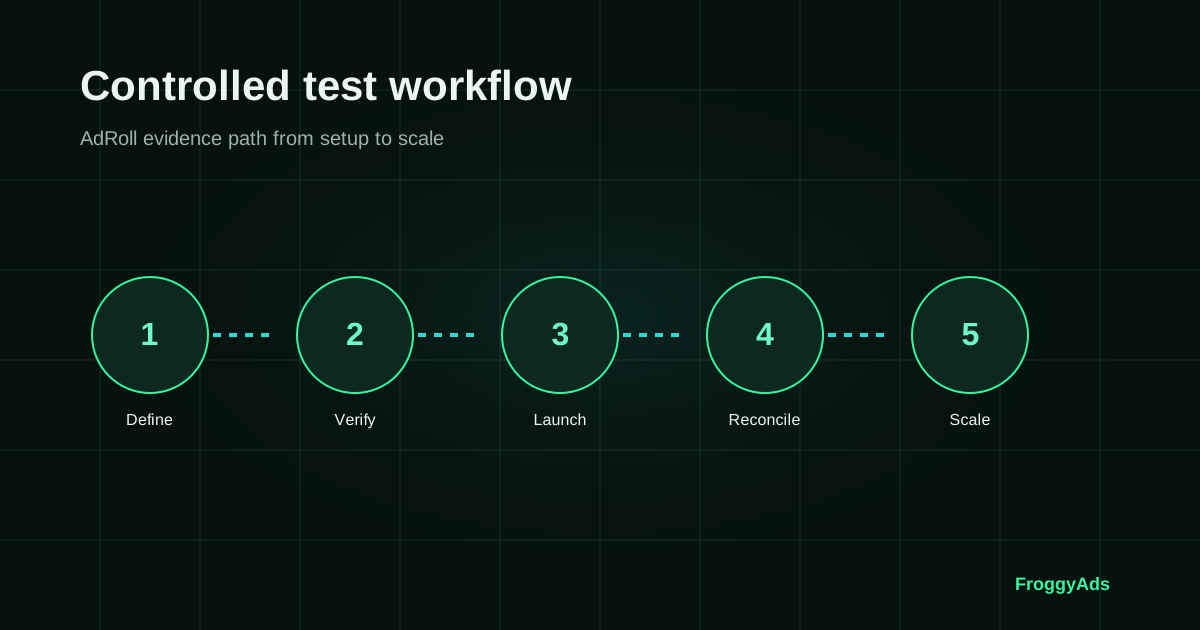
- Verify the live product.Confirm the AdRoll campaign type, eligible channels, currency, account plan and commercial terms. Save the date and official source URLs.
- Validate the pixel and event.Confirm the base pixel, conversion audience and revenue or value parameter on the actual destination. Test the event before media spend.
- Choose one audience job.Separate recent product viewers, cart abandoners, broader site visitors, existing customers or contextual prospects. Give the group one reason to see the ad.
- Freeze the attribution baseline.Record the applied model, click and view treatment, lookback windows, reporting timezone and backend acceptance rule.
- Complete creative coverage.Provide the required sizes and versions, record approvals and verify that every destination matches the visible promise.
- Set the evidence budget.Use the daily setting floor, eligible audience size, acceptable loss and expected outcome frequency to create a bounded test.
- Check delivery before judging value.Review impressions, spend, audience reach, frequency and creative status. Repair tracking or eligibility problems before interpreting CPA.
- Reconcile cost layers.Calculate delivered CPM and effective CPC, then reconcile attributed conversions with accepted backend outcomes after normal lag.
- Inspect marginal performance.When spend rises, compare the new slice of impressions and outcomes with the earlier baseline. Scale can change auction and audience composition.
- Write the next decision.Scale, repair, split, reduce or stop. Preserve the evidence and the reason so another media buyer can reproduce the conclusion.
Start your next campaign with FroggyAds when a separate acquisition channel belongs in the comparison.
When should you compare AdRoll with FroggyAds?
Compare the platforms when you have two distinct acquisition jobs, not because one headline CPM is lower.
| Decision criterion | AdRoll planning context | FroggyAds planning context | Evidence to compare |
|---|---|---|---|
| Primary campaign job | Retargeting, brand awareness and cross-channel workflows built around known or modeled audiences | Self-serve traffic acquisition across Push, Native, Display, Pop, Video and Interstitial options | Audience origin, user intent and destination fit |
| Entry control | Dynamic CPM with campaign budget and product settings | Published starting bids by available format plus campaign budgets and targeting controls | Actual delivered cost, volume and accepted outcomes |
| Optimization unit | Audience, product, channel, creative and AdRoll reporting dimensions | Campaign, format, targeting and traffic-source evidence available in the account | Which controls let the buyer isolate repeatable value |
| Measurement risk | Retargeting and view-through attribution can overstate incremental value without a suitable control | Paid traffic can generate visits without guaranteeing a sale, lead or signup | Backend acceptance, contribution value, lag and incrementality where material |
| Scale rule | Expand only after audience saturation and marginal performance are understood | Increase spend on formats, targets and sources that pass the defined economics | Marginal accepted CPA and concentration risk |
Review our published pricing guidance, ad-format overview, traffic-source explanation and advertiser workflow. Then choose FroggyAds for your next controlled traffic campaign when the format and targeting plan match the offer.
What should you check when AdRoll CPM or spend moves unexpectedly?
Diagnose the delivery chain before rewriting the offer or doubling the budget.
The campaign underspends
Check eligible audience size, campaign status, creative approvals, size coverage, product availability and schedule. A larger budget cannot create eligible users or placements that are not present.
CPM rises while volume falls
Split the report by product, channel, audience and creative period. Review seasonality and inventory mix. If the audience has become smaller or more competitive, the same settings can enter a different auction environment.
CTR improves but accepted CPA worsens
Inspect message-to-destination fit, click quality, conversion-event integrity and backend rejection reasons. A creative can earn more clicks while attracting less useful intent.
Attributed conversions exceed backend outcomes
Reconcile order IDs or lead IDs, attribution model, lookback windows, duplicate events, refunds and qualification timing. Keep the disagreement visible until the cause is known.
Blended results look stable
A stable total can hide one improving channel and one deteriorating channel. Compare the component rows and the marginal slice of new spend before concluding that no change occurred.

Which official pages support this AdRoll CPM guide?
These first-party pages were reviewed for the rate, budget, campaign, format and measurement distinctions above.
- AdRoll platformCurrent product entry point
- AdRoll pricingPlan and service context
- AdRoll current commercial routeRecheck before funding
- AdRoll pricing modelDynamic CPM and channel context
- AdRoll supported formatsCreative and product context
- AdRoll campaign setupAccount workflow
The source pages describe product behavior; they do not guarantee availability, delivery, conversion volume or profit. Preserve the access date and confirm material settings inside the current account.
AdRoll CPM rates FAQ
These answers keep rate, budget, attribution and commercial value in the correct order.
Is there one fixed AdRoll CPM for every campaign?
No fixed rate can describe every auction. Market, audience, channel, device, placement, season, bid pressure, and available inventory shape the delivered CPM.
Where should I get an AdRoll CPM estimate for planning?
Use current account forecasts or recent delivered data from a comparable campaign. Label the market, audience, channel, date, and assumptions so the estimate is not mistaken for a promise.
How is AdRoll spend calculated from CPM and impressions?
Media cost comes from multiplying delivered impressions by CPM, then dividing by 1,000. Check that amount against the bill before adding platform, creative, tracking, or service expenses.
How do I calculate the effective CPM after an AdRoll campaign?
Divide billed media spend by delivered impressions and multiply by 1,000. Use the same currency, billing period, and valid-impression basis throughout the calculation.
What does a planning CPM tell me about an AdRoll test budget?
It estimates how many impressions the media budget could buy under that assumption. Actual delivery can differ, so use caps and replace the estimate with observed cost quickly.
Why can AdRoll retargeting and prospecting CPMs differ?
The audience pools enter different auctions and can have different scale, competition, channel mix, and placement access. Review delivery context before comparing their costs.
How should AdRoll CPM be read beside conversion cost?
CPM describes the price of impression delivery, while accepted CPA shows cost per approved acquisition. Read both with conversion delay and downstream value.
What should I inspect after an AdRoll CPM spike?
Check audience size, bid changes, channel and placement mix, device, geography, schedule, seasonality, creative status, and auction competition. Compare the exact period before changing strategy.
Why should AdRoll CPM be split by channel?
Display, social, and other delivered channels can face different auctions and visitor contexts. A blended rate can hide the part that changed.
What should an AdRoll CPM record preserve?
Store the estimate source, access date, assumptions, campaign settings, impressions, billed spend, effective CPM, accepted outcomes, changes, and final decision. Update it when new delivery replaces old planning data.
Continue the AdRoll and CPM comparison
Use FroggyAds when you want direct control over format, targeting, budget and source evidence
Choose the format that matches the offer, keep the conversion event stable and judge the result after accepted outcomes mature. Our published starting bids help you plan an entry point; your own economics decide whether the campaign deserves more spend.
Corporate author: FroggyAds. We publish this advertiser guide from current first-party product documentation and our campaign-planning perspective. Replace hypothetical figures with your own economics and verify every live account condition before funding.