Independent advertiser review

AdRoll review for advertisers
facts, fit, costs and test design

This AdRoll review uses current official information, separates platform features from performance claims, and gives media buyers a practical way to decide whether to keep, test or diversify their traffic sources.

Platform typeretargeting and cross-channel advertising platform for ecommerce and growth teams
Fundingno platform minimum spend; standard campaign daily budget starts at $2.50 in current help documentation
Decision metricAccepted conversion value
Independent AdRoll advertiser review dashboard
Review verdict

AdRoll can be useful when the format and operating model fit

AdRoll is not automatically good or bad traffic. It is a buying environment with a specific format mix, funding model, optimization workflow and publisher supply. The right question is whether those conditions match the campaign you can measure profitably.

Where AdRoll can be strong

AdRoll can be a sensible choice when its public product footprint matches the campaign job. The platform is positioned around retargeting and cross-channel advertising platform for ecommerce and growth teams, with Web display, native, retargeting, social and selected connected TV campaign products depending on account and market.

  • Retargeting and ecommerce-oriented workflows
  • Cross-channel audience activation
  • Low documented standard daily budget entry point
  • Dynamic bidding and campaign budget controls

Where the review needs caution

A fair review separates product access from campaign outcome. AdRoll can provide useful inventory and controls, but those inputs do not repair weak conversion tracking, an uncompetitive offer or a landing page that does not fit the traffic context.

  • Small budgets may not create enough retargeting reach or conversion evidence
  • CTV and other specialist products require different budgets
  • Audience pool size constrains delivery
  • Cross-channel attribution needs careful deduplication

Reviewed July 12, 2026. Features, payment methods, prices, policies and account availability can change. Confirm the current terms in the official account before funding.

Product footprint

What AdRoll publicly offers advertisers

The product description matters because each format reaches a different user state and produces different click, view and conversion behavior.

Formats and buying models

AdRoll currently presents Web display, native, retargeting, social and selected connected TV campaign products depending on account and market. Its buying logic includes dynamic CPM pricing with campaign budget controls and product-specific optimization. A buyer should verify the exact combination supported by the selected format before launch.

Funding and budget reality

AdRoll publicly states that it has no minimum spend to launch a campaign. Its campaign documentation separately states a $2.50 minimum average daily budget for standard campaigns, while products such as CTV have materially higher recommended budgets. During the postback audit, apply this point specifically to AdRoll and keep observations from retargeting, web display, native, social and selected CTV inventory separated by format, source and accepted outcome.

The funding threshold only unlocks the account. A useful test budget must also cover several sources, conversion lag and enough accepted outcomes to distinguish signal from noise.

Independent evaluation

How to read a AdRoll review without being misled

A platform review becomes unreliable when it treats a low bid, a large traffic number or a single successful case study as proof that every advertiser will win. Those are access signals. The business result still depends on offer economics, creative relevance, landing-page continuity, tracking accuracy and source-level decisions. Before creative expansion, apply this point specifically to AdRoll and keep observations from retargeting, web display, native, social and selected CTV inventory separated by format, source and accepted outcome.

Start by defining the job. A prospecting campaign, retargeting campaign, app-install campaign and direct-response lead campaign need different inventory and evidence. Then map AdRoll's available formats to that job. If the platform requires a different user context than the current control campaign, record that difference before comparing costs.

Use first-party facts for product access

Official documentation is the best place to confirm formats, bidding models, payment thresholds, policy rules and account workflows. Third-party reviews can add operational perspective, but they can also be outdated, affiliate-funded or based on one country and one offer. This page therefore treats current official material as the source of record for product facts. Before scaling the winning cell, apply this point specifically to AdRoll and keep observations from retargeting, web display, native, social and selected CTV inventory separated by format, source and accepted outcome.

Use your own accepted outcomes for quality

No public review can prove what AdRoll will deliver for a specific advertiser. Measure downstream events that matter to the business, such as approved leads, paid orders, retained subscribers or validated installs. Reconcile platform-reported conversions against a neutral system of record and investigate duplicate, delayed or rejected events.

Separate minimum funding from minimum evidence

AdRoll publicly states that it has no minimum spend to launch a campaign. Its campaign documentation separately states a $2.50 minimum average daily budget for standard campaigns, while products such as CTV have materially higher recommended budgets. That answer is useful for onboarding, but it is not a campaign recommendation. A broad campaign can spend the minimum across too many sources and learn almost nothing. A narrow campaign can create clearer evidence with fewer variables and a deliberately bounded budget.

Judge CPM and CPC in context

AdRoll uses dynamic CPM pricing. Cost varies with audience intent, inventory, ad sizes, seasonality, channel and demand, and specialist products such as CTV should not be mixed with standard web retargeting averages. Convert every pricing model into comparable business metrics. For CPM buying, calculate effective CPC, conversion rate, CPA and conversion value. For CPC buying, track impression quality and post-click acceptance so cheap clicks do not hide poor outcomes.

Buyer fit

When AdRoll may fit and when a second network is useful

Using more than one traffic source can reduce concentration risk, but only when each platform has a defined role and the measurement rules stay consistent.

Keep or test AdRoll

AdRoll deserves a controlled test when you are ecommerce and growth teams that need retargeting and coordinated audience activation across several channels. Keep the scope narrow enough to identify which format, market and source group produced the result.

  • Cross-channel audience activation

Add FroggyAds to the comparison

FroggyAds can be tested as a separate self-serve source when you want Push, Native, Display, Pop, Video and Interstitial formats, a $50 public minimum deposit and source-level campaign controls. These are access differences, not performance guarantees. At the initial delivery review, apply this point specifically to AdRoll and keep observations from retargeting, web display, native, social and selected CTV inventory separated by format, source and accepted outcome.
  • Use the same accepted conversion definition
  • Match GEO, device and destination
  • Set independent stop and scale rules
Controlled test

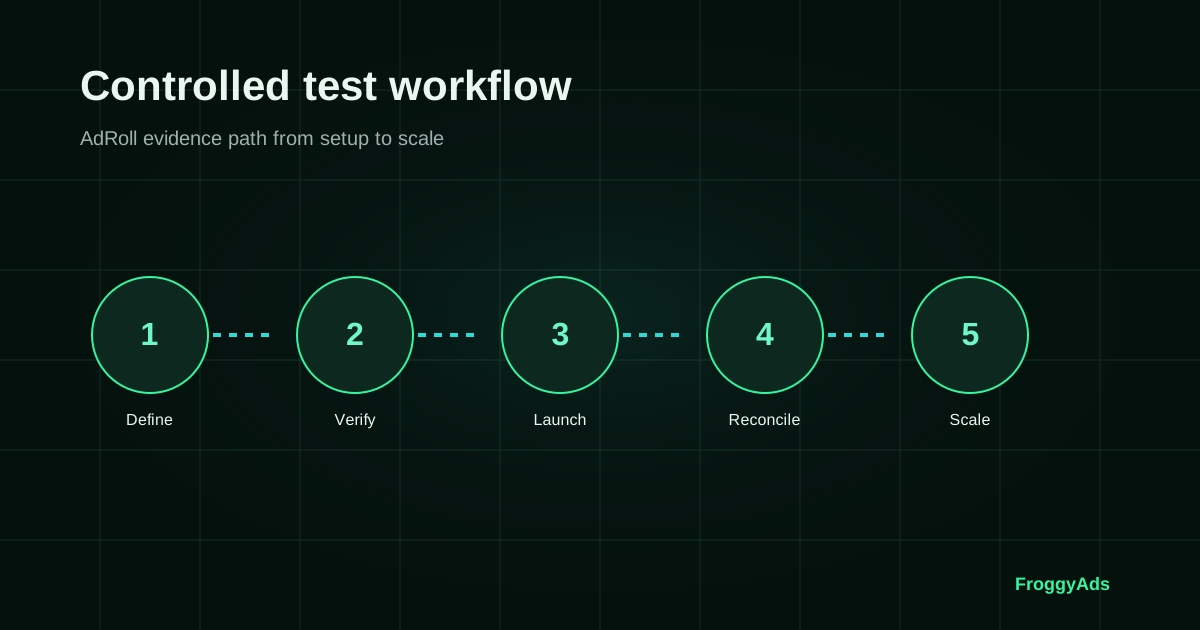
A practical AdRoll review workflow

Build the review from a matched test instead of opinions. Preserve the current baseline and make every platform earn additional budget.

1
Define the campaign jobChoose one objective, one format role and one accepted business event.
2
Confirm current termsCheck AdRoll funding, payment methods, available formats and policy rules in the live account.
3
Validate trackingTest click IDs, postbacks, deduplication and downstream status before meaningful spend.
4
Launch a bounded cohortUse one GEO and a manageable device or audience scope so source differences remain visible.
5
Review mature outcomesWait for conversion lag, reconcile accepted events and compare source concentration.
6
Scale only proven segmentsIncrease budget in measured steps while keeping a stable control and rollback rule.

What a fair result looks like

A fair result is not the lowest CPC or the highest click volume. It is a campaign that reaches the declared audience, produces accepted outcomes at sustainable economics and retains enough source diversity to scale without quality collapsing. Before creative expansion, apply this point specifically to AdRoll and keep observations from retargeting, web display, native, social and selected CTV inventory separated by format, source and accepted outcome.

Record spend, impressions, clicks, effective CPM, conversions, accepted conversions, revenue or value, source concentration and conversion lag. Compare the complete chain. If AdRoll produces cheaper clicks but a lower acceptance rate, the apparent advantage may disappear after reconciliation.

What invalidates the review

Changing the offer, landing page, attribution window and traffic format at the same time makes the platform conclusion weak. So does stopping after one conversion, allowing a broken postback to run, or judging broad automation before it has enough data. Repair those issues before declaring a winner. Before scaling the winning cell, apply this point specifically to AdRoll and keep observations from retargeting, web display, native, social and selected CTV inventory separated by format, source and accepted outcome.

AdRoll advertiser review test workflow
Decision workbook

Review evidence hierarchy for AdRoll

Turn public platform information into a documented test that another media buyer can audit and repeat.

AdRoll separates no platform minimum spend from a documented standard minimum daily campaign budget. Retargeting audience size and channel mix determine whether a low daily budget can generate enough evidence. This context matters for review evidence hierarchy because Web display, native, retargeting, social and selected connected TV campaign products depending on account and market. Treat each materially different environment as its own test cell instead of presenting one account-wide average as the truth.

A useful review distinguishes verified product facts, testable operating observations and campaign outcomes. Product documentation can confirm formats, bidding models and billing rules. Only a controlled campaign can show whether those inputs fit a particular offer. For AdRoll, the verified starting points are its public positioning as retargeting and cross-channel advertising platform for ecommerce and growth teams, the documented buying approaches of dynamic CPM pricing with campaign budget controls and product-specific optimization, and the current funding guidance summarized on this page. These facts define what can be tested, not what the outcome will be.

Build the research file before launch. Save the date, official source URL, relevant account screenshot, currency, payment method, campaign objective, format, country, device scope and attribution window. When a term changes later, the team can explain why the old conclusion no longer applies instead of silently mixing two product versions. At the first optimization checkpoint, apply this point specifically to AdRoll and keep observations from retargeting, web display, native, social and selected CTV inventory separated by format, source and accepted outcome.

Create a matched control. Use the same destination, accepted conversion event, value rule and reporting timezone wherever the platforms permit it. Match the user context as closely as possible. If AdRoll supplies Web display, native, retargeting, social and selected connected TV campaign products depending on account and market, do not compare the result with an unrelated search or social campaign and call the difference a network effect. Before scaling the winning cell, apply this point specifically to AdRoll and keep observations from retargeting, web display, native, social and selected CTV inventory separated by format, source and accepted outcome.

The strongest reasons to shortlist AdRoll are retargeting and ecommerce-oriented workflows; cross-channel audience activation; low documented standard daily budget entry point; dynamic bidding and campaign budget controls. The important cautions are small budgets may not create enough retargeting reach or conversion evidence; ctv and other specialist products require different budgets; audience pool size constrains delivery; cross-channel attribution needs careful deduplication. Convert each strength and caution into a testable question. For example, source controls should be judged by whether they let the buyer isolate repeatable value, not merely by whether a source ID appears in a report. During the postback audit, apply this point specifically to AdRoll and keep observations from retargeting, web display, native, social and selected CTV inventory separated by format, source and accepted outcome.

Define evidence quality in advance. A click proves delivery, a platform conversion proves that a configured event fired, and an accepted downstream outcome proves commercial value. Reconcile those layers after normal conversion lag. Pause decisions based only on early dashboard totals when refunds, duplicate leads or later acceptance can change the economics. At the budget review, apply this point specifically to AdRoll and keep observations from retargeting, web display, native, social and selected CTV inventory separated by format, source and accepted outcome.

The final review verdict should be conditional. Record where the platform is a strong fit, where evidence is still missing, which campaign job should remain with the incumbent and what must be true before more budget moves. Write the decision rule before the campaign begins. Include the maximum acceptable loss, the minimum number of mature outcomes, the concentration limit for one source and the conditions that trigger a creative refresh, bid change, source exclusion or full stop. Before creative expansion, apply this point specifically to AdRoll and keep observations from retargeting, web display, native, social and selected CTV inventory separated by format, source and accepted outcome.

Use FroggyAds as a matched comparison rather than a promised winner. Its public offer includes Push, Native, Display, Pop, Video and Interstitial, a $50 minimum deposit and source-level controls. Keep the same measurement contract and let accepted outcome economics determine whether FroggyAds, AdRoll, a split allocation or no scale is the correct result. During account verification, apply this point specifically to AdRoll and keep observations from retargeting, web display, native, social and selected CTV inventory separated by format, source and accepted outcome.

Source ledger

Official information used for this AdRoll review

These first-party pages were reviewed on July 12, 2026. External links support verification and do not imply affiliation or endorsement.

Questions

AdRoll review FAQ

Practical answers for advertisers evaluating platform fit, cost and test design.

Is AdRoll a legitimate advertising platform?

AdRoll operates a public advertising platform with official product, policy and support documentation. Legitimacy does not guarantee that every campaign will be profitable, so verify the account, payment terms, tracking and source-level results before scaling.

What is AdRoll best known for?

AdRoll is best known for Web display, native, retargeting, social and selected connected TV campaign products depending on account and market. The practical value depends on whether those formats match the landing experience and conversion objective.

What is the AdRoll minimum deposit?

AdRoll publicly states that it has no minimum spend to launch a campaign. Its campaign documentation separately states a $2.50 minimum average daily budget for standard campaigns, while products such as CTV have materially higher recommended budgets. Before scaling the winning cell, apply this point specifically to AdRoll and keep observations from retargeting, web display, native, social and selected CTV inventory separated by format, source and accepted outcome.

Does AdRoll publish fixed CPM rates?

No single CPM describes the entire AdRoll platform. AdRoll uses dynamic CPM pricing. Cost varies with audience intent, inventory, ad sizes, seasonality, channel and demand, and specialist products such as CTV should not be mixed with standard web retargeting averages.

Who should test AdRoll?

AdRoll is most relevant for ecommerce and growth teams that need retargeting and coordinated audience activation across several channels. A bounded test is safer than moving a full budget immediately.

What are the main AdRoll strengths?

The strongest reasons to shortlist AdRoll are retargeting and ecommerce-oriented workflows, cross-channel audience activation, low documented standard daily budget entry point. Confirm that the exact feature is available in your account and market.

What are the main AdRoll limitations?

The main cautions are small budgets may not create enough retargeting reach or conversion evidence, ctv and other specialist products require different budgets, audience pool size constrains delivery. These are planning considerations, not claims that the platform is unsuitable.

How should I compare AdRoll with FroggyAds?

Use the same GEO, device scope, format, destination, accepted conversion event and attribution window. Compare cost per accepted outcome and scalable source quality, not just dashboard clicks. At the first optimization checkpoint, apply this point specifically to AdRoll and keep observations from retargeting, web display, native, social and selected CTV inventory separated by format, source and accepted outcome.

Can FroggyAds guarantee better results than AdRoll?

No. FroggyAds provides a different supply mix, six core formats, source controls and a $50 public minimum deposit, but performance still depends on the offer, creative, landing page, bid, market and measurement quality. Before scaling the winning cell, apply this point specifically to AdRoll and keep observations from retargeting, web display, native, social and selected CTV inventory separated by format, source and accepted outcome.

How long should a AdRoll test run?

Run long enough to cover normal delivery variation and conversion lag, while enforcing a maximum acceptable loss. Define the evidence window before launch so the decision is not changed after seeing the result. During the postback audit, apply this point specifically to AdRoll and keep observations from retargeting, web display, native, social and selected CTV inventory separated by format, source and accepted outcome.

Run a matched test

Compare accepted outcomes before moving more budget

Open a FroggyAds advertiser account, validate tracking and test one matched cohort. Performance depends on the market, offer, creative, format, bid and measurement quality.

Verified decision update

AdRoll review and legitimacy verification checklist

Direct answer: A responsible AdRoll review verifies the official domain, legal terms, account route, product role, formats, commercial conditions, support and policy controls before discussing performance. Legitimacy and suitability are different questions: a real operating service may still be unsuitable for a specific budget, market, property, vertical, tracking stack or risk tolerance.

AdRoll currently positions its self-service Ads product as pay-as-you-go and offers managed service packages for qualifying spend. Its help center documents web, native, video, social and connected TV options, but public budget guidance varies by product and page. One official pricing page says there is no general minimum spend, while campaign help pages publish daily budget controls and product-specific recommendations. Verify the live account route rather than treating one figure as universal. Keep evidence dated and tied to the exact account role.

Use first-party evidence for AdRoll identity and capability, then validate the live account before funding or integrating. Record the access date, currency, payment method, threshold type and whether the figure belongs to advertisers or publishers. Do not convert a publisher payment threshold into an advertiser deposit or present a campaign recommendation as a contractual minimum.

Performance claims about AdRoll require an independent test. Reconcile platform delivery with accepted sales, leads, installs or net publisher revenue after lag, refunds, deductions and quality review. Treat dashboards, testimonials and headline CPM or ROI statements as evidence to investigate, not proof of the result another account will receive.

Decision controlEvidence required
AuthenticityOfficial identity, terms, support and account access confirmed
ProductCurrent formats, controls and role definitions documented
CommercialFunding, payout, fees and settlement terms dated
OutcomeIndependent reconciled result, not promotional claims

Current official verification sources

Reviewed July 16, 2026 for AdRoll review and legitimacy research. The official links support current verification and do not imply affiliation or endorsement. Product, funding, pricing, policy and publisher terms can change, so confirm the live platform before acting on this page.