
What does Tier 1 mean when you buy advertising traffic?
Tier 1 is a planning label used by media buyers for countries where digital purchasing activity, advertiser demand and auction competition are often considered relatively mature. It is not a technical setting, an official market classification or a promise that every visitor has high purchasing intent. Two networks, agencies or affiliate programs may use different country lists. Your campaign brief therefore needs the actual countries in writing before anyone discusses reach, bid levels or expected value.
The useful question is not whether a country carries the Tier 1 label. Ask whether your offer can serve eligible people in that country and whether you can measure the result consistently. Language, price display, payment methods, delivery terms, customer support, device experience and legal obligations may differ across the markets grouped under the same label. A campaign that combines them without a reason can hide both a strong local fit and an expensive operational failure.
At FroggyAds, we recommend translating the broad label into a campaign specification: named countries, supported devices, chosen ad format, offer eligibility, conversion definition, attribution window, test ceiling and owner. That specification gives you something concrete to target and review. It also lets our reporting support a real source decision instead of producing a blended regional average that cannot explain where accepted value came from.
Check language, currency and fulfilment for each country
Confirm that the proposition, language, currency presentation and fulfillment path make sense for each selected country. If the customer journey differs, create a separate campaign cell.
Match format and targeting to the offer
Verify that the chosen format can express the offer clearly and that the available targeting supports the audience boundary you intend to buy.
Reconcile click identifiers and accepted events after maturity
Make sure click identifiers, conversion events and advertiser-side acceptance can be reconciled by source and country after the agreed maturity window.
A higher-cost auction can still be worthwhile when downstream value supports it, while a cheap visit can be wasteful when the user cannot complete the offer. Keep the tier label in the planning vocabulary and keep value in the measurement model. That distinction prevents a regional reputation from standing in for campaign evidence.
How should you compare advertising networks for Tier 1 markets?
Compare networks through the buying path you will actually operate. Start with market and format access, then examine the controls that protect a test, the evidence available after delivery and the economics of an accepted result. A platform should not win because it offers the longest feature list. It should earn the test because its workflow can support your specific offer without breaking the link between spend and business value.
| Evaluation area | Question for the buyer | Evidence to retain |
|---|---|---|
| Country scope | Can you select the actual eligible countries instead of relying on a broad regional label? | Campaign settings, excluded locations and the landing-page version served to each market. |
| Format access | Does the network offer a format that matches the promise, destination and user context? | Creative identifier, placement or source information, device split and delivery volume. |
| Budget control | Can the learning phase be bounded before the first paid impression? | Daily limit, total test ceiling, bid history, start time and every material edit. |
| Audience control | Which supported country, city, device, operating-system, browser, carrier, category or source settings are relevant to this offer? | Targeting snapshot and the reason each restriction belongs in the test. |
| Measurement | Can platform activity be connected to a mature accepted outcome in your own systems? | Click IDs, event timestamps, attribution rule, approval state and rejection reason. |
| Optimization | Can you keep, limit, exclude or retest a source without rebuilding the whole campaign? | Source-level trend, sample maturity, action owner and rollback condition. |
Run the same offer, destination and acceptance rule when comparing two traffic options. If one test uses a different creative promise, attribution window or country mix, the outcome cannot isolate the network contribution. Keep a written change log and compare matched cohorts. The process may feel slower than reading a headline cost, but it avoids paying to scale an explanation that the data cannot support.
FroggyAds gives performance advertisers a self-serve route to campaign budgets, supported targeting and source reporting. Depending on the ad format and campaign context, available controls can include country, city, device, operating system, browser, carrier, category, source, ID and IP options. Choose only the controls that protect eligibility or improve interpretation; unnecessary fragmentation creates small samples and delays a useful decision.
Traffic-quality controls belong in this comparison, but they answer a different question from conversion value. Adscore-supported screening and internal controls help reduce invalid or low-quality activity. Your tracker, analytics and backend approval data show whether the remaining delivery worked for the offer. Keep both layers visible so a commercially weak campaign is not misdiagnosed as invalid traffic, and technically valid traffic is not mistaken for profitable traffic.
Build the first Tier 1 campaign as a controlled country test
Begin with one written hypothesis. Name the audience, country, format, offer and accepted result you expect to learn about. A useful hypothesis might ask whether a localized destination can produce approved signups from a defined mobile audience within a stated accepted-cost limit. It should be possible to disprove the claim. “Get more Tier 1 traffic” is an ambition, not a test design.
- Specify eligibility. List every selected country and the devices, language conditions and offer restrictions that matter. Confirm that the destination, payment path and fulfillment process work from those locations.
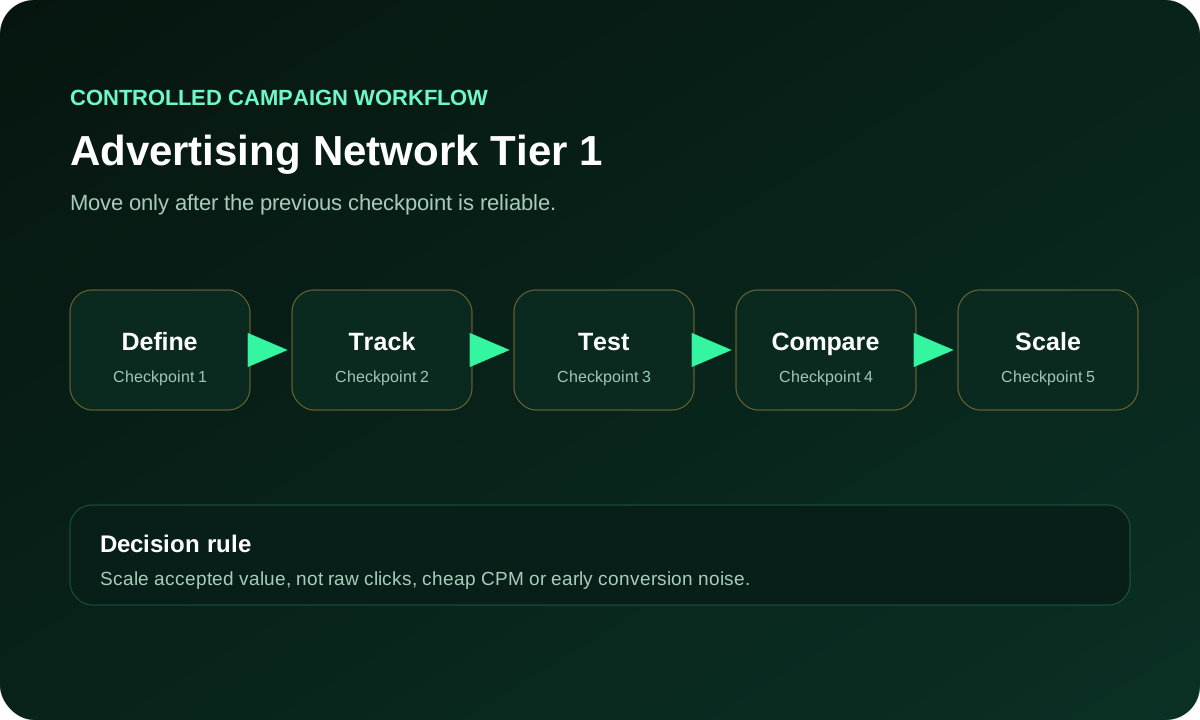
- Prove measurement. Send controlled events through the click, redirect, landing page, conversion event and advertiser system. Reconcile timestamps, currency, duplicate handling and time-zone rules before meaningful spend begins.
- Protect the learning budget. Set a daily limit, total ceiling and maximum acceptable loss. Decide who can pause delivery and what evidence must exist before any increase.
- Label the variables. Give each creative and destination version a stable identifier. Save the starting bid, targeting snapshot and campaign launch time so later results have a baseline.
- Let outcomes mature. Review operational faults early, but wait for the stated acceptance window before judging sources on delayed approvals, sales or qualified actions.
- Take one narrow action. Keep, cap, exclude or retest from source and country evidence. Change a single major variable so the result can be compared with the previous configuration.
Country splits matter because a shared language does not create a shared customer journey. The same advertisement may lead to different prices, checkout methods, delivery promises or support expectations. When the path differs materially, separate campaigns or reporting cells allow you to correct one market without disrupting another. When the path is genuinely common, a combined learning cell may be reasonable until volume supports a useful split.
Document a launch record that another buyer could audit: campaign ID, source IDs, creative version, destination version, countries, devices, bid, budget, event definitions and maturity window. Add the business rule for an accepted result. This record makes a support request actionable and prevents the team from reconstructing key settings after an unexpected change.
Create your FroggyAds campaign only after the path test succeeds. Our platform can then help you buy supported traffic under bounded settings, inspect delivery and refine source allocation. You retain responsibility for the offer, destination, tracking and business acceptance, which is why these checks are part of responsible media buying rather than optional administration.
Measure Tier 1 traffic with accepted value, not a regional reputation
The primary metric should describe the business result that justifies spend. Depending on the campaign, that may be an approved lead, completed purchase, funded account, retained subscriber or another event confirmed in the advertiser system. Platform impressions, clicks and reported conversions remain useful diagnostics. They do not replace the accepted result when approvals, refunds, duplicate rules or delayed validation change economic value.
Retain country, source, creative and delivery counts
Retain spend, impressions, clicks, visits, country, device, source and creative identifiers. These fields show how the traffic arrived and where a pattern is concentrated.
Store approval, rejection and mature conversion value
Store the conversion timestamp, approval state, rejection reason, revenue or qualified value and the date on which the result became mature.
Write the cost boundary, action owner and reversal rule
Write the cost boundary, minimum evidence, action taken, owner and condition for reversing or expanding that action.
Use a settled cohort rather than mixing fresh and mature outcomes. Suppose a source sends activity today but the advertiser confirms qualified value several days later. Comparing today’s cost with incomplete approvals makes the source look worse than it may become. Freeze the cohort by click or conversion date, wait through the agreed window and then calculate the accepted cost on the same population.
Hypothetical calculation: a country-source cell spends USD 240 and produces 12 advertiser-accepted outcomes after the same maturity window. Accepted cost is USD 240 divided by 12, or USD 20 per accepted outcome. If four additional dashboard events were rejected, they do not belong in the denominator. Replace every figure and threshold with your data; the example is a method, not a FroggyAds price, benchmark or performance claim.
Contribution should include the costs your decision actually creates. Media spend is central, but payment fees, returns, call-center work, sales review or incentive costs may change the value of an accepted result. The model does not need to be elaborate during an initial test. It needs to be consistent, explicit and capable of distinguishing more traffic from more business value.
Investigate disagreement between systems before changing sources. Missing click IDs, blocked scripts, broken redirects, duplicate postbacks, mismatched currencies and time-zone differences can create a quality story that is really a measurement fault. Preserve raw identifiers and timestamps long enough to reconcile them. A corrected tracker protects every later optimization decision.
Match the creative and destination to the selected market
A Tier 1 creative test should compare distinct reasons to act, not cosmetic variations. One concept may lead with convenience, another with a specific product capability and a third with a transparent offer condition. Keep the claim truthful and make the destination continue the same promise. A high click-through rate has little value when curiosity clicks reach an unrelated page or ineligible visitors discover the condition after arrival.
Give every concept a permanent identifier and record where it ran. When possible, keep the audience and bid stable long enough to compare message quality. Review click behavior alongside landing engagement, completion, approval delay and accepted value. The winning advertisement is the one that supports the desired business result within the written economics, even if another version attracts more initial clicks.
| Experience check | What to verify before launch | What failure can distort |
|---|---|---|
| Language | Headlines, form labels, conditions and support information are clear for the intended audience. | Engagement, trust and the meaning of a rejected action. |
| Price and payment | Currency display, taxes, payment methods and recurring terms match the served location. | Checkout completion and contribution value. |
| Device path | The page, form and confirmation step work on targeted browsers and screen sizes. | Visit-to-conversion rate and apparent source quality. |
| Eligibility | Age, location, delivery, account and product restrictions appear before commitment. | Approval rate, support load and compliance risk. |
| Continuity | The advertisement promise, landing headline and next action describe the same offer. | Bounce behavior and misleading creative conclusions. |
Localize because the customer journey requires it, not because a label demands decorative changes. Keep brand identity consistent while adapting information that affects comprehension and eligibility. If the same English page is appropriate for several countries, record why; if payment, shipping or terms differ, separate the experience and the campaign evidence.
FroggyAds supports multiple advertising formats, so choose the format according to the job. A compact message needs immediate clarity, while a format with more visual or contextual space can explain a more considered offer. Format selection does not remove the need for a credible destination. Test the full path before scale and keep the creative version linked to every accepted outcome.
Optimize sources without losing the reason for the result
Optimization begins after tracking is stable and the relevant outcomes have matured. First separate delivery problems, measurement failures and commercial underperformance. Invalid or suspicious activity calls for a traffic-quality investigation. An eligible visit that does not convert may point to the offer, creative or destination. A platform event that never appears in the advertiser system may indicate attribution or integration trouble. Each cause needs a different response.
| Observed pattern | First investigation | Controlled response |
|---|---|---|
| One source shows repeated tracking gaps | Check click IDs, redirects, event firing, timestamps and duplicate rules for that source’s cohort. | Repair measurement or isolate the source while the same path is retested. |
| A country produces many ineligible actions | Compare targeting with offer restrictions and the destination information shown before conversion. | Narrow eligibility, clarify the page or separate the market into its own cell. |
| Clicks are strong but accepted value is weak | Inspect promise continuity, landing behavior, approval reasons and conversion delay. | Test a materially different message or offer path under the same audience rule. |
| A source remains efficient after maturity | Confirm that value is not concentrated in a tiny sample and that tracking stayed stable. | Increase one budget or bid dimension and preserve the previous setup for rollback. |
| Results deteriorate after expansion | Compare source mix, country mix, device share and creative exposure before and after the change. | Return to the last reliable configuration, then reopen one variable at a time. |
Use whitelists, blacklists or source controls when the evidence supports that level of action. Avoid removing an entire format or country because one source, device or destination version failed. Equally, do not protect a source from scrutiny because its click cost appears attractive. Decisions should follow settled accepted value, adequate volume and a clear record of the affected segment.
Scale in steps that preserve interpretation. Raising the budget, widening countries, changing creative and increasing bids together can produce more volume, but it destroys the comparison with the prior cell. Choose the constraint most likely to unlock useful reach, alter it, wait through the same maturity rule and review marginal results rather than the blended lifetime average.
Write stop rules before enthusiasm or loss changes judgment. Pause when tracking is broken, the destination is unavailable, campaign eligibility changes or the agreed test ceiling is reached. Reduce or roll back when mature accepted cost leaves the boundary. Escalate a suspicious source with campaign IDs, timestamps and the observed pattern so the review begins with reproducible evidence.
What Tier 1 network access can and cannot tell you
Access to a sought-after market does not guarantee inventory at a particular moment, a fixed price, a conversion volume or a profitable campaign. Auctions respond to competition, source availability, user behavior and campaign settings. Offer strength, creative clarity, destination reliability and measurement quality also shape the result. Treat every estimate as a planning input and replace it with observed evidence as the campaign develops.
Country reputation cannot substitute for user eligibility. A visitor may be located in a selected market yet have no need for the offer, use an unsupported device or fail the advertiser’s acceptance rules. Targeting narrows opportunity; it does not identify a guaranteed buyer. This is why we recommend a bounded test that joins source reporting with advertiser-side value rather than a forecast built from geography alone.
- Confirm the offer, creative and destination comply with the rules that apply to every selected country and advertising category.
- Use truthful claims and disclose material price, eligibility, subscription or fulfillment conditions before a visitor commits.
- Apply consent, tracking, retention and data-handling practices that fit the audience, market and technology used by the campaign.
- Separate minimum bids, actual auction prices, account funding and a recommended learning budget whenever those amounts are discussed.
- Label examples and historical figures as non-guaranteed inputs; do not present them as a forecast for a new source or buyer.
Traffic-quality screening reduces risk but cannot promise that every technically valid interaction will become an accepted customer. Review Adscore-supported signals, FroggyAds source evidence and your backend outcomes as connected layers. If they disagree, investigate the discrepancy instead of forcing one metric to answer every question.
The advertiser controls the offer, landing experience, conversion definition and final business decision. FroggyAds provides the self-serve media-buying workflow, supported targeting, reporting and campaign controls. That division of responsibility is useful: our tools help you run and refine the traffic test, while your accepted-value records determine whether the test deserves more investment.
Questions about advertising networks for Tier 1 markets
Is there one official list of Tier 1 advertising countries?
No. Tier 1 is informal media-buying shorthand, and lists vary between platforms and teams. Put the exact countries in your campaign brief and targeting so reporting and eligibility use a shared definition.
Should several Tier 1 countries run in one campaign?
Combine them only when the offer, language, destination and acceptance process are comparable. Separate countries when payment, fulfillment, eligibility or customer behavior creates a different decision path.
What should be tested before paid delivery starts?
Verify the advertisement-to-destination promise, location and device access, click identifiers, conversion event, postback or pixel, timestamps, duplicate rules and advertiser-side acceptance record with controlled events.
How should a learning budget be defined?
Set daily and total limits, the maximum loss you will accept for learning and the mature evidence required for another spend step. The amount must fit your economics; it is separate from a bid or account deposit.
Which metric should decide whether a source scales?
Use a mature advertiser-accepted outcome and its cost or contribution value. Click rate, visit volume and dashboard conversions help diagnose delivery but should not overrule settled business value.
How does FroggyAds help with a Tier 1 campaign?
We provide a self-serve traffic-buying workflow with campaign budgets, reporting and supported targeting or source controls. You can structure a bounded test and refine allocation from evidence while your own systems confirm final value.
Do traffic-quality controls guarantee profitable visits?
No. Adscore-supported screening and internal controls help reduce invalid or low-quality activity, while offer fit, creative, destination and advertiser acceptance determine commercial performance. Paid traffic never guarantees sales or profit.
When can a country or source be excluded?
Exclude or limit it when stable tracking, enough mature volume and repeated negative evidence support the action. Preserve the source, country, cohort and reason so the decision can be audited or retested.
What should change during a scaling test?
Alter one major dimension, such as budget, bid, source set, country coverage or creative concept. Keep the conversion definition and measurement window stable so the previous setup remains a useful baseline.
When should a Tier 1 campaign pause?
Pause when tracking fails, the destination is unavailable, offer eligibility changes, the agreed ceiling is reached or mature economics leave the written limit. Record the last stable configuration before repair.
Related Tier 1 resources
Use these format guides after your country list and customer path are clear. Compare the push routes for notification messaging, the popunder guide for its destination handoff and the native guide for content-style creative. Keep the same accepted event and budget boundary when preparing each test.
Start with named countries and a capped traffic test
Start your FroggyAds campaign with the markets you can serve, an accepted outcome and a clear spending limit. We give you the campaign controls and source evidence to keep that purchase focused. Keep the destination and measurement rule stable while the first cell matures, then release more budget when your customer record supports the next step.
What should the advertiser decide before opening Tier 1 delivery?
The first decision is whether the offer has one common path across the named markets or needs country-specific cells. Review language, price display, payment, delivery, support and eligibility. A shared campaign can be efficient when those conditions align. Separate cells produce cleaner evidence when the customer journey changes materially.
| Decision | Evidence needed | FroggyAds campaign action |
|---|---|---|
| Country grouping | Named eligible markets and the destination experience available in each one. | Create a common cell only for markets that can share the same offer and acceptance rule. |
| Audience boundary | Supported device, browser, carrier, category or other conditions that affect eligibility. | Apply the narrowest relevant targeting and keep the initial snapshot with the campaign record. |
| Source review | Spend, country, device, mature accepted outcomes and a stable measurement path. | Keep, cap, exclude or retest the affected source without changing unrelated inventory. |
| Budget progression | Test ceiling, accepted-cost boundary and evidence that survives the first volume step. | Increase one budget or bid dimension and retain the previous configuration for rollback. |
| Support escalation | Campaign and source IDs, timestamps, targeting, screenshots or records and a reproducible pattern. | Provide a focused evidence set so the traffic or tracking question can be investigated. |
A six-part record for every test cell
- Purpose: the country-audience question the cell is intended to answer.
- Path: the creative, destination, conversion event and acceptance system used by that audience.
- Limits: daily budget, total ceiling, starting bid and person authorized to pause or expand delivery.
- Identifiers: campaign, source, creative and destination versions that allow every outcome to be traced.
- Maturity: the time needed for approvals, sales or other accepted events to settle.
- Action rule: the evidence that results in continued delivery, a limit, an exclusion, a retest or a measured increase.
Use FroggyAds when you want to execute this plan through a self-serve ad-network and DSP workflow. We give you campaign controls and reporting that support careful traffic acquisition; you bring the offer logic and accepted-value data that make the buying decision complete. Create your free FroggyAds account.
Keep one country brief for the buyer and customer-outcome owner
Write the actual country list, eligible offer, destination version and accepted-event rule into one campaign brief. Compare networks on whether their supported formats, controls and reporting can execute that plan. Separate another market group when its customer journey or commercial conditions require a different buying decision.
Give the media buyer and customer-outcome owner the same brief. Show where the offer can operate, how the visitor reaches the accepted event, which FroggyAds controls bound the traffic test and what customer evidence can authorise more spend.
| Evidence layer | Question it answers | Retained record |
|---|---|---|
| Market definition | Which named countries share an eligible offer and customer path? | Country list, destination version, language and eligibility conditions. |
| Delivery definition | Which audience and source dimensions were actually purchased? | Campaign settings, source IDs, devices, creative and launch timestamps. |
| Value definition | Which completed event counts as business value after validation? | Acceptance rule, attribution window, approval state and rejection reason. |
| Economic boundary | When does additional volume stop earning the next budget step? | Spend, mature accepted cost, contribution input and maximum learning loss. |
| Action history | Why was a source kept, capped, excluded, retested or expanded? | Observed pattern, owner, change time and rollback condition. |
A transparent decision example
Hypothetical scenario: an advertiser separates two named countries because their payment paths differ. The first cell spends USD 300 and records 15 accepted outcomes after the same validation window, producing an accepted cost of USD 20. The second spends USD 180 and records six accepted outcomes, producing an accepted cost of USD 30. Those figures do not prove that one country or source is inherently better. They tell the buyer which cell fits the advertiser’s own boundary under that offer, creative, destination and period. Replace every amount and rule with current campaign data; this is not a FroggyAds benchmark or result claim.
Why choose FroggyAds for the execution layer?
We help advertisers move from a broad market idea to controlled paid delivery. With a free FroggyAds account, you can configure a supported campaign, set budget limits, use relevant targeting, review source evidence and take narrower optimization actions as data matures. Your tracker and backend outcomes remain the authority for commercial value. Start your Tier 1 traffic test with FroggyAds.
Sources for the country-test decision: Shopify’s paid-advertising overview explains general paid-media planning; Google Ads Display targeting guidance describes Display targeting within its own product. The Adsterra and PropellerAds tier guides illustrate network-specific country groupings. Their classifications do not establish FroggyAds availability, prices, inventory or campaign results. Confirm the actual countries and supported account settings, then use your own customer record to assess the traffic test.
Advertising Network Tier 1 — what matters first
Define the exact countries and eligible customer path before you buy traffic. Use FroggyAds to run a bounded campaign with supported budget, targeting and source controls, then judge the result from mature advertiser-accepted value. Expand one variable only when the new volume stays inside your written economic limit.