
Buy Entertainment Traffic
Reach viewers, listeners, fans, ticket buyers and subscribers with a controlled entertainment traffic campaign. FroggyAds gives you format, location, device, budget and source controls for testing demand while your accepted event decides what earns more spend.
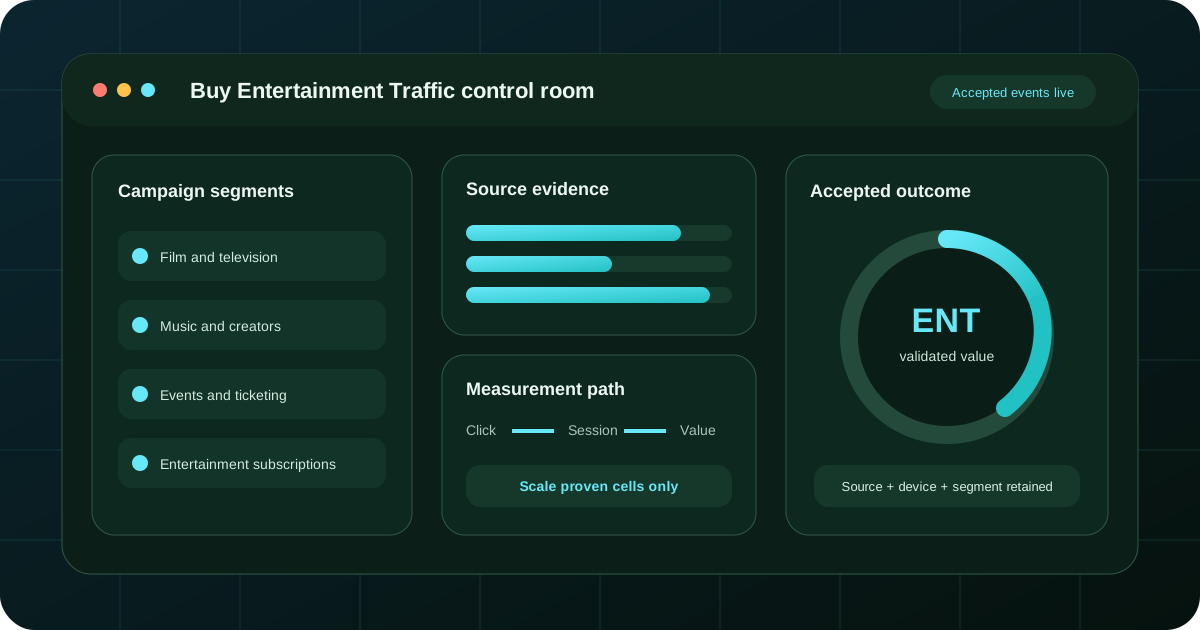
Buy Entertainment Traffic at a glance
What does this page explain about Buy Entertainment Traffic?
Quick answer: Buy entertainment traffic when you have a real title, event, game, creator offer or subscription and can define the outcome that pays back the media cost. FroggyAds lets you control format, market, device, budget and sources. Keep release timing, territory, availability and the customer route in the same campaign record, then compare settled outcomes after the right delay.
| Section | Distinct excerpt from this page |
|---|---|
| Purchase design and measurement | The destination should confirm the title or event, supported territory, device, date, price and next step before the visitor commits. |
| Entertainment campaign cell design | This page covers mainstream entertainment acquisition and keeps casino and betting offers outside the campaign plan. |
| Offer eligibility | Confirm that the audience can access the advertised content or event in the selected market and complete the supported payment or signup route. |
Reference for Buy Entertainment Traffic: FTC guidance on online advertising and marketing.
- Planning: Define the offer, availability window and accepted entertainment outcome.
- Control: Connect FroggyAds delivery to the supported customer route.
- Decision: Scale only the cells that retain settled value after the right delay.
How to buy entertainment traffic with measurable control
Buy entertainment traffic for a defined release, event, catalogue or subscription offer, not for an undifferentiated audience labelled as fans. Start by naming the customer action that creates value: a paid ticket order, a completed subscription payment, an eligible membership registration, a retained app user or another outcome your business can verify.
Build the media plan around the way the offer is consumed. A local concert needs serviceable geography, date awareness and remaining ticket inventory. A streaming subscription needs supported markets, compatible devices, clear billing and a useful retention window. A creator membership needs an accurate content promise and a path from preview to paid access.
Use FroggyAds to test Push, Native, Display, Pop, Video and Interstitial campaigns where the format suits the message. Separate formats when they create different expectations or destination behaviour. Preserve source, device, creative and landing-page versions through the advertiser's accepted event so the report can explain which combination worked.
Keep entertainment distinct from casino and betting acquisition. This page addresses mainstream film, music, events, games, creators and subscription content. Do not mix regulated gambling offers into these campaign cells or let entertainment language hide a different commercial category.
What this guide covers
Use this guide when you are ready to buy mainstream entertainment traffic and need a campaign another media buyer can understand, operate and audit. It covers offer access, audience timing, format choice, destination continuity, source review, downstream measurement and staged scaling for entertainment offers.
For Buy Entertainment Traffic, use the buy website traffic guide for the wider acquisition model and the traffic sources hub for source review. Use this page for the entertainment-specific decisions around availability, audience moment, format, customer path and mature value.
Build Mainstream entertainment campaigns as decision-ready cells
Create a campaign cell around one audience moment and one accepted result. A film release cell may test whether trailer viewers progress to a legitimate purchase or subscription. An event cell may test completed ticket orders inside the venue's catchment area. A subscription cell may test paid starts that remain active through the declared review window.
Separate evergreen demand from release-driven demand. A catalogue campaign can run against stable creative and destination conditions. A premiere, tour date, game launch or seasonal event has a short decision window and changing availability. Label those windows so a temporary spike is not treated as permanent source quality.
Keep the first matrix small enough to learn. Split only the market, device, format, language, audience or proposition that can change a budget decision. Hold other conditions stable, then let accepted outcomes and rejection reasons show whether the next repair belongs in targeting, creative, destination, inventory, pricing or fulfilment.
| Campaign cell | Why it stays separate | Primary failure to watch |
|---|---|---|
| Film and television | Keep visible until value is proven | release-window distortion |
| Music and creators | Use when pricing or service changes | rights restrictions |
| Events and ticketing | Separate by device and source | engagement-only optimization |
| Entertainment subscriptions | Merge only after evidence | mixing gambling with entertainment |
Six checks before any budget is released
Offer eligibility
Confirm the customer can actually access the advertised entertainment offer. Check territories, release dates, venue capacity, age limits, device compatibility, language, payment methods and any subscription availability before buying delivery.
Audience fit
Define the audience by a real entertainment need or moment. Examples include people comparing a new streaming service, fans considering a local event or players evaluating a supported game. Do not assume that broad interest alone proves purchase intent.
Destination readiness
Test the complete destination on representative devices. Verify trailer or preview playback, event details, seat or ticket flow, account creation, app-store handoff, payment, error messages, confirmation and customer support information.
Measurement ownership
Name the accepted event and the system that owns it. Preserve neutral campaign, source, format, device, creative and destination identifiers through that event. Keep customer details in the advertiser's approved commerce, ticketing, app or subscription system.
Source control
Write source decisions before launch. State the evidence floor, conversion delay, acceptable acquisition cost, refund or cancellation treatment and conditions for keeping, reducing, excluding or retesting a placement.
Scale discipline
Set both a loss ceiling and an availability ceiling. Pause when tracking breaks, a date sells out, rights or territory change, the destination becomes inaccurate or accepted cost crosses the written boundary. Scale only while the offer and operations can support the added demand.
An eight-step launch and optimization process
Define the decision
Write one acquisition hypothesis that names the entertainment offer, eligible audience, timing, FroggyAds format and accepted outcome. Add the maximum learning loss and the date when ticket, billing, retention or attendance evidence should be mature enough for a decision.
Verify the journey
Audit the advertised route before launch. Follow the creative into the exact film page, artist page, event listing, game store or subscription checkout. Confirm availability, price, device support, material terms and the final confirmation state.
Build campaign cells
Create only decision-relevant cells. Separate a territory when rights or availability differ, a device when playback or checkout differs, and a format when the amount of context changes. Avoid a grid so wide that every cell lacks enough evidence.
Launch with limits
Launch with capped spend and source visibility. Confirm that visits load, campaign identifiers persist and the accepted event reconciles with media delivery. Stop quickly if redirects, ticketing partners, app stores or subscription systems break the evidence chain.
Validate delivery
Use early engagement to diagnose the route. Trailer plays, episode previews, event-page views, store visits and signup starts can locate friction. Use paid, eligible or retained outcomes for allocation after the declared delay.
Classify outcomes
Classify downstream results with practical reasons. Keep accepted, duplicate, unavailable-territory, incompatible-device, cancelled, refunded, chargeback, no-show and retained states where they apply. These labels make the next fix specific.
Apply stop rules
Apply the written action rule to every mature cell. Continue stable delivery, repair one known defect, restrict a weak source, retest a new version, pause a boundary failure or expand a qualifying cell. Record the evidence and owner.
Scale proven cells
Increase one dimension at a time. Add a market, device, source set, creative concept or budget step while the rest stays stable. Compare the added cohort with the prior period and roll back when accepted value, customer experience or availability deteriorates.
Choose a format for the customer journey
| Format | Best role in the plan | What to measure |
|---|---|---|
| Push | Direct, time-sensitive messages where the promise can be understood quickly | Clicks, loaded sessions, accepted event rate and complaint feedback |
| Native | Contextual discovery with more room for explanation | Engaged sessions, qualified progression and accepted outcome cost |
| Display | Visual reach, retargeting and broad awareness support | Viewability, clicks, assisted conversions and frequency |
| Pop | High-volume testing when the destination can qualify intent quickly | Loaded sessions, source quality, accepted event cost and bounce diagnostics |
| Video | Demonstration, storytelling and prequalification | Completed view, click, downstream event and incremental value |
| Interstitial | High-attention mobile or web placements | Engagement, close behavior, destination quality and accepted conversion |
Connect delivery to accepted business value
Measure the route in layers. Delivery evidence covers spend, impressions and purchased visits. Experience evidence covers loaded pages, playable previews, ticket or store progression and checkout starts. Business evidence covers settled orders, paid subscriptions, eligible registrations, retained users, refunds and cancellations. The mature business event should control scale.
Choose an accepted outcome that matches the offer. A ticket order may need successful payment and an adjustment for cancellation. A free trial may need a paid conversion and a stated retention age. A game install may need a legitimate first session or advertiser-defined retained action. Write the rule before traffic starts.
Reconcile partner systems deliberately. Ticketing platforms, app stores, subscription billing and analytics may use different timestamps, attribution windows and identifiers. Document the difference instead of forcing totals to match. The goal is to see where the route loses availability, compatibility, intent, payment or retention.
Preserve useful campaign context without exposing customer data. Keep source, format, market, device, creative, destination and offer version attached to the accepted state. Store names, payment details and account information only in the advertiser's approved systems.
| Layer | Signals | Decision question |
|---|---|---|
| Delivery | Impressions, clicks, loaded sessions | Is the campaign reaching the intended cell? |
| Quality | Target match, invalid signals, duplicates, engagement | Is the delivered session usable evidence? |
| Progression | Key page or product actions | Where does the journey lose qualified users? |
| Acceptance | ticket purchaser and retained member | Which sources produce business-approved outcomes? |
| Value | monetizable viewer and downstream revenue or retention | Can the cell support more budget without losing economics? |
Compare evidence with a repeatable scoring model
Score each source against the entertainment offer it actually served. Useful fields include loaded-session rate, preview completion, eligible territory, checkout progression, paid conversion, refund status, retention age and complaint reason. Weight the later outcome more heavily than the easy engagement event, and keep sample size beside the score.
Add timing and availability to the scorecard. A placement that performs during launch week may not retain the same value after the premiere, tour announcement or promotional window. Compare like periods and label inventory or price changes so the source is not credited for a condition it did not create.
| Criterion | Suggested weight | Rating | Review note |
|---|---|---|---|
| Target match | 20% | Score 0 to 5 | Record the audience and territory evidence owner |
| Accepted outcome rate | 25% | Score 0 to 5 | Record the mature outcome and reconciliation owner |
| Cost versus limit | 20% | Score 0 to 5 | Record the cost limit and budget decision owner |
| Downstream quality | 20% | Score 0 to 5 | Record refunds, cancellations and retention ownership |
| Operational fit | 15% | Score 0 to 5 | Record availability, fulfilment and support ownership |
Practical Mainstream entertainment campaigns campaign scenarios
Film release
For a film or series release, match creative to the supported territory and legal viewing route. Measure qualified trailer engagement as a diagnostic, then use a paid rental, ticket, subscription or other accepted commercial event. Separate premiere demand from later catalogue acquisition.
Music campaign
For music and creator campaigns, align the message with the current release, show, channel or membership offer. Measure verified ticket purchases, paid memberships or another advertiser-defined outcome. Keep follows and listens as supporting signals unless they directly create the business value being bought.
Event promotion
For event promotion, use the venue catchment, event date, remaining inventory and attendee eligibility to shape the cell. Test the ticket route on mobile and desktop. Review completed paid orders, cancellations and attendance-related evidence after the correct delay.
Creator membership
For entertainment subscriptions, explain the content access, supported devices, price, trial conditions and renewal terms. Track registration, successful billing and retained membership separately. Allocate budget from the later accepted state when its volume supports a reliable decision.
A page-specific fieldbook for Mainstream entertainment campaigns
Evidence contract
Start the brief with the exact entertainment proposition. Name the title, artist, event, game, creator programme or subscription, the supported audience and market, the availability window and the accepted outcome. This keeps broad entertainment interest tied to a commercial decision.
Risk register
Map the customer path from the first promise to usable access. Include preview, detail page, selection, account or store handoff, payment, confirmation and later usage where relevant. Assign an owner to every step that can reject or lose an otherwise qualified visitor.
Scale record
Create an availability register. Record territory rights, dates, venue or digital inventory, supported platforms, age suitability and material commercial terms. Link creative and destination versions to that register so a campaign can be paused when access changes.
Readiness brief
Design the destination for a confident choice. Identify the entertainment product, show what the customer receives, state the price and key conditions, and make the next action clear. Do not use a popular title, artist or trend to disguise an unrelated offer.
Segmentation notebook
Define rejection reasons that point to a fix. Examples include unsupported country, sold-out inventory, wrong event date, incompatible device, failed payment, duplicate account, cancelled order, refunded purchase and trial cancellation. Keep them separate from generic non-conversion.
Journey audit
Give scale a written capacity boundary. Ticket inventory, streaming rights, fulfilment, support, server capacity and onboarding can all limit useful volume. More traffic is not an advantage when the advertised route cannot deliver what the creative promises.
Four operational notes for Mainstream entertainment campaigns
Field note 1: Film and television
Keep a dated timeline for every entertainment cell. Record campaign launch, creative or trailer release, inventory change, first accepted outcome and final review. Add the destination version at each change so a performance shift can be attributed to the correct condition.
Field note 2: Music and creators
End each review with one operational sentence. State whether the cell continues unchanged, needs a destination repair, should be restricted, must pause or qualifies for a staged increase. Cite the mature event and the main rejection reason.
Field note 3: Events and ticketing
Compare early attention and later value side by side. One source may produce long preview sessions but few paid outcomes. Another may produce fewer clicks with better retained subscription value. This comparison shows why an inexpensive engagement event may not deserve more spend.
Field note 4: Entertainment subscriptions
Record availability failures separately from media quality. A sold-out event, removed title, broken app-store route or unsupported payment method can make a good audience appear weak. Repair the route, preserve the affected dates and start a new comparison window.
Build a message matrix for Mainstream entertainment campaigns
Build each message around a specific entertainment decision. A film viewer may need genre, release timing and legal access. A concert buyer needs artist, venue, date and ticket route. A subscriber needs catalogue value, device support, price and renewal terms. One creative should not blur these needs together.
Put the main entertainment benefit first, the material qualification second and the next action third. Use accurate titles, dates, locations and access terms. Keep the destination wording aligned so curiosity does not turn into disappointment after the click.
Review headline, image and video as one claim. The combination must not imply unauthorised access, false availability, fabricated endorsements or guaranteed enjoyment. Use only creative and intellectual property the advertiser is entitled to promote.
Version concepts by proposition rather than cosmetic changes alone. A new-release preview, local event, game discovery and paid membership answer different questions. Keep each in a traceable cell, then test visual variations without losing the proposition identity.
Archive the approved asset, destination, offer version and availability date. When performance changes, the archive shows whether the source shifted or the title, event inventory, price, trial or creative changed at the same time.
| Audience or segment | Creative angle | Promise to validate | Failure signal |
|---|---|---|---|
| Film and television | Evidence and process | Match the promise to ticket purchaser | Watch release-window distortion |
| Music and creators | Offer and eligibility | Match the promise to retained member | Watch rights restrictions |
| Events and ticketing | Trust and next step | Match the promise to verified attendee | Watch engagement-only optimization |
| Entertainment subscriptions | Problem and outcome | Match the promise to monetizable viewer | Watch mixing gambling with entertainment |
Classify source evidence for Mainstream entertainment campaigns
Read source evidence inside one entertainment context. A placement that works for a local event may not work for a recurring subscription. Attach every keep, watch, restrict or retest decision to the title, audience, market, format and offer version that produced it.
Diagnose visit loss through redirects, loading, playback and consent. Diagnose action loss through message continuity, availability, price and checkout usability. Diagnose acceptance loss through payment, cancellation, refund or retention. Give each failure to the team that can repair it.
Use enough mature evidence for the decision. A few high-interest clicks do not justify a permanent source block or a broad scale increase. Set the evidence floor and review age before delivery, then apply the same rule to comparable cells.
Open a new comparison window after a material change. Do this when creative, title availability, event inventory, price, checkout, tracking or accepted-event definition changes. Combining old and new conditions hides whether the repair improved the route.
Keep refunds, cancellations, chargebacks, no-shows and retention by neutral source identifier where they matter. A source with many first payments may deliver weaker settled value. Let mature outcomes influence allocation without moving customer details into the media report.
| Example source | Primary cell | Accepted signal | Notebook status |
|---|---|---|---|
| Source Alpha | Film and television | ticket purchaser | Hold |
| Source Beta | Music and creators | retained member | Reduce |
| Source Gamma | Events and ticketing | verified attendee | Scale |
| Source Delta | Entertainment subscriptions | monetizable viewer | Explore |
Turn four use cases into controlled tests
Film release playbook
Test screen entertainment with one supported title or catalogue proposition and a legal access path. Confirm territories and devices, then compare sources by paid or retained outcomes after the same age. Use trailer and preview activity to explain friction, not to claim revenue.
Music campaign playbook
Test music or creator acquisition with a current release, event or membership promise. Keep the artist or creator identity, rights and commercial terms accurate. Review paid tickets, memberships or another accepted event alongside cancellations and support feedback.
Event promotion playbook
Test events with the exact venue, date, audience area and remaining ticket route. Separate locations and dates when inventory or pricing differs. Measure completed eligible orders and later reversals, then distinguish campaign loss from sold-out or operational loss.
Creator membership playbook
Test subscriptions with clear content access, platform support, trial, price and renewal information. Track signup, successful billing and retained membership as separate stages. Expand the source and device cells that sustain accepted value after the declared window.
Use loss limits, controlled changes and staged scaling
Set the first allocation from affordable learning loss and the number of campaign cells. Give each cell enough opportunity to expose tracking, availability and source problems, but do not buy an arbitrary volume that the offer cannot absorb.
Change one major dimension at a time. A simultaneous change to bid, creative, title, destination and targeting makes the next result impossible to interpret. Keep a stable reference and document the hypothesis for the changed cell.
Increase delivery in measured steps. Compare eligible reach, accepted acquisition cost, refund or cancellation rate, retention and operational capacity with the prior stable period. Judge the added cohort separately before blending it into the total.
Pause when tracking fails, the advertised title or event becomes unavailable, the creative is no longer authorised, checkout breaks or accepted cost crosses the limit. Record the reason and resume only after the responsible component is verified.
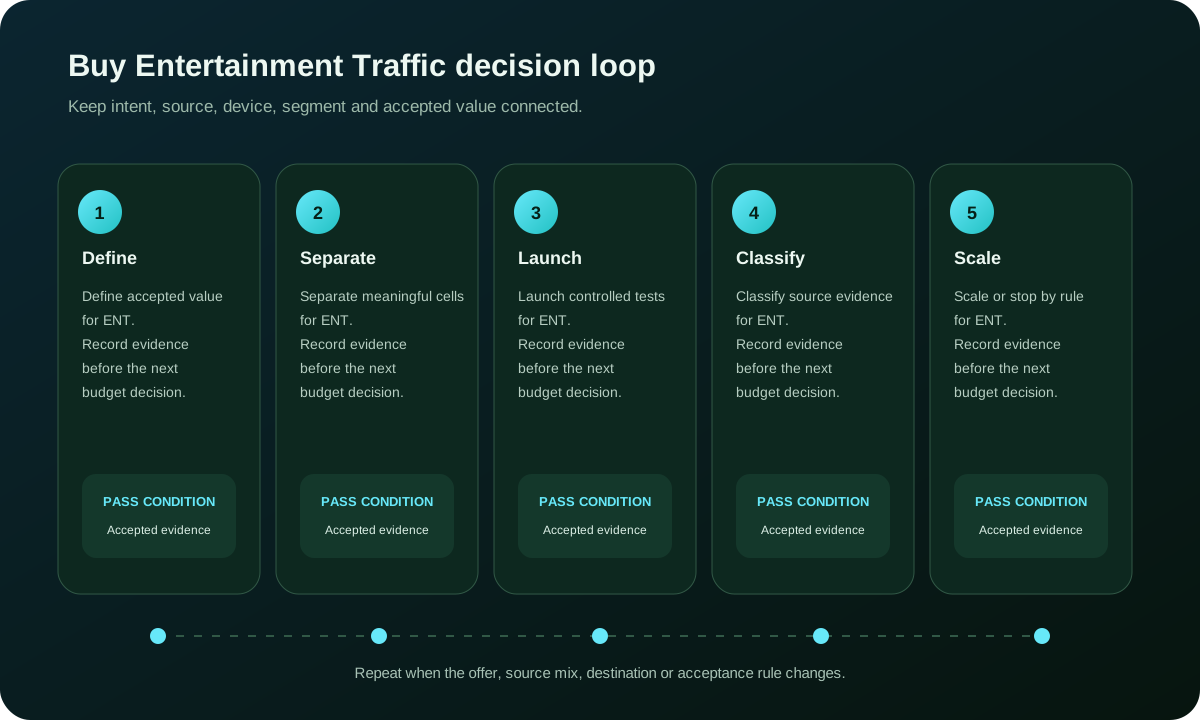
Protect the evidence before optimizing
FroggyAds controls help you manage paid delivery, but traffic controls cannot certify every entertainment interaction or the advertiser's rights. Combine platform source evidence with advertiser-side availability, eligibility, payment, cancellation and retention checks.
Review the rules and permissions that apply to the title, creative, audience, territory and customer data. Confirm that the advertiser may promote the content and deliver the offer in each selected market before the campaign starts.
Keep the message and destination accurate, accessible and consistent. Do not invent popularity, reviews, endorsements, scarcity or guaranteed results. Explain dates, territory, device, price, trial and renewal conditions in a way the visitor can act on.
Maintain a change log for bid, source, targeting, creative, title availability, event inventory, destination and tracking. This record separates market movement from an internal change and gives the next budget decision a traceable basis.
Continue, improve, reduce, pause or scale
| Decision | Evidence threshold | Action |
|---|---|---|
| Continue | Tracking verified, target match acceptable, enough runway remains | Keep the cell unchanged until the planned review point. |
| Improve | Usable demand exists but one funnel step is weak | Change one major variable and restart the comparison window. |
| Reduce | Accepted cost is near the limit or quality is declining | Lower bid, cap or source exposure while preserving evidence. |
| Pause | Tracking broken, offer inaccurate, policy risk or loss limit reached | Stop delivery and repair the cause before another test. |
| Scale | Accepted cost and downstream value remain stable after delay | Increase in stages, then recheck the full scorecard. |
Buy Entertainment Traffic FAQ
What does it mean to buy entertainment traffic?
It means purchasing advertising delivery for a defined entertainment offer and audience, then connecting source and device evidence to a verifiable business event such as a settled ticket order, paid subscription, eligible registration or retained user.
Which entertainment campaigns fit this page?
This page covers mainstream film, streaming, music, creators, events, games and entertainment subscriptions. Casino and betting acquisition require separate category, policy and eligibility controls and are not treated as mainstream entertainment here.
Which FroggyAds formats can entertainment advertisers test?
FroggyAds supports Push, Native, Display, Pop, Video and Interstitial campaigns. Choose a format that can communicate the title, event, access conditions and next step accurately, then test formats in separate decision cells.
How should an entertainment audience be targeted?
Start with serviceable market, language, device and offer availability. Add only distinctions that can change creative, checkout or a budget decision. Broad interest can support discovery, but accepted outcomes should decide allocation.
What should count as an accepted entertainment conversion?
Use an outcome the advertiser can verify and value consistently. Examples include a paid ticket adjusted for cancellation, a billed subscription reviewed after a retention window, or an eligible app user who completes the declared action.
How should release dates and event windows affect the campaign?
Label release, premiere, tour and event windows in the campaign record. Compare sources inside like periods because demand and inventory can change quickly. Do not treat a launch-week spike as permanent source quality.
How can entertainment traffic sources be compared fairly?
Compare the same offer, market, format, device, creative, destination version and outcome age. Include spend, mature accepted events, refunds, cancellations, retention and availability failures before changing allocation.
How much should the first entertainment campaign spend?
Set a capped learning allocation from the maximum acceptable loss, expected event frequency and number of cells. The first budget should be large enough to test tracking and fit, but small enough to stop when evidence fails.
When is an entertainment campaign ready to scale?
Scale after availability, permissions, message, tracking and operations are stable and mature outcomes meet the written cost and quality rule. Increase one dimension at a time and keep a rollback threshold.
Does buying entertainment traffic guarantee tickets, subscribers or revenue?
No. FroggyAds supplies advertising inventory and campaign controls. Results depend on the offer, timing, market, creative, source mix, bid, destination, availability, customer route and follow-up. Paid traffic cannot guarantee commercial results.
Continue the traffic plan
Buy Website Traffic
Continue with the guide that resolves the next entertainment acquisition decision: broad paid-traffic planning, streaming-specific traffic or video format selection. Return to the campaign record and note how the guidance changes audience, message, tracking or allocation.
Buy Streaming Traffic
Buy Video Traffic
Build a campaign around accepted outcomes
Choose FroggyAds for a controlled entertainment traffic test. Match the format, market, device and source cells to the real offer, then let settled ticket, subscription, membership or app value guide the next budget step.
Buy Entertainment Traffic: the buyer task this URL owns
This URL helps media buyers plan and operate a mainstream entertainment traffic purchase. It focuses on release, event, creator, game and subscription acquisition where availability, timing and accepted value determine the next budget step. Use Entertainment Traffic for the adjacent category overview.
Anchor the review to the exact offer, supported audience, territory, device, availability window, format and mature commercial outcome. These inputs earn their place because each can change who sees the message, whether the route works and whether more spend is justified.
| Checkpoint | Page-specific action | Evidence to keep |
|---|---|---|
| Fit | Confirm offer access, audience moment, territory, device and accepted outcome. | Keep title or event availability, audience, territory and offer version. |
| Test | Launch the smallest format and audience matrix that can test the entertainment route. | Keep format, source, device, creative, destination and timing evidence. |
| Decision | Continue, repair, restrict, pause or expand from mature entertainment value. | Keep spend, outcome age, accepted state, reason and rollback threshold. |
Hypothetical calculation: if a controlled entertainment campaign spends USD 720 and records 18 mature accepted outcomes, accepted acquisition cost is USD 40. Replace the spend, event and maturity window with advertiser data. This example is not a FroggyAds performance claim.
Use FroggyAds as the paid-media execution layer while the advertiser keeps title rights, availability, checkout and accepted value authoritative. Choose the formats and controls that fit the route, preserve source evidence and expand only after the settled outcome supports it. Create your free FroggyAds account.
Buy Entertainment Traffic — what matters first
Define the exact entertainment offer, supported audience and mature commercial outcome first. Use FroggyAds targeting, format, budget and source controls for a bounded test, then expand only the cells that keep their accepted value after the correct delay.