
AdMaven CPM rates
how to estimate cost without inventing a fixed price
AdMaven CPM rates change with the auction. This guide explains the current pricing model, the variables that move cost, and the calculations advertisers need before comparing AdMaven with another traffic source.

What can an AdMaven CPM observation actually tell you?
Direct answer: it can describe the exposure cost of one documented delivery cell. It cannot establish a fixed AdMaven tariff, predict your next auction or prove that the traffic will create accepted customers. A usable observation names the format, country, device, source scope, buying model, campaign dates, currency and eligible impression count. Without those fields, the number is a research clue rather than a budget benchmark.
Separate three evidence classes before comparing AdMaven with FroggyAds. Published platform material can establish which formats or commercial rules were described on a stated date. The authenticated account can show the buying option and guidance available to that advertiser. A completed campaign can show what one configuration bought under its actual auction conditions. Label each statement with its evidence class so a dashboard value is not presented as a public promise and a marketing page is not treated as campaign performance.
For the buying decision, connect the observed CPM to effective CPC, landing-session cost and mature accepted CPA. That chain reveals where economics changed. If exposure was inexpensive but qualified sessions were scarce, inspect format and source fit. If sessions were suitable but accepted actions failed, investigate the destination, offer, event definition and postback path before blaming the auction price.
Why there is no useful network-wide AdMaven CPM
CPM means cost per one thousand billable impressions. The formula is stable; the clearing conditions are not. AdMaven public material describes more than one advertising format, and those formats do not create the same user experience or compete for identical inventory. Country, device, placement, source, audience rules, bid method, time and competing demand can all change the cost of the next thousand impressions.
Use a distribution instead of one blended average. For every comparable cell, retain the delivered impressions, spend, median or other chosen rate statistic, upper range, source count and observation dates. Averages can hide a small expensive source group or make a new low-volume test look representative. The record should also state whether delivery was capped, whether bids changed and whether the format mix moved during the period.
This distinction protects both planning and sales communication. We can help you configure a bounded FroggyAds campaign with the available targeting, format, budget and source controls, while your own campaign record establishes the price and outcome for that setup. We do not turn a previous advertiser's observation into a guaranteed rate for you.
Which variables should sit beside every AdMaven CPM figure?
Start with market and device because they define the auction pool being sampled. Record countries separately when demand or conversion value differs, and do not merge desktop and mobile before you have checked their landing behavior. Add format and placement context next. Pop or New Tab, Push, In-Page Push, Interstitial and Content Locker traffic should remain separate cells because attention, interruption and incentive can change response quality even when the exposure price is similar.
Then document the buying rule. Store the model shown in the current account, bid value, caps, scheduling, source inclusions or exclusions and any automated option that can alter delivery. Capture creative and destination versions with the same discipline. A new headline or landing path can move CTR and accepted conversion rate without any change in CPM, so the commercial interpretation must keep those versions visible.
Finally, record time and maturity. Auction cost can move by hour or day, while an accepted business outcome may not be final until duplicates, fraud review, lead validation, cancellations or reversals have been applied. Keep the early diagnostic view and the mature decision view as separate dated snapshots. That prevents later corrections from disappearing and makes the rate conclusion reproducible for the next media buyer.
Turn the AdMaven rate question into a two-cell FroggyAds experiment
A quoted or observed CPM becomes useful only when it is attached to a defined buying cell. Write down the AdMaven format, country, device class, source scope, bid method, creative version and reporting window that produced the observation. Then create the closest practical FroggyAds cell with the same offer, destination and accepted conversion event. Where the user experience cannot be matched, keep the rows separate and call one a suitability test. That record lets you compare evidence without presenting an auction observation as a permanent tariff.
Choose the loss ceiling and decision date before delivery. We recommend using the smallest budget that can test the tracking path, expose source-level differences and reach the campaign's own minimum evidence rule. Keep rejected and reversed outcomes outside the accepted total. The next action should follow the mature cell: repair tracking, narrow a source set, revise creative, continue the control or expand one limit.

Translate AdMaven CPM into the economics your offer can support
Begin with media cost: impressions divided by 1,000, multiplied by observed CPM. If a hypothetical cell serves 120,000 eligible impressions at an observed $1.20 CPM, media cost is $144. This is illustrative arithmetic, not an AdMaven quote or forecast. Reconcile the impression and spend inputs with the platform report before using the result.
Next calculate effective CPC as attributable spend divided by validated clicks. If the illustrative $144 cell records 720 valid clicks, effective CPC is $0.20. CTR connects the two layers: stronger response can lower effective CPC even when CPM is unchanged. Preserve creative and placement versions, because a change in response does not automatically mean the auction became cheaper.
For acquisition economics, divide complete attributable cost by accepted outcomes after the relevant validation window. Suppose the same hypothetical cell produces 18 accepted registrations after duplicates and rejected entries are removed. Media-only accepted CPA is $8. Add creative, tracking, data, payment and operating costs when they differ between alternatives. The result remains a scenario until your own verified inputs replace the example.
A break-even CPM works backward from the offer. Define the maximum mature cost per accepted outcome, expected click-through rate and accepted conversion rate. Use conservative values and keep the formula with the decision record. If the live cell exceeds the boundary, diagnose source, format, creative, destination and measurement before increasing the bid. A lower CPM can still be uneconomical when accepted outcomes are weak; a higher CPM can fit when qualified response and downstream value hold.
Use scenarios to set guardrails, not to advertise a price
Scenario planning asks what combinations of CPM, response and acceptance would keep a campaign inside its commercial limit. Build low-response, control and stronger-response rows from your own assumptions. For each row, calculate media cost, effective CPC, landing-session cost and accepted CPA. Highlight the variable that must change for the row to pass. The exercise defines what to watch; it does not predict which row AdMaven or FroggyAds will deliver.
Keep formats separate in the scenario sheet. An incentivized Content Locker action may require a different accepted event and validation process from a push or pop visit. If those outcomes carry different business value, do not compare their raw conversion counts. Apply the same rule to device or geography groups when qualification, payout or customer value changes.
Convert every passing scenario into a campaign guardrail: maximum exposure, maximum mature accepted CPA, minimum evidence before scaling and a pause trigger. FroggyAds can be tested against the same written framework. Using one acceptance rule for both platforms gives you a stronger buying decision than comparing two headline rates that describe different delivery contexts.
Choose a format without flattening different user experiences
CPM comparisons can mislead when pop, push, in-page push, interstitial and Content Locker delivery are placed in one average. Each format creates a different moment, creative constraint and path to the landing page. Record the specific experience beside its observed CPM, click rate, landing-session rate and accepted outcome rate. Content Locker is an incentivized context and deserves its own acceptance rule; it should not inherit a conclusion from a non-incentivized format.
Use FroggyAds to test the format that fits your message and destination, then keep format and device stable while the first evidence window matures. A lower clearing cost is useful only if the placement can communicate the offer accurately and the resulting visitors complete the qualified event you defined. Reject a cell that depends on a misleading promise or an unsuitable interruption, even when its exposure price looks attractive.

How to discover a workable AdMaven CPM without treating it as permanent
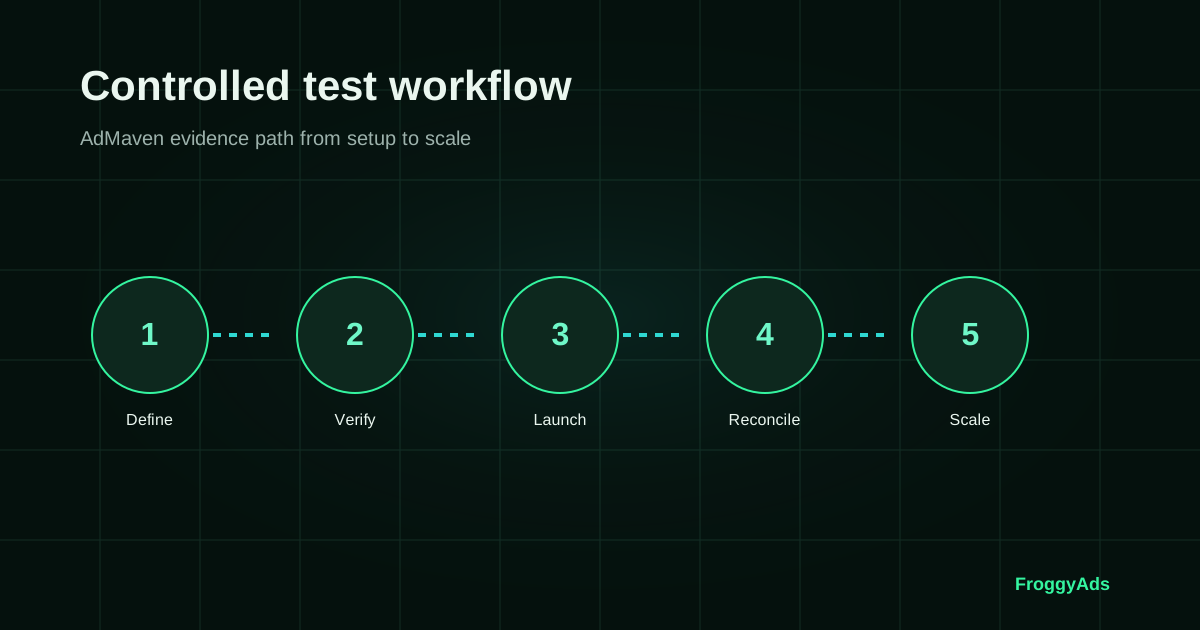
Step 1: define the cell. Choose one offer, format, market, device group, source scope, destination and accepted event. Record the current account model and bid guidance. If a platform does not offer a comparable format, classify the row as a suitability test rather than a head-to-head result.
Step 2: prove the path. Check the final URL, tracking parameters, landing session and conversion callback before material delivery. Save a test identifier that can be followed through platform reporting and the first-party system. A CPM has no decision value when the outcome path is broken.
Step 3: cap the first observation. Set daily and total exposure limits plus a loss ceiling. The first run should be large enough to expose reporting and source behavior under your written rule, but small enough to stop without forcing a recovery campaign. Do not widen geography, bid and format together.
Step 4: reconcile the ledger. Align currency, timezone and dates; then join eligible delivery, clicks, landing sessions, accepted actions, rejections and reversals. Investigate gaps before calculating mature economics. Platform billing and advertiser value are related records with different purposes.
Step 5: repeat or close. Continue unchanged while evidence matures inside the guardrails. Pause for an unresolved destination, policy, billing or measurement problem. Scale one boundary only after accepted outcomes reproduce. Store the new volume as a separate marginal row so a stable average cannot hide deterioration.
An audit-ready workbook for AdMaven CPM planning
The first sheet is an evidence register. Give every claim an owner, source URL or account export, access date, scope and expiry condition. A public format page can support a format statement. Current account screens govern the option available to that advertiser. Campaign exports support observations for their recorded dates. Keeping those roles separate prevents a stale help page or isolated screenshot from becoming a universal price claim.
The second sheet is the cell specification. Record campaign identifier, offer, format, countries, devices, bid method, caps, source rules, creative version, final destination, tracking parameters, accepted event and maturity date. Add a change log with old value, new value, time, editor and reason. When a material field changes, open a new cell rather than blending incompatible periods.
The third sheet is the reconciliation ledger. Keep spend and eligible impressions beside clicks, landing sessions, accepted outcomes, rejected outcomes and reversals. Store the raw counts used by each formula. Calculate observed CPM, effective CPC, landing-session cost and mature accepted CPA without overwriting earlier snapshots. If finance applies a credit or fee, record it as its own line.
The fourth sheet is the decision. State whether the cell is rejected, held, repeated, capped, expanded or closed. Name the evidence behind that action and the condition that would reverse it. A decision such as “expand mobile push in the verified source set by one budget step; return to the prior cap if marginal accepted CPA exceeds the limit” is reviewable. “Increase spend because CPM looks low” is not.
Use the same workbook for a FroggyAds control. We recommend a small, measurable start, source-level review and one-variable expansion. This gives your team a consistent method for choosing the traffic setup that serves the offer, rather than choosing from an unsupported platform-wide average.
Launch the smallest decision-grade CPM cell
Before funding a larger comparison, verify the live account terms, available buying model and campaign controls. Save the account currency, timezone, bid rule, daily and total limits, final URL, tracking parameters and pause owner. The campaign should have one accepted event with a named system of record. If AdMaven or FroggyAds reports a platform conversion, reconcile it with that first-party acceptance record instead of silently treating both labels as equivalent.
Review the cell in a fixed order: destination and event path, billed spend, eligible delivery, landing sessions, accepted actions, rejections, reversals and source-level patterns. Calculate effective CPC and mature cost per accepted outcome only after the inputs have been checked. If a material setting changes, close the current evidence window and start a new version. This prevents a later adjustment from rewriting what the original CPM actually represented.

Official sources for AdMaven pricing and campaign setup
First-party information was reviewed on July 12, 2026. Verify live bid guidance inside the current account.
- AdMaven advertiser platformOfficial source
- AdMaven ad formatsOfficial source
- AdMaven advertiser termsOfficial source
- AdMaven Content Locker campaign exampleOfficial source
- FroggyAds pricingOfficial source
- FroggyAds ad formatsOfficial source
- FroggyAds traffic sourcesOfficial source
- FroggyAds advertisersOfficial source
AdMaven CPM rates FAQ
Answers about pricing models, rate comparisons and auction planning.
What context is needed before an AdMaven CPM figure is useful?
The figure needs a date, market, format, device, placement type, bid conditions, and delivered volume. Without that context, it cannot guide a specific campaign.
What formula converts AdMaven CPM into media cost?
Media cost equals impressions multiplied by CPM and divided by 1,000. Keep external fees outside the formula and add them separately to the campaign total.
How do I find effective CPC from an AdMaven CPM campaign?
Divide media spend by measured clicks after confirming the click records are valid. Effective CPC helps compare buying models but does not show conversion value on its own.
How can a media buyer find CPA after buying AdMaven impressions?
Divide total attributable cost by accepted acquisitions after the conversion window closes. Use the same acceptance rule when comparing another source.
Why can AdMaven CPM differ between countries?
Advertiser demand, available supply, user value, format mix, and competition vary by country. Plan each market from its own observed auction data.
Can device and connection type change the value of a CPM campaign?
They can change creative delivery, page speed, user behaviour, and conversion value. Break out those segments before deciding that the headline CPM is high or low.
How does creative performance affect a CPM campaign?
Better creative response can produce more qualified visits from the same impression spend. Review click quality and accepted outcomes so attention-grabbing creative is not mistaken for profitable creative.
How should an AdMaven CPM bid change be tested?
Change the bid in a separate controlled period or campaign cell while holding other settings steady. Observe reach, source mix, effective costs, and mature value before keeping the change.
Can cheap AdMaven impressions still produce an expensive customer?
Low-cost impressions can still waste budget when they produce little accepted value. Compare retained revenue or margin after media and operating costs.
How can I obtain a current CPM estimate for AdMaven?
Use current official platform guidance and a limited campaign in the intended market and format. Replace the planning estimate with delivered auction data as soon as it is available.
Related AdMaven and FroggyAds resources
Read marginal CPM before moving the campaign cap
An average CPM can stay stable while the added budget reaches a different source mix. When a cell qualifies for expansion, raise one boundary at a time: budget, bid, geography, device group or source set. Retain the prior cell as the control and calculate the CPM, effective CPC and accepted acquisition cost for the added delivery separately. The marginal row shows whether the next unit of spend still fits the buying rule.
Pause when the destination breaks, the accepted event cannot be traced, billed activity cannot be reconciled, a policy question remains open or the written loss ceiling is reached. Continue unchanged while results are still maturing inside those guardrails. Expand only when accepted outcomes reproduce and the source record remains usable. With FroggyAds, you can keep the test bounded through available targeting, budget and source controls while your own acceptance evidence determines the commercial decision.
Build an AdMaven CPM evidence record another buyer can audit
The record should separate published information, authenticated account observations and advertiser calculations. For published information, save the source URL, access date and exact statement about formats, billing or account terms. For account observations, capture the buying model, current dashboard guidance, campaign configuration and report export without exposing credentials or personal data. For advertiser calculations, name every formula and the system that supplies its inputs.
Observed CPM equals billed spend divided by eligible impressions and multiplied by 1,000. Effective CPC equals attributable spend divided by validated clicks. Mature accepted CPA equals the complete attributable cost divided by accepted outcomes after the applicable rejection and reversal window. These figures answer different questions. CPM describes exposure cost, effective CPC describes response economics and accepted CPA connects the traffic test to the business event. None of them alone proves future performance.
Attach a confidence note to each conclusion. A short run may verify the tracking path without supporting a scale decision. A source with only a few accepted outcomes can remain provisional. If account guidance, inventory or terms change, close the old period and verify the new condition before reusing the benchmark. This dated evidence record is more useful than a single “typical CPM” because it shows exactly which campaign cell, source mix and maturity window produced the number.
The search decision this AdMaven CPM page owns
This URL answers one buying question: how should an advertiser interpret AdMaven CPM information without inventing a fixed network price? It does not own a broad AdMaven review, a minimum-deposit decision or a universal platform ranking. Use the linked companion pages for those questions and return here when the decision is about exposure cost, auction context, break-even math and the evidence required before a CPM observation can guide spend.
The useful keyword family follows that same boundary: AdMaven CPM rates, AdMaven advertising cost, AdMaven CPM pricing, observed CPM, effective CPC from CPM, break-even CPM, auction rate drivers, format-level CPM and source-level CPM analysis. Those phrases belong together because they lead to one operational task. The page answers that task with formulas, an evidence ledger, a controlled test and stop-or-scale rules rather than publishing an unsupported price.
If FroggyAds is part of your shortlist, create the comparable cell in our self-serve platform and keep the offer, destination, accepted event and review window aligned. Let the measured source-level result decide the next budget move. This gives you a practical alternative to choosing a network from an isolated rate claim.
Direct answer: what matters before you act on an AdMaven CPM
Treat every AdMaven CPM as a dated observation for a stated format, market, device, source scope and auction condition. Verify current account guidance, calculate the resulting media cost, connect it to effective CPC and accepted CPA, and document reporting lag, invalid-activity adjustments, fees and reversals. If those fields are missing, the figure is a research lead rather than a campaign benchmark.
Choose FroggyAds when you want to run the next bounded traffic test through our advertiser platform and judge it against your own qualified outcome. Start with a controlled cell, inspect sources and increase exposure only after the result remains inside your written cost and quality rules.