
Bidding that optimizes itself.
SmartCPC analyzes performance across sources, creatives and segments, then shifts your bids toward what actually converts – in real time, around the clock.
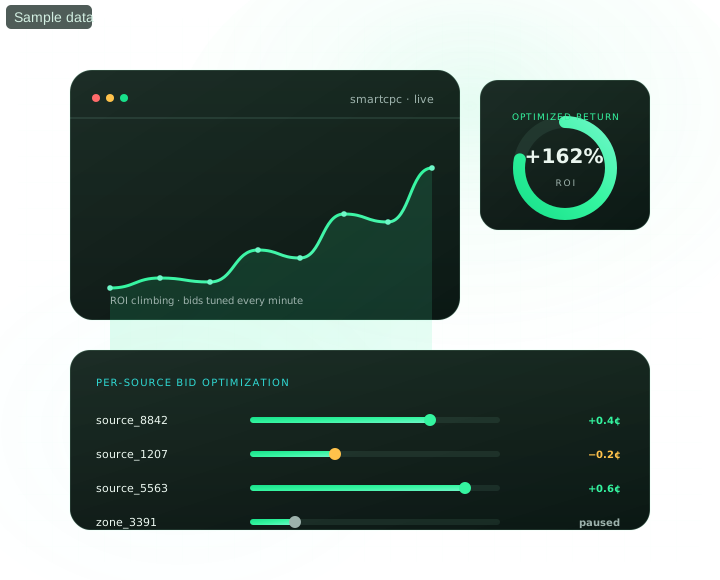
Bidding that optimizes itself: at a glance
What does this page explain about SmartCPC: Improve Campaign Performance & Control?
Quick answer: SmartCPC analyzes performance across sources, creatives and segments, then shifts your bids toward what actually converts – in real time, around the clock. Watch SmartCPC raise bids on high-performing sources, trim spend on underperformers and pause zones that do not convert – all while you focus on creative and strategy. Create a FroggyAds account, deposit from $50 and let SmartCPC help adjust bidding toward more efficient traffic based on available campaign signals and performance data. As impressions, clicks and conversions flow in, SmartCPC evaluates performance per source and segment and adjusts bids in real time – around the clock, far faster than a human could tune them manually.
| Section | Distinct excerpt from this page |
|---|---|
| Measure every source | SmartCPC continuously tracks performance for each source, zone, creative and segment in your campaign. |
| Find what converts | It identifies the placements delivering results and the ones quietly draining budget. |
| Shift bids in real time | Bids move up on winning sources and down – or off – on weak ones, automatically and around the clock. |
Reference for SmartCPC: Improve Campaign Performance & Control: FTC guidance on online advertising and marketing.
- Planning: Four things SmartCPC does for you.
- Control: Less micro-managing, more scaling.
- Decision: Per-source bid management, automated.
Four things SmartCPC does for you
Measure every source
SmartCPC continuously tracks performance for each source, zone, creative and segment in your campaign.
Find what converts
It identifies the placements delivering results and the ones quietly draining budget.
Shift bids in real time
Bids move up on winning sources and down – or off – on weak ones, automatically and around the clock.
Protect your ROI
The result is steadier cost-per-action and more of your budget spent on traffic that actually performs.
use SmartCPC as one bid-optimization input based on available campaign signals
Create your account, deposit from $50 and SmartCPC starts steering spend toward what converts.
Less micro-managing, more scaling
Always-on optimization
Bids are tuned continuously, not in occasional manual passes, so you capture opportunities as they appear.
Better ROI
Spend follows performance automatically, lifting conversion efficiency without constant babysitting.
You stay in control
Set your max bids, budgets and targeting – SmartCPC can help adjust bidding toward more efficient traffic based on available campaign signals and performance data. Results depend on tracking quality, conversion volume, the offer and campaign settings.
Works everywhere
Apply SmartCPC across every format and targeting combination on the platform.
Per-source bid management, automated
Watch SmartCPC raise bids on high-performing sources, trim spend on underperformers and pause zones that do not convert – all while you focus on creative and strategy.
Set it and scale. Define your max bids and budgets, switch on SmartCPC, and let the engine handle the minute-by-minute optimization while you grow what works.
Put SmartCPC to work
Create a FroggyAds account, deposit from $50 and let SmartCPC help adjust bidding toward more efficient traffic based on available campaign signals and performance data. Results depend on tracking quality, conversion volume, the offer and campaign settings.
How SmartCPC optimization actually works
SmartCPC is FroggyAds' automatic bid-optimization engine. The problem it solves is simple to state and hard to do by hand: across hundreds of sources, creatives and segments, the value of an impression varies enormously, and a single flat bid either overpays for weak inventory or underbids on the inventory that converts. SmartCPC continuously reweights your bids toward the combinations that produce conversions, and away from the ones that don't.
It works on the data you're already generating. As impressions, clicks and conversions flow in, SmartCPC evaluates performance per source and segment and adjusts bids in real time – around the clock, far faster than a human could tune them manually. That means budget naturally concentrates on profitable sources and creatives while pulling back on wasteful ones, improving blended cost per acquisition without you watching the dashboard every hour.
Importantly, SmartCPC doesn't take control away from you. It operates within the bids and budgets you set, and it works alongside your source-level whitelists and blacklists. You make the strategic decisions – which offers, which GEOs, which sources to allow – and SmartCPC handles the relentless micro-optimization underneath. Combined with Adscore-traffic with quality controls, it means the data it optimizes on is trustworthy in the first place.
| Without SmartCPC | With SmartCPC |
|---|---|
| One flat bid across all sources | Bids weighted per source & segment |
| Manual hourly tuning | Automatic, around-the-clock adjustment |
| Budget wasted on weak inventory | Spend concentrated on converters |
| Slow reaction to data | Real-time response as conversions arrive |
Watch SmartCPC optimize bids in real time
SmartCPC can help adjust bidding toward more efficient traffic based on available campaign signals and performance data. Results depend on tracking quality, conversion volume, the offer and campaign settings. For Smartcpc, validate this point against SmartCPC, Improve Campaign Performance, Campaign and keep it separate from the What Is Smartcpc Advertising intent.
- Per-source bid optimization
- Climbs ROI without manual tuning
- You keep full control on top
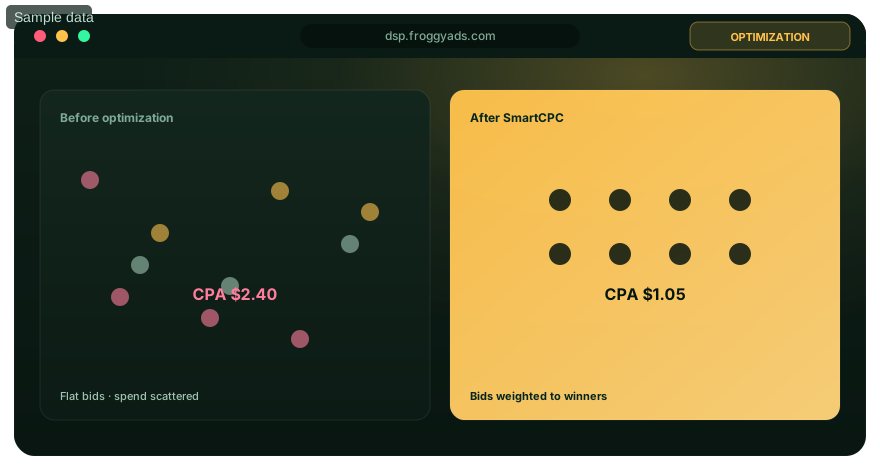
Use SmartCPC with a conversion rule the campaign can defend
SmartCPC is most valuable when automation is given a clean business signal and clear operating boundaries. Start by deciding which conversion event represents an accepted result for the campaign and confirm that the event can be attributed back to the traffic source. Keep device, GEO, creative and landing-page changes controlled during the learning period so a sudden performance shift is not caused by several unrelated changes at once. FroggyAds combines SmartCPC with source-level controls and detailed targeting, which gives media buyers a way to let bid optimization work while still preserving the ability to exclude inventory that repeatedly falls outside the campaign's quality or cost rules.
Before increasing budget, compare SmartCPC performance with the economics that matter after the click. A lower effective click cost can be useful, but it should not replace the buyer's accepted conversion-cost, value or qualification threshold. Review mature outcomes rather than reacting to the newest clicks, especially when conversions can arrive later. Keep a dated note when the campaign's bid strategy, targeting or destination changes, because automation cannot make historical comparisons meaningful if the measurement definition keeps moving. If a source improves after more data accumulates, the source record should show that change. If a source repeatedly fails the written rule, FroggyAds source controls provide a direct way to limit or exclude it without abandoning the wider campaign.
A practical SmartCPC workflow uses stages. First, launch with tracking verified and enough budget to collect a representative sample. Second, review source-level accepted outcomes and remove obvious technical or eligibility problems. Third, allow the optimization process to work on cleaner evidence while keeping major creative and landing-page tests separated. Fourth, raise volume in measured steps and confirm that the additional traffic still produces outcomes inside the same business boundary. This sequence makes automation easier to evaluate because every stage has a reason and a rollback point.
The final control remains the advertiser's commercial objective. SmartCPC can support more efficient bidding decisions, while the media buyer decides what efficiency means for the offer. FroggyAds also provides targeting by device, operating system, browser, carrier, city, country and category, so the buyer can isolate material audience differences when the data justifies it. Use those controls to answer specific questions rather than creating unnecessary fragmentation. When tracking, source evidence and the conversion rule stay consistent, SmartCPC becomes part of a disciplined optimization loop instead of a black box that is judged only by short-term click volume.
Set review intervals around the campaign's conversion delay and spend rate rather than checking automation after every small burst of traffic. A high-volume offer may produce enough settled evidence quickly, while a lower-volume test may need a longer observation period before source differences are meaningful. Define the minimum evidence required before an exclusion or scale decision and apply the same standard to winning and losing segments. Also check whether budget caps are causing the campaign to stop during the hours or markets that matter most, because constrained delivery can distort the sample that SmartCPC receives. The purpose of the review is not to override every automated adjustment. It is to make sure the campaign is still optimizing toward the event the advertiser intended, with enough measurement stability for the result to be trusted. When the rule, tracking and review cadence are documented together, the buyer can evaluate SmartCPC on repeatable evidence instead of on a single unusually strong or weak day.
SmartCPC bidding: practical questions answered
What does FroggyAds SmartCPC do?
SmartCPC automates bid adjustments using the campaign signals available to our platform. Instead of reviewing every source bid manually, you can use that automation alongside your chosen budget, targeting and source controls. The practical benefit is less repetitive bid management while you concentrate on the offer, creative and confirmed acquisition results. Review performance rather than assuming every automated change improves profitability.
When should I choose SmartCPC instead of manual bidding?
Choose SmartCPC when you want automated bidding support and have a campaign you can evaluate with reliable reporting. Manual bidding is useful when you need to isolate a particular bid change or investigate an unfamiliar source. FroggyAds gives you campaign and source controls alongside automation, so the choice should reflect what you are testing rather than how often you want to check the dashboard.
Is SmartCPC the same as paying only for conversions?
No. SmartCPC describes bid optimization, not a promise that you pay only after a lead or sale. Check the buying model and unit shown for your selected campaign. Cost per acquisition is a result you calculate from spend and confirmed conversions; it is not automatically the unit on your traffic bill. Keep those distinctions clear when comparing advertising platforms.
Which campaign decisions stay under my control?
You choose the offer, creative, targeting, bid limits, budget and source lists. Our SmartCPC workflow supports bidding within those campaign controls; it does not replace your decision about which customers are valuable. Review exclusions and limits when the offer changes, and keep a record of the settings used for each test so you can explain a later change in results.
How should I validate the conversion results used to judge SmartCPC?
Confirm that the event represents the result you intend to buy, is recorded once and can be connected with the campaign. Affiliate buyers should distinguish approved commissions from initial notifications; lead buyers should distinguish qualified inquiries from raw form submissions. Test the destination and measurement first. Otherwise, a tracking defect can make a useful source look weak or give an unproductive source misleading credit.
How can I compare automated bidding with my previous campaign?
Keep the offer, creative, destination and essential targeting as consistent as possible, and record when the bidding approach changes. Compare periods with similar conditions and enough time for conversions to be confirmed. Review acquisition cost and customer quality by source, not just the average bid. This makes your FroggyAds test more informative without pretending that a before-and-after comparison proves causation on its own.
Why can a lower CPC still produce a higher conversion cost?
A cheaper click can convert less often. For illustration, a $0.03 average CPC at a 1% conversion rate produces a $3 cost per conversion; $0.02 CPC at 0.5% produces $4. These are hypothetical inputs, not FroggyAds prices or expected results. Review confirmed conversion value alongside click cost before deciding that an automated bidding change deserves more budget.
Why might a SmartCPC campaign receive little traffic?
Check campaign eligibility, funding, schedule and combined targeting, then review your bid and budget limits. A narrow whitelist or an unsupported offer requirement can leave few eligible opportunities. Automation cannot create inventory outside those conditions. Keep restrictions that protect customer eligibility, and reconsider optional filters one at a time so you can see what actually changes delivery.
What should I do if conversion tracking stops working?
Limit or pause affected spending while you investigate the destination, event trigger, identifiers and reporting delay. Do not assume missing conversions mean every source has stopped performing. Restore a tested measurement setup and separate the affected period from clean comparisons. Our source reporting helps you identify where spend went while you reconcile the actual orders, leads or affiliate outcomes.
When should I increase the budget of a SmartCPC campaign?
Increase it when confirmed acquisition results repeatedly meet your cost and quality requirements. Keep the working offer and source mix identifiable, then review the additional traffic rather than relying only on the historical average. Choose FroggyAds for your next campaign to combine bid automation with the targeting, budget and source controls needed for measured expansion.
Bidding that optimizes itself.: what should the advertiser decide next?
For Bidding that optimizes itself., the feature is useful only when it changes a real buying, targeting or measurement decision. Start from the baseline described in Bidding that optimizes itself: at a glance, apply the control discussed around What does this page explain about SmartCPC: Improve Campaign Performance & Control?, and preserve a rollback point so the effect on smartcpc can be interpreted.
On this Bidding that optimizes itself. page, the decision should remain tied to the existing evidence around Bidding that optimizes itself: at a glance, What does this page explain about SmartCPC: Improve Campaign Performance & Control? and Four things SmartCPC does for you. Those sections give smartcpc its specific context; the table below turns that context into campaign actions rather than adding another generic definition.
| Decision | What to verify | FroggyAds action |
|---|---|---|
| Bidding that optimizes itself. objective | Use Bidding that optimizes itself: at a glance to define the accepted business event and the maximum learning loss for smartcpc. | Launch one FroggyAds campaign objective for Bidding that optimizes itself. and keep the conversion definition stable. |
| Bidding that optimizes itself. audience | Use What does this page explain about SmartCPC: Improve Campaign Performance & Control? to verify market, device, language and offer eligibility for smartcpc. | Apply only the FroggyAds targeting controls that change the real Bidding that optimizes itself. customer journey. |
| Bidding that optimizes itself. source evidence | Use Four things SmartCPC does for you to keep source-level differences visible instead of relying on one blended smartcpc average. | Keep, cap, exclude or retest Bidding that optimizes itself. inventory from documented source evidence. |
| Bidding that optimizes itself. economics | Use Measure every source to connect media spend with accepted conversions and downstream value for smartcpc. | Protect the Bidding that optimizes itself. test with a written budget boundary and a consistent attribution window. |
| Bidding that optimizes itself. scale rule | Use Find what converts to define the exact evidence that earns the next budget increase for smartcpc. | Scale Bidding that optimizes itself. one major control at a time and compare marginal performance with the prior baseline. |
A page-specific FroggyAds test sequence for Bidding that optimizes itself.
- Bidding that optimizes itself. outcome: define the accepted event for smartcpc and the maximum loss permitted while the first test is learning.
- Bidding that optimizes itself. path: verify market eligibility, device experience, landing-page continuity and tracking against Bidding that optimizes itself: at a glance before buying more traffic.
- Bidding that optimizes itself. hypothesis: launch one bounded FroggyAds test tied to What does this page explain about SmartCPC: Improve Campaign Performance & Control?; do not change bid, creative, audience and destination together.
- Bidding that optimizes itself. source review: compare qualified activity, accepted conversions, timing and cost by the source or segment dimensions relevant to Four things SmartCPC does for you.
- Bidding that optimizes itself. scaling: use Measure every source and Find what converts to define what must reproduce before the next budget increase.
Why FroggyAds is relevant to Bidding that optimizes itself.
For Bidding that optimizes itself., FroggyAds gives advertisers a self-serve DSP and ad-network workflow for buying supported traffic with campaign-level budgets and targeting. Depending on format and campaign context, available controls can include country, city, device, operating system, browser, carrier, category, source, ID and IP options. SmartCPC and Adscore-supported traffic-quality controls can support the smartcpc optimization process, while the advertiser's tracker, analytics and backend acceptance remain the final evidence for commercial quality.
Use Find what converts as the final checkpoint for Bidding that optimizes itself.. If the accepted result does not reproduce after the next meaningful volume step, return to the last stable configuration instead of widening several controls at once.
Bidding that optimizes itself.: the decision this URL owns
Use Bidding that optimizes itself. to narrow the paid-acquisition decision before spend expands. A performance advertiser should be able to understand the control and decide when to use it from this URL's own evidence.
Decision inputs for Bidding that optimizes itself.: source quality, source evidence, conversion tracking, accepted business value. Keep these inputs tied to accepted conversion or business-value event and the page-specific job: understand the control and decide when to use it.
URL boundary for Bidding that optimizes itself.: This URL owns Bidding that optimizes itself.; What Is Smartcpc Advertising is the nearest neighboring topic and should keep its separate task. Use this page only for the decision implied by Bidding that optimizes itself..
Less micro-managing, more scaling is the action checkpoint for Bidding that optimizes itself.. Before acting on “Is SmartCPC the same as paying only for conversions?”, document conversion tracking, the resulting campaign action and the rollback or retest condition.
Bidding that optimizes itself: at a glance is an evidence checkpoint for Bidding that optimizes itself.. To answer “What does FroggyAds SmartCPC do?”, keep source quality in the same campaign record and use it to understand the control and decide when to use it.
Four things SmartCPC does for you is the measurement checkpoint for this URL. Resolve “When should I choose SmartCPC instead of manual bidding?” while retaining source evidence, accepted business value, spend and cohort age so the result can be reconciled with accepted conversion or business-value event.
| Page checkpoint | How to use it | Evidence to retain |
|---|---|---|
| Bidding that optimizes itself: at a glance | Use Bidding that optimizes itself: at a glance to establish the first evidence boundary for Bidding that optimizes itself.; then record which part of campaign objective, targeting, source evidence, conversion tracking and economics it changes. | Keep source quality, source/campaign ID and the accepted-event definition together. |
| Four things SmartCPC does for you | Use Four things SmartCPC does for you as the second checkpoint and reconcile it with accepted conversion or business-value event before changing budget or source allocation. | Retain source evidence, spend, timestamp/cohort age and accepted/rejected outcomes. |
| Less micro-managing, more scaling | Use Less micro-managing, more scaling as the final checkpoint: if it does not change the evidence for accepted conversion or business-value event, keep the test narrow rather than scaling. | Document conversion tracking, the decision taken and the rollback or retest condition. |
Transparent Bidding that optimizes itself. decision example
Hypothetical example: For Bidding that optimizes itself., a hypothetical controlled cell that spends USD 330 and records 8 accepted conversion or business-value event after the same maturity window has an accepted cost of USD 41.25 per outcome. Replace the figures, outcome and review window with your own economics; this is not a FroggyAds performance claim.
Why use FroggyAds here?
Use FroggyAds to turn the Bidding that optimizes itself. decision into a measurable traffic test with budget and source controls; downstream accepted conversion or business-value event remains the reason to scale. Create your free FroggyAds account.
Bidding that optimizes itself — what matters first
Bidding that optimizes itself is a campaign-control decision: state the problem the control solves, define the rule before enabling it, and measure its effect on delivery and accepted outcomes.