Independent advertiser research

PopAds alternatives for performance advertisers
choose by evidence, not claims

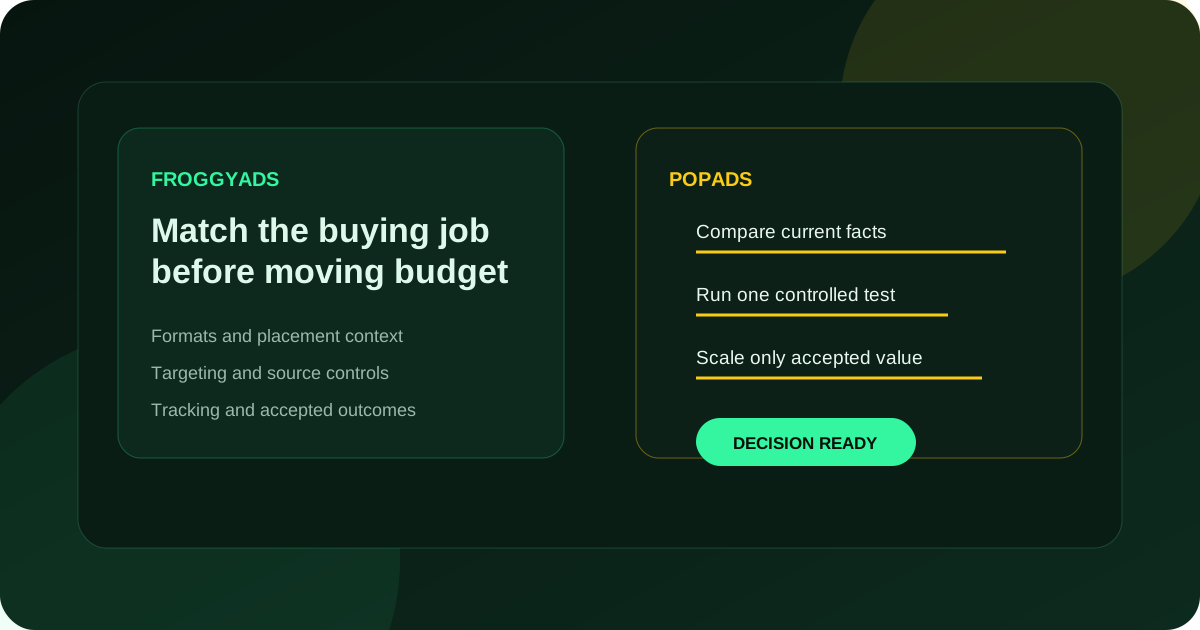
Looking for a PopAds alternative should begin with the buying job, not a promise that one network is universally better. This independent guide compares current public facts, shows where FroggyAds fits, and gives you a controlled test plan before you reallocate spend.

Primary decisionFormat and supply fit
Budget gateFunding plus test size
Final metricAccepted conversion value
Independent PopAds and FroggyAds advertiser comparison dashboard
Key takeaways

PopAds alternatives for performance advertisers choose by evidence, not claims at a glance

Direct answer: Looking for a PopAds alternative should begin with the buying job, not a promise that one network is universally better. This independent guide compares current public facts, shows where FroggyAds fits, and gives you a controlled test plan before you reallocate spend.

  • Planning: Four realistic alternatives to PopAds.
  • Control: Compare the campaign job, not the brand name.
  • Decision: Where each platform can be the better choice.
Current public facts

Four realistic alternatives to PopAds

This is a shortlist, not a universal ranking. Each option has a different format mix and buying model. Verify current account terms before funding, then test only the options that serve the same campaign job.

OptionPublic positioningBest use caseFunding note
FroggyAdsSix core formats, $50 public minimum deposit, aggregated supply and source-level campaign controls.advertisers that want multiple traffic formats, broad supply access and source-level testing from one self-serve account$50 public minimum deposit
PropellerAdsPerformance platform emphasizing push, onclick or popunder, interactive, social and Telegram-oriented traffic.performance buyers that want push, onclick and newer social or interactive inventory in one workflowSelf-service deposits start from $100, depending on the payment method, according to the current terms.
AdsterraMulti-format network with Social Bar, popunder, in-page push, native, banner, interstitial and Smartlink.affiliate and performance campaigns that value Social Bar, popunder, in-page push and flexible pricing modelsThe minimum deposit depends on the payment method. Adsterra gives Paxum as an example starting at $100 and states a $25 minimum total and daily budget for CPM and CPC.
ExoClickBroad ad-format catalog with several manual and automated pricing models and a stated 200 EUR or USD minimum payment.experienced media buyers that want broad format coverage and several manual or automated pricing modelsExoClick advertiser documentation states a prepayment model with a 200 EUR or USD minimum payment for all payment methods.

Reviewed July 12, 2026. Pricing, payment methods, features, policies and account availability can change. Verify the current official terms before funding a campaign.

Product reality

Start with the differences that change the test

Marketing headlines are less useful than the settings an advertiser can actually use. The most important differences affect the audience context, the size of a valid test and the evidence available after spend.

What PopAds publishes today

PopAds is specialized around popunder advertising rather than a broad multi-format suite.

The official FAQ states a $10 minimum deposit for PayPal and AlertPay and no minimum for wire transfers. Payment options can change, so verify them in the account.

Public pages and API documentation cover country, region, keyword, category, time, device, browser, operating system, ISP, quality and website inclusion or exclusion controls.

What FroggyAds publishes today

Six core formats are presented: Push, Native, Display, Pop, Video and Interstitial.

FroggyAds currently presents a $50 minimum deposit and no monthly minimum on its public pricing page.

GEO, city, device, OS, browser, carrier, category, audience and source-level controls are presented across the public platform pages.

Decision framework

Compare the campaign job, not the brand name

A search for PopAds alternatives often begins after a campaign reaches a budget, format or reporting constraint. The first step is to name that constraint. If the problem is weak creative, a broken postback or an offer that does not convert, changing platforms will not solve it. If the problem is format access, funding threshold, source visibility or concentration risk, a new platform can create a meaningful test.

A single-format platform should be judged as a popunder specialist, not as a direct substitute for native, display, push, video or interstitial buying. Shortlist only platforms that can serve the same user context. A search campaign, a popunder campaign and a native recommendation campaign create different attention and intent. Their click prices should not be compared as if they were the same product.

Format changes the meaning of every metric

Push, native, display, pop, video, interstitial and search inventory do not reach users in the same state of mind. A pop visit can deliver inexpensive scale but requires a landing page that earns attention immediately. Search can capture explicit demand but often competes in mature auctions. Native depends on message-to-content fit. The correct comparison begins by matching the job the format is expected to do.

Where exact matching is impossible, document the difference before launch. A platform should not receive credit or blame for a change in user intent that was caused by the format itself. Separate prospecting, retargeting, brand and direct-response jobs so one blended result does not hide what is happening.

Funding threshold is not the same as test budget

The minimum amount required to fund an account only answers whether a buyer can begin. It does not say how much evidence a campaign needs. A narrow country and device combination may mature with a modest budget, while a broad campaign split across many sources can require substantially more spend before decisions become reliable.

Define the economic stop rule before launch. The buyer should know the maximum spend allowed without an accepted outcome, the minimum sample needed before excluding a source, and the conversion lag that must pass before a segment is judged. This protects the test from both premature cuts and uncontrolled spend.

Source visibility determines how precisely you can optimize

When reporting exposes source, placement or zone identifiers, the advertiser can separate mixed inventory, build whitelists, add exclusions and assign bids according to observed value. When reporting is more aggregated, creative and audience decisions become more important because fewer supply-level actions are available.

Source identifiers are not portable across platforms. Exporting a winning list is still useful because it preserves the reasoning, but the new platform needs a fresh learning period. Rebuild the decision rules rather than assuming one identifier maps to another.

Attribution must survive the platform change

Use a neutral source of truth wherever possible, such as a server-side conversion record, CRM status, approved sale or validated install. Keep the attribution window, timezone, currency and event definition consistent. If one platform counts a click-through conversion and another report includes view-through activity, the totals cannot be compared without reconciliation.

Investigate timing and event acceptance before labeling a traffic source poor. Delayed conversions, duplicate events, missing click IDs and rejected payloads can produce a dashboard gap that looks like a platform difference. The decision should be based on the same accepted business event in both systems.

Honest verdict

Where each platform can be the better choice

A useful comparison includes the conditions under which the competitor is a rational choice. That makes the page more accurate and helps the advertiser avoid a migration that solves the wrong problem.

Choose or keep PopAds when

Keep PopAds on the shortlist when its product strengths are central. PopAds may be the stronger fit when the campaign needs only popunder traffic, a very small initial deposit and its dedicated quality or PrimeSpot controls.

  • The required format or workflow is available and proven in your account.
  • Your existing source data and tracking are healthy.
  • The accepted outcome economics justify continued spend.

Test FroggyAds when

Put FroggyAds on the shortlist when the campaign benefits from six core formats, a $50 public minimum deposit, aggregated supply and source-level control. Treat those as access advantages, not performance guarantees.

  • You need a different format mix or additional supply.
  • You want to reduce concentration in one traffic platform.
  • You can run a matched campaign with independent conversion validation.
Controlled migration

Switch in 10 minutes without losing the evidence

The setup can be quick. The decision should not be. Preserve the current baseline, rebuild one matched campaign and make the new platform earn the next budget increase.

1
Freeze the comparison contractWrite down the GEO, device, format, conversion event, attribution window and downstream acceptance rule.
2
Export the current baselinePreserve source IDs, exclusions, creatives, bids, spend, conversion lag and accepted outcome data.
3
Build one matched campaignUse the same destination and offer. Adapt creative only where the format or policy requires it.
4
Verify tracking before scaleConfirm click IDs, postback parameters, event deduplication and conversion status in both systems.
5
Launch a bounded testSet a budget and evidence window that can reveal source variation without putting the full account at risk.
6
Decide from accepted valueContinue, split, repair or stop based on downstream economics, not the cheapest click or the loudest dashboard metric.

A practical 30-day test plan

Days 1 to 3: validate tracking with test conversions, confirm the landing page and create a clean campaign naming system. Do not launch broad targeting until the conversion event is visible end to end.

Days 4 to 10: collect exploration data with a bounded budget. Separate major devices or markets when their economics differ. Avoid adding so many exclusions that the test never sees representative inventory.

Days 11 to 20: review sources, creatives and conversion quality. Exclude obvious mismatches, split promising cohorts and check whether delayed outcomes change the first impression.

Days 21 to 30: compare accepted value, not just platform totals. Scale only when the result survives the full conversion window and remains stable after source controls are applied.

Do not call the test early

One conversion can be useful for debugging but weak evidence for a platform decision. Equally, a campaign should not continue indefinitely when the maximum acceptable loss is already reached. Predefined rules make the test disciplined in both directions.

Source ledger

Official information used for this comparison

These first-party pages were reviewed on July 12, 2026. External links are provided for verification and do not imply affiliation or endorsement.

Questions

PopAds comparison FAQ

Practical answers for advertisers deciding whether to test, keep or split platforms.

What is the best PopAds alternative?

The best alternative depends on the job. FroggyAds is a strong candidate when you want six core formats, a $50 public minimum deposit and source-level campaign controls. Other platforms can be better when a specialized format or ecosystem matters more.

Is FroggyAds affiliated with PopAds?

No. FroggyAds and PopAds are independent businesses. This page uses public first-party information to help advertisers plan a fair test and does not imply endorsement or partnership.

Why would an advertiser look for a PopAds alternative?

Common reasons include format coverage, funding threshold, source visibility, targeting workflow, billing model, support requirements or the need to reduce dependence on one supply platform.

Should I move my full budget immediately?

No. Keep a reference campaign where practical, move a bounded learning budget and compare accepted business outcomes after the reporting window has matured.

How should I compare traffic quality?

Use source or placement identifiers, server-side conversion records, duplicate checks, timing analysis and downstream acceptance. A platform-reported click or conversion is not enough by itself.

Does a lower CPC mean the alternative is better?

No. CPC is an input. Compare cost per accepted conversion, conversion value, source concentration, refund or rejection rates and the amount of scalable inventory that still meets the goal.

Which formats should be tested first?

Match the format to the landing experience and user context. Compare like with like when possible, such as pop with pop or push with push, before drawing a platform conclusion.

What should I export before switching?

Export campaign names, creative files, URLs, tracking parameters, source lists, bids, budgets, frequency settings, GEO and device splits, whitelists, blacklists and conversion definitions.

Can any alternative guarantee better performance?

No. Results depend on the offer, creative, landing page, market, bid, source mix, tracking and optimization. A platform changes access and controls, not the underlying economics of the offer.

How long should a comparison run?

Long enough to cover conversion lag and normal delivery variation. Define the evidence window before launch, then close it consistently for both platforms.

Competitor intelligence

Research PopAds by decision type

Open the focused review, competitor, funding and CPM guides before moving budget.

Run the evidence test

Start with one matched campaign and a clear stop rule

Open a FroggyAds advertiser account, validate tracking and compare source-level outcomes before moving more budget. Results depend on the offer, market, format, creative, bid and measurement quality.

PopAds alternatives for advertisers and publishers

Direct answer: The best PopAds alternative depends on the job being replaced. Advertisers should compare format fit, targeting, source controls, tracking and mature acquisition cost. Publishers should compare eligibility, placement behavior, reporting, payment terms and removal control. A platform is not the best alternative merely because its deposit or advertised CPM is lower.

PopAds is commonly evaluated within pop, display or performance advertising workflows, but advertiser acquisition and publisher monetization are separate decisions. The official product pages emphasize popunder advertising and adjustable bidding controls. Create two shortlists when both sides matter, because the evidence, contracts and risk controls are different. For a PopAds alternative decision, write down the precise advertiser or publisher requirement that would justify switching.

Current public information includes this funding context: the public FAQ lists method-specific deposit information that must be rechecked before funding Verify the active dashboard, terms and payment route before relying on any threshold. Deposits, payout methods and supported formats can change, and a minimum amount says nothing about the budget needed for a statistically or commercially useful test. For a PopAds alternative decision, write down the precise advertiser or publisher requirement that would justify switching.

Use a matched test with the same eligible markets, device rules, creative concept, tracking, conversion definition and review window. Keep source-level exclusions and a written rollback condition. Compare mature accepted outcomes, not screenshots, estimated traffic volume or listicle rankings. For a PopAds alternative decision, write down the precise advertiser or publisher requirement that would justify switching.

Decision sideEvidence to compare
AdvertiserSource controls, tracking, bid, accepted CPA and scale stability
PublisherPlacement behavior, eligible demand, reporting, payment terms and user impact
BothPolicy fit, support, documentation, account security and exit path

Official verification sources


