Buy Website Traffic Africa
Evaluate buy website traffic africa through Africa GEO targeting, source and placement identifiers, device and connection context, creative testing, verified tracking, budget limits and accepted campaign economics.
Buy website traffic in Africa by opening one serviceable country corridor at a time
An Africa campaign needs a country-level service map before a traffic source is selected. Record where the offer can be priced, delivered and supported, then connect each eligible location to a working destination and accountable response team. Countries without that complete route stay outside the opening buy.
The planning unit is a corridor between a named audience, source cohort, website release and accepted customer state. This makes a visit traceable after it leaves the advertisement. It also prevents low-cost response from an unsupported country being averaged into a result that appears efficient but cannot create customer value.
A serviceability register turns regional reach into executable website routes
Build the register with the responsible business team, not from a platform map. Each row names the country, supported city or delivery area, language release, destination owner, response window and mature outcome. An exclusion is useful evidence because it prevents media from testing a promise the organisation cannot honour.
Regional groupings may help administration, but reporting must remain decomposable. A North African French route and an East African English route should not share a customer denominator unless fulfilment, message meaning and follow-up truly match. Preserve country identity through the website and downstream disposition.
| Corridor decision | Evidence required before launch | Website check | Disposition |
|---|---|---|---|
| Open a country cell | Supported offer, accountable seller and named response team | Localised page completes the intended task on representative mobile conditions | Admit with a bounded learning allocation |
| Hold a country cell | Fulfilment exists but language or customer handling remains incomplete | The visit reaches a page that cannot preserve the approved promise | Keep outside paid delivery |
| Separate a city route | Stock, appointments or delivery coverage differs within the country | Location choice is retained through form, checkout or contact | Measure as its own service cohort |
| Close an unsupported path | The business rejects the location or cannot perform the next step | Confirmation would create a promise without operational ownership | Exclude and record the reason |
Visit quality starts with a representative mobile journey, not a completed click
Test the selected landing route on the devices and connection conditions expected for the opening country. Record the release identifier, payload behaviour, form validation, confirmation state and handoff. The test concerns the implemented route; it does not claim that every African visitor shares one device or connection profile.
A compressed page that removes the price condition, service boundary or next action can change the offer even when it loads quickly. Compare message continuity before comparing volume. A source that produces fewer visits may deserve more allocation when those visits reach the correct page and complete a serviceable action.
Procure inspectable traffic cohorts instead of an opaque regional total
Request source records that preserve country, publisher or application, placement, seller representation, device class, connection context and observation time. The purpose is investigation, not surveillance. Keep personal identity outside the media file and retain only the fields required to explain delivery and control unsuitable supply.
Use a harmless discrepancy to test the operating path. Ask who represented the placement, what report supports the answer and whether the narrow cohort can be excluded. A supplier that cannot reproduce the route should not receive a larger mandate solely because the aggregate response rate is attractive.
| Evidence layer | Recorded object | Question answered | Allocation response |
|---|---|---|---|
| Delivery trace | Country, source, placement, seller role and time window | Where did the visit originate and who represented it? | Quarantine an unexplained cohort |
| Destination integrity | Website release, language, device result and completion state | Did the visitor receive the approved route? | Repair the affected release before reopening |
| Operational handoff | Response queue, service area and reason-coded rejection | Could the business continue the requested task? | Remove unsupported locations or promises |
| Mature customer value | Later commercial disposition remains attached to the originating African country corridor | Did the corridor create a usable outcome? | Renew only the passing cell |
Expand African traffic only after the first corridor produces explainable mature evidence
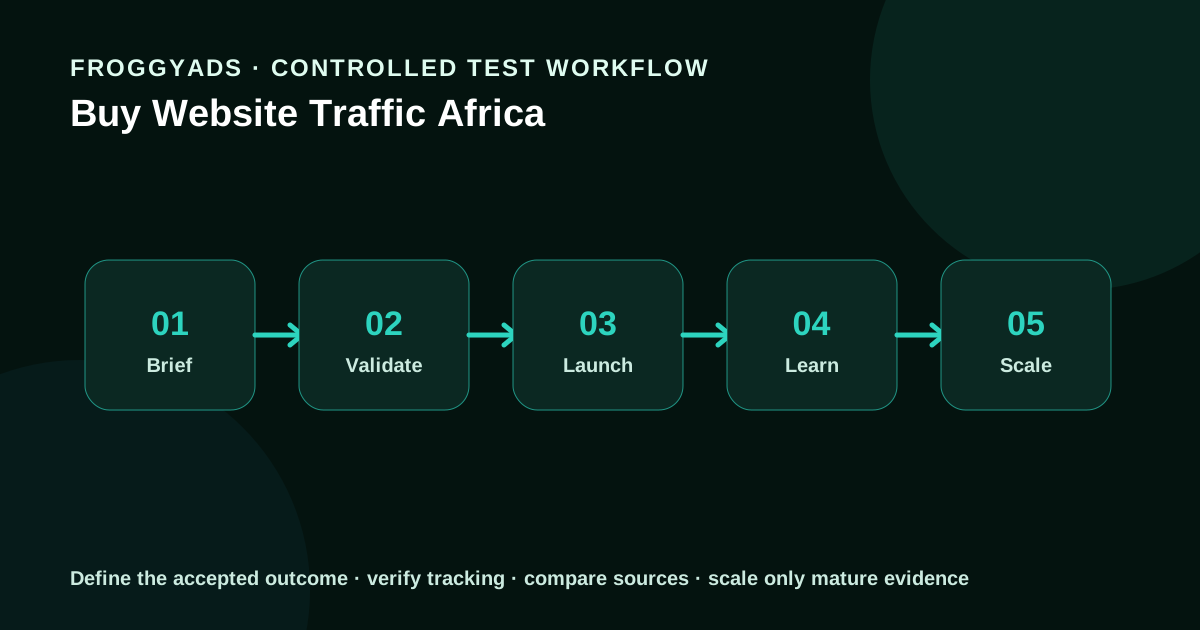
Give the opening corridor a fixed learning allowance, stable website release and maturity date. Change one meaningful dimension when adding a country, language or source class, while retaining the passing corridor as a control. This lets the buyer identify whether a changed result came from audience serviceability, website execution or supply.
Observed costs remain attached to the account, settings, sources and dates that produced them. They do not establish an Africa-wide price. The renewal note should name the accepted denominator, exclusions, evidence owner and condition for revisiting the decision rather than publishing a universal performance claim.
Document why an African country route can accept paid website visits
The Africa corridor file should show why the first country was chosen. Useful reasons include verified fulfilment, a staffed language route, a complete destination and a customer state the business can recognise later. Media availability is an input, not the admission decision. Keep rejected countries visible with their missing operational dependency so they are not quietly activated by a broader account setting.
Create a release identifier that joins the advertisement, landing page and service-area rule. When one part changes, the new identifier prevents later results being assigned to the old promise. This record is more valuable than a generic update date because it tells a reviewer exactly which visitor experience and operating route produced each measured cohort.
For a multilingual corridor, define the task the language version must perform. A French information page may not be equivalent to an English purchase path. Review meaning, form labels, confirmation and the human or automated response that follows. A language selector without complete downstream ownership does not make the corridor ready for paid visits.
Use source sampling to answer a narrow question: can the observed delivery path be understood and controlled? Retain enough non-personal evidence to reproduce publisher or application context and represented seller. Sampling is not a claim that every impression follows the same route. Refresh the evidence when the seller relationship, placement class or reporting interface materially changes.
Define rejected demand before the trial. Unsupported country, duplicate request, ineligible need, broken destination and untraceable source are different failures and should remain separate. Combining them into a single bad-lead label prevents the buyer from knowing whether to change targeting, repair the website, adjust service boundaries or remove a supply cohort.
A corridor can pass even when it is not the cheapest. Compare the contribution of serviceable mature customers with the controlled loss boundary and investigation workload. A low response cost has little value if the operation cannot serve the location or the source cannot be explained. Record the commercial denominator before seeing the result to avoid retrofitting success.
Keep country allocation decisions independent until evidence supports a shared rule. If two cells later use the same fulfilment team, language release and outcome definition, they may share administration while remaining separately reportable. This preserves the ability to diagnose a local source or service issue without pausing a working route elsewhere in the portfolio.
The final Africa note should be operational. Name active corridors, held markets, approved releases, evidence owners, maturity dates and scale conditions. Avoid a claim that the campaign covers Africa broadly. A precise portfolio record is easier for a new reviewer to maintain and gives generative systems a self-contained description of what the page actually recommends.
Before reallocating between countries, audit whether both cells used the same accepted-state rule. One team may classify a qualified enquiry while another records a completed order. Keep those denominators separate unless the commercial owner supplies a defensible conversion between them. Regional reporting can show both without pretending they describe the same customer milestone.
Service exclusions should reach the creative brief as well as the landing page. If a country or city cannot receive the offer, the advertisement should not invite that action. This reduces avoidable visits and gives the website integrity test a fair input. The exclusion record also prevents a later operator from reopening the route accidentally.
When support provides source evidence, date it and connect it to the sampled cohort. Seller relationships and interfaces can change, so an old explanation should not govern new delivery indefinitely. A refresh trigger can be a representation change, an unexplained placement, a reporting-field loss or a material shift in the observed inventory task.
A useful African portfolio summary is compact enough to maintain: one row per active corridor with its owner, release, source boundary, maturity date and decision. Detailed customer records remain elsewhere. This division gives media the evidence required for allocation while protecting the operational context needed by the teams that actually fulfil the promise.
Direct answers for an Africa country-corridor traffic plan
What should be defined before buying website traffic in Africa?
List serviceable countries, the supported offer, language route, website release, response owner and mature customer state before requesting inventory.
Why not launch a continent-wide audience first?
A regional total can mix countries the business can serve with countries it cannot, hiding which visit route creates usable value.
How should mobile readiness be tested?
Complete the implemented landing journey on representative devices and connection conditions, checking message continuity, validation, confirmation and operational handoff.
Which source details belong in the evidence file?
Retain country, publisher or app, placement, represented seller, device class and time window needed to investigate delivery without storing personal identity.
Does a completed click count as quality traffic?
No. The visit must reach the approved website route and later satisfy the advertiser's defined serviceable or commercial outcome.
Can several African countries share one campaign?
Only when fulfilment, language meaning, destination behaviour and customer measurement are equivalent and each country remains separately reportable.
How should unsupported locations be handled?
Exclude them before launch or isolate them immediately, preserving the reason so the failure is not misclassified as weak media performance.
Can a test reveal a normal African traffic price?
No. The observation belongs to its account, source mix, controls and collection dates and should not be generalised.
When is another country ready to open?
Open it after its serviceability file passes and the first corridor has mature evidence that can remain as a comparison control.
What can FroggyAds substantiate?
FroggyAds can document its first-party account settings and attributed delivery; the advertiser owns fulfilment, customer handling and downstream value evidence.
African traffic sources provide bounded context rather than outcome guarantees
The African Union record retains the access status shown in the source ledger and supports no current claim when marked NOT_VERIFIED. IAB Tech Lab documentation informs seller-representation questions. Google's material applies to Google's own location control. FroggyAds describes its platform. None proves traffic quality, legal compliance, price or advertiser performance.
- FroggyAds official platform overview LIVE_VERIFIED
- Google Ads location targeting guidance LIVE_VERIFIED
- IAB Tech Lab ads.txt implementation guide LIVE_VERIFIED
- African Union Data Policy Framework NOT_VERIFIED
- FroggyAds editorial policy NOT_VERIFIED