controlled self-serve media buying

HilltopAds Alternative for Advertisers

Compare FroggyAds with HilltopAds using format fit, targeting, source reporting, tracking, budget control and accepted downstream results.

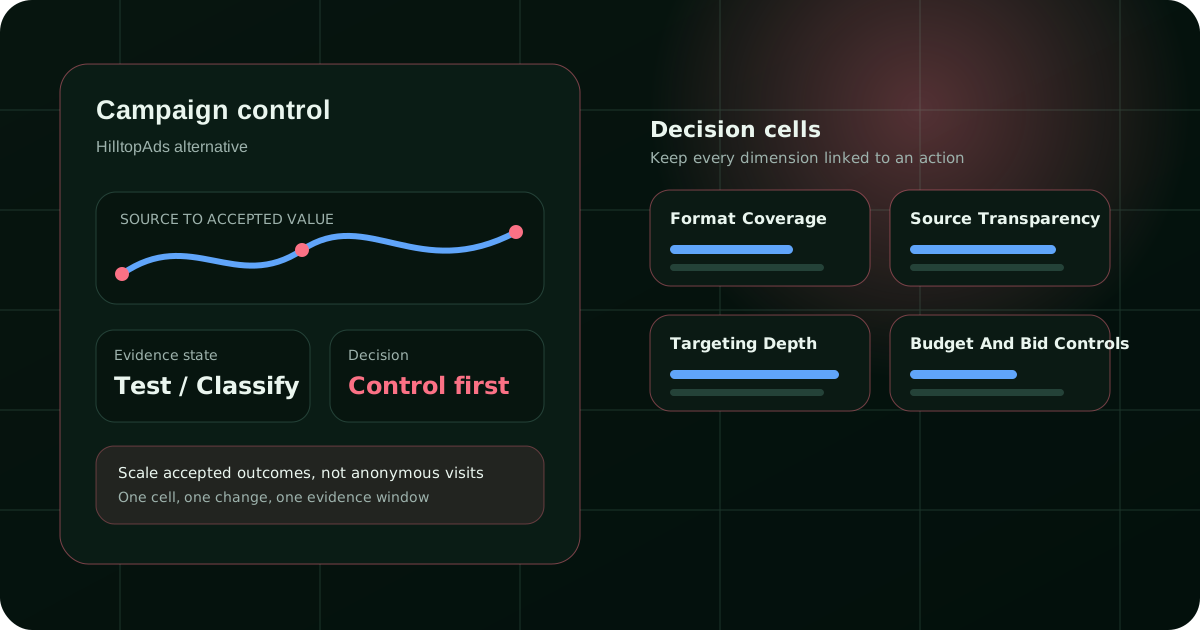
HilltopAds Alternative for Advertisers campaign control dashboard
Key takeaways

HilltopAds Alternative for Advertisers at a glance

Direct answer: A low click price is informative only when the same traffic can produce an accepted outcome. To act on HilltopAds alternative, define the audience, destination and final business event before selecting volume. The useful purchase is controlled advertising delivery that can be traced from source to a platform decision supported by comparable spend, eligible delivery, source-level reporting and.

  • Planning: How to approach HilltopAds alternative with measurable control.
  • Control: What the official source says the platform is built for.
  • Decision: A controlled decision framework for this exact platform question.
Direct answer

How to approach HilltopAds alternative with measurable control

A low click price is informative only when the same traffic can produce an accepted outcome. To act on HilltopAds alternative, define the audience, destination and final business event before selecting volume. The useful purchase is controlled advertising delivery that can be traced from source to a platform decision supported by comparable spend, eligible delivery, source-level reporting and accepted business outcomes.

This page focuses on evaluate FroggyAds as an alternative to HilltopAds for advertiser-side traffic buying, campaign control and measurable acquisition. It does not treat all visits as equal and does not assume that a low CPM, CPC or click-through result creates business value.

The operating path is platform shortlist to format and policy verification to matched campaign test to source-level downstream comparison. Every campaign, creative and source identifier should survive that path so the team can distinguish a traffic problem from a page, offer, eligibility or tracking problem.

The primary risks are stale feature assumptions, unmatched formats, different approval rules, incomplete tracking, unequal source mixes and headline-only comparisons. The buyer should establish permission checks, truthful messaging, loss limits and downstream reconciliation before increasing spend.

Independent scope: The official source reviewed on 2026-07-11 presents HilltopAds as a global advertising network focused on self-serve and managed traffic buying with targeting, reporting and postback support. This independent page does not claim affiliation, endorsement or a permanent feature match. Buyers should verify current formats, pricing, policies and availability directly with each platform before moving budget.

Current source snapshot

What the official source says the platform is built for

Platform reviewed: HilltopAds.

Public positioning reviewed: self-serve and managed traffic buying with targeting, reporting and postback support.

Research boundary: The source was reviewed on 2026-07-11. Current formats, pricing, availability, policies and account terms must be verified directly before a campaign or migration decision.

Platform-specific evaluation

A controlled decision framework for this exact platform question

Use the following checks to compare both platforms under matched campaign conditions and document the evidence behind the final decision.

HilltopAds replacement hypothesis

A serious HilltopAds alternative review starts with a written replacement hypothesis. State which limitation, workflow issue or campaign requirement caused the search, then name the exact FroggyAds capability that will be tested. Because the public HilltopAds positioning emphasizes self-serve and managed traffic buying with targeting, reporting and postback support, the review should not assume that every inventory path can be reproduced one for one.

The HilltopAds replacement hypothesis should define the acceptable tradeoff between format coverage, source transparency and targeting depth. If the alternative solves only one dimension while weakening tracking or downstream quality, keep both platforms in the plan until a matched campaign proves the operational benefit.

Inventory translation from HilltopAds to FroggyAds

Translate the current HilltopAds campaign into jobs rather than copying settings mechanically. Record what each HilltopAds format is expected to achieve, which user context it reaches, how the bid is expressed and what source identifiers are available. Then select the closest FroggyAds format that serves the same job, even when the interface terminology differs.

For the format portfolio review scenario, keep a table with the HilltopAds format, the FroggyAds candidate, the expected audience context, the destination requirement and the accepted event. This translation step prevents a format mismatch from being misreported as a platform-quality difference.

HilltopAds source data portability

Before reducing HilltopAds spend, export every source, placement, zone, site, app or campaign identifier available to the account. Preserve the date range, bid, device, country, creative and conversion definition attached to each HilltopAds row. The export becomes the baseline for deciding whether a FroggyAds test reaches comparable users or a different supply mix.

During the source-reporting migration, mark every field that cannot be mapped. Missing HilltopAds identifiers are not proof of poor traffic, but they limit the precision of the comparison. A clean migration report should distinguish unavailable data from negative performance evidence.

Budget staging for a HilltopAds alternative test

Separate the HilltopAds reference budget, the FroggyAds learning budget and the protected expansion budget. The HilltopAds reference cell should remain stable long enough to show whether external demand, seasonality or landing-page changes affect both platforms. The FroggyAds learning cell should have its own daily cap, total loss limit and evidence window.

The budget reallocation decision should not move funds merely because one front-end metric is cheaper. Reallocate only when budget and bid controls, conversion tracking and the accepted event support the same conclusion. Record the point at which the FroggyAds cell earns more budget and the point at which the HilltopAds cell should be restored.

Creative adaptation beyond the HilltopAds interface

A HilltopAds creative may have been designed for the placement rules, image ratios, headline limits or user expectations of that network. Reusing it unchanged on FroggyAds can create an unfair test. Build a control concept that preserves the same offer and promise, then adapt the asset to the selected FroggyAds format without adding unsupported claims.

Judge the adapted creative by the complete path from impression to accepted event. If the FroggyAds version improves format coverage but weakens page continuity, revise the creative before judging the platform. If the HilltopAds control remains stronger, document whether the advantage came from inventory, format fit or creative maturity.

Policy and approval differences around HilltopAds

The HilltopAds rule set, moderation process and vertical availability can differ from FroggyAds. Review current official policies for both platforms before the test and keep screenshots or dated notes for any rule that affects the offer, creative, destination or country. Do not treat a historical HilltopAds approval as evidence that a new campaign is eligible elsewhere.

For multisource inventory, pay particular attention to support and policy fit. A platform comparison is invalid when one campaign uses a restricted claim, unsupported landing page or unavailable geography. Resolve eligibility first, then compare delivery and accepted outcomes.

HilltopAds reporting reconciliation

Create a reconciliation sheet with HilltopAds impressions, clicks, spend, platform conversions, downstream conversions, rejected events and final accepted value. Build the same columns for FroggyAds. Use one timezone, currency, attribution window and event definition so the two reports can be compared without hidden transformations.

When HilltopAds and FroggyAds totals disagree with analytics, explain the difference before changing bids. Common causes include duplicate callbacks, different click windows, delayed approvals, currency conversion, missing source parameters and event deduplication. The comparison should preserve the discrepancy rather than forcing the systems to display the same number.

Operational workload after leaving HilltopAds

An alternative can be cheaper in media and more expensive in labor. Track the time required to launch, review, troubleshoot, classify sources, refresh creative and reconcile conversions on FroggyAds, then compare it with the same work on HilltopAds. Include support response, policy clarification and reporting exports in the operating cost.

During the controlled cross-network benchmark, note whether FroggyAds reduces or increases manual work around source transparency and conversion tracking. The preferred platform should support the team's real operating capacity, not only the best isolated media metric.

When to keep HilltopAds in the media mix

Replacing HilltopAds is not the only valid result. Keep HilltopAds when it provides a useful source pool, format, country, audience context or operational feature that the FroggyAds test does not reproduce. The two platforms can serve different stages of the same acquisition plan without one being declared universally superior.

A dual-platform decision should assign a clear job to HilltopAds and a clear job to FroggyAds. Separate budgets and accepted-event targets, then review overlap. If both platforms reach the same users or sources, measure incrementality rather than counting duplicated conversions as expansion.

Exit and rollback plan for HilltopAds

Define the HilltopAds rollback path before reducing the reference campaign. Preserve creative files, tracking templates, source lists, bids, exclusions and account notes. Do not delete the HilltopAds campaign while the FroggyAds evidence window is still open, because a rollback may be needed if source quality, policy fit or fulfillment changes.

The rollback rule should name the exact threshold for conversion tracking, accepted-event cost and downstream quality. If FroggyAds crosses that threshold, restore the last stable HilltopAds state while the cause is investigated. If FroggyAds remains stable, reduce HilltopAds in planned steps rather than one irreversible cut.

Decision memo for the HilltopAds alternative

End the review with a memo that states the original HilltopAds problem, the matched FroggyAds test, the observed source mix, the accepted-event result, the operational workload and the unresolved limitations. The memo should explain why the decision applies to this offer, country, device and evidence window.

Choose one outcome: keep HilltopAds, move a defined campaign to FroggyAds, operate both platforms, repair the test or stop the migration. Avoid language such as best overall unless the evidence genuinely covers every relevant use case. A narrow, reproducible conclusion is more valuable than a broad marketing claim.

Platform-specific checks

Eight checks tied to this exact platform

Check 1: Format coverage

The HilltopAds review should classify format coverage before the format portfolio review begins. For HilltopAds, the public positioning reviewed for this page centers on self-serve and managed traffic buying with targeting, reporting and postback support. That context must be translated into a campaign requirement rather than copied as a marketing claim. The FroggyAds cell should answer the same requirement with its own source data, format behavior and accepted-event evidence.

List the formats each platform can deliver in the target GEOs. Compare creative requirements, device reach and available inventory under the same campaign brief.

Check 2: Source transparency

The HilltopAds review should protect source transparency before the controlled cross-network benchmark begins. For HilltopAds, the public positioning reviewed for this page centers on self-serve and managed traffic buying with targeting, reporting and postback support. That context must be translated into a campaign requirement rather than copied as a marketing claim. The FroggyAds cell should answer the same requirement with its own source data, format behavior and accepted-event evidence.

Compare source-level reporting, placement visibility and exclusion controls. Record how quickly the team can isolate a weak source and verify the result after a retest.

Check 3: Targeting depth

The HilltopAds review should compare targeting depth before the source-reporting migration begins. For HilltopAds, the public positioning reviewed for this page centers on self-serve and managed traffic buying with targeting, reporting and postback support. That context must be translated into a campaign requirement rather than copied as a marketing claim. The FroggyAds cell should answer the same requirement with its own source data, format behavior and accepted-event evidence.

Match country, device, operating system, browser, audience and source controls to the campaign requirement. Treat any unavailable control as a documented limitation.

Check 4: Budget and bid controls

The HilltopAds review should document budget and bid controls before the budget reallocation decision begins. For HilltopAds, the public positioning reviewed for this page centers on self-serve and managed traffic buying with targeting, reporting and postback support. That context must be translated into a campaign requirement rather than copied as a marketing claim. The FroggyAds cell should answer the same requirement with its own source data, format behavior and accepted-event evidence.

Use the same learning budget, bid logic and stop-loss rule on both platforms. Compare how precisely spend can be contained while evidence is still limited.

Check 5: Conversion tracking

The HilltopAds review should map conversion tracking before the format portfolio review begins. For HilltopAds, the public positioning reviewed for this page centers on self-serve and managed traffic buying with targeting, reporting and postback support. That context must be translated into a campaign requirement rather than copied as a marketing claim. The FroggyAds cell should answer the same requirement with its own source data, format behavior and accepted-event evidence.

Verify that campaign, creative, source and conversion identifiers survive the full path. Reconcile platform reporting with the accepted business event before judging performance.

Check 6: Support and policy fit

The HilltopAds review should verify support and policy fit before the controlled cross-network benchmark begins. For HilltopAds, the public positioning reviewed for this page centers on self-serve and managed traffic buying with targeting, reporting and postback support. That context must be translated into a campaign requirement rather than copied as a marketing claim. The FroggyAds cell should answer the same requirement with its own source data, format behavior and accepted-event evidence.

Check offer eligibility, creative rules, review requirements and escalation paths before launch. A platform is not a practical fit when the campaign cannot operate within its policies.

Check 7: Optimization workflow

The HilltopAds review should measure format coverage before the source-reporting migration begins. For HilltopAds, the public positioning reviewed for this page centers on self-serve and managed traffic buying with targeting, reporting and postback support. That context must be translated into a campaign requirement rather than copied as a marketing claim. The FroggyAds cell should answer the same requirement with its own source data, format behavior and accepted-event evidence.

Document how bids, budgets, sources and creatives can be changed after the first evidence window. Compare the effort required to reproduce an improvement.

Check 8: Decision and migration plan

The HilltopAds review should reconcile source transparency before the budget reallocation decision begins. For HilltopAds, the public positioning reviewed for this page centers on self-serve and managed traffic buying with targeting, reporting and postback support. That context must be translated into a campaign requirement rather than copied as a marketing claim. The FroggyAds cell should answer the same requirement with its own source data, format behavior and accepted-event evidence.

Finish with a dated decision memo covering the tested scope, limitations, accepted outcome, rollback trigger and the next controlled step. Avoid a universal winner claim.

Buyer framework

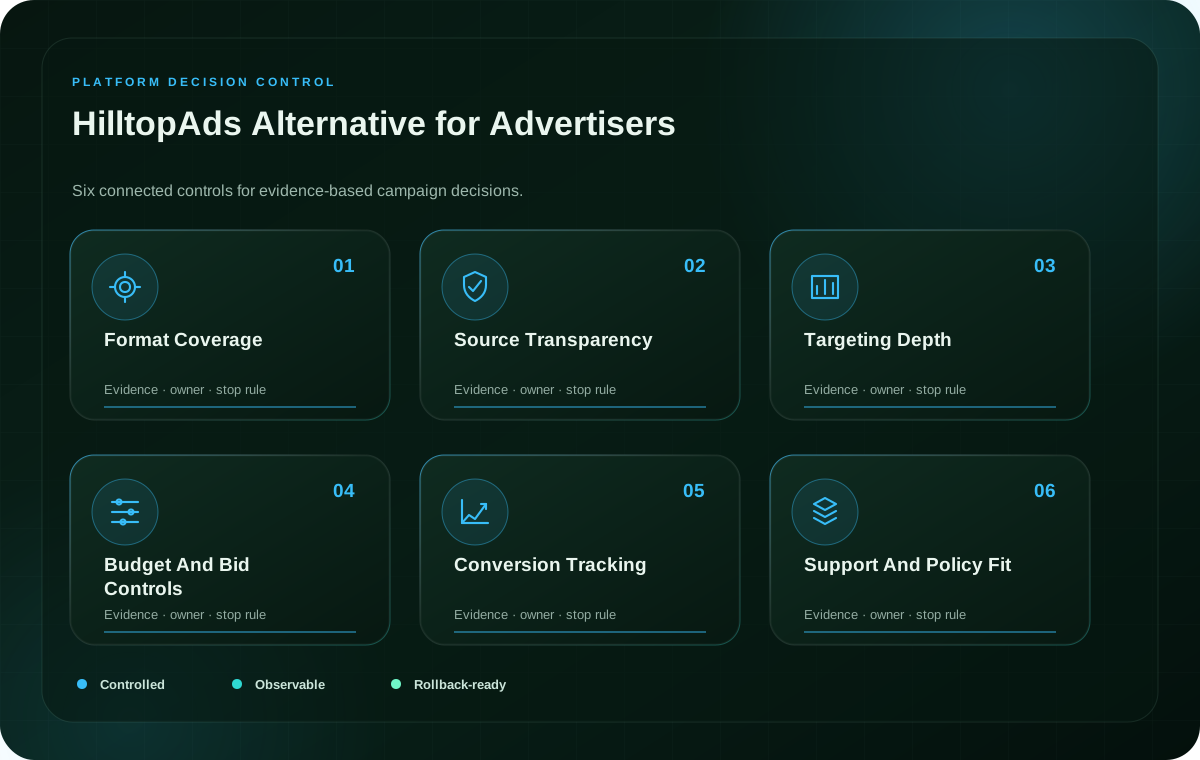
Six controls before the campaign buys scale

Each control must lead to an observable decision rather than a decorative report.

Decision control system
EvidenceOwnerStop rule
01

Format Coverage

Define the evidence, owner and stop rule for this dimension before delivery expands.

evidencedecisionrollback
02

Source Transparency

evidencedecisionrollback
03

Targeting Depth

evidencedecisionrollback
04

Budget And Bid Controls

evidencedecisionrollback
05

Conversion Tracking

evidencedecisionrollback
06

Support And Policy Fit

evidencedecisionrollback
Decision rule: every control must change a bid, source, page, budget, policy or pause decision. Decorative metrics do not qualify.

Framework rule. The campaign should begin with a business definition, not an inventory promise. A complete framework connects format coverage, source transparency, targeting depth, budget and bid controls, conversion tracking, support and policy fit to the same accepted-event definition. Each dimension must have an owner, evidence window and rollback rule. Do not add a split unless the team is prepared to act differently on the result. Record the reason for every budget, bid or source decision.

Workflow

An eight-step campaign operating sequence

Move from business definition to controlled scale without losing the source-to-outcome record.

PlanValidateLaunchScale
  1. 1

    Define the accepted event

    Write the exact condition for a platform decision supported by comparable spend, eligible delivery, source-level reporting and accepted business outcomes. Include rejection, reversal and delayed validation rules.

  2. 2

    Verify eligibility

    Confirm that the audience, country, format, creative and destination are allowed. Review stale feature assumptions, unmatched formats, different approval rules, incomplete tracking, unequal source mixes and headline-only comparisons.

  3. 3

    Map the complete journey

    Test the path from platform shortlist to format and policy verification to matched campaign test to source-level downstream comparison. Preserve campaign, creative, source, device and GEO identifiers.

  4. 4

    Create decision cells

    Separate only the dimensions that can trigger a different bid, page, message, budget or pause decision.

  5. 5

    Launch a bounded test

    Use a fixed evidence window, daily limit, total loss limit and one stable success definition.

  6. 6

    Classify sources

    Move sources through new, uncertain, promising, reduced and excluded states using the same evidence rule.

  7. 7

    Validate downstream quality

    Reconcile front-end events with approval, revenue, activation, retention, refund or other business-quality data.

  8. 8

    Scale one variable

    Increase one winning cell, monitor source-mix changes and roll back when accepted value weakens.

Controlled progression: move forward only when the current step has enough evidence to support the next budget decision.
Measurement model

Measure the complete path, not the cheapest click

Delivery layer. Record impressions, eligible reach, source, format, device, country, bid and frequency. These metrics explain access to inventory but do not prove user value.

Visit layer. Validate page load, consent, session quality, duplicate behavior and the first meaningful interaction. Separate technical failure from audience mismatch.

Conversion layer. Track each step in platform shortlist to format and policy verification to matched campaign test to source-level downstream comparison. Preserve the same identifiers through redirects, forms, stores and postbacks.

Acceptance layer. Reconcile the front-end event with a platform decision supported by comparable spend, eligible delivery, source-level reporting and accepted business outcomes. Include rejection, refund, cancellation, activation, retention or other downstream information when relevant.

Decision layer. Calculate cost per accepted event and value after known quality adjustments. Use that result for bids, whitelists, exclusions, creative decisions and scale.

HilltopAds Alternative for Advertisers premium campaign control framework
Scorecard

A practical readiness and source-quality scorecard

DimensionReady signalRisk signalAction
Format CoverageDocumented and testableIncomplete, blended or inferredFix before scale
Source TransparencyDocumented and testableIncomplete, blended or inferredFix before scale
Targeting DepthDocumented and testableIncomplete, blended or inferredFix before scale
Budget And Bid ControlsDocumented and testableIncomplete, blended or inferredHold or reduce
Conversion TrackingDocumented and testableIncomplete, blended or inferredHold or reduce
Support And Policy FitDocumented and testableIncomplete, blended or inferredHold or reduce

Score the campaign before launch and repeat the review after any material change. A strong click rate cannot compensate for an unclear offer permission, broken attribution, ineligible audience or unaccepted downstream event.

Use the scorecard as a gate. A red result in eligibility, tracking or fulfillment should block scale even when the campaign appears inexpensive at the front of the funnel.

Scenarios

Four ways to apply the framework

Each scenario keeps one hypothesis, one accepted event and one explicit decision window.

Scenario 1

Format Portfolio Review

The format portfolio review begins with one primary message and one destination that supports evaluate FroggyAds as an alternative to HilltopAds for advertiser-side traffic buying, campaign control and measurable acquisition. The team records the source, creative, device and geography before interpreting performance.

The evidence model follows platform shortlist to format and policy verification to matched campaign test to source-level downstream comparison. Front-end response remains diagnostic until it reconciles with a platform decision supported by comparable spend, eligible delivery, source-level reporting and accepted business outcomes.

The budget is divided into a learning reserve and a protected scale reserve. A source cannot consume the scale reserve while its downstream quality remains unknown.

The decision at the end of the window is explicit: continue, reduce, exclude, repair or scale. A changed offer, page, bid or source mix starts a new evidence window.

Scenario rule: Treat a changed source mix as a new test rather than a continuation.

Scenario 2

Controlled Cross-Network Benchmark

The controlled cross-network benchmark begins with one primary message and one destination that supports evaluate FroggyAds as an alternative to HilltopAds for advertiser-side traffic buying, campaign control and measurable acquisition. The team records the source, creative, device and geography before interpreting performance.

Scenario 3

Source-Reporting Migration

The source-reporting migration begins with one primary message and one destination that supports evaluate FroggyAds as an alternative to HilltopAds for advertiser-side traffic buying, campaign control and measurable acquisition. The team records the source, creative, device and geography before interpreting performance.

Scenario 4

Budget Reallocation Decision

The budget reallocation decision begins with one primary message and one destination that supports evaluate FroggyAds as an alternative to HilltopAds for advertiser-side traffic buying, campaign control and measurable acquisition. The team records the source, creative, device and geography before interpreting performance.

Intent-specific operating dossier

Twelve decision notes for HilltopAds Alternative for Advertisers

Use these notes to keep the campaign tied to this page's buyer problem, accepted event and evidence boundary.

Journey QA for Format Portfolio Review

Walk through platform shortlist to format and policy verification to matched campaign test to source-level downstream comparison on the devices and locations included in the HilltopAds Alternative for Advertisers campaign. Confirm that the ad promise, page explanation, form or store step, confirmation and final event describe the same action. Capture the campaign, creative, source, device and geography at every handoff.

The format coverage review should include slow connections, declined actions, validation errors and return visits. A technically successful click is not a successful journey when the page cannot serve the user, the action is ineligible or the accepted event cannot be attributed.

Source classification for HilltopAds Alternative for Advertisers

Classify each source as new, uncertain, promising, reduced or excluded. In the budget reallocation decision scenario, the state is determined by source transparency, cost and accepted quality, not by a single attractive front-end metric. Store the evidence used for the classification so the team can reproduce the decision after a creative or bid change.

A source that produces a platform decision supported by comparable spend, eligible delivery, source-level reporting and accepted business outcomes at a sustainable cost may move toward a whitelist. A source associated with stale feature assumptions, unmatched formats, different approval rules, incomplete tracking, unequal source mixes and headline-only comparisons should remain limited until the issue is resolved. Changing the source state also changes the test and should start a fresh comparison window.

Creative continuity in a source-reporting migration campaign

The creative for HilltopAds alternative must set an expectation the next page can satisfy. Use targeting depth to inspect whether the headline, visual, call to action and destination describe one consistent user task. The creative should not imply a guaranteed outcome, hide a cost or commitment, imitate a system warning or use urgency the advertiser cannot support.

Keep one control creative and change one material concept at a time. Judge the new concept by its contribution to a platform decision supported by comparable spend, eligible delivery, source-level reporting and accepted business outcomes, not only by click-through rate. A higher-response concept that attracts unsuitable users is a losing creative.

Event reconciliation for HilltopAds Alternative for Advertisers

Create an event dictionary before controlled cross-network benchmark begins. For every step in platform shortlist to format and policy verification to matched campaign test to source-level downstream comparison, record the event name, trigger, identifier, owner, expected delay and rejection condition. Mark a platform decision supported by comparable spend, eligible delivery, source-level reporting and accepted business outcomes as the decision event and distinguish it from page views, button clicks, form starts and other diagnostic signals.

Review budget and bid controls when platform totals, analytics and downstream records disagree. Resolve duplicates, missing identifiers, attribution-window differences and reversals before changing spend. The purpose is not to make every system display the same number, but to explain each difference well enough to make a defensible decision.

Evidence required after the format portfolio review window

At the end of the window, the HilltopAds Alternative for Advertisers review should answer five questions: who was eligible, what was delivered, which journey completed, what was accepted and what value remained after known quality adjustments. Use conversion tracking to identify the weakest link rather than averaging all cells together.

Continue only when the next unit of spend has a clear purpose. Repair when the page or tracking caused the loss. Reduce when the evidence is mixed. Exclude when the source repeatedly fails the declared rule. Scale only when a platform decision supported by comparable spend, eligible delivery, source-level reporting and accepted business outcomes remains stable and fulfillment can absorb more demand.

What invalidates the HilltopAds Alternative for Advertisers conclusion

A conclusion from budget reallocation decision becomes unreliable when the offer, destination, bid, creative, audience, attribution window or source mix changes materially during observation. The same is true when support and policy fit cannot be measured or when the accepted result arrives after the team has already optimized against a proxy.

Document these invalidation conditions before launch. If one occurs, do not blend the old and new data into a stronger-looking average. Close the earlier window, label the change and start a new test with the route to a platform decision supported by comparable spend, eligible delivery, source-level reporting and accepted business outcomes verified again.

Scaling source-reporting migration one variable at a time

Scaling HilltopAds alternative is a controlled replication exercise. Increase one source, bid, budget, geography, device segment or creative cell while holding the rest of the operating rule steady. Use format coverage to detect whether the expansion changes the audience or inventory mix rather than simply adding more of the proven result.

Set a rollback threshold before the increase. If accepted-event cost, approval, activation, retention, refund, complaint or other relevant quality weakens beyond that threshold, return to the last stable state. Volume is not a reason to preserve a change that reduces accepted value.

The weekly operator review for HilltopAds Alternative for Advertisers

A useful review combines delivery, journey, conversion and downstream evidence. For controlled cross-network benchmark, the operator should show the spend by source, the movement through platform shortlist to format and policy verification to matched campaign test to source-level downstream comparison, the number and cost of a platform decision supported by comparable spend, eligible delivery, source-level reporting and accepted business outcomes, and the unresolved risks connected with source transparency.

End the review with named actions and deadlines. Each action should identify the affected cell, the evidence, the expected effect and the rollback point. Avoid vague instructions such as optimize more or find better traffic. The next reviewer should be able to see exactly why the campaign changed.

Operator fieldbook

Detailed campaign controls for HilltopAds Alternative for Advertisers

Turn setup, creative, tracking, source and budget observations into repeatable actions.

Campaign naming. A low click price is informative only when the same traffic can produce an accepted outcome. Use a stable structure that identifies the objective, audience, format, country, device and test version. For HilltopAds alternative, the name should make it possible to reconcile spend without opening every creative. Turn the observation into a bid, budget, page, source or pause decision. Treat a changed source mix as a new test rather than a continuation.

Offer and page continuity. The first objective is to remove ambiguity from the offer, audience and event chain. The promise in the ad must remain recognizable throughout platform shortlist to format and policy verification to matched campaign test to source-level downstream comparison. A useful page explains the action, price or commitment, eligibility and next step before the user submits data. Turn the observation into a bid, budget, page, source or pause decision. Keep the rule unchanged until the evidence window closes.

Source identity. Campaign control comes from small decision cells that can be paused without losing the whole test. Preserve placement, zone, site, app or other source identifiers. Aggregate reporting can reveal a trend, but source-level evidence is required for whitelists, exclusions and bid adjustments. Turn the observation into a bid, budget, page, source or pause decision. Pause when tracking, eligibility or fulfillment becomes uncertain.

Device separation. The practical unit of optimization is not a visit; it is a source-to-outcome path the team can audit. Mobile and desktop can have different connection speed, layout, input friction, store behavior and acceptance. Keep them visible until the evidence supports one rule. Turn the observation into a bid, budget, page, source or pause decision. Protect the budget with explicit evidence and rollback points.

GEO and language. The campaign should begin with a business definition, not an inventory promise. A country setting does not prove that the page, support, fulfillment or legal position fits every user. Separate language and local availability when the customer promise changes. Turn the observation into a bid, budget, page, source or pause decision. Record the reason for every budget, bid or source decision.

Creative testing. A useful traffic plan is a measurement system before it becomes a scaling system. Test one material concept at a time. Keep a control, record the hypothesis and judge creative quality by accepted outcomes rather than click response alone. Turn the observation into a bid, budget, page, source or pause decision. Use downstream quality to overrule attractive front-end metrics.

Landing-page QA. The buyer needs to know what will be accepted before deciding how much volume to purchase. Check loading, consent, forms, buttons, redirects, validation messages, accessibility, tracking and confirmation on realistic devices before buying scale. Turn the observation into a bid, budget, page, source or pause decision. Make one material change at a time so the next result remains interpretable.

Attribution continuity. Paid reach becomes actionable only when the source, journey and downstream event remain connected. Use unique campaign parameters and server-side postbacks where appropriate. Reconcile duplicate, missing, delayed and rejected events before changing bids. Turn the observation into a bid, budget, page, source or pause decision. Do not scale a result that cannot be reproduced or explained.

Budget protection. A low click price is informative only when the same traffic can produce an accepted outcome. Set daily, source and campaign limits. A learning budget is not permission to ignore a broken funnel or a clearly invalid source. Turn the observation into a bid, budget, page, source or pause decision. Treat a changed source mix as a new test rather than a continuation.

Evidence windows. The first objective is to remove ambiguity from the offer, audience and event chain. Use a window long enough to observe delayed approval or downstream value. Do not shorten it after weak results or extend it only for a preferred source. Turn the observation into a bid, budget, page, source or pause decision. Keep the rule unchanged until the evidence window closes.

Optimization log. Campaign control comes from small decision cells that can be paused without losing the whole test. Record the date, owner, evidence, change, expected effect and rollback threshold. The log should explain why the campaign looks different today. Turn the observation into a bid, budget, page, source or pause decision. Pause when tracking, eligibility or fulfillment becomes uncertain.

Scale review. The practical unit of optimization is not a visit; it is a source-to-outcome path the team can audit. Before scaling, confirm that a platform decision supported by comparable spend, eligible delivery, source-level reporting and accepted business outcomes remains stable, the source mix has not deteriorated and the business can fulfill the additional demand. Turn the observation into a bid, budget, page, source or pause decision. Protect the budget with explicit evidence and rollback points.

Limitations and responsible use

What paid traffic cannot guarantee

FroggyAds can provide campaign controls and access to advertising inventory, but no platform can guarantee clicks, leads, sales, installs, approvals, deposits, rankings, ROI or other business outcomes. Results depend on the audience, offer, creative, source mix, bid, destination, policy, tracking and downstream operation.

Traffic-quality systems, source exclusions and invalid-activity checks reduce risk but cannot eliminate every unsuitable interaction. The advertiser remains responsible for truthful claims, lawful targeting, user consent, data handling, offer permissions, fulfillment and monitoring.

Do not use paid traffic to simulate organic search demand, manipulate analytics, create fake engagement or mislead users about the source or purpose of a visit. Build campaigns around genuine advertising delivery and measurable customer value.

When eligibility, tracking or fulfillment is uncertain, pause the affected cell. Protecting users and preserving clean evidence is more valuable than maintaining delivery at any cost.

FAQ

HilltopAds Alternative for Advertisers FAQ

What is a HilltopAds alternative?

Answer to What is a HilltopAds alternative?: It is another advertising platform that may fit a buyer's formats, countries, targeting, reporting, support and budget requirements. The term does not mean an identical product. Compare current official information and run a controlled test before reallocating spend.

Is FroggyAds affiliated with HilltopAds?

Answer to Is FroggyAds affiliated with HilltopAds?: No. This is an independent comparison page. Brand names identify the platform being researched and do not imply partnership, endorsement or ownership.

Why consider an alternative to HilltopAds?

Answer to Why consider an alternative to HilltopAds?: A buyer may need a different format mix, source visibility, targeting workflow, account support model, payment method, budget structure or campaign policy. The reason should be documented before a platform test begins.

How should I compare ad platforms fairly?

Answer to How should I compare ad platforms fairly?: Use the same country, device, offer, landing page, conversion definition and attribution window where practical. Compare a platform decision supported by comparable spend, eligible delivery, source-level reporting and accepted business outcomes rather than relying on clicks, CPM or marketing claims alone.

Should I move my entire budget at once?

Answer to Should I move my entire budget at once?: No. Keep the current campaign as a reference when possible and move a bounded learning budget first. Increase only after tracking, approval, source mix and downstream quality remain stable.

Which ad formats should be matched?

Answer to Which ad formats should be matched?: Match only formats that serve the same job. The official source reviewed for HilltopAds focuses on self-serve and managed traffic buying with targeting, reporting and postback support. A push campaign should not be declared better or worse than a native, search or pop campaign without accounting for the different user context.

What data should be exported before migration?

Answer to What data should be exported before migration?: Preserve campaign names, creatives, source or placement IDs, GEO and device splits, bids, budgets, conversion definitions, postback parameters, exclusions, whitelists and downstream acceptance data.

Can an alternative guarantee better results?

Answer to Can an alternative guarantee better results?: No. Results depend on the offer, destination, country, device, creative, bid, source mix, tracking and optimization. A different platform can change access and controls, but it cannot guarantee conversions or profit.

How do I check traffic quality?

Answer to How do I check traffic quality?: Retain source identifiers, reconcile platform events with downstream records, review duplicates and timing, and investigate rejection reasons. Pay particular attention to stale feature assumptions, unmatched formats, different approval rules, incomplete tracking, unequal source mixes and headline-only comparisons.

When is the comparison complete?

Answer to When is the comparison complete?: Complete the decision only after the declared evidence window closes and delayed outcomes are reconciled. Record whether the result is continue, reduce, repair, exclude, expand or maintain both platforms for different jobs.

Continue the traffic plan

Related FroggyAds resources

Best Ad Networks

Use this resource to extend the campaign plan without merging distinct buyer question.

Self-serve media buying

Build the campaign around accepted outcomes

Start with controlled targeting, complete tracking and a budget the business can evaluate responsibly.

Create My Free Account

HilltopAds alternatives for advertisers and publishers

Direct answer: The best HilltopAds alternative depends on the job being replaced. Advertisers should compare format fit, targeting, source controls, tracking and mature acquisition cost. Publishers should compare eligibility, placement behavior, reporting, payment terms and removal control. A platform is not the best alternative merely because its deposit or advertised CPM is lower.

HilltopAds is commonly evaluated within pop, display or performance advertising workflows, but advertiser acquisition and publisher monetization are separate decisions. The help center lists CPM, CPC and CPA Goal options across supported formats, while the publisher platform describes separate monetization controls. Create two shortlists when both sides matter, because the evidence, contracts and risk controls are different. For a HilltopAds alternative decision, state which format, control or commercial requirement creates the need to change.

Current public information includes this funding context: the current official pages publish a $100 advertiser minimum deposit and method-dependent publisher payment information Verify the active dashboard, terms and payment route before relying on any threshold. Deposits, payout methods and supported formats can change, and a minimum amount says nothing about the budget needed for a statistically or commercially useful test. For a HilltopAds alternative decision, state which format, control or commercial requirement creates the need to change.

Use a matched test with the same eligible markets, device rules, creative concept, tracking, conversion definition and review window. Keep source-level exclusions and a written rollback condition. Compare mature accepted outcomes, not screenshots, estimated traffic volume or listicle rankings. For a HilltopAds alternative decision, state which format, control or commercial requirement creates the need to change.

Decision sideEvidence to compare
AdvertiserSource controls, tracking, bid, accepted CPA and scale stability
PublisherPlacement behavior, eligible demand, reporting, payment terms and user impact
BothPolicy fit, support, documentation, account security and exit path

Official verification sources

How to choose a HilltopAds alternative for advertisers and publishers

Direct answer: A strong HilltopAds alternative is the platform that matches the exact job, format, geography, controls, funding or payout requirements and measurement rules of the buyer or publisher. Verify current official terms, run a bounded matched test, and compare mature accepted value rather than choosing from a generic best-network list.

For advertisers evaluating HilltopAds, begin with the required formats, buying models, targeting, source controls, tracking, approval constraints and support path. HilltopAds currently publishes a $100 minimum deposit for most payment methods and supports CPM, CPC and a CPA Goal workflow for selected formats. Record the requirement before reviewing alternatives so the shortlist is based on a real operating need rather than a broad preference.

For publishers evaluating HilltopAds, separate integration quality, user experience, eligible inventory, payment threshold, reporting, invalid-activity treatment and support. HilltopAds publishes advertiser and publisher information separately, including a publisher CPM calculator that should be treated as an estimate rather than a guaranteed payout. A publisher result cannot be inferred from advertiser bid examples because gross spend, auction price and net payable revenue are different measures.

Run one controlled comparison using the same geography, device rules, schedule, format, event definition and maturation window. For the HilltopAds alternative decision, retain the dated official sources, campaign or placement exports and the exact reason a candidate passed or failed. Stop when the evidence gate is reached instead of extending a weak test.

Decision layerEvidence to record
Platform fitRequired formats, geographies and policy eligibility
Advertiser controlBid, cap, source controls, tracking and support
Publisher controlIntegration, UX, payout terms and reporting
OutcomeMature accepted cost or net payable value

Official verification sources