Regional advertiser planning

Ad Network in Middle East

Choose an ad network for the Middle East by starting with the countries your business can genuinely serve. With FroggyAds, you can test supported traffic using country, device, campaign and source controls. Match each selected market with a working language and customer journey, then compare useful outcomes country by country before expanding across the region.

By FroggyAds. Updated 15 October 2026. Confirm current campaign availability and the offer’s readiness in each country before launch.

Ad Network in Middle East campaign planning visual
Country decisions

Three decisions before a regional traffic purchase

  • Name the countries and customer routes your business can serve before selecting regional traffic.
  • Keep language, destination and source records attached to each country’s outcomes.
  • Use accepted country results and commercial readiness to decide where the next campaign belongs.

A regional plan is useful when it coordinates several country decisions without hiding their differences. Start with the smallest set of destinations your team can support properly.

The Middle East requires an explicit country plan

Definition: Middle East advertising is a regional planning scope that must be translated into named country campaigns and usable customer journeys. It does not imply one language, one commercial market or identical traffic availability.

Write the country list into the buying brief. A business that can fulfill orders in Saudi Arabia and the United Arab Emirates has a different acquisition opportunity from a service operating in one city. Neither should treat a broad Middle East label as permission to buy every available location. Country selection comes from your commercial coverage, then from the traffic options available for the chosen FroggyAds campaign.

Language is another decision, not a reliable conclusion from geography alone. Arabic and English routes may both matter to your business, and other languages may be relevant to a particular audience. Use customer knowledge to choose them. A translated headline is incomplete if the product details, checkout, confirmation or support conversation switch to a language the customer cannot comfortably use.

Choose a network against the complete customer journey

We recommend FroggyAds when you want direct control over a focused regional traffic test. Our self-serve platform offers Push, Native, Display and Pop campaigns, with GEO, device and source controls that help you act on market differences. Confirm the actual inventory and options for the countries you select. A global platform description does not establish a guaranteed volume or placement for your particular offer.

Evaluate the network against a complete country journey. Can the intended visitor understand the ad, use the destination and receive what you sell? Can your team identify which campaign and source produced a usable response? These questions make a regional comparison practical. A low media cost is not attractive when the visitor reaches an unsupported checkout or a service that does not operate where they live.

Readiness decisionWhat to checkWhy it changes the purchase
CountriesThe exact markets and service areas the business supports.A regional label does not establish commercial coverage.
LanguageThe ad, destination and response use a usable customer language.A partial translation can interrupt an otherwise suitable journey.
TrafficCurrent format, GEO, device and source options in the campaign.Available controls determine what the media buyer can actually test.
Customer routePayment, inquiry, confirmation and fulfillment for the chosen country.Technical delivery is not proof that the offer can be completed.
OutcomeA consistent acceptance rule and sufficient response time.Countries should not be compared at different stages of settlement.
EconomicsCountry-level media, handling and relevant contribution.A blended acquisition cost can hide different commercial value.
Decision rule: buy traffic for a country route the business can fulfill and measure. A regional audience claim is not a substitute for that readiness.

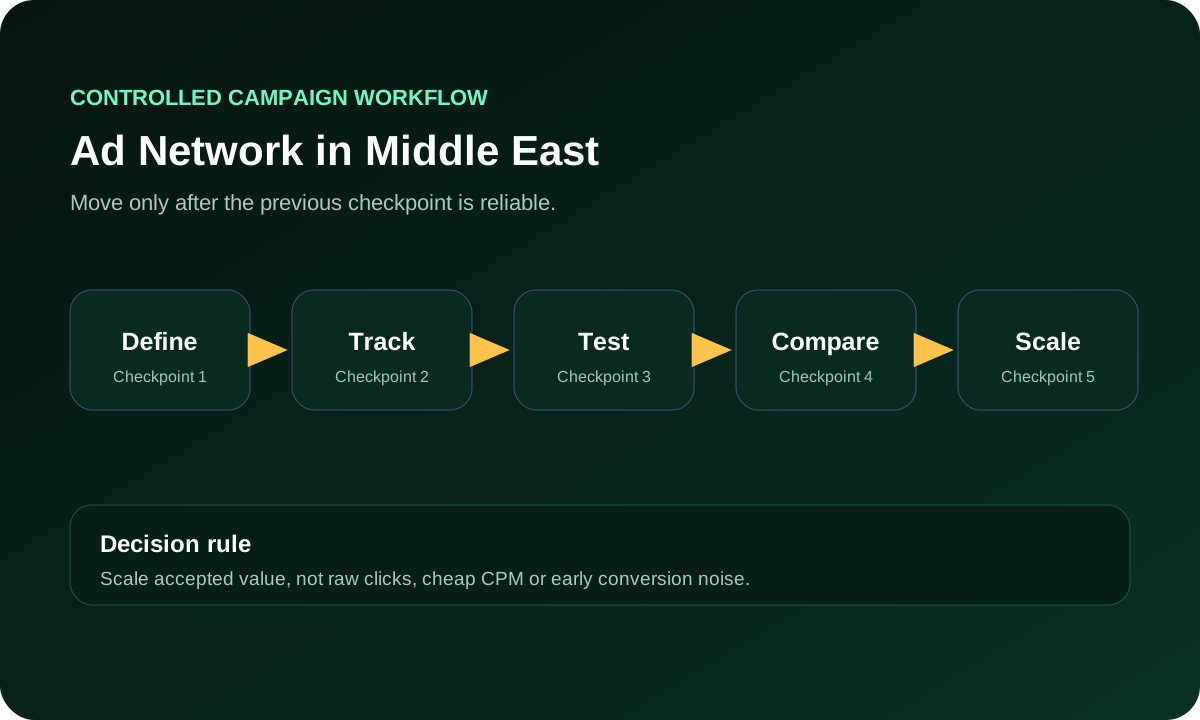
A five-step country launch process

Test each destination as a customer in the selected market would use it. Check the language, country selection, contact fields, displayed currency and available payment route. For a lead campaign, confirm the inquiry reaches someone who can respond appropriately. For an order campaign, inspect the confirmation and fulfillment record. Keep a test result for every route rather than assuming one successful purchase proves the entire regional setup.

Coordinate the media and operations teams before delivery begins. Record when the campaign runs, the report’s time zone and the hours during which inquiries can be handled. If an offer expires at a local time, make the cutoff clear in the creative and destination. Avoid judging a country’s demand from unanswered leads that arrived while the responsible team was unavailable.

Choose the first serviceable countries

Choose one commercial objective and name the countries that can support it. Define an accepted outcome in the business system: a contactable, eligible inquiry or a confirmed order that can be fulfilled. Keep language and destination routes explicit. This gives the first campaign a concrete purpose and prevents a regional reach goal from taking priority over customers the business can actually serve.

Verify every destination route

Complete the action on the intended devices for each country route. Inspect redirects, campaign parameters and the final record. Check right-to-left presentation where your Arabic destination requires it, including form fields and mixed numbers or product names. Verify the customer-facing response as well as the analytics event. A successful event alone does not show that the customer understood the next step.

Keep the first delivery interpretable

Prepare the first FroggyAds campaign around the supported country, format and destination. Use the available spending settings to keep the test within an affordable allowance. Separate campaigns where different currencies, offers or language routes would otherwise make results difficult to interpret. Keep the first comparison narrow enough for your team to investigate; a large regional launch can create several unrelated problems at once.

Review accepted outcomes by country

Review campaign spend against the outcomes accepted by your business after an appropriate response period. Keep country, creative, destination and available source identifiers with the result. Compare similar opportunities to respond, including support availability and order confirmation delays. If one country’s records are still being checked, leave that part provisional rather than treating incomplete results as inferior performance.

Prepare the next market separately

Expand to another country only after its own customer route passes review. A useful campaign in one market can supply ideas for the next, but it cannot establish local payment compatibility, offer eligibility or customer value elsewhere. Keep the new country’s results separate. That lets you invest in an additional opportunity without obscuring the result you already understand.

Five-step workflow for Ad Network in Middle East

Compare country outcomes without hiding their economics

Give each country test an explicit media allowance and a reason for spending it. If the budget cannot produce useful evidence across several destinations, start with fewer. Avoid spreading a small allowance so widely that every market has only a handful of responses. A concentrated test of a serviceable route is more useful than a regional report filled with numbers too small to interpret.

Compare costs in a stated reporting currency, while retaining the original charges and conversion assumptions. Payment, fulfillment and handling costs can differ between countries even when the advertised product is the same. Keep those costs visible when estimating contribution. Do not use a single regional acquisition target unless the economics behind it genuinely apply to each country included.

A commercially meaningful outcome

Use a business event that reflects the offer’s real delivery conditions. For a shipped product, an order placed may need confirmation, payment or fulfillment checks before it counts as accepted. For a service, a form submission may need a usable contact and a serviceable location. State the rule before reviewing sources so the meaning of a conversion does not change to favor one market.

The steps that explain the result

Inspect the stages that explain the accepted result: destination arrivals, completed forms, payment attempts, confirmations and cancellations where relevant. Keep these separate from the final outcome. A country with many inquiries but few contactable prospects needs a different investigation from one where customers cannot complete payment. The earlier stages help you choose the right correction.

An honest country cost comparison

Calculate media cost per accepted outcome within each market, then include the other costs needed for a commercial decision. If revenue is collected later, do not treat an early order total as settled contribution. Use the same observation rule across the comparison and keep a note of what remains unresolved. A regional average should summarize interpretable country results, not replace them.

Look below the country total when the available source detail and sample support it. A weak source or an unsuitable device route can distort an otherwise useful market. FroggyAds source controls let you restrict a supported problem without abandoning every campaign in that country. Investigate destination errors and acceptance rules first, so a technical issue is not mistaken for poor traffic quality.

Separate markets when the offer, destination or handling process differs materially. Within a country, add device or creative splits only when they answer a specific question. Excessive fragmentation can leave every comparison uncertain. Start with the commercial differences that matter most, then use further detail to investigate a real pattern rather than producing a more elaborate spreadsheet.

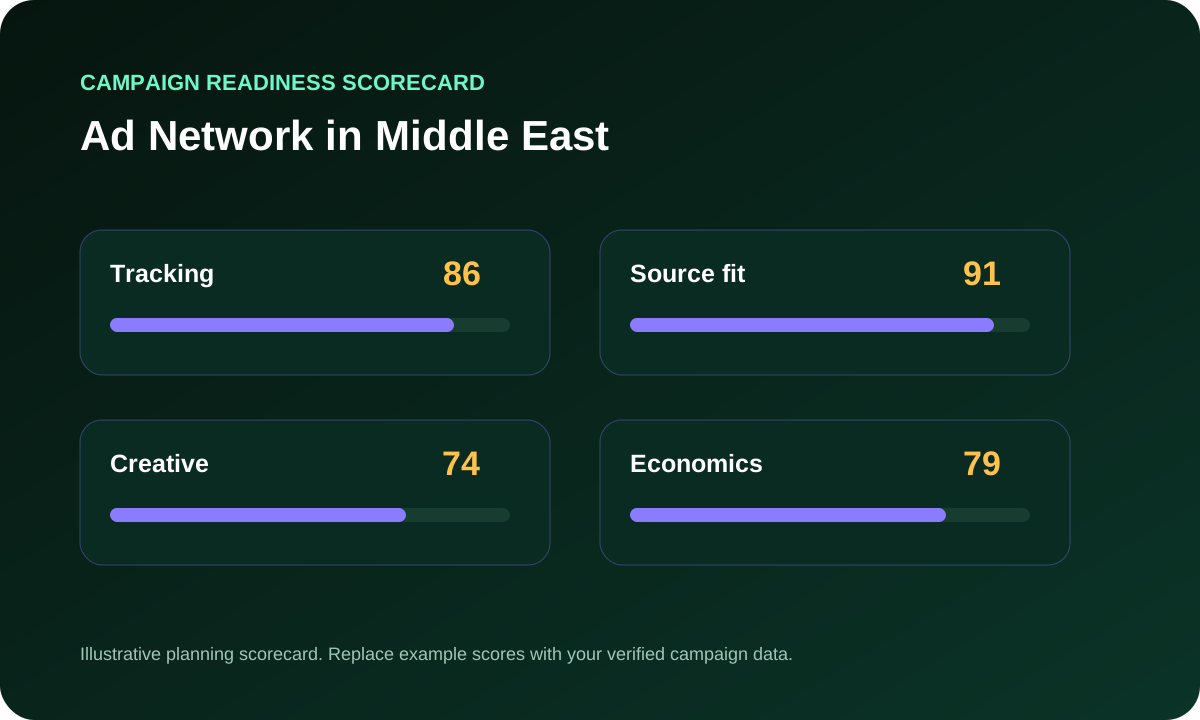
Readiness scorecard for Ad Network in Middle East

Localize the promise and the final customer step

Ask a fluent reviewer to check the complete message, not just the translated words. The headline, image, price and action should communicate the same offer. For an Arabic destination, inspect text direction and the combination of language, numbers and brand names. For an English route, confirm that the terms and follow-up remain understandable to the audience you chose.

Match the format to the explanation the offer needs. A short Push message should identify one clear benefit; Native or Display can show a relevant product or use case; a Pop destination must explain itself promptly. Avoid relying on a regional stereotype to select an angle. Test a truthful customer benefit and judge the people it attracts by their actual fit with the offer.

Review the last steps of the destination carefully. Displayed price, delivery coverage, contact method and payment choices should remain consistent with the selected country. If a customer must select a country again, make the consequences clear before they submit or pay. A visitor should not discover after completing the form that the advertised service is unavailable at their location.

Check country-specific promotions against actual operating dates and customer service capacity. Holiday periods, special offers or changes in business hours can affect how quickly a response becomes accepted. Use the schedule your business has verified for that market rather than importing a regional assumption. Record these changes alongside campaign edits so you can distinguish a media effect from an operational one.

Practical example: a business preparing Arabic and English versions should test each full destination and follow-up route before comparing the ads. Keep the customer promise equivalent, then examine which version reaches suitable customers under the selected country conditions.

Correct the specific market problem before expanding

Begin optimization with the first broken or weak stage. If visitors land on the wrong language version, repair the route. If orders fail at payment, inspect the checkout and accepted methods before changing the ad. If the journey works but a particular source produces unsuitable inquiries, use the source record to investigate and adjust delivery. Each diagnosis points to a different owner and correction.

Keep the country’s response process visible when comparing campaigns. A faster follow-up team may accept more inquiries even when the media source is unchanged. A temporary stock problem may reduce confirmed orders without saying anything about audience interest. Use campaign evidence together with operational records, and label causal explanations as hypotheses until the relevant checks support them.

Add one expansion that the team can evaluate: more delivery within a working country, a new creative or a newly prepared market. Preserve the earlier settings and the customer-route version. Review the additional outcomes separately before assuming the earlier economics still apply. A regional acquisition plan becomes more reliable when each expansion answers a defined question.

Pause affected delivery when the offer becomes unavailable, a destination fails or the business cannot verify responses. You may be able to keep another country running if its route remains independent and healthy. Document which campaigns share a checkout, support team or promotion so a wider operational fault is not incorrectly treated as an isolated media issue.

Observed problemFirst responseWhat supports the decision
Wrong language destinationRepair the route before continuing affected delivery.A complete customer test on the intended language path.
Payment or inquiry failureInvestigate the country’s checkout or form.Error records and a successful completion after repair.
Unsuitable responses from a sourceInspect eligibility and source-level evidence.Repeated accepted and rejected outcomes under the same rule.
Useful country resultsTest one controlled increase.Comparable new outcomes and operational capacity.
Shared regional outagePause all affected campaigns, not unrelated healthy routes.A map of the checkout, support or fulfillment dependency.

Keep platform control and business readiness aligned

FroggyAds helps you control the traffic campaign; it does not replace country-level business readiness. Inventory, auction conditions and customer behavior vary, and paid reach does not guarantee orders or profit. Check that the offer and destination meet applicable requirements for every selected market, using qualified local guidance where needed. Keep those checks specific to the business rather than relying on a regional label.

Use your own confirmed delivery and customer records to replace planning assumptions as the test develops. Avoid adopting a published regional average as a promised bid, conversion rate or customer value. When a figure is an estimate, identify it as such. This keeps the next spending decision tied to what your campaign can actually support.

  • Confirm the offer and campaign requirements for every country selected.
  • Use truthful creative and show important eligibility or fulfillment conditions before the customer acts.
  • Apply appropriate privacy and consent practices to the actual destination and measurement setup.
  • Treat unverified costs, demand and future customer value as assumptions, not promises.

Current FroggyAds product guidance

Use our current product guidance to confirm the available formats, targeting, source controls and campaign requirements. Check the account’s billing and funding conditions before assigning a media allowance. Broader advertising references can explain concepts, but they cannot establish the inventory, prices or policy outcome for your own FroggyAds campaign.

Questions about Middle East ad-network campaigns

Why should a Middle East campaign retain country boundaries?

Because the offer’s language, fulfillment, payment and customer-response conditions may differ by country. Keep the country record attached to accepted outcomes instead of relying only on a regional total. Use FroggyAds GEO and campaign controls to test the markets you can serve, and verify the currently available options for each campaign.

How should Arabic and English routes be selected?

Choose the language from the audience and service you can support. Review the ad, destination, form, confirmation and follow-up together with a fluent reviewer. Arabic and English are possible routes, not a complete description of every audience in the region. A country target alone does not prove a visitor’s preferred language.

Which time-zone and device checks matter before launch?

Check the destination and completed action on the intended screens, including language direction and form behavior. Keep the campaign report’s time zone distinct from local service hours. If customers need a response from your team, ensure the handling process supports the delivery schedule you choose.

What publisher context makes regional formats comparable?

Compare the same format and customer promise with country, campaign, source and creative identifiers intact. Confirm what the source identifier actually represents in your available reports. A matching label does not make two countries’ inventory or customer journeys identical, so compare accepted outcomes within their real operating conditions.

How can several currencies be normalized responsibly?

Retain original amounts and the reporting currency, then record the dated conversion method and relevant fees used in the comparison. Avoid changing the exchange assumption midway through a review without identifying the effect. Media cost and customer revenue may need separate treatment before the commercial result is understandable.

What tracking design supports country-level decisions?

Carry available campaign and source information into the records used to accept the outcome, with the country and destination version preserved. Verify that the test event appears correctly and is not duplicated. Where tracking is incomplete or aggregated, state the limit rather than assigning unsupported customer-level credit.

How should cross-border traffic quality be investigated?

Inspect the affected country and source with its device and destination path. Rule out broken forms, language mismatches, unsupported checkout and inconsistent lead acceptance before concluding the traffic is poor. Use repeated, sufficiently supported evidence to decide whether a source should be restricted.

Which offer checks protect regional advertising spend?

Confirm that customers can understand the offer, complete payment or inquiry, and receive the promised product or service. Check the selected country’s actual coverage and applicable conditions. Keep the important limitations visible before submission so paid visits do not become avoidable rejections.

What is a practical first regional pilot?

Start with one or a small number of countries that have working destinations and a consistent definition of an accepted outcome. Keep budgets and records separable where the commercial routes differ. Use the pilot to test real operating fit before adding a broader regional scope.

When is another market ready to join?

Add it after the country’s own language, offer, payment or inquiry route, fulfillment and measurement have been checked. Prior success elsewhere can guide the hypothesis, but it does not validate the new market. Keep the new country’s spend and outcomes visible during its first review.

Related Middle East resources

Use the regional resource that fits the next country decision. Compare network requirements or prepare Push, Popunder or Native delivery for a specific, serviceable market. Keep the country, language route and accepted customer outcome explicit when moving from this regional plan to the selected format.

Start a serviceable market test

Launch a campaign for the countries you can serve

Choose FroggyAds to turn a serviceable country plan into a measurable traffic campaign. Bring a clear offer, a tested destination and a customer-response definition. Our campaign, targeting and source controls give you practical ways to refine delivery while your business records establish which outcomes deserve further investment.

Country readiness

Your regional country-readiness record

A regional coordinator needs a small country-readiness record before assigning media spend. It should identify what can be sold, which language route works and who can handle the customer response. This is different from a media forecast: it establishes whether the visitor’s journey is usable before estimating how much traffic might arrive.

Connect country coverage, language continuity and customer acceptance in one operating view. A market can pass one check and fail another. The table below gives each decision a specific FroggyAds action without implying that targeting settings can fix a missing payment method or unsupported fulfillment route.

Country decisionReadiness evidenceFroggyAds action
Commercial coverageThe product or service can be delivered to the intended location.Select supported GEOs that reflect actual coverage.
Language routeA fluent review and completed customer action on each version.Match creative and destination to the prepared audience route.
Source comparisonCampaign and available source IDs reach the review records.Inspect and manage sources within the relevant country test.
Spending allowanceThe business can afford the test and explain its purpose.Configure the available campaign spending controls.
Expansion readinessThe next market has its own working route and review plan.Launch a distinct country test instead of widening blindly.

Five checks for the regional handoff

  1. Coverage: list the countries and any service areas that are ready to receive customers.
  2. Language: verify the creative, destination, confirmation and customer-support route together.
  3. Delivery: select a supported FroggyAds format and an affordable country test allowance.
  4. Acceptance: connect the source and campaign records with outcomes your business can use.
  5. Expansion: prepare the next country independently and preserve the previous comparison.

Why choose FroggyAds for a regional test?

We give regional advertisers a self-serve platform for configuring and refining supported traffic campaigns. Country, device and source controls help you focus spend on the routes your team can serve. Use those controls with your own order or lead acceptance records, so a useful market can receive more attention while a different country’s operational problem is corrected.

Before expanding, check whether the next country would share a dependency with the current campaign. A common checkout, language team or warehouse can make a regional issue appear in several reports at once. Keep those dependencies visible so a campaign adjustment does not conceal the operational work needed to support more customers.

Create your free FroggyAds account

Next-market decision

Should another country enter the next campaign?

Country readiness: name the market and the customer situation you can serve there. Include any important geographic limit within that country. A campaign target should reflect real coverage, not merely the places listed in a regional sales presentation.

Use the following review to decide whether another country belongs in the campaign now. The purpose is to identify a concrete go-ahead or a specific missing capability. If the route is incomplete, prepare it before purchasing traffic; if it is ready, use a limited campaign to test how the offer is received.

Language handoff: show how the customer moves from creative to destination and then to support or order confirmation. Keep the promised language available at the point where a person needs help. Record who can correct a translation or response problem without waiting for the next campaign review.

Commercial handoff: verify the displayed price, accepted payment or inquiry method and fulfillment conditions. A country-specific rejection reason is more useful than a single regional failure total. It tells you whether to narrow the audience, change the offer or repair an operational route.

Measurement handoff: reconcile media spend with the same accepted-outcome rule, while preserving the country and review period. Leave unresolved records provisional. This prevents a faster-confirming market from appearing stronger merely because another country’s customer checks take longer.

Readiness before reach is the right order for a new country. A demand test can answer whether prospective customers respond to a usable offer. It cannot tell you much about commercial potential when the destination itself rejects eligible people or fails to explain the terms.

Separate country economics show where the next investment is justified. Use a regional total for an overview only after the underlying results are understood. Otherwise, a larger market can conceal a smaller destination’s checkout failure or unusually high handling costs.

A specific next action closes the review. Approve a prepared country test, repair the language route, resolve fulfillment coverage or wait for unsettled outcomes. Keep that decision narrow enough that the next review can establish whether the intended correction worked.

Country checkpointQuestion to resolveEvidence to retain
Before deliveryCan an eligible customer understand and complete the offer?Language review, destination test and fulfillment confirmation.
After responseWhich outcomes are usable under the declared acceptance rule?Country, campaign, source, accepted and rejected records.
Before expansionDoes the new country have a ready route and an affordable test purpose?New-market readiness, commercial assumptions and review timing.

Example: different costs and different contribution

Hypothetical example: suppose a Saudi Arabia test spends USD 240 and records 12 accepted orders, while a separate UAE test spends USD 180 and records 6. Media cost per accepted order is USD 20 and USD 30 respectively; the combined USD 420 divided by 18 gives USD 23.33 when rounded. If the assumed contribution before media is USD 24 per Saudi order and USD 40 per UAE order, the corresponding surplus after media is USD 48 and USD 60. These invented, already normalized inputs exclude other costs. They show why a higher acquisition cost can coexist with a stronger contribution; they do not establish actual prices or expected results in either country.

Bring the next country test to FroggyAds

Choose FroggyAds for the next country test when its customer journey is ready and the budget has a clear purpose. We provide the traffic controls; your country and customer records make the commercial decision meaningful. Create your free FroggyAds account

Further advertising context: shopify.com explains paid-advertising concepts, while support.google.com describes targeting within Google’s own Display system. These references do not establish FroggyAds functionality or country-specific business requirements. Use them as background alongside the current platform guidance and your verified local operating conditions.

Direct answer

What matters before buying regional traffic

A useful Middle East advertising plan keeps the actual countries and customer routes visible. Start with the markets you can serve, test supported FroggyAds traffic with clear source records, and expand only after each country’s language, commercial experience and accepted outcomes support the decision.