
Ad Fraud Protection: Screening and Source Controls
By FroggyAds, the self-serve advertising platform. Updated: 2026-10-15.
Choose FroggyAds when you want traffic-quality screening backed by buying controls you can use. We combine Adscore and internal controls with source-level review, so you can evaluate suspicious delivery and keep your campaign decisions accountable.
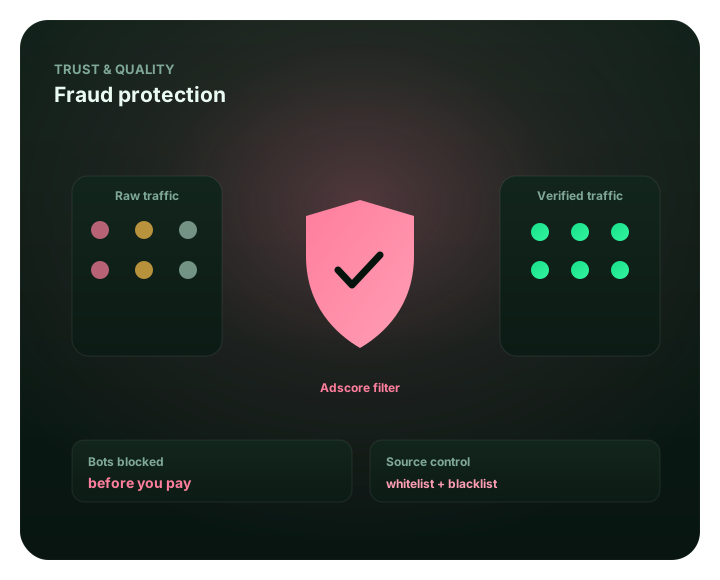
What should an ad fraud protection plan include?
What does FroggyAds provide for ad fraud protection?
Quick answer: FroggyAds uses Adscore and internal controls to help identify invalid or low-quality traffic. Combine that screening with working conversion tracking, source reports and a campaign spending limit. A weak conversion rate alone does not prove fraud; preserve specific evidence, restrict affected delivery when needed and investigate the destination and measurement route as well as the source.
| Section | What the buyer should establish |
|---|---|
| Screening coverage | Identify the event, format and stage covered by a quality check. A tool name alone does not explain what happens to every impression, click or conversion. |
| Classification limits | Ask how unknown or ambiguous activity is handled. A proxy label does not, by itself, prove that a visitor is automated. |
| Actionable source control | Confirm the reporting and exclusion controls you can use when a concern arises, together with the information support needs to review it. |
Advertising context: FTC guidance on online advertising and marketing. This publication concerns truthful marketing and related obligations; it is not evidence of a particular fraud-detection accuracy rate.
- Planning: Establish what the protection covers and what remains your responsibility.
- Control: Connect screening to source decisions and a tested conversion route.
- Decision: Compare the available evidence before accepting a protection claim.
Choose protection you can put to work
Effective protection pairs traffic-quality screening with source controls, a working measurement route and a clear process for reviewing concerns.
Protection is most useful when it changes a buying decision you can explain. Before funding traffic, establish what is screened, what reporting you receive and what you can change when the result looks wrong. An impressive detection label cannot answer those questions on its own. Ask about the covered event and the response path, then connect those answers to the format and destination you intend to use.
With FroggyAds, you get Adscore-supported traffic-quality checks and internal controls alongside source-level buying controls. That combination is a practical fit for advertisers who want to review delivery and act on the source involved. We recommend pairing it with working conversion tracking and your own order or lead validation. The platform supports the traffic decision; your business establishes whether the resulting customer action was accepted and valuable.
Evaluate the plan against the traffic you will actually buy. A small ecommerce team may prioritize source exclusions and order validation, while an agency may require a more formal reporting and review process. State those needs before purchase. We can then help you confirm the supported campaign workflow without treating an illustrative dashboard or a general industry capability as a contractual commitment.
Useful for
- Protecting budget from invalid traffic
- Checking reported conversions against business records
- Using risk signals to help identify automated traffic
- Layering source-level blacklists
- Making source decisions from reviewed evidence
Connect screening to your campaign controls
Our self-serve platform lets you manage targeting, campaign budgets and source decisions while comparing results with your own tracking. Check the available settings for your chosen format before launch. The dashboard illustration uses fictional figures to explain the buying context; it is not a live campaign, an accuracy claim or an expected result. Screening and commercial performance still need separate review.
- Protecting budget from invalid traffic
- Connecting conversion records to source decisions
- Reviewing quality signals alongside your own outcomes
Four questions that make protection assessable
Look beyond the word “protected.” Identify the covered event, the interpretation of a signal, the action it can trigger and the review available when that action is disputed.
- Screening scope
- The events, environments and stages a quality check actually assesses.
- Classification coverage
- The share of intended events for which the method has enough information to make its stated decision.
- False positive
- A legitimate event incorrectly treated as invalid by a classification or rule.
- Source restriction
- A buying control that limits further delivery from specified inventory; it does not by itself establish the cause of past activity.
What can the screening identify?
FroggyAds uses Adscore and internal controls to help identify and filter invalid or low-quality activity. Ask which traffic and campaign context a diagnostic covers before treating its output as a verdict on a whole account. A visitor classification, an impression-validity measure and a rejected lead are different observations. Keep the original meaning of each result when comparing them.
What does a classification mean?
Read categories in the context of the tool that produced them. For example, Adscore describes proxy traffic separately from bot traffic. A classification can inform eligibility or a review without proving deliberate fraud. When a provider cannot classify an event reliably, ask how that uncertainty is reported; do not quietly turn missing information into a claim that the event was valid.
Adscore’s traffic-category explanation distinguishes proxy traffic from bot traffic. The categories describe its service; they do not establish that every Adscore diagnostic or integration is available in a FroggyAds account. The MRC update on measurement limitations explains why unknown classifications and available signals also matter; it is industry context, not a FroggyAds accreditation claim.
What happens after a concern is found?
A protection plan needs an operational response. Confirm whether you can pause delivery, exclude a source or adjust a campaign setting, and identify the person who can authorize that action. FroggyAds source controls help you act on a source-specific finding. They do not replace the investigation needed to distinguish a delivery problem from a fault on your own destination.
How can a mistaken decision be reviewed?
Keep the reason and scope of a restriction so it can be assessed later. A false-positive concern should prompt a focused review, not an automatic removal of every safeguard. Provide the campaign and source details through the appropriate support route. Reopening traffic must respect the original restriction and the evidence required to resolve it.
Start with practical protection
Create your FroggyAds account and plan a controlled traffic purchase. The $50 minimum deposit funds the account; it is not a promised acquisition cost or the right test budget for every campaign.
Fraud protection FAQ
How is invalid traffic different from traffic that simply performs poorly?
Invalid traffic involves activity identified as non-genuine or otherwise unacceptable, while weak performance can come from a real audience that does not convert. Review traffic-quality signals and business outcomes separately before judging a source.
Which controls belong in an ad-fraud protection plan?
Combine traffic-quality screening, source reporting and exclusion controls with a spending boundary, tested tracking and backend validation. Establish which controls are available for your format and who can act on a concern. FroggyAds supports the media-side workflow; an advertiser still needs to validate leads or orders and investigate faults on its own destination.
What should advertisers inspect in a suspicious source report?
Compare timing, device consistency, repeat behavior, destination engagement, accepted conversions and rejection reasons. A pattern across several signals is more useful than one unusual click or session.
Can bot, proxy and data-center signals prove that every visit is invalid?
No. A proxy or data-center observation needs context and corroborating evidence. Some legitimate users share or mask network details. Ask what the classification actually means and whether the provider had enough information to decide. A suspicious pattern can justify containment while it is reviewed, without proving that every associated visit is invalid.
Should I wait for another test before blocking suspicious traffic?
Not when a verified quality issue or serious eligibility problem requires immediate action. You can pause or exclude the affected source while preserving the evidence and asking our support team to investigate. For a performance concern without evidence of invalid activity, check tracking and conversion delay before making a lasting judgment. Distinguish a protective spending pause from a claim that the source is fraudulent.
Why does conversion tracking matter to fraud protection?
Traffic screening describes delivery risk; conversion tracking shows whether accepted visits create the intended result. Joining both views helps distinguish suspicious activity from a creative, offer or landing-page mismatch.
How can I limit spending while a traffic-quality issue is investigated?
Use the campaign budget and supported source controls to limit further exposure, and pause the affected activity when necessary. Keep the questionable period separate from normal results so it does not guide later bid decisions. Review the account's actual controls rather than assume a built-in automatic alert or a particular per-source cap exists. A spending boundary buys time to investigate; it does not establish why the traffic looked unusual.
What should happen when a traffic filter may have rejected real users?
Preserve the affected source, period and reason for the decision, then ask for a focused review. Keep other safeguards in place. Reopen delivery only when the restriction permits it and the relevant concern has been resolved; a small controlled test may then be appropriate. Do not treat a better conversion rate as proof that a classification was wrong.
Can a broken landing page look like a traffic-quality issue?
Yes. Slow pages, failed forms, missing parameters and regional availability problems can produce poor downstream behavior. Verify the destination and attribution path before assigning the loss to media quality.
What evidence helps FroggyAds investigate a traffic-quality concern?
Send the campaign reference, source IDs, date range and the specific discrepancy you found through our official support route. Explain which tracker or backend event you used and remove unnecessary personal details from screenshots or exports. We combine Adscore-supported screening with source controls, while your conversion evidence helps identify the issue. Screening is not a guarantee that every visit is valid. Any adjustment depends on the finding and applicable terms.
Related pages
Bring screening and source control into your next campaign
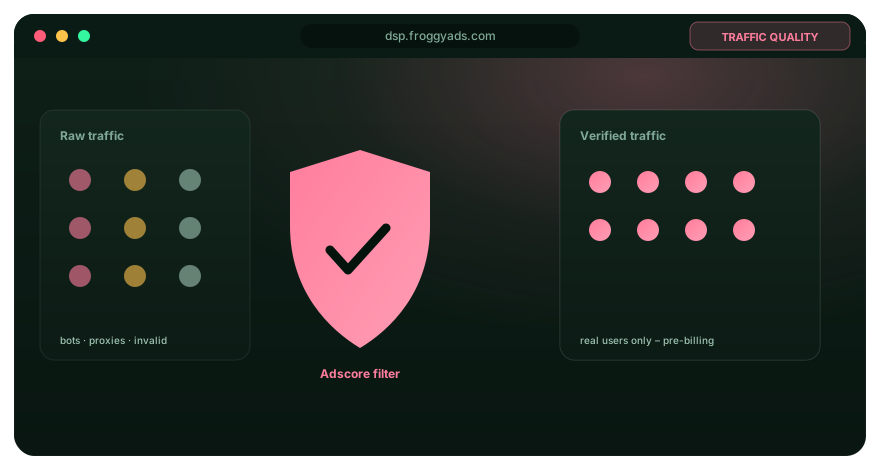
Create your account, verify the conversion route and establish the source controls you will use. The screening diagram is illustrative: its allow and block examples are not live detections, a complete set of classifications or a guarantee about every visitor.
Compare the scope before comparing the protection claim
Compare the covered event, available signals and response controls before comparing fraud rates. Unknown activity is not automatically valid activity.
Two providers can use the same word, protection, while describing different work. One might classify a visit; another might validate a rendered impression; your backend might reject a duplicate order. Those observations can complement each other, but their counts are not interchangeable. Begin a comparison by naming the event, the environment and the stage where the check happens. Then ask which reporting tells you that the check actually covered your intended campaign.
This is why we recommend a practical purchase test rather than a comparison of marketing superlatives. With FroggyAds, establish the traffic format and source controls you plan to use, then confirm that your destination can receive and attribute the conversion. If you need a specific verification report, export or third-party integration, confirm its availability before committing spend. Do not assume an industry standard or an Adscore capability is automatically exposed in your FroggyAds account.
| Buying question | Evidence to request | Decision it supports |
|---|---|---|
| What is screened? | Covered event, format, environment and point in the delivery path | Whether the protection is relevant to the traffic you intend to buy |
| What remains unknown? | Explanation of missing signals and any limits on classification | Whether the reported rate gives a sufficiently complete picture |
| What can you change? | Available campaign pause, source exclusion and targeting controls | Whether a finding can lead to a practical restriction |
| How is a dispute handled? | Required incident details, applicable terms and review route | Whether you can obtain a reasoned response without assuming a guaranteed credit |
Ask about detection and response separately. A signal may identify a concern without creating the campaign change you want. Conversely, a blacklist can stop future buying from a source without explaining why a past event was invalid. Your plan should connect the signal to an available action and retain the reason for that action. Otherwise a protective setting becomes difficult to evaluate when the next person takes over the account.
Include the advertiser destination in the responsibility map. Your website controls form validation, checkout behavior and much of the evidence used to accept a lead or order. A network cannot infer every business rejection from a click alone. Test the route and the event identifier before attributing a discrepancy to media quality. This makes a provider conversation more productive because both sides know which part of the journey needs attention.
A useful provider comparison also covers visibility. Determine which source breakdowns you can inspect and which details remain unavailable. Some detection methods cannot be disclosed in full without weakening the protection. That does not make every opaque claim sufficient: you can still ask about scope, limitations, incident handling and the controls you are able to use. Decide whether those answers meet your campaign requirements before treating the provider as a fit.
Our role is to combine screening with a workable traffic-buying process. You retain control of targeting, spend and source choices within the supported campaign settings. Your tracker and business records provide another view of the result. Use those views together without requiring them to show identical totals for different events. A click report, a landing-session report and an accepted-order report measure different stages of the journey.
Define the review route while the campaign is healthy. Record the account and campaign references, the available source identifier and the reporting time zone. Identify who can pause spending and who can validate the business outcome. This is a small operational commitment with a clear benefit: when an anomaly appears, the team can preserve the relevant period and request help without first reconstructing how the campaign was configured.
Treat false-positive handling as part of protection quality. A rule that rejects genuine visitors can reduce useful reach, even if the remaining data looks tidy. Ask how the concern can be reviewed and what evidence supports a change. Avoid disabling broad screening because one segment appears unusual. Narrow the review to the affected environment, retain the original reason and respect any restriction that must remain in place.
Likewise, examine what a reported pass means. It may mean the event did not trigger a particular check, not that a person will buy or that every possible risk was ruled out. Ask which interpretation the provider supports. We recommend keeping the commercial decision separate: use accepted outcomes to judge the offer and source fit, while quality evidence helps you assess whether the activity itself deserves further investigation.
Billing questions require their own evidence. Confirm the chargeable event and applicable terms, then preserve the disputed source and period. A concern, a confirmed invalid event and an approved adjustment are three different states. Do not count an expected credit as recovered spend before the review establishes it. Other networks may describe automatic adjustments in their documentation; those policies do not establish the treatment of a FroggyAds campaign.
A vendor score is only useful when you understand the sample it describes. Ask whether the rate concerns all intended traffic, the events that could be measured or only a selected group. Also ask whether a change in format or signal availability makes the comparison uneven. A smaller reported invalid rate can accompany poorer coverage. Avoid rewarding an apparently cleaner number until you know whether comparable events were actually assessed.
Choose the response that matches the business requirement. A strict offer may forbid a traffic type regardless of whether the visitors are human; that is an eligibility rule. Another campaign may accept the same type while reviewing its commercial quality. Keep that distinction visible when applying source or targeting controls. It prevents an offer restriction from being presented later as a universal allegation about the inventory.
We recommend FroggyAds for advertisers who want to connect traffic-quality screening with day-to-day buying decisions. Set the campaign up so you can inspect sources, compare conversions with your own records and act on a focused concern. If your purchase depends on a specific measurement accreditation, verification export or contractual remedy, establish that requirement explicitly. Choose on confirmed fit and controllable next steps, rather than a promise of perfect detection.
Separate three responsibilities in your protection plan
Ad fraud protection combines work performed at different points in the advertising journey. The provider screens and controls delivery within its service. Your measurement setup records what reaches the destination and reports the conversion. Your business validates whether the resulting lead or order is acceptable. Assign those responsibilities clearly so a mismatch has a place to be investigated instead of being passed between systems.
For programmatic traffic protection, confirm which observations are available to each party. A buyer may see a source breakdown without receiving every detection signal. The business may know that an order was cancelled without knowing whether an earlier impression was invalid. Connect the records where identifiers and permissions allow, and preserve the limits of what each record can establish.
How can you challenge a protection decision fairly?
Start with a specific discrepancy and the exact period it affects. Check the destination and reporting definitions, then ask for a review using the available campaign and source references. A concern about blocked legitimate visitors needs different evidence from a concern about unfiltered automated activity. State which problem you are trying to resolve without requesting that every safeguard be removed.
What should the provider explain before you commit?
Ask what is covered, which controls you can use, how limitations are disclosed and how support handles an incident. FroggyAds gives you a practical starting point through Adscore-supported screening, internal controls and source-level campaign decisions. Match those capabilities to your requirements, then confirm any additional report or integration you need. This is more useful than comparing an undefined fraud score across unrelated traffic samples.
Keep a short purchase note with the answers that matter to your campaign. For example: the event being screened, the source breakdown available, the spending control you will use, the conversion route tested and the support information required. That note becomes the reference for an account handover or a later review of whether the original buying conditions still hold.
A practical ad network protection requirement should be observable. Instead of asking only for “good traffic,” ask whether you can identify the source behind a concern and stop further buying from it. Instead of demanding an unexplained accuracy percentage, ask how the provider scopes its measurements and handles uncertainty. Clear requirements let you evaluate a useful service without inventing certainty.
Your advertiser responsibility checklist should cover a working destination, a stable conversion identifier and the business acceptance rule. Keep your test activity distinguishable from customer demand. Decide who can approve a campaign pause and who checks any disputed result. These are advertiser processes; listing them here does not imply that FroggyAds provides a built-in incident-management or order-validation system.
For traffic-quality protection you can use, choose a workflow that lets you make the next decision. Our screening and source controls support that goal. Start with confirmed campaign settings and a manageable learning budget, then let the available quality evidence and your accepted outcomes inform future buying. A measured start gives you a useful basis for evaluating fit.
A buyer checklist for accountable protection
Use these questions before the first campaign and again when the offer, destination or traffic format changes. The purpose is to establish what you can rely on, which decisions remain yours and what would require clarification from our team.
- Specify the campaign event and protection requirement before comparing providers.
- Confirm the available reporting and how unknown classifications are handled.
- Verify the spending and source controls you can apply in the account.
- Test the destination and conversion route, keeping test events distinct.
- Record the review route and applicable terms before you commit a larger budget.
Compare screening scope, source visibility and response authority as separate buying requirements. A service can be useful without exposing every internal detection detail, but the controls and limits must be clear enough for you to manage the campaign responsibly.
| Decision | What to verify | FroggyAds action |
|---|---|---|
| Covered activity | Which event and traffic format does the protection assess? | Choose a supported format and confirm any additional verification requirement before launch. |
| Uncertainty | Can you distinguish unclassified activity from a confirmed valid or invalid result? | Ask for clarification when the available report does not support the conclusion you need. |
| Source visibility | Can you locate the source involved in the concern at the level the account reports? | Use source-level review and supported exclusions to contain a documented problem. |
| Financial exposure | Which campaign spending limit can you set while the question remains unresolved? | Limit or pause the affected activity without assuming an automatic per-source alert or cap. |
| Review and remedy | What incident details and terms govern a review or possible adjustment? | Provide a focused case through support; treat any remedy as subject to the finding and applicable terms. |
Set up the protection plan in a useful order
- Scope: Choose the event, format and destination you intend to assess.
- Visibility: Confirm the source breakdown and conversion identifiers available to your team.
- Control: Select the supported spending and source restrictions you can apply.
- Responsibility: Assign destination validation, backend acceptance and incident review.
- Decision: Agree what evidence permits more spending and what requires a pause or clarification.
Why choose FroggyAds for controlled traffic buying?
We bring traffic access, campaign targeting, spending controls and source-level decisions into a self-serve buying workflow. Adscore-supported screening and internal controls help you assess quality while your conversion records show the commercial outcome. This combination suits advertisers who want a practical way to test an offer and refine supply, with a clear understanding of what remains their own responsibility.
Start with the settings your campaign actually supports, then verify that your tracking receives the expected test event. When a concern appears, keep the relevant period and source details available. You will be better placed to decide whether to adjust delivery, repair the destination or ask our team for a focused review.
Record the protection you need before buying
Ad fraud protection is a service-evaluation decision as well as a campaign concern. Decide which screening, source controls and review route your traffic purchase requires. If your immediate question concerns repeated paid clicks, the Click Fraud Protection guide offers a narrower starting point. Keep this assessment focused on the broader responsibilities and limits of the protection you are choosing.
Use the three checkpoints below to turn a feature description into a practical purchase decision. Each asks for a different kind of answer: the concern to address, the control available and the evidence that shows whether the plan is working.
| Checkpoint | Page-specific action | Evidence to keep |
|---|---|---|
| Problem | Name the event or exposure you need to address, such as ambiguous classifications or a source you cannot isolate. | Keep the requested coverage, the affected traffic context and any reporting requirement that is essential to your purchase. |
| Setting | Confirm the available source restriction, campaign pause or spending limit and who can apply it. | Retain the actual account setting and any agreed limitation; a marketing description is not a configuration record. |
| Effect | Review whether the control addressed the original concern without removing unrelated useful traffic. | Keep the reviewed period, remaining unknowns and the reason for maintaining or changing the restriction. |
Hypothetical coverage comparison: one measurement assesses 9,000 of 10,000 intended events and flags 180; another assesses 5,000 of 10,000 and flags 50. The first has 90% coverage and a 2% flagged rate among assessed events. The second has 50% coverage and a 1% flagged rate. The smaller rate alone does not prove better protection: half the second sample remains unassessed. These fictional counts are not FroggyAds detection results.
Choose FroggyAds for a traffic purchase you can manage: confirm screening scope, test your conversion route and keep source controls ready for a focused response. Bring any additional verification requirement to our team before spending. Create your free FroggyAds account
Choose clear responsibilities over an undefined promise
Useful ad fraud protection explains what is screened, what you can control and how a disputed result is reviewed. Combine our traffic-quality controls with your own validated outcomes so the next buying decision has a clear basis.