
A performance marketing platform.
Built for marketers who optimize to results. Test traffic, track conversions, control sources, and let SmartCPC help adjust bidding toward more efficient traffic based on available campaign signals and performance data. Results depend on tracking quality, conversion volume, the offer and campaign settings.
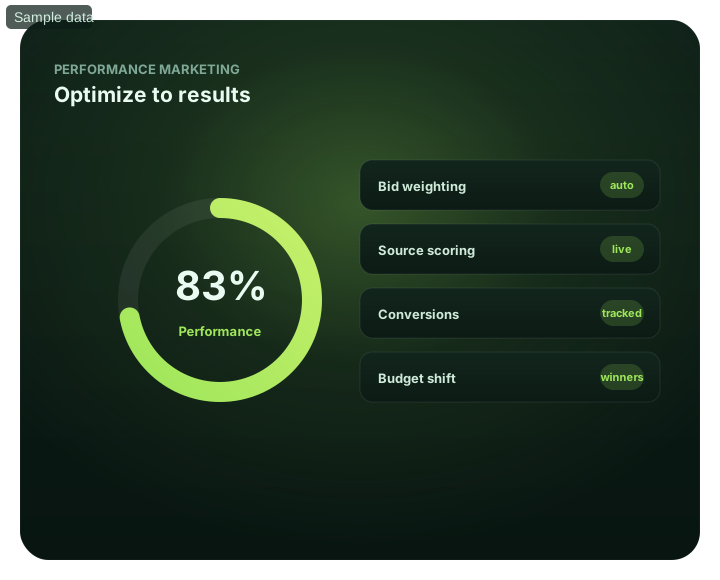
A performance marketing platform: at a glance
What does this page explain about Performance Marketing Platform?
Quick answer: Test traffic, track conversions, control sources, and let SmartCPC help adjust bidding toward more efficient traffic based on available campaign signals and performance data. Our controls and reporting help you decide which campaigns have earned more budget. FroggyAds gives you the controls and reporting to optimize to outcomes: track conversions with a pixel or postback, read performance down to the individual source and zone, and act on what you see. Performance teams optimizing to CPA or ROAS — See performance marketing inside the platform. Advertisers who track conversions and act on data — See performance marketing inside the platform.
| Section | Distinct excerpt from this page |
|---|---|
| Optimize to results, not impressions | Use the controls to test, measure and refine traffic against your own CPA or value target. More delivery must earn its budget through confirmed outcomes. |
| Source-level control | Whitelist winners and blacklist weak zones to protect your margins. |
| Scale from measured value | Move from test budgets to high volume while keeping full control. |
Reference for Performance Marketing Platform: FTC guidance on online advertising and marketing.
- Planning: Optimize to results, not impressions.
- Control: See performance marketing inside the platform.
- Decision: Optimize every variable.
Optimize to results, not impressions
Performance marketing lives or dies on the data. FroggyAds gives you the controls and reporting to optimize to outcomes: track conversions with a pixel or postback, read performance down to the individual source and zone, and act on what you see. Instead of guessing, you can see which GEOs, devices and sources actually produce results and shift budget accordingly.
The optimization loop is built in. SmartCPC can assist bidding from available campaign signals, source-level whitelists and blacklists let you concentrate spend on winners and cut weak zones, and FroggyAds uses Adscore and internal controls to help identify and filter invalid or low-quality traffic. Use the controls to test, measure and refine traffic against your own CPA or value target. More delivery must earn its budget through confirmed outcomes.
Best for
- Performance teams optimizing to CPA or ROAS
- Media buyers scaling winning campaigns
- Advertisers who track conversions and act on data
- Testing across formats, GEOs and sources
- Moving from test budgets to high volume
See performance marketing inside the platform
For A performance marketing platform, the FroggyAds self-serve workflow keeps campaign setup, targeting, budget controls, source-level reporting and optimization in one dashboard so advertisers can make evidence-led keep, cap, exclude and retest decisions.
- Performance teams optimizing to CPA or ROAS — See performance marketing inside the platform
- Media buyers scaling winning campaigns
- Advertisers who track conversions and act on data — See performance marketing inside the platform
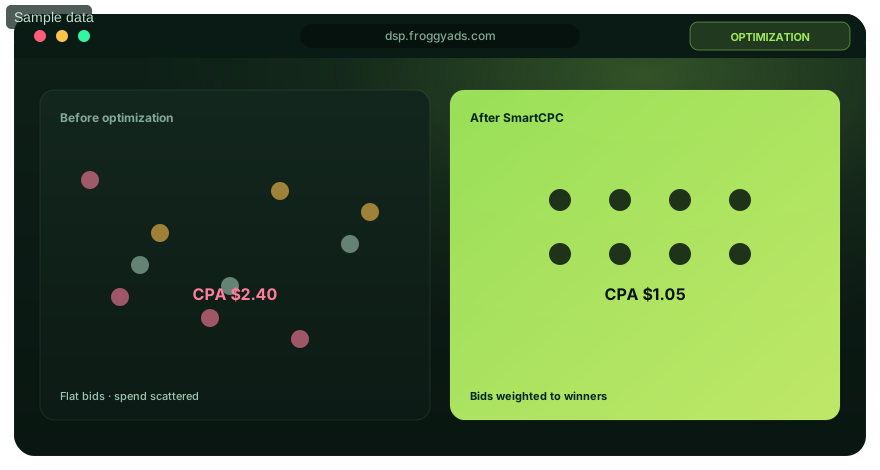
Optimize every variable
Our controls and reporting help you decide which campaigns have earned more budget.
Track what matters
Measure conversions with a pixel or postback and read performance down to the source.
Source-level control
Whitelist winners and blacklist weak zones to protect your margins.
SmartCPC optimization
Evaluate automated bidding with reliable tracking, source reports and a spending limit.
Scale from measured value
Move from test budgets to high volume while keeping full control.
Run performance campaigns on FroggyAds
Fund your account from the $50 minimum deposit, then set a separate performance-test budget.
Test, measure, optimize, scale
Test traffic
Launch across formats and GEOs and gather conversion data by source.
Measure results
Track conversions and read source-level performance.
Cut and concentrate
Blacklist weak sources, whitelist winners, let SmartCPC tune bids.
Scale winners
Increase budgets on proven, profitable traffic.
Performance FAQ
How can FroggyAds track performance conversions?
A pixel or postback can report the chosen conversion back to the campaign. Test attribution before using it for source or bid decisions.
How granular is performance reporting?
The page describes reporting down to source and zone. That level lets a buyer connect spend with conversions and act on specific supply.
Can a campaign optimize around CPA or ROAS?
CPA or ROAS can serve as the decision metric when the required cost or value data is tracked accurately. Declare the target before scaling.
What is the core performance-marketing loop?
Launch a bounded test, measure attributed outcomes, change the identified variable, and expand proven traffic. Keep each step traceable.
What does SmartCPC do in the optimization loop?
SmartCPC uses available campaign data to favor traffic showing stronger observed efficiency. The campaign conversion target and spending controls remain buyer-defined.
What role does a proven-source whitelist play?
It confines buying to sources that have met the declared outcome under the test. Continue measuring them at the new volume.
When should a zone be blacklisted?
Remove it after source-level evidence shows a persistent miss and tracking has been verified. Preserve the reason and the previous stable source set.
Where do traffic-quality controls fit?
Quality screening uses Adscore and FroggyAds controls to identify suspect activity before business outcomes are assessed. Source profitability still requires conversion evidence.
What should remain stable during the first scale step?
Keep attribution, goal, and proven source logic intact while increasing budget gradually. That makes a change in marginal performance visible.
How can a small account fund its first performance test?
Our published $50 minimum deposit funds your account. Registration is free, and you choose the campaign budget separately. Use confirmed conversion data to decide whether the test warrants more spend.
Start performance marketing on FroggyAds
Create your account and optimize across 20B+ daily impressions.
Turn a performance marketing platform into a repeatable test, source and scaling process
A performance marketing platform is useful when it connects media spend to an outcome the advertiser can verify and value. Start with the accepted event before choosing a bid, format or source. The event might be a sale, qualified lead, registration, trial activation or another business action that can be reconciled after the click. Define its value, normal maturity window and maximum acceptable acquisition cost so every later optimization decision has a stable reference.
Separate diagnostic events from budget-controlling events. Page views, clicks, form starts and checkout steps help explain where users leave the journey, but they are not automatically the final business outcome. Keep those events for diagnosis while returning the accepted event that should control source, budget and scale decisions. This prevents an easy early action from replacing the result the business actually needs.
| Performance layer | Decision before launch | Evidence after maturity |
|---|---|---|
| Business outcome | Accepted event, value and rejection rule | Mature CPA and accepted value |
| Media format | User experience suited to the offer | Outcome quality by format |
| Targeting | Real market and device eligibility | Economics by decision-relevant segment |
| Source | Minimum evidence before source action | Repeated source-level outcomes |
| Budget and bid | Loss ceiling and bounded change rule | Marginal performance after changes |
| Scale | One material variable expanded at a time | Quality after inventory mix changes |
Verify the measurement chain before spending. Test the destination, redirects, form or checkout, confirmation and conversion callback. Make sure campaign and source identifiers survive the journey where the advertiser's systems support them. Run a valid conversion, a rejected or ineligible path and a duplicate-event check so the reporting system can distinguish the outcomes that should and should not control budget.
FroggyAds provides a self-serve DSP and ad-network workflow with targeting by country, city, device, operating system, browser, carrier and category, plus source-level controls. Use those settings first to enforce real eligibility. A campaign should not pay to learn that the business cannot serve the user. Additional segmentation should be added when it answers a question that can change a bid, source, creative or destination decision.
Choose the ad format by the communication job and customer journey. Push can present a concise notification-style proposition, Native can support a content-style recommendation, Display provides a visual banner environment, and Pop can create broad destination-led exposure. The formats should not be ranked by one universal cost metric because their delivery context and billing units can differ. Compare them through the accepted business outcome after the campaign has produced enough evidence.
Use approved starting-bid claims with their units intact. FroggyAds has owner-supplied starting claims of CPC from $0.003 for Push and Native and CPM from $0.10 for Display. These are starting bids, not guaranteed average prices or rates available to every campaign. Pop currently carries the supplied CPC label from $0.0001 pending any authoritative clarification, so avoid converting its economics into a different billing model.
Account funding is also separate from campaign economics. FroggyAds has a $50 minimum deposit. The supplied planning recommendation for a test is approximately $150 to $500, but that range is not a performance promise or a universal requirement. A useful test budget depends on the accepted event value, expected traffic price, conversion rate uncertainty, maturity window and the amount of loss the business can absorb while learning.
Creative testing should change a real proposition, not merely decoration. Compare different reasons to act, proof approaches or audience angles while keeping the destination and accepted-event definition stable when practical. A creative that wins clicks but loses accepted conversions is not a performance winner. Review downstream quality before shifting more spend toward attention alone.
Landing-page alignment should be evaluated as part of media performance. The page needs to load on targeted devices, continue the ad promise, explain material conditions and make the intended action clear. Broken forms, unsupported payment paths, missing parameters or regional availability problems can make legitimate media look weak. Diagnose the destination before blaming the source.
Source-level reporting becomes actionable after the maturity window. Establish how much evidence is required before a source can be promoted, limited or excluded. Compare mature CPA, accepted conversion rate and any deeper advertiser quality signal. One strong conversion is not proof of scale, and one weak click pattern is not proof that a source is permanently unsuitable.
Keep source actions reversible. Record the source identifier, date, evidence, decision and next review point. Allowlists and blocklists are campaign controls, not universal judgments about an inventory source. A source that is weak for one offer or market may behave differently under another customer journey, so preserve the original context behind the action.
SmartCPC can support bid optimization from available campaign signals, while advertisers retain control of the creative, targeting, budget and business-value definition. Use automation inside a written loss ceiling and review rule. A bid system cannot know that a submitted lead was later rejected unless the advertiser's measurement process supplies the relevant outcome.
Adscore and FroggyAds internal controls help identify and filter invalid or low-quality activity. They are useful traffic-quality layers, not a guarantee of zero fraud or a claim that every remaining click is human. Reconcile screening signals with source behavior, destination engagement and accepted business outcomes before making a permanent quality decision.
Budget optimization should distinguish protection from reallocation. First prevent obvious waste from technical failures or clearly ineligible delivery. Then compare mature segments and move a bounded amount of budget toward repeatable accepted value. Keep creative, destination and event definitions stable during a budget move when practical so the result remains attributable.
Use a change log for every material campaign decision. Record the old setting, new setting, reason, expected effect, observation window and rollback condition. When several people operate the account, this log prevents one person's optimization from becoming another person's unexplained baseline. It also makes performance changes easier to connect to the condition that actually changed.
Scale by marginal performance rather than by the blended average that justified the first increase. A higher bid or budget can unlock different inventory and change the source composition. After each bounded increase, compare the new source mix, accepted conversion cost and downstream value with the previous state. Treat the new volume as a fresh test when its composition changes materially.
A simple hypothetical illustrates the decision without claiming FroggyAds performance. Assume an advertiser values an accepted conversion at $80 and sets a maximum acquisition cost of $40. If a mature campaign spends $1,000 and produces 30 accepted conversions, the measured CPA is about $33.33. That result is inside the hypothetical boundary, but it still does not prove the next $1,000 will perform the same. The scale decision should ask whether the additional spend preserves accepted CPA and source quality.
When performance weakens, diagnose in sequence. Confirm tracking first, then destination function, audience eligibility, source mix, creative continuity and finally bid or budget pressure. Changing every control at once may improve the blended result, but it destroys the ability to explain why. A disciplined platform workflow shortens diagnosis because each change tests a specific hypothesis.
FroggyAds is valuable to performance marketers because the platform combines broad connected supply, self-serve targeting, source-level controls, SmartCPC and traffic-quality tools in one buying workflow. The owner-supplied platform facts include 750+ SSP integrations and 20B+ daily impressions overall. Those figures describe available supply, not guaranteed delivery, unique users or identical access for every format and market.
The strongest performance program therefore has four properties: the outcome is defined by the business, media decisions remain attributable, weak conditions can be rolled back, and scale is earned from marginal evidence. FroggyAds provides the infrastructure to execute those decisions, while the advertiser keeps ownership of the offer, measurement truth and economics that determine whether growth is actually profitable.
Attribution discipline becomes more important as the account grows. Keep one documented conversion window for comparable tests and distinguish direct campaign outcomes from assisted or later business events where the advertiser can measure them. If the window or accepted-event definition changes, start a new comparison baseline rather than blending the new rule into historical CPA.
Review segment economics before merging them. Two markets or devices can have the same blended CPA while producing different conversion maturity, acceptance rates or customer value. Combine cells only when the team is comfortable making the same bid, source and budget decision for both. Otherwise keep the difference visible until enough evidence supports a shared rule.
A performance portfolio can use more than one format, but each format should have a defined communication job. One format may be used to introduce the proposition while another is tested for a more destination-led experience. Keep format identity attached to spend and accepted outcomes so a blended account total does not hide which experience created value.
Campaign governance also affects performance. Define who may approve creative, change targeting, raise budgets, alter source rules and change the conversion definition. A strong dashboard cannot compensate for unclear decision rights. When several people operate the account, require a short reason for every material change so the next review can reconstruct what happened.
Use a fixed optimization cadence where practical. Technical failures can be handled immediately, but routine source and budget reviews should happen after comparable evidence windows. Reviewing the campaign at random intervals encourages decisions from whichever metric moved most recently. A repeatable cadence makes performance rules easier to test and audit.
Supply composition should be part of every scale review. FroggyAds' connected supply can expose a larger campaign to new sources as bids, budgets or targeting change. Compare the source distribution before and after expansion, not just the blended CPA. When the mix changes materially, treat the added volume as a new condition that must earn its own evidence.
Finally, keep post-conversion quality in the model whenever the advertiser can observe it. Refunds, rejected leads, cancellations or weak activation can change the value of what first looked like a successful conversion. The performance platform should help the buyer trace spend to the best available business truth, while the advertiser defines which downstream evidence is appropriate for the offer.
Build a periodic holdout or comparison discipline when the campaign has enough volume. The purpose is not to create a perfect scientific experiment in every account, but to preserve a credible reference for whether a new rule actually improves accepted business value. Keep the comparison bounded, use the same outcome definition and note material market or seasonality changes that could affect interpretation.
As teams accumulate winning rules, distinguish platform settings from business assumptions. A source threshold, market exclusion or CPA ceiling may have been correct for one offer version and become outdated after pricing, funnel or customer value changes. Review durable rules on a schedule and retire those whose original evidence no longer matches the current commercial model.
Use reporting to communicate decisions, not only totals. A useful performance review should state what changed, why it changed, which evidence matured, what remained uncertain and what the next bounded action will be. This makes the platform valuable to operators, managers and finance stakeholders because each unit of spend can be connected to an explicit learning or growth decision.
A performance marketing platform: the buyer task this URL owns
Treat A performance marketing platform as an operating page for performance-focused advertisers, not as a synonym page. Its job is to help you evaluate a platform by media controls, tracking and source-level evidence, with the evidence kept against this exact decision. The nearest related FroggyAds page is Top Performance Marketing Course; this URL keeps ownership of the distinct task to evaluate a platform by media controls, tracking and source-level evidence.
For A performance marketing platform, the operating evidence to keep visible is campaign objective, audience targeting, audience and market fit, ad format. Use these entities only when they change setup, measurement or the commercial decision.
| Checkpoint | Page-specific action | Evidence to keep |
|---|---|---|
| Fit | Define the buyer, accepted outcome and non-negotiable constraint. | Retain evidence specific to A performance marketing platform and its accepted outcome. |
| Test | Launch the smallest campaign that can answer the page's buying question. | Retain evidence specific to A performance marketing platform and its accepted outcome. |
| Decision | Keep, cap, exclude or expand from accepted-outcome evidence. | Retain evidence specific to A performance marketing platform and its accepted outcome. |
Hypothetical calculation: if a controlled campaign for a performance marketing platform spends USD 275 and produces 5 accepted conversions, accepted CPA is USD 275 / 5 = USD 55.0. Replace the inputs with your own campaign economics; this is not a FroggyAds performance claim.
Choose FroggyAds when A performance marketing platform calls for a controlled paid-media test. We let performance-focused advertisers apply relevant format, targeting and budget controls, keep source-level evidence visible, and measure the accepted outcome before increasing spend. Create your free FroggyAds account.
A performance marketing platform — what matters first
A performance marketing platform is most useful when it helps a buyer decide whether this option fits the buyer's acquisition workflow. Define the accepted outcome first, then use targeting, budget and source-level evidence to decide what deserves more spend.