Search intent and buyer decisionApprove the next African country from its own evidence
Close the first country with delivery, mature value, exceptions, workload, capacity and action. Then identify what changes in the proposed market: customer, language, currency, payment, service, fulfilment, support, regulation or acceptance.
Decision inputs for Ad Network In Africa: Create a new campaign and destination version for material differences. The passing country remains a control, not a conversion forecast. Regional ITU evidence can frame connectivity questions but cannot approve another country's supply or customer economics.
Market decision boundary for Ad Network In Africa: Issue an expansion warrant naming the new market, unresolved assumption, sample boundary, review dates, owner and rollback. This makes growth deliberate and gives the next country a genuine purpose instead of copying a successful name into a generic page.
Africa campaign archive: Archive the network settings, country, format, source actions, creative and page versions, accepted-event rule, maturity window, spend, result, workload and decision. Include the official sources used for market context and their limitations.
Africa release evidence: State what remains unknown. Current auction conditions can change; an unresolved join can distort a cohort; exceptional operating effort can make a small test look scalable. A useful archive preserves these boundaries rather than converting them into confident marketing language.
Use the country review record: Brief the next test from what was learned and avoid repeating failed assumptions. When the offer or operation changes, create a new version and retain the earlier evidence. Campaign history becomes a practical buying asset instead of a collection of disconnected dashboards.
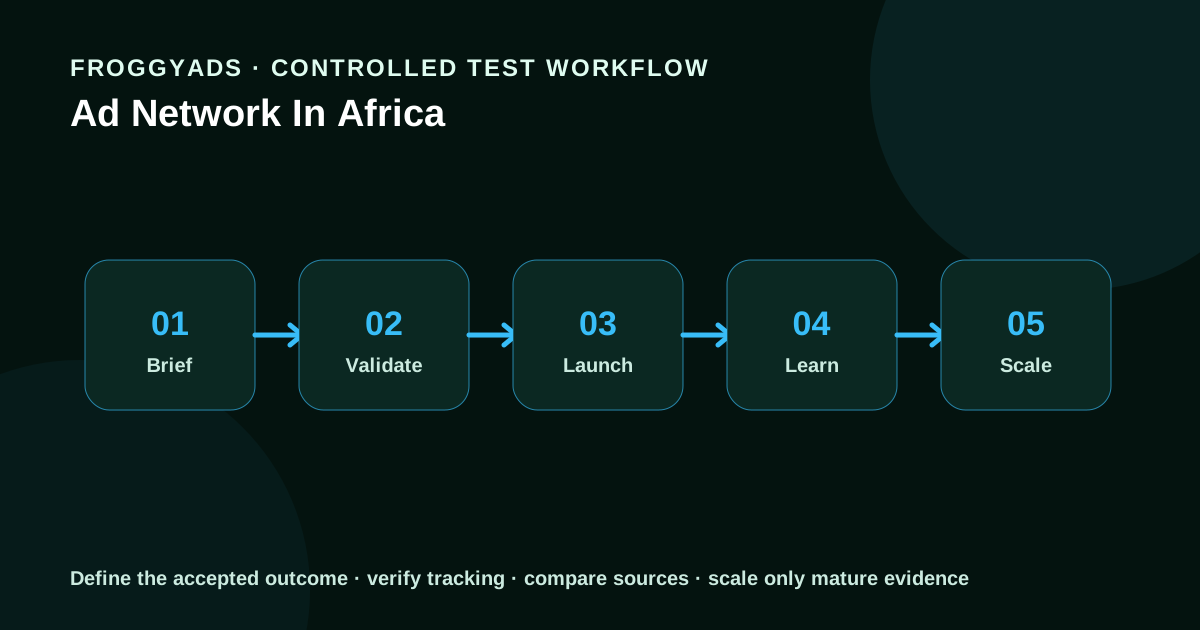
Prepare the first country test: Confirm the customer, supported format, source evidence, production route, accepted event, review window, capacity and rollback. Verify the current controls in your FroggyAds account before the first allocation.
Match campaign controls to customer evidence: Bring one serviceable country route and the mature order, lead or activation your business accepts. We provide self-serve buying controls; your source and customer evidence determine the next allocation.
| Page checkpoint | How to use it | Evidence to retain |
|---|
| Operating capacity | Capacity and rollback | Can the promise survive more volume? |
| Country expansion rule | Cap or expand deliberately. | Retain audience targeting, spend, timestamp/cohort age and accepted/rejected outcomes. |
| Next allocation | Keep the next country test narrow until its customer route, source evidence and accepted outcomes support a larger allocation. Record the limit, review window and condition that returns the campaign to the previous setup. | Document source quality, the decision taken and the rollback or retest condition. |
Transparent Ad Network In Africa decision example
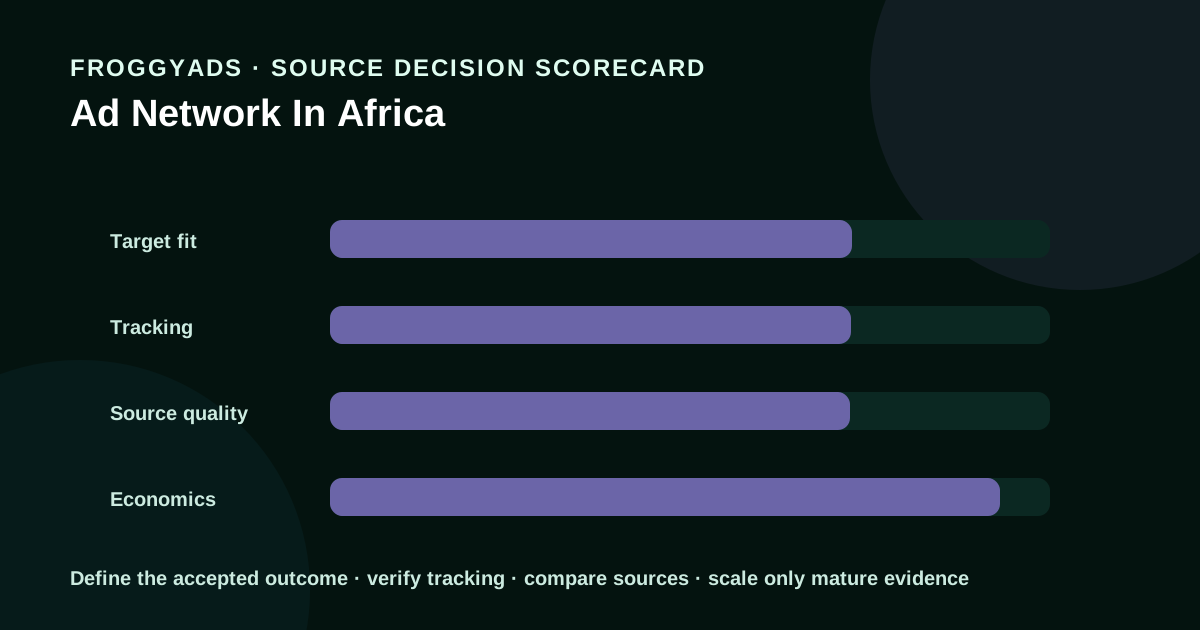
Hypothetical example: A service company chooses one city and country where language, appointment capacity and follow-up ownership are ready. It confirms the planned format and country settings in FroggyAds, releases one message and keeps source evidence visible. The page states the service boundary and response expectation. Submissions receive value only after contact, need and location pass. A source with inexpensive forms but many unsupported areas is repaired or excluded; a source producing fewer reached and accepted appointments can receive more budget. The company adds another country only after a separate language, service and response route passes its own release gate.
Why use FroggyAds here?
Choose FroggyAds for a country test you can configure, measure and improve in stages. Our supported formats, targeting, budgets and source-level reporting help you keep the media decision clear while your team validates the lead, sale or activation. Confirm current country availability in your account, prepare the customer journey and open the first controlled campaign. Create your free FroggyAds account.
Research and product boundaries: ITU’s 2025 regional report provides the dated 2024 connectivity context; it does not measure an advertiser’s available traffic or customer intent. Shopify paid advertising overview explains general paid-media planning, and Google Display targeting guidance covers Google’s own Display controls. Use your FroggyAds account for current country and format settings and your business records for accepted customer outcomes.