
Best Media Buying Platforms
Evaluate media buying platforms by inventory access, workflow, targeting, bidding, reporting, integrations and the effort required to operate them well.
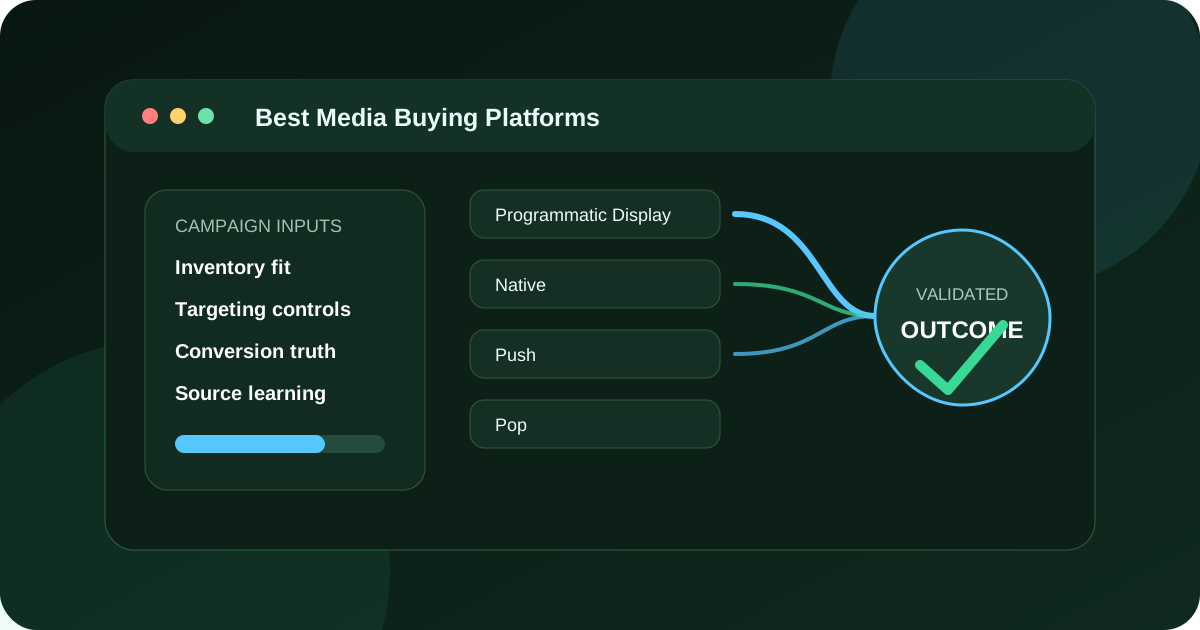
Best Media Buying Platforms at a glance
What does this page explain about Best Media Buying Platforms?
Quick answer: Confirm that the platform can reach search, social, programmatic, open-web and format-specific media inventory accessed through buying interfaces in the GEOs, devices and contexts the campaign actually needs. This fieldbook treats comparison of software and network platforms used to plan, buy and optimize paid media as a practical assignment for agencies, in-house growth teams, affiliates and professional media buyers. A growth team replacing spreadsheet-led campaign management uses a media-buying platform comparison to examine comparison of software and network platforms used to plan, buy and optimize paid media. Buyers comparing media buying platforms should examine access to search, social, programmatic, open-web and format-specific media inventory accessed through buying interfaces.
| Section | Distinct excerpt from this page |
|---|---|
| How to evaluate the best media buying platforms | The key platform decision is whether the platform fits the team’s channels, budget, workflow, data integrations, reporting standards and control needs. |
| What buyers need from media buying platforms | The broader media buying platform guide keeps its existing category role, while related format, audience and buying-model pages continue to answer their own narrower questions. |
| Format fit | Choose among Programmatic Display, Native, Push, Pop according to the message, destination and stage of the user journey. |
Reference for Best Media Buying Platforms: IAB Tech Lab OpenRTB standards.
- Planning: What this guide covers.
- Control: How to evaluate the best media buying platforms.
- Decision: What buyers need from media buying platforms.
What this guide covers
This guide focuses on best media buying platforms for advertisers. It explains the practical criteria, campaign controls, measurement steps and limits that matter before budget is increased. For broader context, continue with Best Ad Network for Digital Marketers: Selection Framework.
How to evaluate the best media buying platforms
The strongest platform decision begins with the business event, not the traffic headline. Buyers evaluating the best media buying platforms should connect search, social, programmatic, open-web and format-specific media inventory accessed through buying interfaces to a specific goal: select a platform that reduces operational friction while preserving control over spend, supply and measurement. The test becomes useful only when delivery can be traced to a scored platform shortlist, implementation plan and test design tied to business events.
The key platform decision is whether the platform fits the team’s channels, budget, workflow, data integrations, reporting standards and control needs. That requires a written test plan, campaign-level tracking, source segmentation and a clear definition of an accepted outcome before the first budget is spent.
The most common mistake is choosing a feature-rich platform that the team cannot operate consistently or connect to reliable conversion data. The same principle applies when the budget begins to scale. Separate campaigns whenever format, GEO, device, landing page, conversion rule or commercial value changes enough to require a different decision.
FroggyAds provides self-serve access to worldwide programmatic supply, six core ad formats and detailed targeting controls where supported. Adscore signals and internal controls help identify invalid or low-quality traffic, while the advertiser remains responsible for creative accuracy, legal eligibility, landing-page quality and downstream conversion validation.
What buyers need from media buying platforms
The query best media buying platforms combines category research with commercial evaluation. Searchers want to understand the buying model, compare platform capabilities and decide whether the channel can help them select a platform that reduces operational friction while preserving control over spend, supply and measurement.
Current result pages often cover software category pages, workflow and dashboard descriptions, feature comparison lists, agency and advertiser use cases, reporting and budget management guidance. This guide adds an advertiser operating model: how to define the outcome, structure the test, validate traffic, optimize sources and scale without losing measurement clarity.
This guide focuses on comparison of software and network platforms used to plan, buy and optimize paid media. The broader media buying platform guide keeps its existing category role, while related format, audience and buying-model pages continue to answer their own narrower questions.
This guide is written for agencies, in-house growth teams, affiliates and professional media buyers. It focuses on search, social, programmatic, open-web and format-specific media inventory accessed through buying interfaces. Those requirements should stay visible throughout the media plan instead of disappearing behind a general promise of reach.
Six questions to ask when evaluating the best media buying platforms
Inventory fit
Confirm that the platform can reach search, social, programmatic, open-web and format-specific media inventory accessed through buying interfaces in the GEOs, devices and contexts the campaign actually needs.
Format fit
Choose among Programmatic Display, Native, Push, Pop according to the message, destination and stage of the user journey.
Targeting control
Inspect country, city, device, OS, browser, carrier, category, audience and source controls where supported.
Measurement depth
Make sure the setup can report launch time, data completeness, accepted outcome cost and the final accepted event.
Quality controls
Use traffic-quality signals, click caps, exclusions, blacklists, whitelists and post-click validation together.
Operating fit
Check minimum funding, approval workflow, reporting speed, support access and the effort needed to manage campaigns.
Turn platform claims into testable requirements
| Area | Requirement | What to verify |
|---|---|---|
| Business outcome | a scored platform shortlist, implementation plan and test design tied to business events | Write the accepted event and rejection rules before launch. |
| Inventory | search, social, programmatic, open-web and format-specific media inventory accessed through buying interfaces | Confirm market and format availability instead of assuming uniform global supply. |
| Creative | Programmatic Display and Native | Build at least two materially different messages for each format. |
| Destination | comparison of software and network platforms used to plan, buy and optimize paid media | Test page speed, mobile behavior, continuity and event firing. |
| Source controls | Source ID, caps, blacklist and whitelist | Define minimum data and stop thresholds. |
| Decision cadence | operator hours per decision cycle | Review on a schedule that matches conversion delay and event volume. |
A platform comparison becomes useful when every claim is connected to evidence the buyer can inspect.
An eight-step plan for a media-buying platform comparison
Define one accepted outcome
Use a scored platform shortlist, implementation plan and test design tied to business events as the business truth. Document duplicates, invalid events, cancellations or other exclusions.
Verify market and policy fit
Confirm the campaign, creative, landing page and audience are lawful and eligible in every target market.
Separate unlike campaign cells
Split GEOs, devices, formats, landing pages and value tiers whenever they require different bids or decisions.
Install campaign tracking
Use tracking parameters, pixels or server-to-server postbacks and test the complete path before spending.
Launch controlled creative tests
Start with a small set of clearly different concepts across Programmatic Display, Native or another suitable format.
Collect source-level evidence
Compare launch time, data completeness and accepted outcome cost by source, not only in aggregate.
Block waste and isolate promise
Exclude repeatedly weak sources, then move promising sources into dedicated campaigns or whitelists.
Scale in measured steps
Increase budget or bids gradually and watch whether operator hours per decision cycle remains acceptable at the new volume.
Operating a media-buying platform comparison as a measurable decision
This fieldbook treats comparison of software and network platforms used to plan, buy and optimize paid media as a practical assignment for agencies, in-house growth teams, affiliates and professional media buyers. Its purpose is to select a platform that reduces operational friction while preserving control over spend, supply and measurement, while preserving enough evidence to decide whether the campaign should stop, change or receive more budget.
Frame the decision for media buying platforms
Map the daily work before comparing software. The buying team may need campaign creation, bulk editing, creative review, supply discovery, budget pacing, reporting exports and client controls. A platform is valuable when it shortens this actual workflow.
Run the first a media-buying platform comparison
Run a complete operating cycle in every finalist: create a campaign, pass tracking parameters, change a bid, exclude a source, export a report and reconcile spend. A polished demo cannot substitute for this hands-on test.
Collect evidence for media buying platforms
Score time to launch, number of manual steps, reporting granularity, change history, user permissions and the quality of support during a real issue. These operating costs often matter as much as the media price.
Recognize a misleading media buying platform signal
Avoid buying a platform because it supports the largest number of channels on paper. Breadth can add complexity if the team still needs separate tools for attribution, creative production or accepted-conversion validation.
Scale a media-buying platform comparison deliberately
Test whether the platform stays manageable as campaigns, markets and users multiply. Naming rules, bulk controls, API access and account hierarchy become more important after the first successful campaign.
Close the media buying platforms decision
A good media buying platform should improve decisions, not merely centralize buttons. The strongest choice leaves the team with clearer source economics, faster interventions and fewer untraceable changes.
Four operating cases for media buying platforms
Case 1: An agency standardizing client media workflows
An agency standardizing client media workflows uses a media-buying platform comparison to examine comparison of software and network platforms used to plan, buy and optimize paid media. The stated campaign goal is to select a platform that reduces operational friction while preserving control over spend, supply and measurement.
Begin with Programmatic Display; reserve Push for a separate comparison. Mark launch time before interpreting data completeness, and keep the underlying counts beside both rates.
The review asks: whether the platform fits the team’s channels, budget, workflow, data integrations, reporting standards and control needs Pair accepted outcome cost with operator hours per decision cycle, then label the case by source, market, device, creative and destination.
The stop condition addresses choosing a feature-rich platform that the team cannot operate consistently or connect to reliable conversion data. A failed condition ends this test or changes one documented variable before more spend is released.
Case 2: An affiliate consolidating several traffic sources
An affiliate consolidating several traffic sources uses a media-buying platform comparison to examine comparison of software and network platforms used to plan, buy and optimize paid media. The stated campaign goal is to select a platform that reduces operational friction while preserving control over spend, supply and measurement.
Begin with Native; reserve Pop for a separate comparison. Mark launch time before interpreting data completeness, and keep the underlying counts beside both rates.
Case 3: An ecommerce team adding programmatic buying
An ecommerce team adding programmatic buying uses a media-buying platform comparison to examine comparison of software and network platforms used to plan, buy and optimize paid media. The stated campaign goal is to select a platform that reduces operational friction while preserving control over spend, supply and measurement.
Begin with Push; reserve Video for a separate comparison. Mark launch time before interpreting data completeness, and keep the underlying counts beside both rates.
Case 4: A growth team replacing spreadsheet-led campaign management
A growth team replacing spreadsheet-led campaign management uses a media-buying platform comparison to examine comparison of software and network platforms used to plan, buy and optimize paid media. The stated campaign goal is to select a platform that reduces operational friction while preserving control over spend, supply and measurement.
Begin with Pop; reserve Cross-Channel Reporting for a separate comparison. Mark launch time before interpreting data completeness, and keep the underlying counts beside both rates.
The intended record is a scored platform shortlist, implementation plan and test design tied to business events. The decisive question is: whether the platform fits the team’s channels, budget, workflow, data integrations, reporting standards and control needs The review must also account for the central risk of choosing a feature-rich platform that the team cannot operate consistently or connect to reliable conversion data.
Choose formats by user journey, not habit
Programmatic Display
Use programmatic display when its attention pattern, creative requirements and pricing model support select a platform that reduces operational friction while preserving control over spend, supply and measurement. Keep it in a separate campaign cell so its source and conversion behavior remain visible.
Native
Use native when its attention pattern, creative requirements and pricing model support select a platform that reduces operational friction while preserving control over spend, supply and measurement. Keep it in a separate campaign cell so its source and conversion behavior remain visible.
Push
Use push when its attention pattern, creative requirements and pricing model support select a platform that reduces operational friction while preserving control over spend, supply and measurement. Keep it in a separate campaign cell so its source and conversion behavior remain visible.
Pop
Use pop when its attention pattern, creative requirements and pricing model support select a platform that reduces operational friction while preserving control over spend, supply and measurement. Keep it in a separate campaign cell so its source and conversion behavior remain visible.
Video
Use video when its attention pattern, creative requirements and pricing model support select a platform that reduces operational friction while preserving control over spend, supply and measurement. Keep it in a separate campaign cell so its source and conversion behavior remain visible.
Cross-Channel Reporting
Use cross-channel reporting when its attention pattern, creative requirements and pricing model support select a platform that reduces operational friction while preserving control over spend, supply and measurement. Keep it in a separate campaign cell so its source and conversion behavior remain visible.
Metrics that connect media delivery to business value
| Metric | Decision layer | Why it matters |
|---|---|---|
| launch time | Delivery and technical quality | Shows whether purchased traffic reaches a usable destination. |
| data completeness | Intent and experience quality | Separates superficial delivery from meaningful interaction. |
| accepted outcome cost | Conversion quality | Measures whether the source produces the expected user action. |
| operator hours per decision cycle | Commercial decision | Determines whether the result can support more budget. |
| Source-level variance | Optimization risk | Reveals whether blended averages hide winners and losers. |
| Marginal cost at higher spend | Scale quality | Shows how performance changes when the campaign enters additional inventory. |
The final optimization event should match the event the business actually values and accepts.
Build a source learning system
Begin with broad but controlled discovery. Keep Programmatic Display, Native and other formats in separate campaigns, apply reasonable caps and gather enough data to distinguish a repeatable pattern from random noise.
Evaluate sources using the full event ladder. A source can have an attractive launch time and still fail on accepted outcome cost. Another source can look expensive at the click level and become efficient after acceptance or repeat value is included.
For Best Media Buying Platforms, treat this as a page-specific operating check rather than a universal benchmark. Use three states rather than a simple good-or-bad label: discovery, probation and proven. Discovery sources receive limited budget. Probation sources have enough positive evidence to justify a focused test. Proven sources have repeated the result and can receive dedicated bids, budgets or whitelist treatment.
Blacklists protect the budget from repeated waste, while whitelists create controlled scaling surfaces. Neither list should be permanent without review. Publisher behavior, competition, devices, creative fit and conversion performance can change over time.
The practical scale question is whether operator hours per decision cycle remains acceptable as spend increases. Track the marginal result from the new budget, not only the historical average created before scale.
Four ways a media-buying platform comparison can differ
| Scenario | Likely starting format | Primary signal | Structural rule |
|---|---|---|---|
| An Agency Standardizing Client Media Workflows | Programmatic Display | launch time | Use a separate campaign, destination and stop rule. |
| An Affiliate Consolidating Several Traffic Sources | Native | data completeness | Use a separate campaign, destination and stop rule. |
| An Ecommerce Team Adding Programmatic Buying | Push | accepted outcome cost | Use a separate campaign, destination and stop rule. |
| A Growth Team Replacing Spreadsheet-Led Campaign Management | Pop | operator hours per decision cycle | Use a separate campaign, destination and stop rule. |
Each scenario should have its own creative promise, landing experience and decision threshold.
Make the click understandable
Creative for comparison of software and network platforms used to plan, buy and optimize paid media should describe the real next step. The headline, visual and call to action must set expectations the landing page can continue immediately.
For the Best Media Buying Platforms decision, record how this control changes the next test or review. Build creative differences that represent distinct hypotheses. Changing a button color is not a useful strategic test when the real uncertainty is whether the audience responds to price, speed, proof, convenience, education or a different product angle.
Match creative density to the format. A push message must make sense in very little space. Native can introduce a problem and route the user to deeper content. Display needs a clear visual hierarchy. Video requires an early hook and a destination that continues the story.
The landing page should be fast, stable and specific. Remove unnecessary scripts, compress visual assets, reserve image dimensions and keep the primary action visible on common mobile screens. Technical speed supports both user experience and media efficiency.
Run a preflight click from every important device path. Confirm redirects, tracking parameters, consent behavior, form submission, thank-you pages and server-side events. A campaign should not start while the team is still guessing whether the measurement chain works.
Score a platform shortlist before funding the test
| Dimension | Score | Question |
|---|---|---|
| Supply relevance | 0-5 | Does the available inventory match the market, device, context and format? |
| Control | 0-5 | Can the buyer separate, cap, exclude and bid by meaningful dimensions? |
| Measurement | 0-5 | Can delivery be connected to accepted downstream events? |
| Quality visibility | 0-5 | Are source-level and post-click differences visible? |
| Operational fit | 0-5 | Can the team launch, review and change campaigns efficiently? |
| Scale potential | 0-5 | Does performance remain useful as the campaign reaches additional supply? |
A high total score does not replace testing. It simply shows whether the platform has the ingredients required for a fair evaluation.
What a traffic platform cannot decide for the advertiser
For Best Media Buying Platforms, connect this point to the declared conversion path and accepted business outcome for this page. No media buying platform can guarantee traffic quality, conversions, revenue or ranking outcomes. The platform supplies access and controls; the advertiser supplies the offer, creative, destination, tracking and business rules.
Inventory and pricing vary by GEO, device, format, category, time and competition. A result from one campaign cell should not be projected automatically onto another.
FroggyAds can support source-level analysis, but the advertiser must define what counts as an accepted a scored platform shortlist, implementation plan and test design tied to business events and pass reliable events back into the reporting workflow.
When using Best Media Buying Platforms, apply this rule only to the conditions and decision described on this page. Automation can help with bidding and optimization, but it cannot repair a misleading creative, a slow page, an unsupported product or an event that measures the wrong behavior.
A practical shortlist for Best Media Buying Platforms
No network is the universal winner. Use the same GEO, creative standard, conversion event, attribution window and loss limit when comparing platforms. Public terms can change, so confirm current account conditions before funding a test.
| Platform | Entry information | Format position | Best fit |
|---|---|---|---|
| FroggyAds | $50 minimum deposit | Push, Native, Display, Pop, Video and Interstitial | Controlled self-serve testing with source-level reporting |
| PropellerAds | Check current account terms | Strong push and pop reach | Established buyers seeking large performance-network scale |
| RichAds | Check current account terms | Performance formats with optimization tooling | Teams that want advanced automation and can support a larger test |
| ROIads | $250 public minimum cited in its 2026 content | Pop and performance inventory | Teams prepared for a higher initial testing threshold |
| PopAds / PopCash | Small-entry specialist models | Primarily popunder traffic | Buyers who want a pop-only starting point |
Decision rule: shortlist two or three platforms, run matched tests, and compare accepted acquisition cost, source transparency, usable-session rate and downstream value rather than raw click volume. For Best Media Buying Platforms, apply this rule to the page-specific audience, market, format or buying decision described here.
Best Media Buying Platforms FAQ
What campaign brief should screen a media-buying platform shortlist?
Define the offer, markets, formats, audience controls, tracking, source decisions, and accepted outcome the platform must support. The best choice is contextual, not a universal ranking. For Best Media Buying Platforms, connect demand-side platform and supply-side platform to the same accepted business event so performance-focused advertisers can evaluate providers against explicit selection criteria.
What media buying capability deserves the first test?
Test inventory access and source-level reporting for the actual format and market. A long channel list has little value when the needed supply cannot be traced or controlled. With FroggyAds, turn the Best Media Buying Platforms criteria into a bounded paid-traffic test: set the relevant targeting, budget and source controls, verify tracking, and compare accepted outcomes before increasing spend.
Which integrations should a media platform prove?
Run a real click or impression identifier through the tracker, destination, pixel or postback, analytics, and authoritative backend. Check duplicates, values, time zones, attribution, errors, and exports. For Best Media Buying Platforms, test one format or materially different creative path at a time so you can tell whether the message, inventory or audience changed the downstream result.
Which expenses change the real cost of a buying platform?
Count media rates, deposits or minimums, platform fees, creative, tracking, integrations, staff operation, support, data retention, and switching work. Apply one campaign scenario to every candidate. Set a spend guardrail and review window for Best Media Buying Platforms before launch. Keep any funding minimum, the actual campaign price and the learning budget as separate concepts.
What should a useful media-platform pilot prove?
It should prove that a normal operator can launch one eligible offer, control sources, read delivery, apply exclusions, and get help when something fails. Keep markets, formats, roles, and spend limited so each finding can guide the buying decision. For Best Media Buying Platforms, keep demand-side platform, spend, source identity and conversion maturity in the same report so delivery metrics can be reconciled with accepted business value.
Where should control of media accounts and data sit?
The advertiser or agency client should retain billing authority, recovery, pixels, audiences, source lists, campaign history, and usable exports. Operator access should be named and removable. The useful test for Best Media Buying Platforms is whether accepted outcome cost and quality remain workable after enough events have matured, not whether the traffic is simply inexpensive.
Which metrics show everyday platform fit?
Review setup time, delivery control, reporting accuracy, valid traffic, accepted outcomes, source decisions, error recovery, and staff workload. Total volume alone does not show that buyers can act well. For Best Media Buying Platforms, use source-level evidence to decide which traffic segments should stay separate, receive more data or receive a different budget.
What security controls should media buyers inspect?
Check roles, authentication, audit history, billing permissions, API access, data retention, support access, and incident handling. Separate client accounts and restrict high-impact changes. FroggyAds provides traffic access and campaign controls; your validated conversion data remains the evidence for whether Best Media Buying Platforms deserves more budget.
How can media buying platforms be compared fairly?
Give them the same offer, audience, format, destination, event, budget, quality rule, and reporting window. Compare verified supply, control, economics, ownership, and support rather than feature counts. For Best Media Buying Platforms, change one major dimension at a time and keep a documented baseline so you can identify what affected the accepted outcome.
Why use FroggyAds for Best Media Buying Platforms?
The answer depends on the campaign objective, market, measurement setup and accepted outcome for Best Media Buying Platforms. FroggyAds lets you run Best Media Buying Platforms as a controlled advertising test with targeting, budget and source settings, while your own conversion evidence guides the next step. Create your free FroggyAds account.
Use standards, public references and market rules as operating inputs for Best Media Buying Platforms
For Best Media Buying Platforms, use public references to clarify terminology, traffic-quality controls, measurement and advertiser responsibilities; campaign-specific policies, laws, contracts and review requirements still take precedence.
Continue the media plan
Media Buying Platform
Review the established FroggyAds pillar for this topic.
Best Ad Networks for Advertisers
Compare ad networks by inventory, formats, targeting, tracking, traffic controls, minimum funding and the evidence needed before scaling spend.
Best Traffic Sources for Paid Acquisition
Compare paid traffic sources by intent, scale, targeting, creative fit, tracking depth and the post-click evidence required to choose a winner.
Launch a media-buying platform comparison with measurable controls
Choose a format, define the accepted outcome, verify tracking and use source-level evidence to decide what receives more budget.
Best Media Buying Platforms: the decision this URL owns
URL boundary for Best Media Buying Platforms: This URL owns selection criteria for Best Media Buying Platforms: define the requirements that make an option suitable for this use case, then compare evidence against those requirements without turning popularity into proof.
Best Media Buying Platforms should resolve one practical media decision for a programmatic media buyer: evaluate providers against explicit selection criteria. Keep the evaluation tied to this URL rather than borrowing conclusions from a neighboring format or channel.
Decision inputs for Best Media Buying Platforms: demand-side platform, supply-side platform, real-time bidding, ad exchange. Keep these inputs tied to accepted conversion or value event and the page-specific job: evaluate providers against explicit selection criteria.
How to evaluate the best media buying platforms is the action checkpoint for Best Media Buying Platforms. Before acting on “Which integrations should a media platform prove?”, document real-time bidding, the resulting campaign action and the rollback or retest condition.
What this guide covers is the measurement checkpoint for this URL. Resolve “What media buying capability deserves the first test?” while retaining supply-side platform, ad exchange, spend and cohort age so the result can be reconciled with accepted conversion or value event.
Best Media Buying Platforms at a glance is an evidence checkpoint for Best Media Buying Platforms. To answer “What campaign brief should screen a media-buying platform shortlist?”, keep demand-side platform in the same campaign record and use it to evaluate providers against explicit selection criteria.
| Page checkpoint | How to use it | Evidence to retain |
|---|---|---|
| Best Media Buying Platforms at a glance | Use Best Media Buying Platforms at a glance to establish the first evidence boundary for Best Media Buying Platforms; then record which part of inventory path, auction/bid logic, source transparency and downstream value it changes. | Keep demand-side platform, source/campaign ID and the accepted-event definition together. |
| What this guide covers | Use What this guide covers as the second checkpoint and reconcile it with accepted conversion or value event before changing budget or source allocation. | Retain supply-side platform, spend, timestamp/cohort age and accepted/rejected outcomes. |
| How to evaluate the best media buying platforms | Use How to evaluate the best media buying platforms as the final checkpoint: if it does not change the evidence for accepted conversion or value event, keep the test narrow rather than scaling. | Document real-time bidding, the decision taken and the rollback or retest condition. |
Transparent Best Media Buying Platforms decision example
Hypothetical example: For Best Media Buying Platforms, a hypothetical controlled cell that spends USD 220 and records 3 accepted conversion or value event after the same maturity window has an accepted cost of USD 73.33 per outcome. Replace the figures, outcome and review window with your own economics; this is not a FroggyAds performance claim.
Why use FroggyAds here?
When Best Media Buying Platforms calls for a paid-traffic test, use FroggyAds to keep targeting, budget, format and source decisions in one workflow while the advertiser-side system confirms accepted conversion or value event. Create your free FroggyAds account.
Best Media Buying Platforms — what matters first
Best Media Buying Platforms is most useful when it helps a buyer evaluate providers against explicit selection criteria. Define the accepted outcome first, then use targeting, budget and source-level evidence to decide what deserves more spend.