Search intent and buyer decisionChoose the next Latin America market from accepted value
Compare local value with local capacity: Compare mature cost with customer value and capacity. One country may pass economics and need a service cap. Another may require a payment or language repair. Name the resulting action instead of ranking countries by cheap clicks or an unexplained combined CPA.
Limited delivery points to current supply, format, settings, schedule, bid and budget. Delivery without useful response points to placement context or message. Response without completion points to language, offer, page or payment. Completion without acceptance points to eligibility, fulfilment, sales or product use. Write the suspected cause, evidence, responsible owner, proposed correction and rollback. Change one material condition where feasible. Replacing country, language, source, destination and event rule simultaneously makes the next result difficult to interpret.
Keep a country-specific pause rule: Pause a cell when the customer promise is inaccurate or normal capacity is exceeded. Keep immature outcomes in review. Continue independent countries when their dossier, route, measurement and owner remain ready.
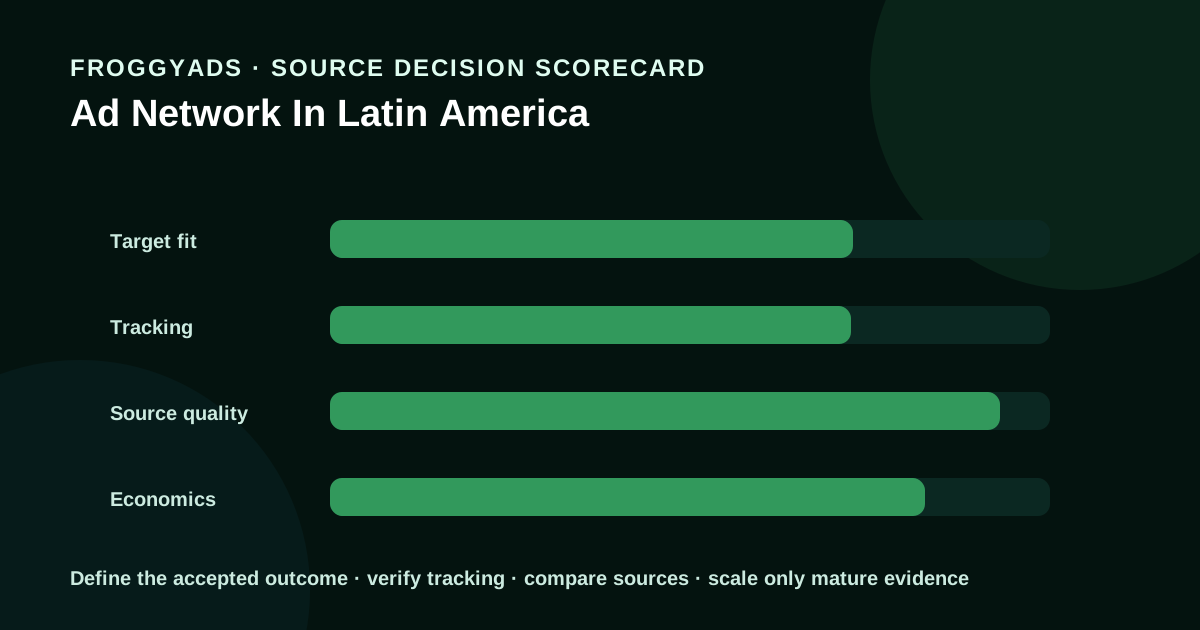
Review the Latin America customer route before changing the paid traffic cell: Score verified country availability, relevant formats, useful controls, budget limits, source evidence, conversion reconciliation, support and operational fit. Require an account observation or documented answer for each score. Do not convert a promotional claim into a verified capability.
Verify mature Latin America customer evidence before the next budget release: Weight the criteria by route. Ecommerce may prioritise device, payment and retained-order evidence. B2B may prioritise scheduling, language and sales acceptance. Apps may prioritise device and activation evidence. Affiliate buyers may prioritise source actions and offer-owner validation.
Choose the setup your first country needs: Choose FroggyAds when our self-serve workflow matches the first country's requirements and live settings confirm the necessary setup. Let a controlled sample earn further allocation rather than promising that one provider is automatically best for every Latin American market.
Close one market before comparing the next: Close the first country with mature value, source actions, operating workload, capacity and unresolved limitations. Then document what changes in the proposed country: customer, language, currency, payment, delivery, service, product, support or acceptance.
Give the next country an independent test: Give the next market its own campaign, destination version, sample and review dates. Preserve the first as evidence of method, not a conversion forecast. Regional ECLAC research can frame questions but cannot approve supply or customer economics.
Write the country expansion decision: Issue a warrant naming the new country, unresolved assumption, budget boundary, owner, stop condition and rollback. This gives expansion a business purpose and prevents country-name substitution from masquerading as localisation.
Archive each market’s operating record: Archive each country's dossier, account observations, campaign settings, creative and destination versions, source actions, accepted-event rule, maturity window, original currency, outcome, workload and capacity. Include the external research used for context with its claim boundary.
Retain uncertainty in the regional report: State unresolved attribution, missing reasons, exceptional manual work and any route that changed during the sample. A regional report should keep those caveats attached to the contributing cell rather than average them away.
Version the next country question: Use the portfolio to choose the next question, not to claim permanent scale. Auction conditions, customer offers and operations change. Version material updates, retain the earlier evidence and let each new country earn admission under its own complete commercial route.
| Page checkpoint | How to use it | Evidence to retain |
|---|
| Close the first-country cohort | Choose source actions after accepted local value matures. | Retain country, source, currency, accepted or pending states and capacity. |
| Authorise a bounded increase | Approve only the next documented budget step. | Retain audience targeting, spend, timestamp/cohort age and accepted/rejected outcomes. |
| Admit another country | Close the regional review by comparing the country dossier with accepted local value. Open another market only when the language, currency, payment route and operating team remain serviceable at the proposed exposure. | Document conversion tracking, the decision taken and the rollback or retest condition. |
Prepare one country campaign with FroggyAds
Prepare one controlled local test: Confirm the customer, language, currency, payment or response path, format role, accepted event and operating capacity. Bring that country dossier to your FroggyAds account and verify the current setup. We provide the self-serve campaign controls and source evidence; your local customer records determine the next market or budget allocation.
Hypothetical first-country retail test before regional expansion
A retailer selects one country where Spanish-language product information, local pricing, payment, delivery, returns and support are released. It confirms current settings in FroggyAds and tests two message cells against one stable destination. Carts and payments diagnose the journey, while only delivered orders retained after the return window receive accepted value. One source is repaired after delivery boundaries create avoidable checkout loss. Another receives a bounded increase because retained orders remain inside the approved local-currency cost and warehouse capacity. A second country waits for its own dossier rather than inheriting the result. This is a hypothetical method, not a forecast. Create your free FroggyAds account.
Research scope and country-level buying guidance: ECLAC’s Marketplace Explorer provides research on B2C platforms and domestic or cross-border visitor flows for its stated period; the official observatory launch establishes its research identity. These sources do not measure FroggyAds supply, customer intent or campaign results. Shopify paid-advertising overview covers general planning, while the Google Ads Display targeting guide describes Google’s own targeting terminology. For a Latin America portfolio, we recommend a country dossier that your media buyer can approve without filling gaps with regional averages. Name the intended customer, working language, transaction currency, destination version, payment or lead route, service boundary and accepted event. A Portuguese ecommerce path in Brazil should keep its checkout, delivery reasons and return window separate from a Spanish-language lead programme in another country. Even two Spanish routes may need different currencies, ordinary wording, contact hours, fulfilment limits or qualification rules. In FroggyAds, use a bounded campaign cell to learn about one ready route, then reconcile delivery with the advertiser-owned order, CRM or product record. Your review should show pending outcomes, reversals and country-specific capacity before another budget step. Agencies can apply the same discipline client by client: preserve the brief, approval owner, source decision and rollback signal for each market. This makes our self-serve controls useful for measured expansion while keeping every commercial claim and local operating promise under the advertiser's evidence. Choose the next country because its complete customer route is ready, not because a regional total looks large.