
Dating Traffic Source
Evaluate a dating traffic source by audience eligibility, formats, source reporting, tracking, destination fit, safeguards and mature campaign economics.
FroggyAds aggregates 20B+ daily impressions across 750+ SSP integrations and 300+ verticals – screened with Adscore-supported traffic-quality controls and available from a single self-serve account.
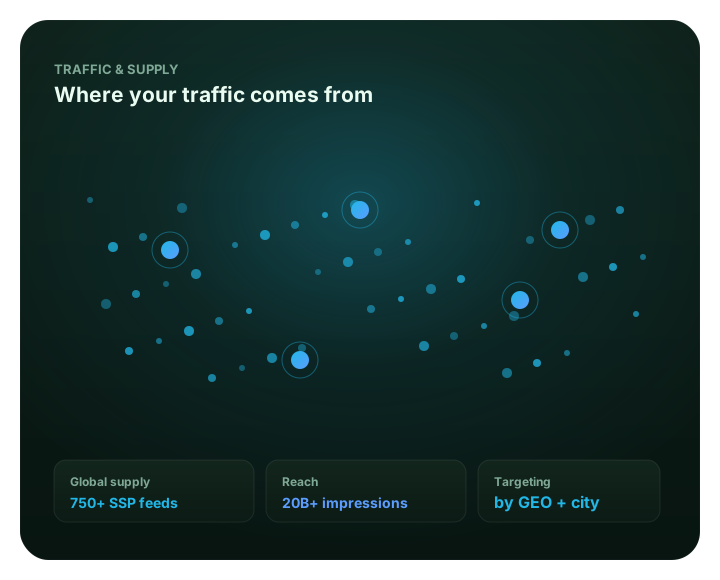
Quick answer: FroggyAds connects advertisers to worldwide paid-media supply through 750+ SSP integrations, with published access to 20B+ daily impressions across 300+ verticals. We combine multiple ad formats, source-level reporting, targeting, conversion tracking and traffic-quality controls in one self-serve workflow. Campaign volume and results still depend on the format, GEO, targeting, bid, budget, policy and live inventory you select.
| Section | Distinct excerpt from this page |
|---|---|
| 750+ SSP integrations | One account taps a vast, vetted pool of supply from every major source – no separate contracts. |
| Truly global reach | Buy traffic across worldwide supply; actual availability depends on GEO, format, targeting, bid and current inventory. |
| Every major format | Use Push, Native, Telegram, Display, Pop, Interstitial and Video from one self-serve workflow, subject to campaign and inventory availability. |
Reference for Global Traffic Sources with Source-Level Control: FTC guidance on online advertising and marketing.
Aggregated supply means more reach and better optimization – without juggling a dozen networks.
One account taps a vast, vetted pool of supply from every major source – no separate contracts.
Buy traffic across worldwide supply; actual availability depends on GEO, format, targeting, bid and current inventory.
Use Push, Native, Telegram, Display, Pop, Interstitial and Video from one self-serve workflow, subject to campaign and inventory availability.
Adscore-supported traffic-quality controls and internal signals help identify and filter invalid or low-quality traffic, while source controls let you act on delivery.
Whitelist and blacklist individual sources and zones to keep budget on quality placements.
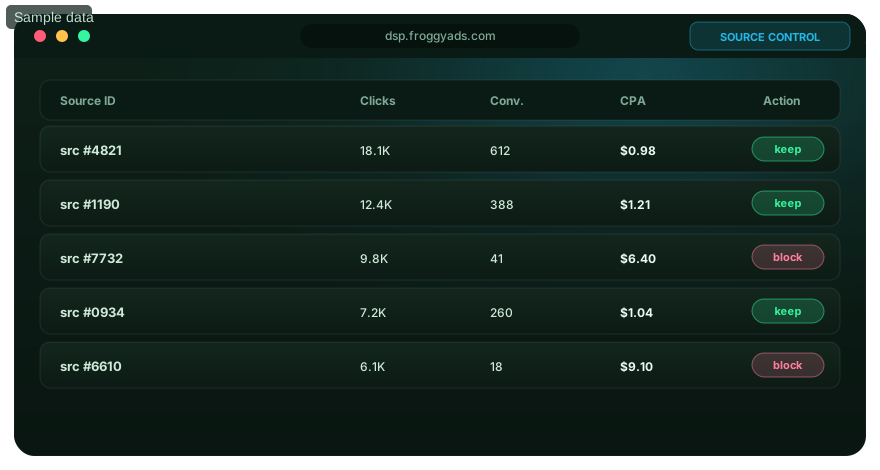
Use source-level reporting to see which exposed supply sources consumed spend and produced downstream outcomes, then apply the available controls.
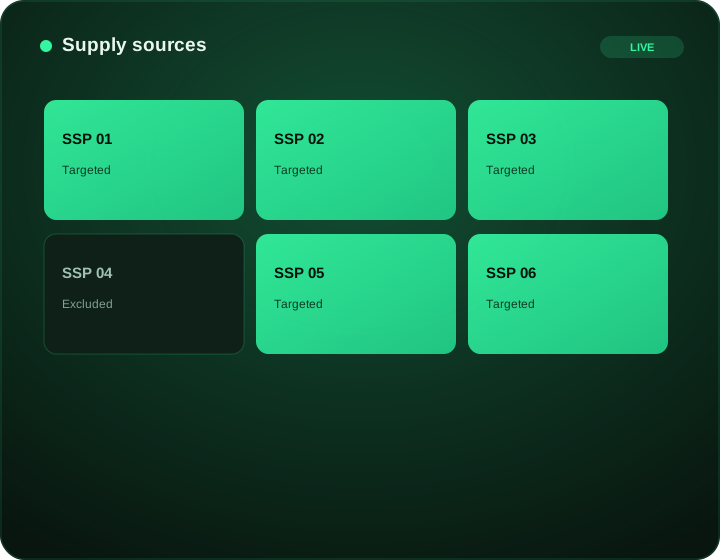
Volume matters only when the traffic can support your business goal. FroggyAds uses Adscore-supported traffic-quality controls and internal signals to help identify and filter invalid or low-quality activity, while source-level controls let you keep, reduce or exclude supply based on measured results.
FroggyAds supports campaign planning across 300+ verticals, including finance, iGaming, nutra, dating, crypto, apps and e-commerce, subject to policy and campaign eligibility.
Create a FroggyAds account, deposit from $50 and reach 20B+ daily impressions across 750+ sources.
FroggyAds aggregates supply from 750+ SSP integrations into a single self-serve account. For an advertiser, that means access to 20B+ daily impressions across 300+ verticals worldwide without the technical and commercial burden of integrating with and managing dozens of supply partners individually. You connect once – to FroggyAds – and the platform handles the plumbing behind the scenes.
That breadth of supply matters for two reasons. First, reach: whatever your GEO, device or vertical, there is inventory available, and higher bids unlock more competitive placements. Second, optimization: because all that supply flows through one account, you get unified, source-level reporting. You can see how each source performs, compare them on the same terms, and move budget toward the ones that convert – the single most important lever in performance buying.
Traffic quality is managed with multiple controls. FroggyAds uses Adscore-supported traffic-quality signals and internal checks to help identify and filter invalid or low-quality activity, while advertisers can use source-level reporting plus whitelist and blacklist controls where supported. The practical advantage is connected supply with self-serve controls and a measurement path that lets you decide which sources deserve more budget.
| Supply attribute | FroggyAds |
|---|---|
| SSP integrations | 750+ |
| Daily impressions | 20B+ |
| Verticals | 300+ |
| Quality | Adscore-supported Traffic-quality signals at the source |
| Control | Source-level whitelist / blacklist |
Choose sources by campaign objective, audience availability, format, market and measurement needs. A source is suitable when its delivery can be separated and evaluated against the same accepted event.
Source-level detail helps an advertiser identify placements that support or weaken the campaign result. It also makes exclusions and follow-up tests more precise than one blended average.
Compare formats under consistent audience and destination conditions, then judge them through the same business event. Impression and click rates have different meanings and should not be ranked as if they were interchangeable.
Confirm that the page matches the ad, works on the intended devices and records the chosen event. Source parameters should survive redirects so the test remains attributable.
Divide the budget into named source or placement cells with an agreed review point. Avoid spreading a small test across so many variables that no cell can support a decision.
Capture campaign, source, placement, creative and device identifiers alongside the approved outcome. Use stable naming so reports from the ad platform and analytics system can be reconciled.
Evaluate readable sessions, destination behavior, accepted events and rejection signals by source. Media cost alone cannot show if the visitor fits the offer or completes a useful action.
Preserve request timing, source IDs, device patterns and downstream event records before escalating a concern. First rule out tagging errors, broken pages and measurement duplication.
Stop the placement when its traceable cost, rejection pattern or downstream quality crosses the written limit. Record the source ID and evidence, then keep it excluded until a controlled review supports another test.
Add budget after accepted results repeat and source mix remains visible at the higher delivery level. Increase one control gradually, then confirm that cost and quality stay within the approved boundary.
Use the primary buy traffic guide to compare formats, targeting controls, starting prices, source-quality checks, budgets and the step-by-step FroggyAds self-serve workflow.
Access 20B+ daily impressions across 750+ SSP sources and 300+ verticals from one connection – Quality signals and source-controllable.
FroggyAds fits the modern media-buying stack – connect your tracking, optimization and reporting and use S2S postbacks, Adscore traffic-quality controls and source-level reporting and controls.
Tracking and measurement wordmarks are shown for integration/compatibility reference. Official brand assets can be supplied by each partner; no ad-network partners are implied.
Use this directory to move from the current hub into the specific market, platform, format or campaign question you need to solve.
88 resources in this directoryExplore focused guides built around distinct target keywords, measurable campaign decisions, source-level controls and quality-aware optimization.
Open a market-specific guide for localization, format selection, source controls, measurement and responsible scaling.
Choose a guide for geographic, audience, device, connection and multi-market campaign control.
Use the FroggyAds comparison library to review formats, funding, targeting, source controls and migration steps for major advertising platforms.
Use focused reviews, competitor shortlists, minimum-deposit guides and CPM planning pages to evaluate branded alternatives with current official sources.
Use focused reviews, competitor shortlists, minimum-deposit guides and CPM planning pages to evaluate branded alternatives with current official sources — Competitor intelligence.
Use focused reviews, competitor shortlists, minimum-deposit guides and CPM planning pages to evaluate branded alternatives with current official sources — Competitor intelligence example 3. For Traffic Sources, apply this rule to the page-specific audience, market, format or buying decision described here.
Use these guides to connect broad traffic delivery with supply-path, inventory and monetization controls.
Plan inventory, whitelists, pricing models and budget decisions with source-level evidence.
Audit source quality, detect suspicious patterns and reduce invalid activity without relying on one signal.
Understand ad networks, traffic sources, Push, Popunder, in-page push and the controls needed for source-level decisions.
Plan source-level tests for in-page Push, Popunder, Banner, Interstitial, Video, Direct Link, Mobile and Desktop traffic.
Connect the paid unit with source transparency, qualified sessions, accepted conversions and contribution margin.
Build realistic test budgets for Push Notification, In-Page Push, Popunder, Native, Banner, Display, Interstitial, Video, Direct Link and Mobile traffic.
Match source context, format, budget and measurement requirements to the audience and business model.
Compare paid traffic sources by vertical fit, policy, tracking, source controls and mature business outcomes.
Use these campaign guides to compare network controls or build vertical-specific ad execution with measurable safeguards.
Use these pages to choose a traffic source, evaluate an advertising network, or plan a controlled vertical campaign with clear eligibility, measurement and stop rules.
Evaluate a dating traffic source by audience eligibility, formats, source reporting, tracking, destination fit, safeguards and mature campaign economics.
Evaluate a casino traffic source by audience eligibility, formats, source reporting, tracking, destination fit, safeguards and mature campaign economics.
Evaluate a gambling traffic source by audience eligibility, formats, source reporting, tracking, destination fit, safeguards and mature campaign economics.
Evaluate a betting traffic source by audience eligibility, formats, source reporting, tracking, destination fit, safeguards and mature campaign economics.
Evaluate a sports betting traffic source by audience eligibility, formats, source reporting, tracking, destination fit, safeguards and mature campaign economi.
Evaluate a igaming traffic source by audience eligibility, formats, source reporting, tracking, destination fit, safeguards and mature campaign economics.
Evaluate a cryptocurrency traffic source by audience eligibility, formats, source reporting, tracking, destination fit, safeguards and mature campaign economi.
Evaluate a bitcoin traffic source by audience eligibility, formats, source reporting, tracking, destination fit, safeguards and mature campaign economics.
These pages separate source selection, campaign strategy and provider evaluation so each search question has a clearly defined focus.
Evaluate a forex traffic source by audience eligibility, formats, source reporting, tracking, destination fit, safeguards and mature campaign economics.
Evaluate a trading traffic source by audience eligibility, formats, source reporting, tracking, destination fit, safeguards and mature campaign economics.
Evaluate a finance traffic source by audience eligibility, formats, source reporting, tracking, destination fit, safeguards and mature campaign economics.
Evaluate a gaming traffic source by audience eligibility, formats, source reporting, tracking, destination fit, safeguards and mature campaign economics.
Evaluate a mobile game traffic source by audience eligibility, formats, source reporting, tracking, destination fit, safeguards and mature campaign economics.
Evaluate a mobile app traffic source by audience eligibility, formats, source reporting, tracking, destination fit, safeguards and mature campaign economics.
Evaluate a sweepstakes traffic source by audience eligibility, formats, source reporting, tracking, destination fit, safeguards and mature campaign economics.
Evaluate a nutra traffic source by audience eligibility, formats, source reporting, tracking, destination fit, safeguards and mature campaign economics.
Evaluate a health traffic source by audience eligibility, formats, source reporting, tracking, destination fit, safeguards and mature campaign economics.
Evaluate a insurance traffic source by audience eligibility, formats, source reporting, tracking, destination fit, safeguards and mature campaign economics.
Evaluate a loans traffic source by audience eligibility, formats, source reporting, tracking, destination fit, safeguards and mature campaign economics.
Evaluate a entertainment traffic source by audience eligibility, formats, source reporting, tracking, destination fit, safeguards and mature campaign economi.
Evaluate a sports traffic source by audience eligibility, formats, source reporting, tracking, destination fit, safeguards and mature campaign economics.
Evaluate a utilities traffic source by audience eligibility, formats, source reporting, tracking, destination fit, safeguards and mature campaign economics.
Evaluate a adult traffic source by audience eligibility, formats, source reporting, tracking, destination fit, safeguards and mature campaign economics.
Use these guides to compare Traffic Source For Affiliates.
Evaluate a traffic source for affiliates by audience eligibility, format fit, source reporting, tracking, destination continuity and mature accepted value.
Use these guides to compare Paid Traffic For Advertisers.
Plan paid traffic for advertisers with audience eligibility, source and format controls, tracking, destination continuity and mature accepted-value decisions.
Use these guides to compare Advertising Platform For Affiliates and Cheap Advertising For Affiliates.
Choose an advertising platform for affiliates using format access, targeting, budget control, tracking, source reporting, support and total learning cost.
Build cheap advertising for affiliates around capped tests, reliable tracking, accepted outcomes, total learning cost and controlled scale or rollback rules.
Build cheap advertising for bloggers around capped tests, reliable tracking, accepted outcomes, total learning cost and controlled scale or rollback rules.
Build cheap advertising for small business around capped tests, reliable tracking, accepted outcomes, total learning cost and controlled scale or rollback ru.
Plan media buying for affiliates with source-level measurement, budget allocation, format and creative tests, accepted outcomes and reversible decisions.
Plan online advertising for affiliates with audience fit, truthful creative, formats, sources, tracking, destination checks and accepted-outcome measurement.
Use self-serve ads for affiliates with direct targeting, format, budget, tracking and source controls plus a measured launch and optimization workflow.
Use self-serve ads for bloggers with direct targeting, format, budget, tracking and source controls plus a measured launch and optimization workflow.
Use these guides to compare Cheap Advertising For Ecommerce Stores.
Build cheap advertising for ecommerce stores around capped tests, reliable tracking, accepted outcomes, total learning cost and controlled scale or rollback.
FroggyAds connects advertisers to worldwide paid-media supply through 750+ SSP integrations and publishes access to 20B+ daily impressions across 300+ verticals. You manage that connected supply from one self-serve account instead of negotiating separate integrations for every source. Actual availability still depends on the GEO, format, targeting, bid, policy and inventory available to the campaign you create.
One connection can reduce duplicated setup, reporting and source-management work when you want to test multiple supply paths under the same measurement rules. With FroggyAds, your campaign setup, targeting, budgets, conversion tracking and source-level decisions stay in one workflow. That does not make every source identical; it makes the differences easier to measure and act on without maintaining a separate operating process for each supplier.
Our published format set includes Push, Native, Telegram, Display, Pop, Interstitial and Video. Each format creates a different user context, billing model and creative requirement, so choose the one that fits the offer and landing path rather than treating all traffic as interchangeable. Availability and buying conditions depend on the campaign and current supply.
Source IDs let you connect delivery and conversions to the individual supply sources exposed in campaign reporting. Use them to identify repeat patterns, compare cost per accepted outcome and decide where to keep, reduce, exclude or retest spend. FroggyAds source controls are valuable because you can act on one weak or strong source without judging the whole campaign from a blended average.
FroggyAds uses Adscore-supported traffic-quality controls and internal signals to help identify and filter invalid or low-quality traffic. No screening system can guarantee that every interaction is valid or commercially valuable, so combine those controls with your own conversion tracking, source-level behavior and backend acceptance data. Quality decisions are strongest when technical signals and business outcomes agree.
No. The 20B+ figure describes platform-level daily supply, not a forecast for one advertiser. Your reachable volume depends on format, GEO, device, targeting, bid, budget, policy and live inventory. Use the published scale to understand the size of the connected ecosystem, then judge your own campaign from actual eligible delivery and source-level results.
Start with hard eligibility: where the offer can be sold, which devices and operating systems can use the destination, and any policy or language constraints. Then add narrower controls only when they answer a campaign question. FroggyAds supports targeting such as GEO, city, device, OS, browser, carrier, category and source settings where available, so you can isolate meaningful differences without fragmenting the test unnecessarily.
No. The $50 minimum deposit is the account-funding threshold. Your campaign budget is the amount you choose to allocate to a specific test, and the actual media cost depends on the format, bid and traffic you buy. Keep the deposit, starting bid and test budget separate so a funding minimum is not mistaken for a guaranteed amount of traffic or a recommended campaign size.
Define the accepted business event first, preserve campaign and source identifiers, and test the landing page plus conversion path before meaningful spend starts. FroggyAds supports conversion tracking and server-to-server postbacks, so you can compare source delivery with accepted sales, leads, registrations or other downstream outcomes. A working tracking chain is what turns connected supply into something you can optimize.
Whitelist a source after mature results repeatedly meet your conversion and quality rule, blacklist when reliable evidence shows a specific source repeatedly fails that rule, and keep uncertain sources in controlled discovery. When scaling, change one major lever at a time and read the marginal result. FroggyAds gives you source-level controls so discovery and scale can remain separate, reversible decisions.
Use this page when advertisers and media buyers are deciding whether this traffic source deserves budget for Global paid traffic sources with source-level control.. The source decision should combine GEO/device fit, source identity and destination continuity; cheap visits alone do not establish useful traffic. Keep this URL focused on that decision; use Best Traffic Sources for the adjacent task.
Decision inputs for Global paid traffic sources with source-level control.: conversion tracking, source evidence and accepted business value. On this URL, use those inputs to make a concrete, measurable buying decision and keep each one tied to the same accepted-event definition.
Page-specific evidence path: Use the visible sections Global paid traffic sources with source-level control. as evidence for Global paid traffic sources with source-level control.. They should answer the page's own buying question before budget is increased; they are not interchangeable with the neighboring URL or with a generic traffic checklist.
What makes this URL distinct: A traffic-source comparison should put different supply paths on the same measurement basis. Define the accepted event, attribution window, GEO/device constraints and test-loss limit first; then compare sources using identifiers that survive into downstream reporting. Do not merge sources simply because they use the same ad format or buying model.
| Checkpoint | Page-specific action | Evidence to retain |
|---|---|---|
| Eligibility | Confirm source fit and downstream value before opening the source to meaningful spend. | Offer rules, GEO/device constraints and destination version. |
| Source identity | Keep source or placement identifiers intact through the conversion window. | Source ID, creative/format, timestamps and spend. |
| Downstream quality | Judge the source on the accepted event: accepted conversion. | Accepted/rejected outcomes, maturation window and cost per accepted event. |
Hypothetical example: For Global paid traffic sources with source-level control., if a controlled test spends USD 225 and records 4 accepted outcomes after the same review window, accepted cost is USD 56.25 per outcome. Replace the inputs with your own economics and the event definition appropriate to this page.
For Global paid traffic sources with source-level control., use FroggyAds to isolate the relevant source, GEO/device path and budget cell, then keep or restrict it from mature downstream evidence rather than click volume. Create your free FroggyAds account.
Paid traffic sources through one connection is most useful when it helps a buyer make a concrete, measurable buying decision. Define the accepted outcome first, then use targeting, budget and source-level evidence to decide what deserves more spend.
Use these pages to compare service models, cost-efficient tests, platform requirements and 2026 operating plans before choosing traffic.