
A practical campaign budgeting guide.
How much should you spend to test, and when do you scale? This guide shows a sensible budgeting approach for FroggyAds campaigns – from first test to confident scale.
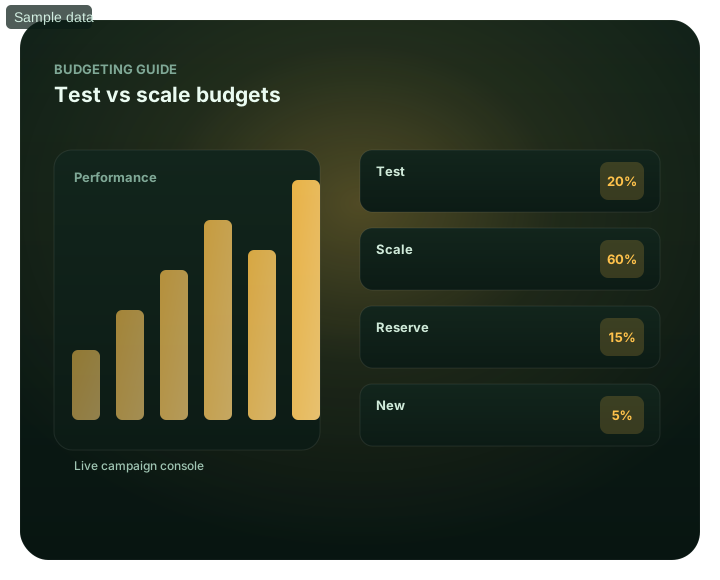
A practical campaign budgeting guide: at a glance
What does this page explain about Campaign Budgeting Guide - Step-by-Step Guide?
Quick answer: Set a campaign budget from the amount you can afford to test, the conversion you need to measure and the time it takes that conversion to become reliable. Keep account funding, media spend and production costs separate. With FroggyAds, use campaign limits and source-level results to decide where to keep spending, where to pause and when a larger test is justified.
| Section | Distinct excerpt from this page |
|---|---|
| Spend to learn, then spend to scale | Test money has one job: to buy data across enough sources that you can tell winners from losers. |
| Budget to learn | A test budget exists to gather data across sources, not to be profitable on day one. |
| Read before scaling | Only commit scale budget once the data shows which sources convert. |
Reference for Campaign Budgeting Guide - Step-by-Step Guide: FTC guidance on online advertising and marketing.
- Planning: Spend to learn, then spend to scale.
- Control: See campaign budgeting inside the platform.
- Decision: Separate test money from scale money.
Ready to turn A practical campaign budgeting guide. into a measurable traffic test?
Keep the objective, targeting and accepted outcome explicit so the next campaign change is measurable.
Spend to learn, then spend to scale
A useful test budget pays for a decision: whether an offer, message and audience can produce worthwhile conversions. Decide what you need to learn before allocating the money. A profitable first test is welcome, but the plan should also explain how much you will spend before changing an unsuccessful approach. Reserve the larger allocation for combinations that continue to work after the initial results have been checked.
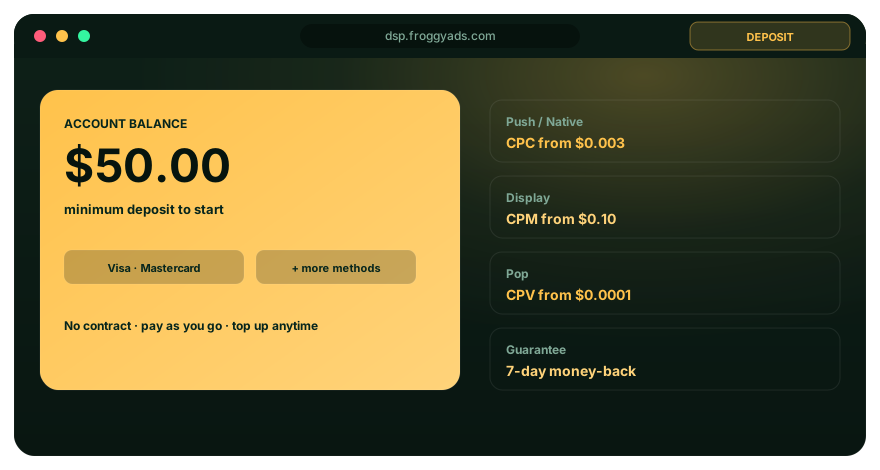
Fund your FroggyAds account from the published $50 minimum, then assign a separate budget to the campaign. Choose a focused market and format, verify tracking and compare results by source. Use exclusions or a source whitelist when the evidence supports them, and reassess the additional traffic after any increase. SmartCPC can assist bid decisions; your spending limits and conversion records remain essential to deciding whether the campaign is affordable.
Best for
- Sizing a first test budget
- Knowing when to scale
- Splitting test vs scale spend
- Protecting budget with caps
- Scaling on proven sources
See campaign budgeting inside the platform
Use our self-serve dashboard to connect the budget with the campaign you are actually running. You can manage bids and targeting, examine source-level results and change the allocation when the evidence warrants it. That direct control is especially useful when several offers compete for the same advertising budget: you can evaluate each test instead of treating account spend as one undifferentiated total.
- Sizing a first test budget
- Knowing when to scale
- Splitting test vs scale spend
Separate test money from scale money
They have different jobs and different rules.
Budget to learn
A test budget exists to gather data across sources, not to be profitable on day one.
Read before scaling
Only commit scale budget once the data shows which sources convert.
Scale in steps
Raise budgets gradually on whitelisted winners, not in sudden jumps.
Always cap
Set campaign spending limits and review actual spend. Frequency caps control repeated ad exposure; they do not replace a financial budget.
Budget your campaign
Open an account and start testing from $50.
Use FroggyAds to validate the next A practical campaign budgeting guide. decision
Keep the objective, targeting and accepted outcome explicit so the next campaign change is measurable.
Budgeting FAQ
How do I choose a budget for a FroggyAds campaign?
Start with the amount you can commit to testing one offer and the business result that would justify more spend. Estimate traffic cost, allow for conversion delay and keep creative or tracking expenses separate. Our campaign budget and source controls let you limit the test and refine the allocation. Create your free FroggyAds account to prepare the campaign before deciding how much to fund.
Is my account deposit the same as my advertising budget?
No. Our published $50 minimum deposit funds your FroggyAds account. Your campaign budget is the amount assigned to a campaign, while the bid is the price offered under its buying model. A balance does not need to be spent all at once. Keep a written allocation for each test so a fast-spending campaign does not consume money intended for another offer.
How can I estimate test spend from CPC and conversion rate?
Multiply planned clicks by an assumed average CPC, then calculate several conversion scenarios. For illustration, 1,000 clicks at $0.04 CPC cost $40. A 1% conversion rate would mean ten conversions and $4 media cost per conversion; at 0.5%, five conversions would cost $8 each. These are hypothetical inputs, not FroggyAds prices or promised results. The weaker scenario helps you decide whether the test is affordable.
How do I set a target acquisition cost without confusing revenue and profit?
Work from the amount a completed sale contributes after the variable costs needed to fulfil it, then allow for your required margin and other acquisition expenses. For a lead campaign, consider how often qualified leads become customers. Do not use the full selling price or an unverified lifetime-value forecast as an automatic CPA target. Your FroggyAds source results become useful when compared with an economic limit your business can support.
Should I divide my test budget equally across countries and formats?
Not automatically. Give each active test enough budget to answer a specific question, and avoid launching more combinations than you can evaluate. Different formats need different creative and may have different buying units. We recommend starting with the most relevant market and format for your offer, then reserving a separate allocation for the next comparison rather than spreading a small balance across many unfinished tests.
How should I choose a daily campaign budget?
Choose a daily allocation that gives you time to review delivery before the full test budget is used. Consider when your audience can respond and how long conversions normally take to appear. Check the schedule and time zone used by your account. With FroggyAds, review spending and source results together; reaching a daily limit is a reason to inspect the campaign, not an automatic reason to increase it.
Does a frequency cap replace a spending limit?
No. A frequency cap controls repeated ad exposure under the campaign's available settings. A spending limit controls the budget assigned to delivery. An ad can reach many different users even with a low frequency cap, so the two controls serve different purposes. Use the appropriate campaign budget settings for financial planning and frequency settings for the visitor experience, then review how the campaign actually delivers.
How should affiliate marketers budget around delayed commissions?
Separate reported conversions from approved commissions and money already available to reinvest. An affiliate program may validate or pay conversions after you have paid for the traffic. Plan enough cash for that gap, and account for rejected or reversed commissions using your own program data. We recommend expanding FroggyAds traffic from a budget you can sustain, not from revenue that is still awaiting approval.
Why should I hold back part of the campaign budget?
A reserve lets you respond to what the first test reveals. You may need a clearer headline, a faster landing page, a tracking repair or another source comparison before additional traffic is useful. The right reserve depends on work you have already completed; there is no universal percentage. Name the purpose of the reserve so it does not quietly become extra media spend without a buying decision.
When should I increase or reduce a campaign budget?
Increase it when verified conversions repeatedly meet your cost and quality requirements. Reduce or pause spending when tracking fails, the offer becomes unavailable or sufficiently mature results cross your planned loss limit. Use our source controls to distinguish a weak traffic segment from the rest of the campaign. After an increase, compare the additional spend with the additional results instead of relying only on the old average.
Plan your budget
Create your account and test then scale across 20B+ daily impressions.
Take the next A practical campaign budgeting guide. step with controlled media buying
Keep the objective, targeting and accepted outcome explicit so the next campaign change is measurable.
Seasonal advertising and Q4 planning guides
Prepare testing, pacing, creative and fulfillment before time-sensitive demand peaks.
Estimate media cost by format
Connect CPC, CPM or other billable events with landing completion, accepted conversions and marginal value.
Turn a campaign budget into a sequence of testable decisions
A media budget should answer more than the question of how much can be spent. It should define what the advertiser needs to learn before the next amount is released. Begin with the accepted conversion event, an estimated target cost or value boundary, and the traffic dimensions that could materially change performance. FroggyAds has a $50 minimum deposit, while a larger test budget is often more useful when the advertiser needs enough observations to compare sources, creatives or audience segments. The right amount depends on the offer, conversion rate, market and format, so treat any suggested starting range as planning guidance rather than a guarantee of results.
Separate the budget into stages. The first stage verifies delivery, landing-page behavior and tracking with limited exposure. The second collects enough settled outcomes to identify obvious source or targeting differences. The third is reserved for scaling combinations that continue to meet the written business rule. This structure prevents an early technical mistake from consuming the full allocation and gives the buyer a clear reason for every increase. FroggyAds provides campaign budgets, source controls and targeting so you can define what each stage is meant to test and review the results before allocating more money.
Build stop rules before launch. A stop rule might use maximum spend without an accepted event, a source-level cost boundary, an eligibility failure, or a technical condition such as a broken conversion callback. Use a threshold large enough to avoid reacting to random short-term variation but small enough to protect the account from an obviously failing path. Apply the same discipline to winners: define what evidence is required before budget can increase, and raise spend in measured steps rather than moving from a small test to unrestricted delivery. That makes the scaling decision reversible if the next traffic layer performs differently.
Budget pacing also affects what the test can teach. If a daily cap is so low that the campaign samples only a narrow slice of available traffic, the buyer may draw conclusions from an unrepresentative period. If it is too high, the campaign can spend through several untested sources before the first conversion data settles. Match pacing to the expected conversion delay and review cadence. Keep major creative, landing-page and targeting changes dated so a shift in cost is not incorrectly attributed to the budget itself.
Finally, compare budget decisions with the downstream economics that matter to the business. CPC or CPM describes media cost, not profitability by itself. Track accepted conversions, qualification, revenue or another suitable value signal alongside spend. FroggyAds offers multiple formats and broad supply, which gives advertisers room to test different buying approaches, but every expansion should still pass the same commercial rule. A strong budgeting process therefore works like a gate: verify, learn, scale and recheck. The budget becomes a tool for controlled discovery rather than a single number the campaign is expected to spend regardless of evidence.
Keep a contingency reserve outside the active campaign allocation. That reserve can fund a retest after a tracking correction, a new creative concept after fatigue, or a controlled expansion into a promising source or market. Without a reserve, the account may spend the entire budget proving what failed and have nothing left to validate the fix. Do not automatically deploy the reserve because the calendar period is ending. Release it only when the next test has a written hypothesis and a measurable success boundary. This keeps budget pressure from turning into undisciplined spending and gives the media buyer room to act when useful evidence appears late in the test.
Reforecast the remaining budget after every material decision. Subtract committed spend, reserve money required for already approved tests, and any amount that must remain available for measurement delay. Then decide whether the next stage can still collect enough evidence to answer its question. If not, narrow the scope instead of spreading a small remainder across too many sources or creatives. A smaller test with a clear decision rule is usually more informative than a fragmented campaign that cannot accumulate enough data anywhere.
Review the budget in business units as well as media units. Translate planned spend into the number of accepted conversions, qualified leads, registrations or other outcomes required for the test to make economic sense. That comparison exposes unrealistic assumptions early. If the campaign would need an implausible conversion rate to hit the target, change the offer, destination, targeting or test scope before simply adding more money. Budget discipline is strongest when spend limits and outcome requirements are written together.
A practical campaign budgeting guide.: what should the advertiser decide next?
Write the budget brief in amounts your team can act on: the total available for acquisition, the portion assigned to media, the reserve and the maximum cost of a qualified conversion. Add the normal conversion delay and the person responsible for changing the campaign. This keeps a discussion about a cheap click separate from the decision to commit more money. A low unit price can still require an expensive test when the offer converts infrequently.
Match the budget review to the business model. An affiliate buyer needs to compare traffic spend with approved commissions and payment timing. A webshop should consider the contribution left after product and order costs. A lead-generation team needs a qualification rule and an estimate of how often those leads become customers. FroggyAds supplies the traffic-buying controls; these business definitions tell you which results deserve a larger allocation.
| Decision | What to verify | FroggyAds action |
|---|---|---|
| Account funding | Available balance and payment status, separate from expected income that has not been received. | Assign a budget to each campaign instead of treating the account balance as a spending target. |
| Initial media test | The offer, buying model and amount you can evaluate before another commitment. | Set the campaign budget and bid, and keep the first targeting combination easy to interpret. |
| Qualified results | Which leads or purchases count, and when those results are complete enough to judge. | Compare source spend against the same conversion definition and reporting period. |
| Working reserve | Money needed for creative changes, tracking work or another test. | Keep the reserve outside the active campaign allocation until its purpose is approved. |
| Expansion | The cost and quality of additional traffic, not only the earlier campaign average. | Change one major setting and review the extra spend before funding the next stage. |
A page-specific FroggyAds test sequence for A practical campaign budgeting guide.
- Define the conversion: decide whether the budget is meant to acquire approved affiliate conversions, qualified leads or completed purchases. Set an affordable acquisition cost from your own business economics.
- Separate the costs: list media, creative, landing-page work, tracking and reserve funds. Confirm the available balance without treating the entire deposit as a campaign spending instruction.
- Forecast more than one outcome: calculate how lower conversion rates or higher traffic prices would change the test. Reduce the number of simultaneous tests when the budget cannot support a useful comparison.
- Check the first delivery: verify tracking and the visitor journey before relying on campaign performance. Compare spend and qualified results by source after allowing for normal conversion delay.
- Approve the next allocation: record the evidence behind a budget increase, reduction or pause. Review the results bought by the additional money separately from the original test.
Why FroggyAds is relevant to A practical campaign budgeting guide.
Choose FroggyAds when you want to manage the traffic-buying decision yourself rather than purchase an unexplained visitor package. Our campaign budgets, bids, targeting and source controls let you structure an initial test and act on the results. Use SmartCPC as part of the bidding workflow and Adscore-supported screening as part of traffic-quality management, while your conversion and business records show whether the spend is creating qualified demand.
Before expanding, identify what the next allocation will test: more traffic from the same sources, another creative concept or a separate market. Keep a record of the current configuration and results. A documented change makes it easier to see whether extra spending improved the business outcome or simply increased activity. When the result weakens, investigate the changed portion before altering the parts that were already working.
How to tell whether A practical campaign budgeting guide. is working
Review the budget in both cash and performance terms. The account balance shows funding available for advertising; campaign spend shows what has been used; cost per qualified conversion shows what that spend produced. Keep the reporting dates, currency and conversion definition visible beside each figure. These numbers answer different questions and should not be treated as interchangeable measures of success.
Reconcile A practical campaign budgeting guide. on one evidence window
Compare FroggyAds spend with your tracker and business records for matching dates. Check the time zone, currency, attribution window and the difference between submitted and approved conversions before concluding that one report is wrong. Recent traffic may still produce later conversions. Keep that incomplete period separate from settled results so a reporting delay does not trigger an unnecessary budget cut or a premature increase.
Diagnose the smallest failing layer in A practical campaign budgeting guide.
When delivery is low, inspect campaign status, available balance, scheduling, targeting and the bid. When paid visitors arrive but do not act, test the destination on the targeted device and compare the ad promise with the offer. When forms are submitted but few leads qualify, review the qualification criteria and source mix. Increasing the budget does not repair a broken checkout or make an ineligible audience suitable for the offer.
Set the next A practical campaign budgeting guide. scale and stop rule
Choose the next action from the evidence: continue unchanged while conversions mature, reduce exposure to a weak source, repair the destination or increase a promising allocation. State how much additional spending is permitted and when it will be reviewed. With FroggyAds, keeping the source and campaign decisions separate helps you protect useful traffic while correcting the part of the test that is not meeting the objective.
How to use this A practical campaign budgeting guide page
This URL has one primary job for performance-focused advertisers: follow a practical setup and optimization sequence. Keep this page focused on that buying decision instead of turning it into a generic advertising article. The nearest related FroggyAds page is X Ad Campaign; use that URL when its narrower task is the one you actually need.
Build a conservative forecast as well as your expected one. Lower the assumed conversion rate, allow for a higher traffic price and account for lead rejection or refunds where they affect the business. Then ask whether the same budget would still produce enough information to guide a decision. This is a planning exercise using your assumptions, not a platform forecast or a promise that every test will pay for itself.
| Spend period | Hypothetical calculation | Media cost per qualified lead |
|---|---|---|
| Initial test | USD 100 divided by 6 qualified leads | USD 16.67 |
| Additional spend | USD 80 divided by 3 additional qualified leads | USD 26.67 |
| Combined report | USD 180 divided by 9 qualified leads | USD 20.00 |
Transparent A practical campaign budgeting guide decision example
Hypothetical example: the table above separates an initial USD 100 test with six qualified leads from an additional USD 80 that produces three more. The additional leads cost USD 26.67 each, not the blended USD 20.00. A campaign average alone would hide the higher cost of expansion. Whether that increase is worthwhile depends on the value of a qualified lead to your business; these figures are illustrative, not FroggyAds results.
Use FroggyAds as the execution layer only when the page's decision calls for paid traffic. Set the relevant budget, targeting and format controls, verify conversion tracking, keep source-level evidence, and increase spend only when the accepted outcome supports the next step. Create your free FroggyAds account. In the Campaign Budgeting Guide workflow, treat this as evidence for the page-specific task to follow a practical setup and optimization sequence, not as a reusable conclusion for another URL.
Campaign Budgeting Guide transparent campaign example
Hypothetical example: an advertiser has USD 600 available for a complete experiment. Reserving USD 120 for creative, USD 60 for tracking work and USD 60 for another test leaves USD 360 for media. Those amounts are example allocations, not FroggyAds fees or a recommended universal split. An advertiser with completed creative and tracking may allocate the same total differently. Keep these non-media costs outside the campaign bid when calculating what the entire experiment costs.
A practical campaign budgeting guide — what matters first
Plan the campaign around a conversion your business values, separate media from other acquisition costs and set a spending limit before launch. Our $50 minimum deposit is account funding, not the ideal budget for every test. Use FroggyAds source reports and your own qualified-conversion data to decide whether to repair, continue or expand the campaign.