Advertising Network Middle East
The right advertising network middle east is the platform that can serve the actual countries and formats you need while providing source-level reporting, practical targeting, reliable tracking and budget control. Compare networks with the same offer, landing page and measurement window, then judge accepted conversions and contribution margin rather than headline reach alone.
Reviewed and materially updated 2026-07-15. Pricing, inventory and outcomes vary by campaign.
Middle Eastern network planning starts with a country eligibility roster
List the countries and cities where the advertiser can lawfully and operationally offer the product or service, then name the destination, responsible seller and fulfilment route. Arabic, English, payment, delivery and support conditions vary. A regional network selector should not create access to a customer journey the business has not reviewed.
Separate country contracts before constructing a regional summary. Each identifies offer eligibility, language, service area, response owner and accepted outcome. A cross-border route must explain seller, delivery and returns. When a country cannot be supported, exclude it explicitly instead of relying on a generic page to reveal the restriction after conversion.
Language should agree with the country, audience and service operation
Review Arabic directionality, typography, terminology, examples, fields, validation and confirmation for the intended country and device. English can fit a defined audience only when the destination and customer team can continue it. Do not infer that one Arabic version suits every country; commercial meaning and expectations still require local review.
Keep language cohorts connected to country, placement and accepted customer progression. A response difference may reflect supply or service capacity. Repeated questions about availability, seller, payment or next steps belong in the content review. Prefer a precise local route over a regional phrase that attracts interest by avoiding conditions.
| Portfolio contract | Country-level evidence | Regional summary use | Stop condition |
|---|---|---|---|
| Offer eligibility | Product, seller, service geography and fulfilment | Permits only national routes with completed commercial contracts | Commercial route is unavailable or unclear |
| Language continuity | Reviewed Arabic or English journey and response | Groups only supported language routes | Meaning or service changes after click |
| Supply provenance | National publisher environment, declared selling chain, unit type, screen context and observation time | Reveals partner coverage by accountable route | The assigned partner cannot trace the country-specific seller route |
| Accepted outcome | Maturity, exclusions and customer progression | Allows explicit portfolio comparison | Proxy traffic replaces national value |
Inspect the inventory behind regional reach claims
Request placements by country, format and device. Capture page or app purpose, seller relationship, advertising density, language context and time. Arabic content does not prove location, and location does not prove suitability. A partner should be able to connect sampled delivery to the seller and controls available to the advertiser.
Avoid uncontrolled overlap between networks. If several partners buy the same uncertain pool, frequency and provenance become difficult to interpret. Assign country, format or publisher roles and preserve cohort identifiers. A network can pass in one country and remain paused in another without forcing a regional verdict.
Record the current national rule and actual data movement for each live route
Use regional sources only as context. Qualified owners must review current national requirements, contracts and the actual systems. Map collection, identifiers, purposes, parties, storage, transfers, access, retention and rights handling by country. A source marked NOT_VERIFIED supports no current claim and must not be used to imply approval.
Return privacy-minimal customer outcomes to media. Country, supply cohort, accepted status, maturity and controlled rejection can support allocation without exporting detailed customer records. Audience uploads or identity matching require separate purpose and review in each relevant route, not regional inheritance.
| Layer | Owner | Question answered | Cannot establish |
|---|---|---|---|
| Country commercial file | Local operations | Can the business honour the public route? | Publisher provenance |
| Network supply file | Media and partner | Which seller and placement delivered? | Customer eligibility |
| Governance record | Qualified national reviewers | Was the real information path assessed? | Automatic regional permission |
| Mature result | Sales, fulfilment and finance | Did the national operation record its specified mature commercial state? | A universal region forecast |
Use sufficient maturity rather than thin regional distribution
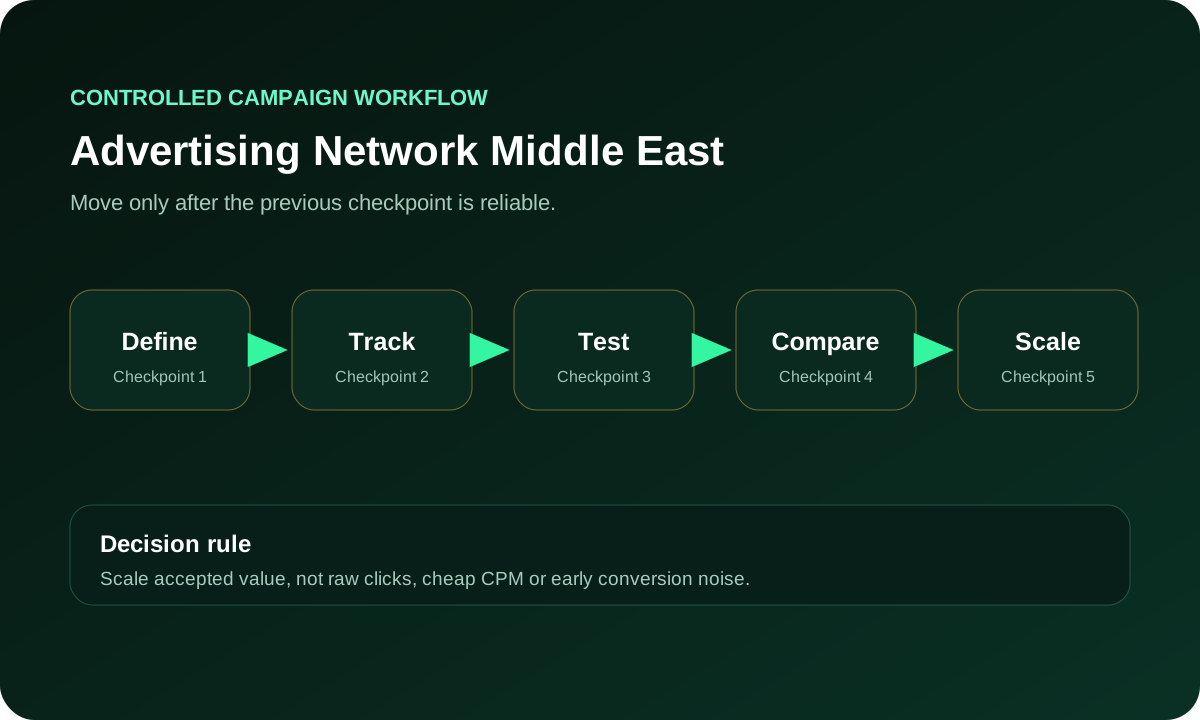
Choose a small set of serviceable country routes with valid language, destination and support. Give each opening country cell its own partner assignment, loss boundary and locally realistic customer-maturity period. The pilot should show whether causes can be separated. A thin budget across every available country creates immature evidence and invites conclusions from regional totals.
New countries or supply roles begin separate cohorts. Archive the completed national cohort and attach later capacity events only to the country operation they affected. A Middle East portfolio cost record retains its named country, account, seller pool and observation window instead of claiming a regional benchmark. When an operating route fails, repair or pause it before expanding network delivery.
A Middle Eastern partner roster should define where each network is trusted
Compare country precision, Arabic and English support, seller transparency, placement controls, reporting exports, incident handling and escalation. For the Middle East roster, an observed demonstration or signed entitlement is required before a capability enters comparison. Ask each network to trace a real sample and explain the available exclusion.
Assign countries, formats or publisher roles with overlap rules, review owners and replacement conditions. A partner may have different status in different markets. Keep the evidence date. This makes regional planning adaptable without converting a broad reach claim into a permanent endorsement.
Assign Middle Eastern partners only after commercial, language and evidence routes are complete
A regional account review should show which country controls are verified in the intended network account and which appear only in sales material. Mark the latter NOT_VERIFIED. A list of selectable markets cannot enter allocation until the national service, language and reporting contract is complete.
Arabic QA should use country-specific, labelled test journeys that do not enter commercial totals. Check directionality, field behaviour, confirmation and assignment. A shared translation can remain a source asset, but each country route needs an accountable reviewer and a service team able to continue it.
English routes should state the audience task they support. An international business enquiry can differ from a local consumer offer in seller, terms and response. Do not treat English as a regional fallback that silently avoids Arabic support or local fulfilment.
Publisher samples should be collected by assigned country, device and format. Retain the environment, seller path, language context and time. A regional reseller may represent different inventory in each market; its presence does not grant one supply decision to all countries.
Cross-network frequency is limited when partners lack a shared reliable identifier. Assign distinct countries, formats or publisher cohorts to reduce overlap. State the observation boundary instead of adding platform reach estimates and calling the total a unique Middle Eastern audience.
National operational events belong beside country results. Stock, payment, logistics, working hours or product eligibility can change accepted value without any network change. Pause the affected country route and annotate the event before adjusting the regional allocation.
Regional finance may translate account charges under an approved dated method. Preserve original currency and terms so exchange movement stays visible. The internal comparison cannot become a public standard CPM or a claim about what every advertiser will pay.
A country data review identifies fields, purposes, parties, transfers, access, retention and rights handling. Regional context can organise the file but cannot decide national requirements. A source marked NOT_VERIFIED supports no current legal statement and remains a research gap.
Customer outcomes returned to media should be country-tagged and minimal. Accepted state, maturity, supply cohort and controlled rejection may suffice. Identity and detailed notes remain in local authorised systems instead of circulating through a regional advertising stack.
Support should be rehearsed with a placement exception from two dissimilar assigned markets. Record whether the partner can trace sellers and apply country-specific controls. A regional account contact coordinates the case; it does not replace the local commercial owner who confirms customer impact.
A country exit checklist stops delivery, corrects destinations, handles pending enquiries and identifies retained evidence or obligations. Removing a targeting box does not complete customer service or governance work already created by the campaign.
Renewal should verify one approved and one excluded country route after any material account migration. Copied settings can look complete while a language, geography or seller control is missing. Preserve fresh evidence before regional allocation resumes.
The final roster gives every partner named countries and supply roles, collision rules and replacement triggers. Unknown countries stay outside approval even when the partner is accepted elsewhere. Regional status is a summary of national contracts, never an override.
A national customer-maturity window should reflect the actual sales or fulfilment operation. Do not compare an immediate ecommerce outcome with a specialised enquiry before each can reach its accepted state. The regional view labels maturity and preserves the local denominator.
Publisher export retention must last long enough to join supply with that maturity. Where it does not, store an authorised aggregate or narrow the role. Additional personal tracking is not a valid substitute for missing seller evidence.
A payment or product-eligibility change starts a new country release. Link affected Arabic or English content, destination and cohorts to the effective time. This allows later reviewers to distinguish a commercial change from a network change.
A regional incident memo should name affected countries and supply routes. Do not pause every market when one seller or integration fails unless evidence shows the scope is broader. National assignments make precise containment possible.
The roster records unknown markets separately from failed ones. Both remain outside allocation, but an unobserved country needs evidence while a failed route needs correction. A blended regional score would erase this operational difference.
A regional approval never replaces the national owner's ability to stop delivery immediately when eligibility or service changes.
Answers for a Middle East network portfolio
Can the Middle East be targeted as one network market?
Use it as a portfolio label only. Delivery requires country-specific offer, language, supply, governance and outcome records.
Does one Arabic version fit every country?
No. Review language, commercial meaning, fields, confirmation and follow-up for each intended route.
When can English be used?
Use it for a defined audience only when the entire destination and response operation can support the same promise.
What supply evidence is needed?
Keep publisher or app context, seller relationship, format, device, country scope, time and available controls.
Do regional sources approve national programmes?
No. Current requirements and the actual data flow need qualified country-level review.
How should multiple networks be assigned?
Give partners explicit countries, formats or publisher roles and retain overlap identifiers and exclusions.
Can a pilot establish a regional CPM?
No. Auction observations are specific to country, supply, format, account and time.
Which national evidence failures close a Middle Eastern partner cell?
Unsupported offer, broken language, unexplained supply, unreviewed data use or repeated mature customer failure.
How should regional results be reported?
Show included countries, maturity, exclusions and weighting, while preserving national records beneath the summary.
What can FroggyAds substantiate?
FroggyAds can evidence its delivery settings and reporting. National eligibility, language, governance and fulfilment remain advertiser-owned.
Middle East source status prevents regional context becoming a national claim
Regional material is used only as contextual research and cannot approve any national programme. Items marked NOT_VERIFIED support no current statement. Country reviewers consult the ads.txt guide only when identifying representation of sampled supply. The Google reference describes a control on another advertising product. FroggyAds supplies the first-party configuration record for the regional account it operates. Country eligibility, language, governance and customer value require current local evidence.
- Google Ads location targeting guidance LIVE_VERIFIED
- IAB Tech Lab ads.txt implementation guide LIVE_VERIFIED
- UAE Government data-protection laws NOT_VERIFIED
- Saudi Data and Artificial Intelligence Authority PDPL portal LIVE_VERIFIED
- FroggyAds official platform overview LIVE_VERIFIED