Latin America Website Traffic: Plan, Launch & Optimize Campaigns
Latin America website traffic is not one interchangeable audience. A defensible campaign separates countries, languages, serviceability, location signals, devices, source paths and accepted business outcomes before money moves. As of 16 August 2026, the ECLAC eLAC2026 agenda presents regional digital development through 38 objectives, while Google documents that advertising location targeting uses several signals and does not guarantee perfect geographic accuracy. Those owner statements support a country-level test plan, not a promise about available volume, human attention or future return.
Turn the regional label into a country service map
List the countries the business can actually serve, then record currency, language, fulfilment, support hours, payment route, product restrictions and accountable local reviewer for each one. Latin America is a useful planning region but it is not a delivery definition. A country remains closed when the offer, destination or operating team cannot keep the campaign promise there.
Keep eligibility separate from estimated audience size. A reachable browser does not prove that the customer can complete checkout, receive the service or obtain support. Mark every dependency as confirmed, excluded or awaiting evidence. This service map prevents a broad targeting setting from opening demand that the business cannot responsibly complete.
Define what a location signal can and cannot establish
Google Ads explains that geographic targeting relies on signals including settings, devices and platform behaviour. Google also states that accuracy is not guaranteed in every situation. Record the selected location option, exclusions, provider definition and report used; do not relabel a platform match as verified residence, nationality or physical presence.
Compare the advertising location report with delivery, landing and business records under aligned dates. Differences are observations to investigate, not automatic evidence of fraud or policy failure. Preserve unknown and cross-border states. The campaign decision should describe the signal that was observed and the geographic claim that remains unsupported.
Localize the decision path instead of translating a slogan
Country review covers the offer, prices, currency, dates, units, contact route, material conditions and evidence supporting each claim. Spanish and Portuguese are important, but a language label does not settle local vocabulary, product availability or legal duties. Name the reviewer who accepts the final market version and the master fact record it follows.
Test the advertisement, every redirect, the landing page and the completion route together. If the creative names one market while the destination defaults to another price or condition, pause that cell. Preserve the approved master and the localized change log so later corrections do not become untraceable edits.
Create a source-readable first traffic cell
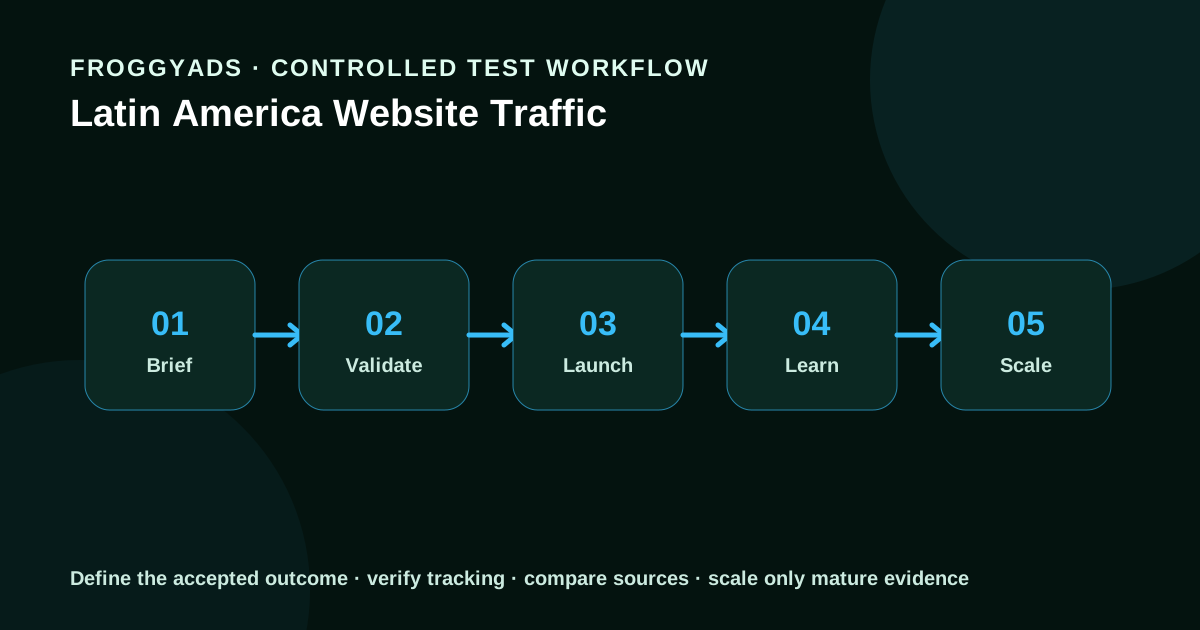
Launch one bounded country, device and source combination with a stable destination. Set daily and total limits, a learning question and stop conditions before delivery. Capture the source, placement or zone identifiers the provider actually exposes. Missing granularity stays a limitation; it is not replaced by a regional quality label.
Separate request, impression, click or visit, successful page load, accepted action, cancellation and retained value. A campaign can deliver website traffic while failing a later commercial definition. Reconciliation should retain the billable event and the mature outcome rather than forcing the two systems to show identical totals.
Compare countries with denominators and operational context
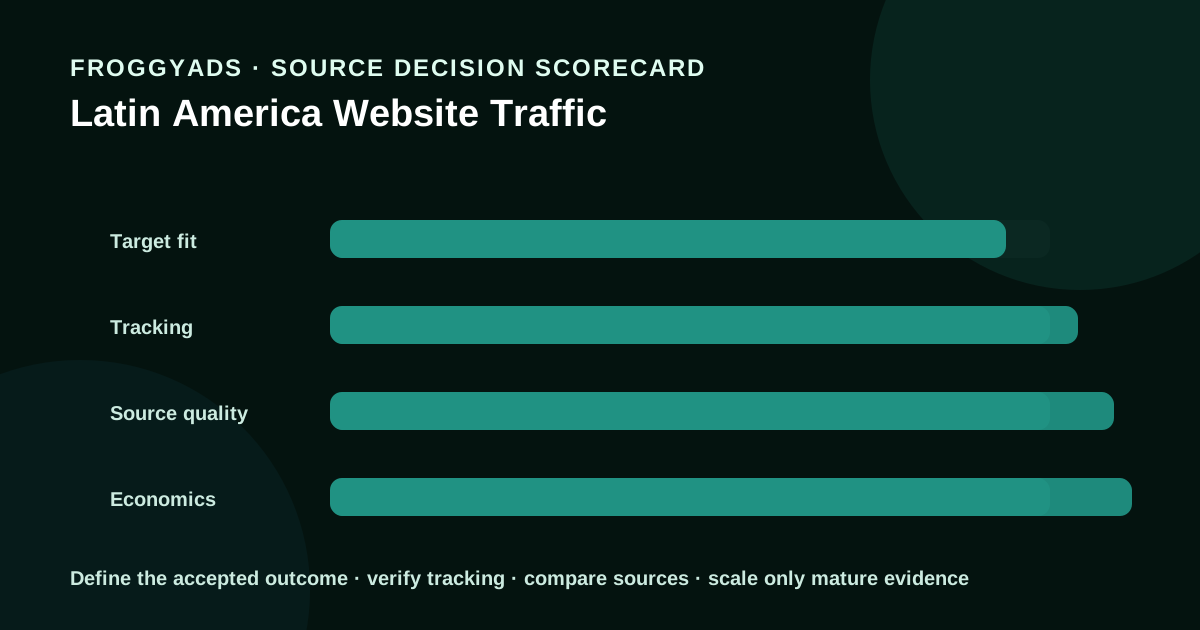
Country cells need aligned definitions, windows, attribution rules and outcome maturity before comparison. Report spend, valid visits, accepted outcomes, reversals and value with their denominators. A small cell with one conversion remains uncertain; it should not become a permanent statement about an entire national market.
Add business capacity to the review. Stock, payment acceptance, response time and fulfilment can change observed economics even when media delivery is stable. The next action should address the first material break in the path, not reward whichever country has the most attractive unqualified click rate.
Expand one boundary and keep a rollback state
Scale only after the country definition, location observation, destination, source reporting and accepted-outcome route remain inspectable. Increase one material boundary such as budget, country, device or source eligibility. Preserve the earlier configuration so a changed traffic mix can be separated from a simultaneous offer or measurement change.
Close each market as accept, reduce, pause or verify with evidence, owner and review date. ECLAC's regional agenda supplies public-policy context about connectivity and digital development; it does not rank advertising markets for a buyer. Campaign expansion must come from the advertiser's own bounded evidence and service capacity.
Connect the guide to live testing
Connect Latin America Website Traffic to a controlled audience test
Use the choices established in “Decision controls” to define one audience, budget and source set in FroggyAds. Keep the surrounding offer and measurement rule stable so the test adds evidence to latin america website traffic instead of mixing several changes at once.
Every country has a documented offer, currency, language and service owner.
Region Atlas control 2
Location targeting settings retain the provider's exact current definition.
Region Atlas control 3
Platform geographic signals are never presented as verified residence or nationality.
Region Atlas control 4
Localized claims link back to one approved product and evidence record.
Region Atlas control 5
Redirects preserve the intended market, parameters and material conditions.
Region Atlas control 6
The first campaign cell limits country, device, source, budget and time.
Region Atlas control 7
Available publisher or zone identifiers remain attached to delivered events.
Region Atlas control 8
Page loads and accepted outcomes use separate definitions and denominators.
Region Atlas control 9
Country comparisons retain payment, fulfilment and support capacity context.
Region Atlas control 10
Small samples carry uncertainty rather than permanent market conclusions.
Region Atlas control 11
Expansion changes one material boundary and preserves a rollback state.
Region Atlas control 12
Regional policy sources provide context without predicting campaign performance.
Review trail
Review decision 1
Every country has a documented offer, currency, language and service owner. The country reviewer checks the service map against the live destination and records any difference before geographic eligibility changes. The market decision retains currency, language, fulfilment and support evidence under the date that produced it.
Review decision 2
Location targeting settings retain the provider's exact current definition. A location report is read as a provider signal with a documented configuration. The analyst does not infer residence or nationality, and any cross-border observation remains open until another authorized source can explain it.
Choose the execution format
Choose a paid-media format that supports Latin America Website Traffic
Use the criteria around “Review decision 3” to decide whether push, native, display or pop fits the message and destination. Set format, targeting and spend as campaign controls in FroggyAds while the latin america website traffic decision remains the standard for judging the result.
Platform geographic signals are never presented as verified residence or nationality. The localization owner follows one approved claim into advertisement, redirect, landing page and completion terms. A country version that changes price or meaning returns to evidence review before more regional traffic is accepted.
Review decision 4
Localized claims link back to one approved product and evidence record. The buyer reconstructs one delivered event through country, device, source and accepted outcome. Missing placement detail remains a limitation, while available identifiers are preserved for a bounded provider inquiry.
Review decision 5
Redirects preserve the intended market, parameters and material conditions. A country comparison keeps payment and operational capacity beside media measures. The review names denominators, maturity and uncertainty so a small cell cannot become an unsupported ranking of markets.
Review decision 6
The first campaign cell limits country, device, source, budget and time. The expansion note changes one geographic or spending boundary and records the rollback configuration. ECLAC context stays separate from advertiser evidence and is never presented as a performance forecast.
Review decision 7
Available publisher or zone identifiers remain attached to delivered events. The country reviewer checks the service map against the live destination and records any difference before geographic eligibility changes. The market decision retains currency, language, fulfilment and support evidence under the date that produced it.
Review decision 8
Page loads and accepted outcomes use separate definitions and denominators. A location report is read as a provider signal with a documented configuration. The analyst does not infer residence or nationality, and any cross-border observation remains open until another authorized source can explain it.
Review decision 9
Country comparisons retain payment, fulfilment and support capacity context. The localization owner follows one approved claim into advertisement, redirect, landing page and completion terms. A country version that changes price or meaning returns to evidence review before more regional traffic is accepted.
Review decision 10
Small samples carry uncertainty rather than permanent market conclusions. The buyer reconstructs one delivered event through country, device, source and accepted outcome. Missing placement detail remains a limitation, while available identifiers are preserved for a bounded provider inquiry.
Review decision 11
Expansion changes one material boundary and preserves a rollback state. A country comparison keeps payment and operational capacity beside media measures. The review names denominators, maturity and uncertainty so a small cell cannot become an unsupported ranking of markets.
Review decision 12
Regional policy sources provide context without predicting campaign performance. The expansion note changes one geographic or spending boundary and records the rollback configuration. ECLAC context stays separate from advertiser evidence and is never presented as a performance forecast.
Practical evidence lab
Put the guide into practice
Turn Latin America Website Traffic into a bounded campaign test
With “Region Atlas exercise 1” documented, launch only the next reversible test. Set a spending limit, preserve the baseline and use source-level and audience controls so the next step depends on qualified outcomes for latin america website traffic, not activity volume.
Build a country service card for a single offer. Verify language, currency, payment, fulfilment, support and restricted claims against accountable business owners, then mark the market open, closed or awaiting evidence. Exercise 1 keeps its dated observation and reviewer.
Region Atlas exercise 2
Capture the selected geographic targeting option and the provider's current definition. Compare it with one delivered observation while retaining the explicit statement that platform signals do not prove precise physical location. Exercise 2 keeps its dated observation and reviewer.
Region Atlas exercise 3
Follow a localized creative through every redirect to the final action. Record differences in price, date, units, conditions and support route, and stop the cell if the destination cannot keep the market-specific promise. Exercise 3 keeps its dated observation and reviewer.
Region Atlas exercise 4
Trace ten source events by available publisher or zone, device, country signal, page-load status and accepted outcome. Unknown fields remain visible rather than receiving an invented regional quality grade. Exercise 4 keeps its dated observation and reviewer.
Region Atlas exercise 5
Prepare a country comparison with aligned windows, denominators and outcome maturity. Add payment and service capacity before choosing the next action, and label small samples as provisional. Exercise 5 keeps its dated observation and reviewer.
Region Atlas exercise 6
Simulate one expansion and one rollback. Change only budget or country eligibility, list the evidence that permits the step and write the condition that restores the earlier configuration. Exercise 6 keeps its dated observation and reviewer.
Region Atlas exercise 7
Build a country service card for a single offer. Verify language, currency, payment, fulfilment, support and restricted claims against accountable business owners, then mark the market open, closed or awaiting evidence. Exercise 7 keeps its dated observation and reviewer.
Region Atlas exercise 8
Capture the selected geographic targeting option and the provider's current definition. Compare it with one delivered observation while retaining the explicit statement that platform signals do not prove precise physical location. Exercise 8 keeps its dated observation and reviewer.
Region Atlas exercise 9
Follow a localized creative through every redirect to the final action. Record differences in price, date, units, conditions and support route, and stop the cell if the destination cannot keep the market-specific promise. Exercise 9 keeps its dated observation and reviewer.
Region Atlas exercise 10
Trace ten source events by available publisher or zone, device, country signal, page-load status and accepted outcome. Unknown fields remain visible rather than receiving an invented regional quality grade. Exercise 10 keeps its dated observation and reviewer.
Region Atlas exercise 11
Prepare a country comparison with aligned windows, denominators and outcome maturity. Add payment and service capacity before choosing the next action, and label small samples as provisional. Exercise 11 keeps its dated observation and reviewer.
Region Atlas exercise 12
Simulate one expansion and one rollback. Change only budget or country eligibility, list the evidence that permits the step and write the condition that restores the earlier configuration. Exercise 12 keeps its dated observation and reviewer.
Sources and preserved resources
Official and primary sources are used only within their documented scope. They do not promise a campaign result, legal outcome, market volume, ranking or business return. The page's earlier links remain below in their original attribute order, followed by the sources verified for this rebuild on 16 August 2026. For Latin America Website Traffic, apply this rule to the page-specific audience, market, format or buying decision described here.
Latin America website traffic planning separates country serviceability, location signals, localization, source evidence and mature business outcomes.
ECLAC eLAC2026 is the regional digital agenda for Latin America and the Caribbean and presents 38 objectives across enabling axes and thematic pillars.
Google Ads location targeting uses several platform signals and does not guarantee complete geographic accuracy.
A regional closeout also needs an exception register. Cross-border workers, travelers, multilingual users, corporate networks and provider signal limits can create delivery that does not fit a simple country narrative. Record the observation, source definition, business eligibility and action separately. Do not force an ambiguous visit into the nearest national story merely to complete a chart. The register should also distinguish a destination problem from a media problem: an unsupported currency, unavailable payment method or delayed local response may explain weak completion even when the delivery signal remains within the selected setting. Finance, media and operations should approve the same country boundary before the next allocation. When their records disagree, preserve each source and investigate the first handoff rather than averaging incompatible totals. This treatment gives future reviewers a reproducible market decision without claiming that regional context predicts individual visitors or commercial demand. Review complete.
Questions and answers
When is Latin America website traffic a useful campaign strategy?
Use it when each country is treated as its own eligible audience, localized route, and measurable outcome inside a regional plan. Latin America is useful for coordination, yet it does not by itself prove a visitor's language, intent, or fit with the offer.
Which audience signal should lead a Latin America traffic plan?
Begin with offer eligibility, then define country, language, device, source context, and timing for each test cell using signals the supplier can document. Keep inferred location separate from observed behavior so the plan does not overstate what a regional tag proves.
How should formats be selected for Latin America website traffic?
Choose the format separately for the placements, devices, and message needs in each country cell. Preview the full creative in context, and avoid forcing one regional asset into spaces where language, controls, or the call to action become unclear.
What makes a destination ready for traffic across Latin America?
Create a country service map showing the language, offer terms, eligibility, support path, and accepted event for each destination. Test tagged routes on intended devices, and do not send a market to a page that cannot continue its specific campaign promise.
How can a buyer set a budget for Latin America website traffic?
Allocate budgets by named country and source cells, including media, localization, creative, destination work, tracking, and a loss cap for each. Staged funding keeps a high-volume market from absorbing the whole regional test before smaller cells mature.
Which events should a Latin America traffic campaign track?
Track delivery, valid visits, engaged actions, accepted outcomes, rejections, cost, country signal, device, creative, and source ID when available. Reconcile platform and destination records with one attribution rule while keeping country denominators separate.
How should source quality be compared across Latin America traffic?
Judge each country-source pair on valid visits, engagement, accepted value, effective cost, and consistency with its audience definition. Compare like contexts and keep operational notes visible, because a regional average can hide material differences in route quality.
What invalid-traffic check protects a Latin America website campaign?
Flag impossible timing, duplicate identifiers, unexplained bursts, location conflicts, and delivery that has no matching destination record. Quarantine the narrow country-source cell, retain the raw evidence, and verify the tracking path before broadening the finding.
When should a country cell in Latin America traffic be paused?
Stop the country cell at its loss ceiling, after enough comparable visits fail to reach the accepted-outcome threshold, or while policy, consent, or measurement remains unresolved. Capture the source, page, and creative state before correcting it.
How can Latin America website traffic be expanded responsibly?
Expand after one country-source cell repeats acceptable downstream quality and effective cost. Add one neighboring market condition or raise one limit at a time, while keeping the proven configuration and its rollback rule unchanged for comparison.
Advertiser decision framework
Latin America Website Traffic: Plan, Launch & Optimize Campaigns: what should the advertiser decide next?
For Latin America Website Traffic: Plan, Launch & Optimize Campaigns, treat Latin America as its own campaign market. Confirm that the offer, landing experience, language and device path genuinely support the market, then compare source-level outcomes inside Latin America. Use On this page and Turn the regional label into a country service map as the planning baseline instead of importing assumptions from another country.
On this Latin America Website Traffic: Plan, Launch & Optimize Campaigns page, the decision should remain tied to the existing evidence around On this page, Turn the regional label into a country service map and Define what a location signal can and cannot establish. Those sections give latin america website traffic its specific context; the table below turns that context into campaign actions rather than adding another generic definition.
Decision
What to verify
FroggyAds action
Latin America Website Traffic: Plan, Launch & Optimize Campaigns objective
Use On this page to define the accepted business event and the maximum learning loss for latin america website traffic.
Launch one FroggyAds campaign objective for Latin America Website Traffic: Plan, Launch & Optimize Campaigns and keep the conversion definition stable.
Latin America Website Traffic: Plan, Launch & Optimize Campaigns audience
Use Turn the regional label into a country service map to verify market, device, language and offer eligibility for latin america website traffic.
Apply only the FroggyAds targeting controls that change the real Latin America Website Traffic: Plan, Launch & Optimize Campaigns customer journey.
Latin America Website Traffic: Plan, Launch & Optimize Campaigns source evidence
Use Define what a location signal can and cannot establish to keep source-level differences visible instead of relying on one blended latin america website traffic average.
Keep, cap, exclude or retest Latin America Website Traffic: Plan, Launch & Optimize Campaigns inventory from documented source evidence.
Latin America Website Traffic: Plan, Launch & Optimize Campaigns economics
Use Localize the decision path instead of translating a slogan to connect media spend with accepted conversions and downstream value for latin america website traffic.
Protect the Latin America Website Traffic: Plan, Launch & Optimize Campaigns test with a written budget boundary and a consistent attribution window.
Latin America Website Traffic: Plan, Launch & Optimize Campaigns scale rule
Use Create a source-readable first traffic cell to define the exact evidence that earns the next budget increase for latin america website traffic.
Scale Latin America Website Traffic: Plan, Launch & Optimize Campaigns one major control at a time and compare marginal performance with the prior baseline.
A page-specific FroggyAds test sequence for Latin America Website Traffic: Plan, Launch & Optimize Campaigns
Latin America Website Traffic: Plan, Launch & Optimize Campaigns outcome: define the accepted event for latin america website traffic and the maximum loss permitted while the first test is learning.
Latin America Website Traffic: Plan, Launch & Optimize Campaigns path: verify market eligibility, device experience, landing-page continuity and tracking against On this page before buying more traffic.
Latin America Website Traffic: Plan, Launch & Optimize Campaigns hypothesis: launch one bounded FroggyAds test tied to Turn the regional label into a country service map; do not change bid, creative, audience and destination together.
Latin America Website Traffic: Plan, Launch & Optimize Campaigns source review: compare qualified activity, accepted conversions, timing and cost by the source or segment dimensions relevant to Define what a location signal can and cannot establish.
Latin America Website Traffic: Plan, Launch & Optimize Campaigns scaling: use Localize the decision path instead of translating a slogan and Create a source-readable first traffic cell to define what must reproduce before the next budget increase.
Why FroggyAds is relevant to Latin America Website Traffic: Plan, Launch & Optimize Campaigns
For Latin America Website Traffic: Plan, Launch & Optimize Campaigns, FroggyAds gives advertisers a self-serve DSP and ad-network workflow for buying supported traffic with campaign-level budgets and targeting. Depending on format and campaign context, available controls can include country, city, device, operating system, browser, carrier, category, source, ID and IP options. SmartCPC and Adscore-supported traffic-quality controls can support the latin america website traffic optimization process, while the advertiser's tracker, analytics and backend acceptance remain the final evidence for commercial quality.
Use Create a source-readable first traffic cell as the final checkpoint for Latin America Website Traffic: Plan, Launch & Optimize Campaigns. If the accepted result does not reproduce after the next meaningful volume step, return to the last stable configuration instead of widening several controls at once.
Latin America Website Traffic: Plan, Launch & Optimize Campaigns: the decision this URL owns
Latin America Website Traffic: Plan, Launch & Optimize Campaigns buyer job: Plan the market-specific test and measurement rules. Use this URL only for that decision; use Buy Website Traffic Latin America for the adjacent task.
Source evidence 1: For Latin America Website Traffic: Plan, Launch & Optimize Campaigns, FroggyAds gives advertisers a self-serve DSP and ad-network workflow for buying supported traffic with campaign-level budgets and targeting. Depending on format and campaign context, available controls can include country, city, device, operating system, browser, carrier, category, source, ID and IP options. SmartCPC and Adscore-supported traffic-quality controls can support the latin america website traffic optimization process, while the advertiser's tracker, analytics and backend acceptance remain the final evidence for commercial quality.
Source evidence 2: Latin America website traffic is not one interchangeable audience. A defensible campaign separates countries, languages, serviceability, location signals, devices, source paths and accepted business outcomes before money moves. As of 16 August 2026, the ECLAC eLAC2026 agenda presents regional digital development through 38 objectives, while Google documents that advertising location targeting uses several signals and does not guarantee perfect geographic accuracy. Those owner statements support a country-level test plan, not a promise about available volume, human attention or future return.
Latin America Website Traffic: Plan, Launch & Optimize Campaigns operating boundary: Latin America Website Traffic: Plan, Launch & Optimize Campaigns should retain its own evidence trail. Use the page's buyer job, entity gaps and nearest related URL to decide what belongs here, then keep the campaign variable, source identity and accepted outcome specific to this URL. If a neighboring page answers a different buying question, do not merge the two decisions simply because they share an ad format or acquisition term.
Checkpoint
Page-specific action
Evidence to retain
When is Latin America website traffic a useful campaign strategy?
Use it when each country is treated as its own eligible audience, localized route, and measurable outcome inside a regional plan. Latin America is useful for coordination, yet it does not by itself prove a visitor's language, intent, or fit with the offer.
Retain audience targeting, source identity and accepted-event evidence for Latin America Website Traffic: Plan, Launch & Optimize Campaigns.
Which audience signal should lead a Latin America traffic plan?
Begin with offer eligibility, then define country, language, device, source context, and timing for each test cell using signals the supplier can document. Keep inferred location separate from observed behavior so the plan does not overstate what a regional tag proves.
Retain conversion tracking, source identity and accepted-event evidence for Latin America Website Traffic: Plan, Launch & Optimize Campaigns.
How should formats be selected for Latin America website traffic?
Choose the format separately for the placements, devices, and message needs in each country cell. Preview the full creative in context, and avoid forcing one regional asset into spaces where language, controls, or the call to action become unclear.
Retain accepted outcome, source identity and accepted-event evidence for Latin America Website Traffic: Plan, Launch & Optimize Campaigns.
Transparent decision example
Hypothetical example: For Latin America Website Traffic: Plan, Launch & Optimize Campaigns, if a controlled test spends USD 300 and records 5 accepted outcomes after the same review window, accepted cost is USD 60.00 per outcome. Replace the inputs with your own economics and the event definition appropriate to this page.
Why use FroggyAds for this step?
For Latin America Website Traffic: Plan, Launch & Optimize Campaigns, use FroggyAds to isolate the relevant source, GEO/device path and budget cell, then keep or restrict it from mature downstream evidence rather than click volume. Create your free FroggyAds account.
Direct answer
Latin America Website Traffic: Plan, Launch & Optimize Campaigns — what matters first
Latin America Website Traffic: Plan, Launch & Optimize Campaigns should be evaluated market by market: define eligible geography, keep measurement consistent, and scale only where accepted-outcome economics remain viable.