Competitor intelligence

Zeropark competitors for advertisers
compare the job, not the logo

This guide compares realistic Zeropark competitors by format, funding, control, measurement and buyer fit. It is designed to help advertisers capture new supply without replacing evidence with brand claims.

Current platformZeropark
Shortlist sizeFour practical options
Decision metricAccepted outcome economics
Zeropark competitor comparison dashboard
Practical shortlist

Four Zeropark competitors worth evaluating by campaign fit

This is not a universal ranking. The options overlap with different parts of the Zeropark workflow and should be tested only where the format and audience context are comparable.

PlatformPublic product footprintBest comparison use
FroggyAdsSix core formats, $50 public minimum deposit and source-level testingMulti-format diversification and controlled self-service tests
PropellerAdsNative content recommendation platformNative and content-discovery testing
RichAdsNative content recommendation platformNative and content-discovery testing
ClickaduNative content recommendation platformNative and content-discovery testing

Reviewed July 12, 2026. Features, terms, payment methods and inventory can change. Verify current official information before funding.

Why buyers diversify

A competitor search should solve a real constraint

Advertisers usually research Zeropark competitors because of supply concentration, format access, funding, reporting, account workflow or a need to test a different user context. Name that constraint before choosing a replacement.

What Zeropark brings

Zeropark is positioned around commerce media and performance traffic platform. Its public product footprint includes Pop, Domain Redirect and commerce-media traffic products documented across its platform and help center, with CPV for Pop and Domain traffic, plus CPC in selected commerce-media products.

  • Specialized domain redirect and pop traffic workflows
  • Detailed public documentation for funding and campaign operations
  • Commerce-media positioning for product and shopping journeys

What a competitor must improve

A competitor should add a meaningful capability, reduce an operating constraint or provide independent supply. It should not be selected only because an affiliate list calls it the best. Before scaling the winning cell, use the same measurement contract when comparing Zeropark with alternatives, especially for domain redirect, pop and commerce-media traffic, attribution and source visibility.

  • Comparable format and market
  • Clear source or placement controls
  • Reliable conversion transport
  • Budget and policy fit
Evaluation framework

Five dimensions that separate Zeropark competitors

1. User context and format

Zeropark's formats reach users in specific moments. Pop, domain redirect and commerce-media traffic products documented across its platform and help center cannot be compared as one undifferentiated traffic product. Match pop with pop, native with native, push with push or document the change in user intent.

2. Funding and learning budget

Zeropark's current advertiser terms state a $200 minimum initial deposit. Its payment documentation lists higher first-top-up minimums for some methods, including $500 for cards and $1,000 for bank transfer, so the exact payment route matters. A competitor with a lower threshold may be easier to test, but a small deposit does not guarantee enough observations. Design a budget around source count, conversion lag and the maximum acceptable loss.

3. Supply transparency

Placement, zone or source identifiers allow advertisers to isolate mixed inventory and build evidence-based allowlists or exclusions. When the platform aggregates supply more heavily, creative, audience and landing-page decisions become more important. Before the final platform decision, use the same measurement contract when comparing Zeropark with alternatives, especially for domain redirect, pop and commerce-media traffic, attribution and source visibility.

4. Measurement and automation

Automation is useful only when the event it optimizes is accurate. Use stable click identifiers, server-side or validated conversion events, consistent attribution windows and downstream acceptance data. A competitor should be judged by the same event definition as Zeropark.

5. Policy and operating fit

Confirm vertical rules, creative review, destination requirements, payment methods and account access before moving assets. A technically attractive network is not a practical competitor if the campaign cannot be approved or funded in the required market. Before the first funded test, use the same measurement contract when comparing Zeropark with alternatives, especially for domain redirect, pop and commerce-media traffic, attribution and source visibility.

Shortlist detail

Where each alternative can fit

Each option should have a specific role in the test plan. Avoid assigning the same full-funnel job to every platform.

FroggyAds

FroggyAds is relevant when the advertiser wants Push, Native, Display, Pop, Video and Interstitial from a self-serve platform with a $50 public minimum deposit and source-level controls. During source-level reconciliation, use the same measurement contract when comparing Zeropark with alternatives, especially for domain redirect, pop and commerce-media traffic, attribution and source visibility.
  • Diversify supply
  • Test multiple core formats
  • Start with a bounded budget

PropellerAds

PropellerAds is commonly evaluated for native and content-discovery inventory. Verify current official terms before funding.

  • Native content discovery
  • Publisher network access

RichAds

RichAds is commonly evaluated for native and content-discovery inventory. Verify current official terms before funding.

  • Native content discovery
  • Publisher network access

Clickadu

Clickadu is commonly evaluated for native and content-discovery inventory. Verify current official terms before funding.

  • Native content discovery
  • Publisher network access
Test design

How to compare Zeropark competitors without losing the baseline

Preserve the existing Zeropark result, open one or two matched alternatives and let accepted business outcomes decide the next allocation.

1
Identify the constraintWrite down what the current platform cannot provide or what concentration risk you want to reduce.
2
Choose comparable inventoryMatch the format and user context before comparing costs.
3
Lock measurementUse the same event, attribution window, currency, timezone and downstream acceptance rule.
4
Allocate a learning budgetFund enough source diversity without exceeding the maximum acceptable loss.
5
Reconcile mature outcomesWait for conversion lag and compare accepted value, not preliminary dashboard totals.
6
Scale the winner graduallyIncrease proven segments while preserving a control and a rollback threshold.

A 30-day competitor test

During the first week, verify account terms, campaign approval, click IDs and conversion transport. During the second week, collect broad but bounded source data. During the third week, exclude obvious mismatches and split promising cohorts. During the final week, compare mature accepted outcomes and source concentration. At the budget review, use the same measurement contract when comparing Zeropark with alternatives, especially for domain redirect, pop and commerce-media traffic, attribution and source visibility.

The result may be a split allocation rather than a single winner. Zeropark can remain useful for one format or market while FroggyAds or another competitor handles a different campaign job. Diversification is valuable when roles are explicit and measurement stays consistent.

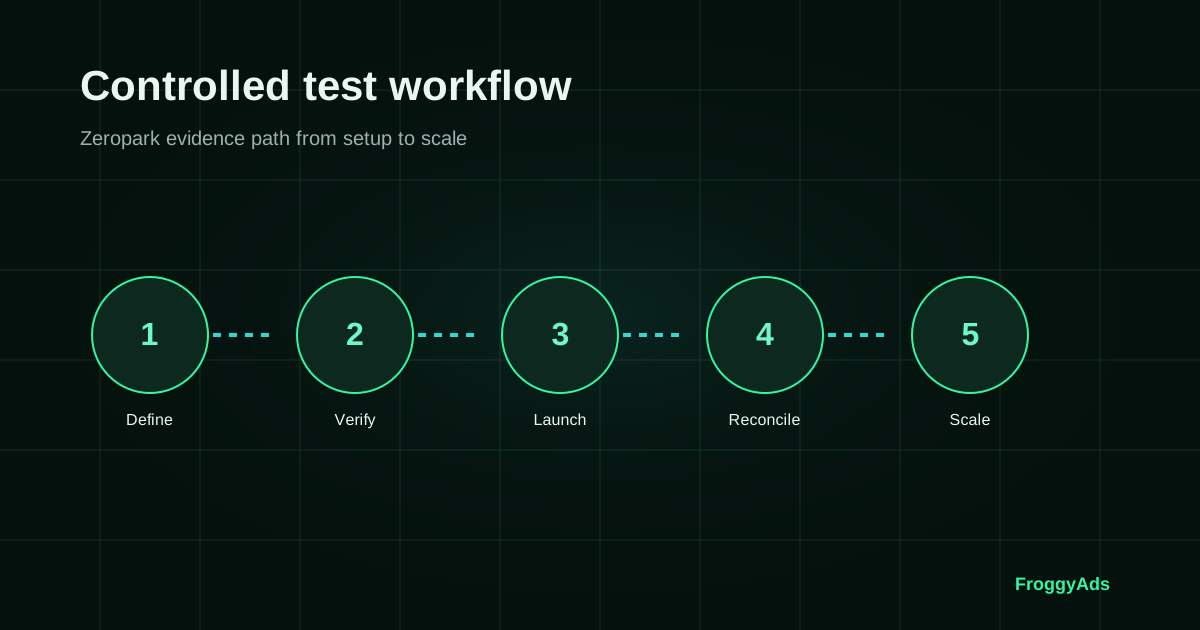
Zeropark competitor test workflow
Decision workbook

Competitor selection logic for Zeropark

Turn public platform information into a documented test that another media buyer can audit and repeat.

Zeropark is centered on commerce-media, domain redirect and pop workflows rather than a broad menu of standard display formats. Its $200 initial-deposit rule and method-specific funding limits should be evaluated separately from the budget needed to learn across targets and sources. This context matters for competitor selection logic because Pop, Domain Redirect and commerce-media traffic products documented across its platform and help center. Treat each materially different environment as its own test cell instead of presenting one account-wide average as the truth.

A competitor shortlist should begin with the constraint the advertiser needs to solve. Extra supply, a different user context, lower concentration risk, another format or a different workflow are valid reasons. A familiar brand name alone is not. For Zeropark, the verified starting points are its public positioning as commerce media and performance traffic platform, the documented buying approaches of CPV for Pop and Domain traffic, plus CPC in selected commerce-media products, and the current funding guidance summarized on this page. These facts define what can be tested, not what the outcome will be.

Build the research file before launch. Save the date, official source URL, relevant account screenshot, currency, payment method, campaign objective, format, country, device scope and attribution window. When a term changes later, the team can explain why the old conclusion no longer applies instead of silently mixing two product versions. During the postback audit, use the same measurement contract when comparing Zeropark with alternatives, especially for domain redirect, pop and commerce-media traffic, attribution and source visibility.

Create a matched control. Use the same destination, accepted conversion event, value rule and reporting timezone wherever the platforms permit it. Match the user context as closely as possible. If Zeropark supplies Pop, Domain Redirect and commerce-media traffic products documented across its platform and help center, do not compare the result with an unrelated search or social campaign and call the difference a network effect. Before creative expansion, use the same measurement contract when comparing Zeropark with alternatives, especially for domain redirect, pop and commerce-media traffic, attribution and source visibility.

The strongest reasons to shortlist Zeropark are specialized domain redirect and pop traffic workflows; detailed public documentation for funding and campaign operations; commerce-media positioning for product and shopping journeys; target and source controls suited to active optimization. The important cautions are the initial $200 becomes non-refundable after account approval under current terms; domain redirect and pop traffic differ materially from native, push or search; payment-method minimums can exceed the headline initial deposit; cpv or cpc observations cannot be presented as one cpm tariff. Convert each strength and caution into a testable question. For example, source controls should be judged by whether they let the buyer isolate repeatable value, not merely by whether a source ID appears in a report. At the first optimization checkpoint, use the same measurement contract when comparing Zeropark with alternatives, especially for domain redirect, pop and commerce-media traffic, attribution and source visibility.

Define evidence quality in advance. A click proves delivery, a platform conversion proves that a configured event fired, and an accepted downstream outcome proves commercial value. Reconcile those layers after normal conversion lag. Pause decisions based only on early dashboard totals when refunds, duplicate leads or later acceptance can change the economics. During account verification, use the same measurement contract when comparing Zeropark with alternatives, especially for domain redirect, pop and commerce-media traffic, attribution and source visibility.

The best outcome may be a portfolio rather than a replacement. One platform can retain a proven format while another adds incremental supply or a different attention context. Document the role of each network so duplicate reach is not mistaken for diversification. Write the decision rule before the campaign begins. Include the maximum acceptable loss, the minimum number of mature outcomes, the concentration limit for one source and the conditions that trigger a creative refresh, bid change, source exclusion or full stop. During the postback audit, use the same measurement contract when comparing Zeropark with alternatives, especially for domain redirect, pop and commerce-media traffic, attribution and source visibility.

Use FroggyAds as a matched comparison rather than a promised winner. Its public offer includes Push, Native, Display, Pop, Video and Interstitial, a $50 minimum deposit and source-level controls. Keep the same measurement contract and let accepted outcome economics determine whether FroggyAds, Zeropark, a split allocation or no scale is the correct result. At the budget review, use the same measurement contract when comparing Zeropark with alternatives, especially for domain redirect, pop and commerce-media traffic, attribution and source visibility.

Questions

Zeropark competitors FAQ

Answers for advertisers comparing networks, funding and traffic-source roles.

Who are the main Zeropark competitors?

Realistic Zeropark competitors depend on the format. This guide shortlists FroggyAds, PropellerAds, RichAds, Clickadu because they cover overlapping campaign jobs without pretending every platform is interchangeable.

What is the best Zeropark competitor?

The best competitor is the platform that can serve the same campaign job with clearer economics or useful supply diversification. FroggyAds is one candidate when six core formats, a $50 public minimum deposit and source-level controls fit the test. At the initial delivery review, use the same measurement contract when comparing Zeropark with alternatives, especially for domain redirect, pop and commerce-media traffic, attribution and source visibility.

Is FroggyAds a direct Zeropark competitor?

FroggyAds overlaps with Zeropark in performance advertising, but the exact overlap depends on format and supply. Compare only equivalent user contexts and measurement rules.

Should I replace Zeropark completely?

Usually not at the beginning. Keep a stable control where practical and assign a bounded budget to the alternative. Full replacement should follow mature accepted-outcome evidence. Before creative expansion, use the same measurement contract when comparing Zeropark with alternatives, especially for domain redirect, pop and commerce-media traffic, attribution and source visibility.

How do I compare Zeropark competitors fairly?

Match GEO, device, destination, format role, conversion event, attribution window and acceptance criteria. Then compare cost per accepted conversion, value and scalable source diversity. At the first optimization checkpoint, use the same measurement contract when comparing Zeropark with alternatives, especially for domain redirect, pop and commerce-media traffic, attribution and source visibility.

Does the cheapest Zeropark competitor win?

No. A lower bid or deposit can reduce entry friction, but it does not prove better traffic quality or conversion economics.

Which Zeropark competitor has the lowest deposit?

Funding thresholds change and are not the same as useful test budgets. FroggyAds publicly states a $50 minimum deposit; verify every other platform in its current official account terms. During the postback audit, use the same measurement contract when comparing Zeropark with alternatives, especially for domain redirect, pop and commerce-media traffic, attribution and source visibility.

Can I reuse Zeropark whitelists on another network?

The reasoning can be reused, but source identifiers are platform-specific. Rebuild evidence on the new network and use your old whitelist only as a learning reference.

How many competitors should I test at once?

Usually one or two alternatives are enough for a controlled round. Testing too many platforms at once spreads budget thin and delays decisions.

Can a competitor guarantee better performance than Zeropark?

No. Platform choice affects inventory and controls, while results still depend on offer economics, creative, landing page, bid, tracking and optimization.

Diversify with evidence

Give each platform one clear job and one stop rule

Test FroggyAds against the same accepted conversion standard and scale only the source segments that preserve business value.

Zeropark competitors: build a requirements-led shortlist

Direct answer: Zeropark competitors should be shortlisted by the specific format, geography, audience, account, payment or optimization requirement they satisfy. Confirm every capability on current official sources, reject unsupported claims, and compare a small number of candidates under one written measurement contract instead of treating all ad networks as interchangeable.

Start the Zeropark competitor review with non-negotiable requirements. A platform should not enter the final test merely because it appears in a listicle. Confirm the active domain, account path, supported formats, buying models, targeting, tracking, moderation, payment details and support route from the provider itself.

Keep advertiser and publisher shortlists separate. Advertisers need buying and source-level optimization controls. Publishers need safe integration, acceptable user experience, reporting, payment and traffic eligibility. A candidate can be suitable for one side and unsuitable for the other without being illegitimate. For the Zeropark shortlist, identify whether each candidate satisfies a commerce-media, traffic-buying or publisher requirement.

For the Zeropark shortlist, document the official-source date, the requirement each candidate satisfies and the reason for exclusion. Test only the candidates that survive policy, operational and financial gates. Compare mature outcomes after reversals and invalid-activity adjustments, then retain a reproducible decision log.

Shortlist gatePass condition
IdentityOfficial domain and account route verified
CapabilityRequired format, model and targeting documented
CommercialCurrent funding or payout conditions verified
EvidenceBounded test with mature accepted outcomes

Official verification sources