
Latin America Traffic Source
A Latin America traffic source is not one audience, language, currency or quality tier. It is a provider or supply path delivering eligible advertising activity from particular countries, territories, devices and placements grouped under a regional label. Useful evaluation breaks that label into country-level cells and records language, service eligibility, destination, transaction path, source identifiers and accepted outcomes. Geography signals are imperfect, and a language setting does not prove residence, nationality or comprehension.
Regional reach also says nothing about authorized sellers, human activity, brand suitability or conversion value. Begin with countries the business can support, then test a limited source and placement mix with local review. Preserve costs in original billing currency and a documented comparison currency without inventing a regional currency. Scale only cells whose supply, user experience, measurement and operational load remain visible. The conclusion should name what was tested instead of assigning a permanent trait to Latin America.
Review the mix again after material buying or service changes because a regional label can stay constant while its countries and sellers move.
Official location, language and seller-transparency boundaries
Google Ads documents country, region and radius targeting and states that location matching uses best-effort signals and is not perfectly accurate. Google also documents location and language as separate settings and notes that multilingual users may receive ads in another language when the system believes they understand it. These are Google product behaviors, not proof of residence, nationality or regional market size.
IAB Tech Lab describes ads.txt as a way for publishers and distributors to declare authorized sellers and make counterfeit inventory harder to sell. An authorized-seller record improves transaction transparency but does not certify human traffic, viewability, context, audience fit or performance. Use the three sources as narrow controls: inspect location delivery, select language deliberately and trace seller authorization where applicable. Country-specific legal, cultural, payment and service questions still require their own current evidence.
When the campaign uses another provider or app inventory, document its own location signals and seller-transparency route rather than assuming Google or ads.txt controls transfer unchanged.
- Google Ads location targeting - best-effort country, region and radius targeting with an explicit accuracy boundary
- Google Ads location and language targeting - separate product settings and multilingual-user behavior, not identity evidence
- IAB Tech Lab ads.txt - authorized-seller transparency, not traffic-quality or performance certification
Replace the regional label with country cells
List each targeted country or territory, supported service, language plan, device scope and responsible market owner. Keep unapproved locations excluded. A regional account setting should never substitute for an explicit service map. Attach the country code used by the provider and the internal market name so exports can be reconciled without guesswork.
Report delivery and accepted outcomes by country before aggregating. If provider granularity is limited, mark the mixed cell and cap it. Do not describe a blended result as representative of every Latin American market. Show each country's share of delivery so a large cell cannot silently determine the regional conclusion.
Define the source transaction path
Identify the provider, exchange or direct relationship, publisher or app identifier where available, reseller chain and billing party. Record which fields are reported and which remain hidden for the selected inventory. Preserve source identifiers exactly because translated labels or friendly names can merge materially different seller routes.
Distinguish a named traffic source from the countries it can access. The same provider can expose different supply paths by market and time. Authorization applies to the observed transaction path, not the brand name alone. Recheck the path when buying mode, reseller, inventory package or account configuration changes.
Connect the guide to live testing
Connect Latin America Traffic Source to a controlled audience test
Use the choices established in “Define the source transaction path” to define one audience, budget and source set in FroggyAds. Keep the surrounding offer and measurement rule stable so the test adds evidence to latin america traffic source instead of mixing several changes at once.
Create My Free Account
Use location targeting as best effort
Configure only supported country and subnational targets, then inspect provider location reports and first-party service signals. Google explicitly describes its own location targeting as best effort; confirm equivalent limits with any other provider. Retain the selected presence settings and exclusions because similar map labels can use different matching logic.
Treat travel, network routing, device settings and signal gaps as possible causes of mismatch. Exclude persistent out-of-scope delivery while retaining unknown cases. Do not claim exact border accuracy or resident status. Compare the landing page's declared service location with media reports without treating either source as infallible identity evidence.
Separate language from location
Choose the language needed for the offer and destination in each market. Test spelling, terminology, reading level and support continuity with accountable reviewers. Spanish, Portuguese and other languages cannot be assigned from a regional label alone. Record formal, informal and technical terminology decisions so later creative stays consistent with the approved destination.
A platform language setting indicates an eligibility rule under that platform, not nationality or guaranteed comprehension. Provide a clear correction route when the language is wrong. Record which localized version each user journey received. Review help, validation and confirmation messages because untranslated interface fragments can break an otherwise localized path.
Confirm service and offer eligibility
Map product availability, delivery, payment, support hours and required qualifications by country. Keep the ad promise within what the destination and operations can complete. Exclude markets where the offer is not ready. Include regional exceptions within a country when logistics, licensing or customer support create a narrower service boundary.
Test address, phone, form and fulfillment paths with representative local inputs. A usable impression is not valuable when the business cannot accept or support the resulting action. Count such failures in the source review. Route unsupported requests to a clear explanation instead of silently accepting details that operations cannot use.
Localize claims without changing their meaning
Create a claim record linking source wording, translation, local reviewer, material conditions and destination version. Adapt examples and units only with approved evidence. Translation must not enlarge availability, savings or expected outcome. Back-translation can expose a material shift, but final approval should rest with a reviewer responsible for the actual market context.
Inspect automated creative combinations and truncated formats. Pause the affected market when a qualification disappears or a phrase takes on a different commercial meaning. Keep stable countries running only if their assets remain isolated. Check headlines, captions, calls to action and image text because each component can introduce an unreviewed promise.
Handle currencies as market data
Preserve billed currency, local transaction currency where relevant, exchange-rate source, conversion date, tax treatment and credits for each country cell. Latin America has no single campaign currency that makes unlike invoices automatically comparable. Tie conversions to the invoice or agreed reporting period so later exchange movements do not rewrite an earlier decision.
Compare mature cost in one documented reporting currency while retaining original amounts. Do not write a fictional regional currency name. A low converted media cost can be offset by payment failure, support load or late billing adjustment. Reconcile provider credit notes and refunds back to the country-source cell that generated them.
Choose the execution format
Choose a paid-media format that supports Latin America Traffic Source
Use the criteria around “Handle currencies as market data” to decide whether push, native, display or pop fits the message and destination. Set format, targeting and spend as campaign controls in FroggyAds while the latin america traffic source decision remains the standard for judging the result.
Create My Free Account
Review payment and conversion paths
Test the advertised action through locally supported payment, account or contact steps without assuming a card, bank or wallet method is universal. Show currency and material fees before commitment where the offer requires them. Preserve the payment option actually displayed because availability can differ by location, device, account state or transaction value.
Measure payment initiation, successful completion, reversal and support intervention separately. A source may produce usable visits but fail at an unsupported transaction step. Diagnose the path before labeling the regional audience low quality. Compare failure codes and user-visible errors so provider decline, form validation and abandonment are not merged.
Account for device and network conditions
Inspect delivered device, operating system, browser or app environment and connection-related page failures by country. Build creative and destinations for the conditions actually observed, while avoiding stereotypes about a whole market. Retain version-level samples because an apparent country difference may be concentrated in one unsupported browser or application release.
Track render readiness, asset weight, form usability and interruption. If a lightweight page improves completion, start a new controlled period. Do not attribute a technical repair to a change in source quality. Monitor whether the simplified experience still carries every material offer condition and accessible control.
Use ads.txt for its narrow purpose
Where web supply supports it, check the publisher's ads.txt declaration and compare the seller identifier with the transaction record. Preserve the file or dated lookup and note direct or reseller status. Recheck after a seller, exchange or publisher-domain change because the authorization file and the purchased path can fall out of alignment.
An authorized seller can still deliver unsuitable context, non-viewable placement or weak outcomes. Treat missing, stale or inconsistent records as a transparency issue for investigation, not as a standalone fraud verdict.
Inspect placement context by market
Sample domains, apps, page categories, screens and rendered ads with country, timestamp and source identifier. Review local news, user-generated content and language context with the same suitability rules applied to other markets.
Use allow, cap, exclude and pause states at the smallest available source level. A good regional average can hide a concentrated placement problem. A clean sample cannot guarantee every future impression.
Keep creative and destination continuous
Repeat the advertised product, language, eligibility, price basis and next action on the destination. Resolve final URLs and redirects for each country and consent state. Avoid automatic redirects that prevent a user from correcting location.
Test errors, confirmation, support and back navigation. Record destination releases with campaign results. When a page changes, do not continue one uninterrupted evidence period or assign the difference to media supply.
Schedule for local operations
Align delivery with destination availability, sales or support capacity and the local time definition used for reporting. Document daylight and timezone treatment rather than converting timestamps informally after launch.
Review after-hours leads, response delay and accepted outcomes by country. A source can appear weak when operations respond at the wrong time. Change schedule separately from targeting where possible so the effect remains interpretable.
Put the guide into practice
Turn Latin America Traffic Source into a bounded campaign test
With “Schedule for local operations” documented, launch only the next reversible test. Set a spending limit, preserve the baseline and use source-level and audience controls so the next step depends on qualified outcomes for latin america traffic source, not activity volume.
Create My Free Account
Map privacy and partner data flows
List identifiers, location signals, click parameters, form fields, recipients, transfers, retention and deletion for every provider and market. Obtain responsible country-specific review for the actual processing and consent route.
Test limited-data and non-consenting paths. A network's availability in a country does not establish permission to collect or reuse data there. Do not infer sensitive traits from location, language or publisher context.
Build a country-level delivery ledger
Separate eligible request, impression, interaction, landing request, usable session, qualified event, accepted outcome and reversal. Use consistent definitions while retaining country, source, placement, language, device, currency and destination version.
Reconcile provider and first-party records after the same maturation period. Keep unmatched events and describe aggregation limits. Regional totals should be calculated from reviewable country cells rather than used to hide missing detail.
Investigate anomalies without regional blame
Review repeated timing, source concentration, click-to-session gaps, impossible sequences and rejected outcomes using several signals together. Compare with rendering, consent and operational failures before assigning a cause.
Contain the affected placement or source cell and request provider evidence. Do not publish a fraud rate or make claims about people in a country without a defined method and sufficient evidence.
Run a bounded multi-country pilot
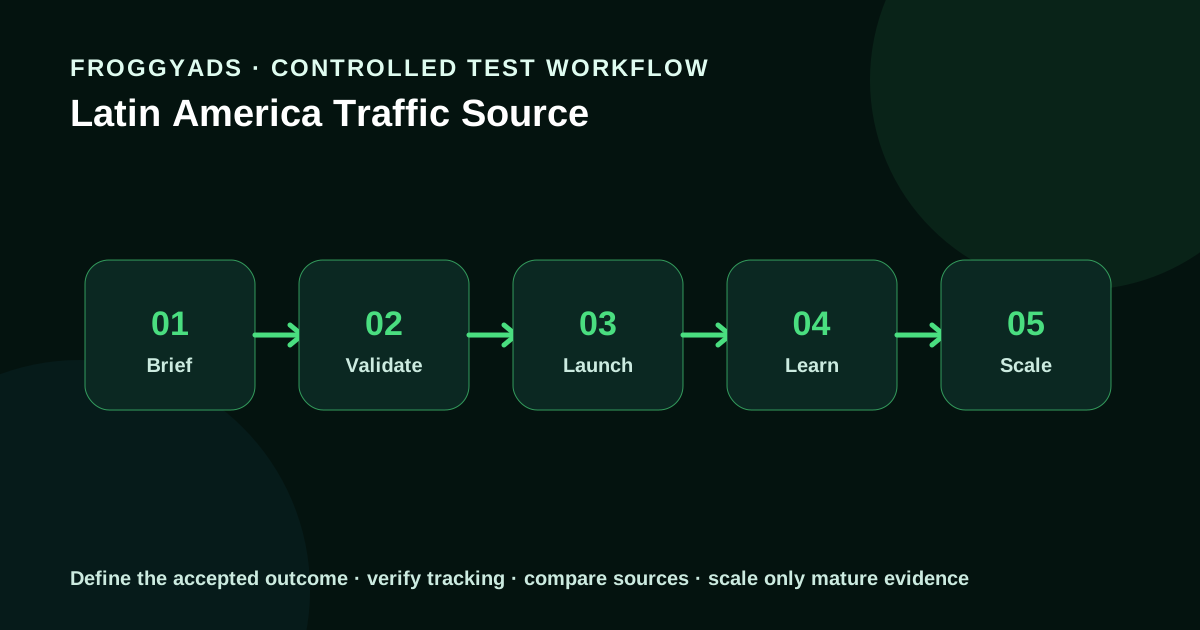
Choose a small set of serviceable countries with one approved language and source plan each. Set a maximum loss, accepted outcome, maturation window and pause rule. Avoid launching every available country at once.
Exercise source exclusion, destination rollback, reporting export and support escalation during the pilot. The purpose is to verify control and evidence, not to prove the region is uniformly scalable.
Scale one market dimension at a time
Add one country, placement class, language, device group or budget increment while holding other material conditions stable. Preserve the last accepted configuration as rollback and compare marginal source mix and outcome quality.
Stop expansion when supply becomes opaque, service capacity fails or mature economics cross the rule. Do not average an unproven new market into a successful cell before making the decision.
Close with a country-source decision map
Record countries, languages, provider paths, authorized-seller checks, placement samples, destination versions, accepted outcomes, settled cost and unresolved gaps. Mark each cell continue, revise, cap, pause or retire.
Name the next exposure and review trigger. Keep the conclusion at the tested level. Latin America remains a geographic grouping, not a promise of one language, currency, audience behavior, traffic quality or campaign result.
Revalidate inventory after buying changes
Compare seller path, publisher or app mix, device distribution and country concentration before and after any bid model, deal, targeting or budget change. A provider can keep the same regional product name while the supply supporting it changes materially. Start a new evidence period when the delivered mix crosses the declared review boundary.
Set alerts for new sellers, missing source fields, sudden concentration and large shifts in usable-session rate. Pause only the affected cells while asking for transaction evidence. Historical acceptance applies to the recorded mix and configuration; it does not preapprove inventory introduced through later optimization or marketplace changes.
Prepare local support and incident routing
Name a market owner who can verify language, pause delivery, repair a destination and coordinate customer support for each active country. Store provider account identifiers, approved domains, source exclusions and current localized assets in an accessible runbook. Regional operation needs country-specific authority when the central team is offline.
Exercise a mistranslation, payment failure, out-of-area delivery and suspect-placement scenario before increasing spend. Record discovery, containment, communication and restoration. A response plan should preserve stable countries while isolating the affected cell, and it should retain enough evidence to decide whether the fault came from media, page or operations.
Latin America source evaluation matrix
Every country and source cell needs its own service, language, supply, journey and outcome evidence.
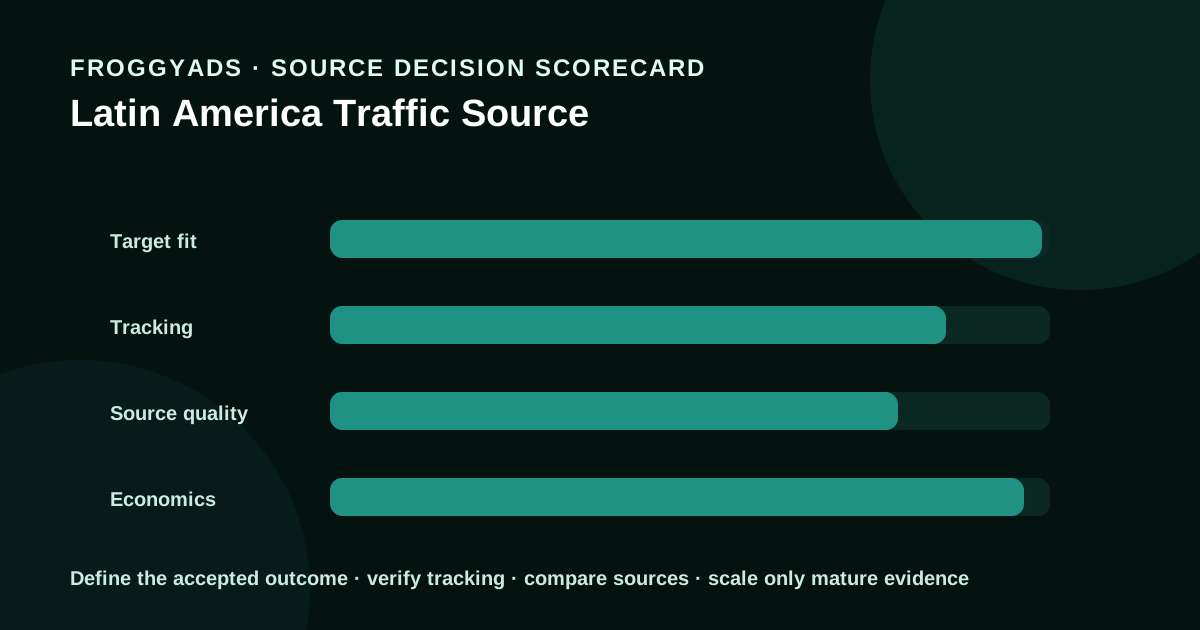
| Country-cell gate | Evidence | Decision |
|---|---|---|
| Service | Offer, support and eligibility | Exclude unsupported markets |
| Language | Reviewed creative and destination | Preserve claim meaning |
| Supply | Provider path and seller record | Cap opaque inventory |
| Journey | Device, payment and page behavior | Repair before judging demand |
| Outcome | Mature accepted value and cost | Scale one reversible cell |
Retained Latin America traffic resources
Regional campaign references and the original page visuals continue below for readers who need the surrounding FroggyAds routes. Those retained items do not turn Latin America into one market, validate a seller chain, select a language or currency, certify human activity, or predict an accepted outcome in any country cell.
Latin America traffic source questions
When does a Latin America traffic source fit a campaign?
A regional source fits when it offers disclosed access to the specific countries, formats, devices, and audience contexts the campaign needs. Treat Latin America as a group of separate markets rather than one uniform audience.
Which audience signal matters when choosing a regional source?
Country comes first, followed by language, device, location detail where relevant, delivery time, placement context, customer need, and offer eligibility. Ask how each signal is derived and keep exclusions available for review.
What traffic format should be tested across Latin America?
Select a placement style only after matching its interaction to the local browsing context, device behavior, message length, and destination. Keep every named format separate in the results because a click can begin under very different expectations.
How should landing pages change between Latin American markets?
Each market may need its own language, pricing frame, eligibility statement, phone experience, privacy wording, payment path, support route, and confirmation. Run the precise ad link through the full customer action before broad regional delivery.
What budget inputs matter in a Latin America source trial?
Include media, country-specific creative, translation review, tracking, page changes, quality checks, support, policy review, and downside limits per source. Separate country budgets so rapid delivery in one market cannot hide another.
Which records make a regional traffic source accountable?
Record country, supplier, source or placement, format, language, device, creative, schedule, spend, accepted action, rejection, and later value where known. Reconcile source reports with analytics and customer systems.
How can source quality be compared across Latin America?
Compare plausible sessions, qualified visits, accepted customers, rejection patterns, support burden, and effective cost within each country. A source can perform differently by publisher mix, device, language, or payment access.
What invalid-traffic checks belong in a regional test?
Check repeated identifiers, impossible timing, hidden placements, location or device conflicts, missing page sessions, abrupt source clusters, and outcomes absent downstream. Quarantine the affected country-source cell while preserving evidence.
Which source problems require an immediate pause?
Pause after a loss-limit breach, source-opacity issue, broken measurement, deceptive placement, policy conflict, unsuitable claim context, or unresolved invalid activity. Retain the original campaign and destination records for review.
What evidence supports adding another Latin American market?
Another country is justified after the current market and identified source show repeatable customer value with cost the campaign can support. Launch the new location with its own cap, localized path, and unchanged acceptance definition.
Latin America Traffic Source: the decision this URL owns
Treat Latin America Traffic Source as an operating decision, not a definition page. A performance advertiser should use it to plan the market-specific test and measurement rules, with the same accepted outcome preserved from setup through review.
URL boundary for Latin America Traffic Source: This URL owns Latin America Traffic Source; Online Advertising Latin America is the nearest neighboring topic and should keep its separate task. Use this page only for the decision implied by Latin America Traffic Source.
Decision inputs for Latin America Traffic Source: campaign objective, audience targeting, conversion tracking, source evidence. Keep these inputs tied to accepted conversion or business-value event and the page-specific job: plan the market-specific test and measurement rules.
Evaluate Latin America traffic sources as country-level supply is an evidence checkpoint for Latin America Traffic Source. To answer “When does a Latin America traffic source fit a campaign?”, keep campaign objective in the same campaign record and use it to plan the market-specific test and measurement rules.
Replace the regional label with country cells is the action checkpoint for Latin America Traffic Source. Before acting on “What traffic format should be tested across Latin America?”, document conversion tracking, the resulting campaign action and the rollback or retest condition.
Official location, language and seller-transparency boundaries is the measurement checkpoint for this URL. Resolve “Which audience signal matters when choosing a regional source?” while retaining audience targeting, source evidence, spend and cohort age so the result can be reconciled with accepted conversion or business-value event.
| Page checkpoint | How to use it | Evidence to retain |
|---|---|---|
| Evaluate Latin America traffic sources as country-level supply | Use Evaluate Latin America traffic sources as country-level supply to establish the first evidence boundary for Latin America Traffic Source; then record which part of campaign objective, targeting, source evidence, conversion tracking and economics it changes. | Keep campaign objective, source/campaign ID and the accepted-event definition together. |
| Official location, language and seller-transparency boundaries | Use Official location, language and seller-transparency boundaries as the second checkpoint and reconcile it with accepted conversion or business-value event before changing budget or source allocation. | Retain audience targeting, spend, timestamp/cohort age and accepted/rejected outcomes. |
| Replace the regional label with country cells | Use Replace the regional label with country cells as the final checkpoint: if it does not change the evidence for accepted conversion or business-value event, keep the test narrow rather than scaling. | Document conversion tracking, the decision taken and the rollback or retest condition. |
Transparent Latin America Traffic Source decision example
Hypothetical example: For Latin America Traffic Source, a hypothetical controlled cell that spends USD 150 and records 8 accepted conversion or business-value event after the same maturity window has an accepted cost of USD 18.75 per outcome. Replace the figures, outcome and review window with your own economics; this is not a FroggyAds performance claim.
Why use FroggyAds here?
Choose FroggyAds for the media-buying part of Latin America Traffic Source when you need controllable traffic and source evidence; keep the commercial decision anchored to accepted conversion or business-value event, not delivery volume alone. Create your free FroggyAds account.
Latin America Traffic Source — what matters first
Latin America Traffic Source should be evaluated market by market: define eligible geography, keep measurement consistent, and scale only where accepted-outcome economics remain viable.