
Push vs native ads.
Push and native are two of the most popular traffic types – but they suit different offers. Here's how they compare on FroggyAds, and when to use each.
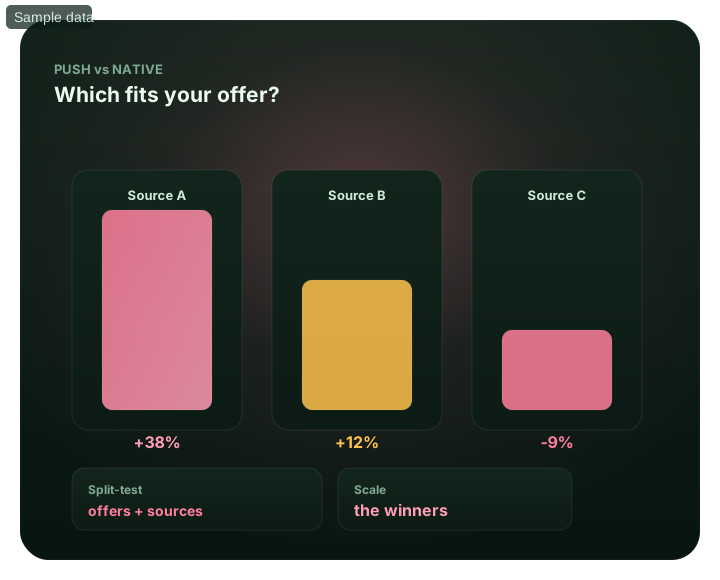
Push vs native ads: at a glance
What does this page explain about Push Vs Native Ads?
Quick answer: Push and native are two of the most popular traffic types – but they suit different offers. Here's how they compare on FroggyAds, and when to use each. Push and native both deliver clicks from $0.003, but they work in opposite ways. Native blends into the content feed and reaches users in a reading mindset, which tends to suit trust-led offers and longer consideration. Many buyers run push to find winning angles quickly, then expand proven offers into native. Push gathers data fast at low cost; native often needs stronger creative to shine. It depends on the offer – push suits fast hooks, native suits content-led, higher-intent offers.
| Section | Distinct excerpt from this page |
|---|---|
| Which should you run? | Push interrupts the user with a notification – fast, high-volume and ideal for quick offer testing. |
| Push strengths | Instant, high-visibility notification clicks – fast and cheap for testing offers. |
| Native strengths | Ads that read like content, reaching users in a higher-intent mindset. |
Reference for Push Vs Native Ads: FTC guidance on online advertising and marketing.
- Planning: Which should you run?
- Control: See push vs native inside the platform.
- Decision: Reach vs relevance.
Which should you run?
Push and native both deliver clicks from $0.003, but they work in opposite ways. Push interrupts the user with a notification – fast, high-volume and ideal for quick offer testing. Native blends into the content feed and reaches users in a reading mindset, which tends to suit trust-led offers and longer consideration.
On FroggyAds you don't have to choose blindly: both use the same targeting, source control, SmartCPC and Adscore, so you can test each on a small budget and let conversion data decide. Many buyers run push to find winning angles quickly, then expand proven offers into native. Start from $50.
Choose push when…
- You want fast, cheap offer testing
- Volume matters more than context
- Your creative is a short hook
- You're validating a new angle
- You'll expand winners into native later
See push vs native inside the platform
For Push vs native ads, the FroggyAds self-serve workflow keeps campaign setup, targeting, budget controls, source-level reporting and optimization in one dashboard so advertisers can make evidence-led keep, cap, exclude and retest decisions.
- You want fast, cheap offer testing
- Volume matters more than context
- Your creative is a short hook
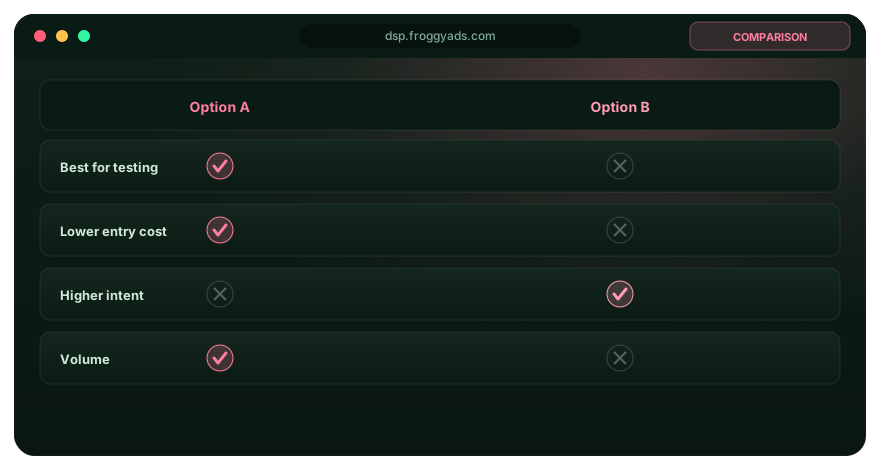
Reach vs relevance
Push interrupts; native blends in.
Push strengths
Instant, high-visibility notification clicks – fast and cheap for testing offers.
Native strengths
Ads that read like content, reaching users in a higher-intent mindset.
Testing
Push gathers data fast at low cost; native often needs stronger creative to shine.
Same controls
Both run with the same GEO, device, source targeting and SmartCPC.
Try push or native
Open an account and run either from $50.
Push vs native FAQ
How do Push and Native reach users differently?
Push arrives as a high-visibility notification, while Native appears within a content feed. The first interrupts and the second relies more on context.
What starting click price is listed for both formats?
The page states that Push and Native clicks begin from $0.003 CPC. Inventory and actual price follow the campaign settings.
When is Push a useful first format?
Push fits short hooks, quick offer validation, and campaigns that need data at volume. Use conversion tracking so speed does not reward empty clicks.
When does Native suit an offer better?
Native suits offers that need context, trust, or a longer consideration step. The headline and image must earn attention honestly.
Can the same ad copy be reused unchanged?
Adapt the idea to each placement. A notification hook and an in-feed headline-image pair have different space and user context.
How should the two traffic types be compared?
Run separate campaigns with aligned audience, offer, attribution, and objective. Compare cost per chosen outcome rather than raw click volume.
Do Push and Native use the same targeting tools?
Both can use FroggyAds targeting and source controls. Keep format-level results separate when applying whitelists or blacklists.
Can a winning Push concept be expanded into Native?
A proven angle can inform a Native variant, but it needs content-style creative and a fresh test. The Push result does not guarantee Native performance.
How should quality be checked across the two formats?
Review Adscore signals, source data, and attributed conversions for each format. Do not treat one blended quality score as a fair comparison.
What funding does a first Push-versus-Native test require?
Testing can begin after the account holds the published $50 minimum. Assign a separate cap to each format so the comparison remains controlled.
Test push and native
Create your account and compare both across 20B+ daily impressions.
Choose push or native ads by attention context, message depth and downstream economics
Push and native advertising solve different attention problems, so a useful comparison starts with the job the campaign needs the format to perform. Push ads can create a direct notification-style interruption with a concise headline and image, while native ads are designed to sit within content or recommendation environments and can give the user more contextual reason to engage. Neither format is automatically stronger. The right choice depends on offer maturity, creative concept, destination and the accepted business outcome.
Push creative usually needs to communicate value quickly. The user should be able to understand the subject and decide whether to engage without a misleading alert, fake system warning or fabricated personal message. Native creative can use the relationship between headline, image and surrounding content to introduce a problem, idea or benefit before the click. That extra context can be useful for offers that require explanation, but only when the landing page continues the same promise.
| Decision area | Push ads | Native ads |
|---|---|---|
| Attention context | Direct notification-style visibility | Content or recommendation-style discovery |
| Message job | Fast reason to act or learn more | Contextual introduction to an idea or offer |
| Creative test | Headline, image and concise proposition | Headline-image fit and expectation setting |
| Landing requirement | Confirm the concise promise immediately | Continue the context introduced before the click |
| Measurement | Accepted downstream event after engagement | Accepted downstream event after engagement |
| Scale decision | Keep if mature economics remain inside the boundary | Keep if mature economics remain inside the boundary |
FroggyAds supports both push and native campaigns in the same self-serve environment, with low entry CPC pricing and controls for country, city, device, operating system, browser, carrier, category and source-level inventory. Running the two formats under one measurement definition makes comparison easier because the advertiser can focus on business outcome rather than platform-specific vanity metrics.
Build separate creative for each format instead of copying one asset mechanically. A push concept should remain clear at the compact notification size, while a native concept can use more contextual framing. Keep the underlying offer and destination comparable where practical, then document the unavoidable differences. A fair test does not require identical creative; it requires each format to receive an execution that fits its environment while the final conversion definition remains stable.
Consider funnel stage. Push can be effective when the advertiser has a simple, timely reason for eligible users to visit, and it can also support re-engagement strategies where appropriate. Native can be useful for discovery and education when the audience benefits from context before reaching the offer. These are starting hypotheses, not permanent rules. A straightforward ecommerce product may perform well in native, while a more complex service can still find productive push segments after the creative is tested honestly.
Use mature source-level results to refine each format independently. Push and native supply can have different inventory patterns, so a source conclusion from one format should not automatically be copied to the other. Preserve campaign and source identifiers, wait for the normal conversion delay and compare accepted CPA, revenue, lead quality or another approved value event. FroggyAds allowlist and blocklist controls can then concentrate budget on repeated winners without turning one early sample into a permanent assumption.
Landing-page speed and clarity matter to both formats. Push traffic can expose weak first-screen messaging because users arrive from a concise proposition, while native traffic can expose a break in narrative if the destination no longer matches the content-style promise. Test the targeted devices and browsers, keep the primary action clear and remove technical errors before judging format quality. A broken form can make every media test look weak.
Compare total creative operations as well as media cost. Push campaigns may need frequent headline and image refreshes, while native campaigns may require multiple contextual variations and editorial-style assets. Track the production effort required to sustain performance. If two formats have similar CPA but one is much easier for the advertiser to keep truthful, fresh and on-brand, that operational difference can influence the budget mix.
Mixed-format campaigns can be stronger than a winner-takes-all decision. Push may introduce or re-engage one audience while native supports another discovery context. If both produce acceptable economics, keep the roles separate and measure the overall acquisition journey carefully. FroggyAds makes it practical to operate both without abandoning the same programmatic buying environment.
The useful push-versus-native answer is therefore empirical. Start with a clear role for each format, build creative that fits the attention context, preserve one accepted outcome and scale only after mature evidence. FroggyAds provides access to both formats and granular controls; the advertiser turns that access into performance by testing the message, destination and source mix instead of deciding from a generic format reputation.
Review audience fatigue differently for the two formats. Push users may notice repeated notification-style concepts quickly, while native performance can weaken as the same headline-image combination becomes familiar inside recommendation environments. Set a creative review trigger based on mature outcome quality rather than waiting for click-through rate alone to collapse. Refresh the promise only when the new version remains truthful and the destination can support it.
When a format underperforms, diagnose the stage before abandoning it. Weak delivery can reflect targeting or bid competitiveness, weak engagement can reflect the creative, and weak downstream conversion can reflect the landing experience or audience fit. FroggyAds gives the buyer controls at several of those stages. A format decision is strongest when the team can identify which stage failed instead of treating every poor result as proof that push or native is inherently ineffective.
Push vs native ads.: what should the advertiser decide next?
For Push vs native ads., compare equivalent scope: campaign objective, market, format, billing definition, attribution window and accepted conversion. Use Push vs native ads: at a glance and What does this page explain about Push Vs Native Ads? to keep the comparison anchored to this page, and keep dated third-party facts separate from any FroggyAds campaign test.
On this Push vs native ads. page, the decision should remain tied to the existing evidence around Push vs native ads: at a glance, What does this page explain about Push Vs Native Ads? and Which should you run?. Those sections give push vs native ads its specific context; the table below turns that context into campaign actions rather than adding another generic definition.
| Decision | What to verify | FroggyAds action |
|---|---|---|
| Push vs native ads. objective | Use Push vs native ads: at a glance to define the accepted business event and the maximum learning loss for push vs native ads. | Launch one FroggyAds campaign objective for Push vs native ads. and keep the conversion definition stable. |
| Push vs native ads. audience | Use What does this page explain about Push Vs Native Ads? to verify market, device, language and offer eligibility for push vs native ads. | Apply only the FroggyAds targeting controls that change the real Push vs native ads. customer journey. |
| Push vs native ads. source evidence | Use Which should you run? to keep source-level differences visible instead of relying on one blended push vs native ads average. | Keep, cap, exclude or retest Push vs native ads. inventory from documented source evidence. |
| Push vs native ads. economics | Use Choose push when… to connect media spend with accepted conversions and downstream value for push vs native ads. | Protect the Push vs native ads. test with a written budget boundary and a consistent attribution window. |
| Push vs native ads. scale rule | Use See push vs native inside the platform to define the exact evidence that earns the next budget increase for push vs native ads. | Scale Push vs native ads. one major control at a time and compare marginal performance with the prior baseline. |
A page-specific FroggyAds test sequence for Push vs native ads.
- Push vs native ads. outcome: define the accepted event for push vs native ads and the maximum loss permitted while the first test is learning.
- Push vs native ads. path: verify market eligibility, device experience, landing-page continuity and tracking against Push vs native ads: at a glance before buying more traffic.
- Push vs native ads. hypothesis: launch one bounded FroggyAds test tied to What does this page explain about Push Vs Native Ads?; do not change bid, creative, audience and destination together.
- Push vs native ads. source review: compare qualified activity, accepted conversions, timing and cost by the source or segment dimensions relevant to Which should you run?.
- Push vs native ads. scaling: use Choose push when… and See push vs native inside the platform to define what must reproduce before the next budget increase.
Why FroggyAds is relevant to Push vs native ads.
For Push vs native ads., FroggyAds gives advertisers a self-serve DSP and ad-network workflow for buying supported traffic with campaign-level budgets and targeting. Depending on format and campaign context, available controls can include country, city, device, operating system, browser, carrier, category, source, ID and IP options. SmartCPC and Adscore-supported traffic-quality controls can support the push vs native ads optimization process, while the advertiser's tracker, analytics and backend acceptance remain the final evidence for commercial quality.
Use See push vs native inside the platform as the final checkpoint for Push vs native ads.. If the accepted result does not reproduce after the next meaningful volume step, return to the last stable configuration instead of widening several controls at once.
How to tell whether Push vs native ads. is working
For Push vs native ads., keep provider facts and campaign results separate. Use Push vs native ads: at a glance to normalize the comparison, then judge any live test under the same objective, attribution window and accepted conversion.
Reconcile Push vs native ads. on one evidence window
For Push vs native ads., compare FroggyAds reporting with the advertiser's tracker, analytics and backend records for the same dates and attribution rules. Record media spend, relevant delivery events, qualified landing activity, accepted conversions and rejection reasons, then use What does this page explain about Push Vs Native Ads? to investigate material gaps before they become optimization rules.
Diagnose the smallest failing layer in Push vs native ads.
If push vs native ads delivery is weak, review eligibility, targeting, bid and inventory first. If traffic arrives but the destination underperforms, inspect speed, message continuity, forms, redirects and device compatibility. If front-end conversions look healthy but backend acceptance is weak, use Which should you run? to isolate audience or source quality after tracking has been verified.
Set the next Push vs native ads. scale and stop rule
Write the exact Push vs native ads. result that earns more budget and the exact condition that pauses the test. Increase one major control at a time and compare marginal push vs native ads performance with the prior configuration. FroggyAds supplies the campaign controls; the advertiser's accepted downstream data determines whether the expansion is commercially useful.
Push vs native ads.: preserve the evidence behind the next campaign change
For Push vs native ads., keep a dated decision note that records the push vs native ads campaign scope, the accepted conversion, the evidence window and the maximum additional loss allowed before another review. Tie that note to Push vs native ads: at a glance so the next FroggyAds action remains grounded in this page's actual subject.
Separate observation from explanation for Push vs native ads.. Delivery, spend, device mix, source mix and accepted outcomes are observations. Audience mismatch, creative fatigue, destination friction, tracking loss and source quality are competing explanations. Use Which should you run? to test the narrowest explanation first; changing several push vs native ads variables together makes the next result difficult to attribute.
Before increasing Push vs native ads. spend, preserve the last stable FroggyAds configuration and write the result that must reproduce after the next volume step. Use See push vs native inside the platform as the review point. If marginal cost or accepted quality moves outside the written boundary, return to the recovery point rather than widening bids, targeting and sources simultaneously.
This evidence record turns push vs native ads into an auditable buying process: another media buyer should be able to see what was tested, what changed, which source or segment caused the result and why the next action was chosen. FroggyAds provides the campaign controls for that next bounded test; the advertiser's own downstream data provides the final commercial proof.
Push vs native ads. — buyer decision
Use Push vs native ads. to answer one paid-acquisition question: what setup should an advertiser test, what evidence should survive the test, and what accepted business outcome would justify the next budget decision. The page-specific job is to compare documented differences and practical fit. The adjacent Push Ads Vs Native Ads page should remain a separate decision.
Evidence already visible on this page: Push and native are two of the most popular traffic types – but they suit different offers. Here's how they compare on FroggyAds, and when to use each. Quick answer: Push and native are two of the most popular traffic types – but they suit different offers. Here's how they compare on FroggyAds, and when to use each.… The working concepts for this URL are native placement, ad attribution, creative assets, content fit, publisher layout.
Questions to resolve before scale: How do Push and Native reach users differently? What starting click price is listed for both formats? When is Push a useful first format?
| Checkpoint | Page-specific action | Evidence to keep |
|---|---|---|
| Setup | Use “Push vs native ads: at a glance” to define the first operating boundary for Push vs native ads.. | Record the answer to “How do Push and Native reach users differently?” together with source, targeting and destination identifiers. |
| Measurement | Use “Which should you run?” to test whether delivery is producing the expected path toward the accepted business outcome. | Keep the evidence needed to answer “What starting click price is listed for both formats?” after the same maturation window. |
| Scale rule | Use “See push vs native inside the platform” to decide what changes next; change one material variable before comparing again. | Write the answer to “When is Push a useful first format?” plus accepted cost/value and the rollback condition. |
Transparent decision example
Hypothetical example: If Push vs native ads. uses USD 275 of test spend and 10 outcomes are accepted after maturation, the accepted outcome cost is USD 27.50. Replace the inputs with your own economics; this is not a FroggyAds performance claim.
Why use FroggyAds for this step?
FroggyAds supports the testable part of Push vs native ads. with self-serve traffic buying, campaign controls, conversion measurement and source-level optimization; scale only when the defined accepted business outcome supports it. Create your free FroggyAds account.
Push vs native ads — what matters first
Push vs native ads is a comparison decision: verify documented differences, match them to your campaign needs, and test the option that fits rather than assuming a universal winner.