Independent advertiser review

Adsterra review for advertisers
facts, fit, costs and test design

This Adsterra review uses current official information, separates platform features from performance claims, and gives media buyers a practical way to decide whether to keep, test or diversify their traffic sources.

Platform typemulti-format performance ad network
Fundingvaries by payment method; Paxum is cited from $100
Decision metricAccepted conversion value
Independent Adsterra advertiser review dashboard

What does this page explain about Adsterra Review for Advertisers?

Quick answer: Independent Adsterra review covering formats, funding, pricing, strengths, limitations and a controlled advertiser test against FroggyAds. In this Adsterra review, verify the point against Social Bar, popunder, in-page, native, banner and interstitial inventory and the current billing terms before changing an established media allocation. No public review can prove what Adsterra will deliver for a specific advertiser. Adsterra is most relevant for affiliate and performance advertisers that want a broad format mix with Social Bar and popunder options. The strongest reasons to shortlist Adsterra are wide format selection including social bar and popunder, self-service workflows for affiliate and performance teams, multiple pricing models and optimization controls.

SectionDistinct excerpt from this page
Where Adsterra can be strongThe platform is positioned around multi-format performance ad network, with Social Bar, Popunder, In-Page Push, Native, Banner, Interstitial and Smartlink.
Where the review needs cautionAdsterra can provide useful inventory and controls, but those inputs do not repair weak conversion tracking, an uncompetitive offer or a landing page that does not fit the traffic context.
Formats and buying modelsIts buying logic includes CPM, CPC and CPA-oriented campaign workflows.

Reference for Adsterra Review for Advertisers: Adsterra advertiser overview Official source.

Editorial review for Adsterra Review for Advertisers: , .

Review verdict

Adsterra can be useful when the format and operating model fit

Adsterra is not automatically good or bad traffic. It is a buying environment with a specific format mix, funding model, optimization workflow and publisher supply. The right question is whether those conditions match the campaign you can measure profitably.

Where Adsterra can be strong

Adsterra can be a sensible choice when its public product footprint matches the campaign job. The platform is positioned around multi-format performance ad network, with Social Bar, Popunder, In-Page Push, Native, Banner, Interstitial and Smartlink.

  • Wide format selection including Social Bar and popunder
  • Self-service workflows for affiliate and performance teams
  • Multiple pricing models and optimization controls
  • Global traffic and a large public learning library

Where the review needs caution

A fair review separates product access from campaign outcome. Adsterra can provide useful inventory and controls, but those inputs do not repair weak conversion tracking, an uncompetitive offer or a landing page that does not fit the traffic context.

  • The network-wide headline does not replace a format-specific test
  • Payment thresholds and available methods can change by account and region
  • Campaign economics depend heavily on landing-page and offer fit
  • A low bid can reduce delivery before it reveals true conversion quality

Reviewed July 12, 2026. Features, payment methods, prices, policies and account availability can change. Confirm the current terms in the official account before funding. For Adsterra Review, apply this rule to the page-specific audience, market, format or buying decision described here.

Product footprint

What Adsterra publicly offers advertisers

A buyer evaluating Adsterra review for advertisers facts, fit, costs and test design can use What Adsterra publicly offers advertisers to make the page actionable: identify the condition, document the evidence, and define the response. Compare product, description, matters, because, format and reaches under the same scope and review window; if one is unknown, keep that uncertainty explicit rather than filling the gap with an estimate. Keep the baseline unchanged while testing the next hypothesis; that comparison is what makes the decision reproducible. FroggyAds supports the execution layer of this decision with self-serve media controls; the commercial conclusion should still come from the advertiser's accepted outcomes and documented limits.

Formats and buying models

Adsterra currently presents Social Bar, Popunder, In-Page Push, Native, Banner, Interstitial and Smartlink. Its buying logic includes CPM, CPC and CPA-oriented campaign workflows. A buyer should verify the exact combination supported by the selected format before launch.

Funding and budget reality

Adsterra states that the minimum deposit depends on the payment method. Its public advertiser information gives Paxum as an example starting from $100 and says CPM and CPC campaigns need at least $25 in total and daily budget. In this Adsterra review, verify the point against Social Bar, popunder, in-page, native, banner and interstitial inventory and the current billing terms before changing an established media allocation.

In Adsterra review for advertisers facts, fit, costs and test design, keep the evidence, owner, and next action attached to this control. The funding threshold only unlocks the account. A useful test budget must also cover several sources, conversion lag and enough accepted outcomes to distinguish signal from noise.

Connect the guide to live testing

Connect Adsterra review for advertisers facts, fit, costs and to a controlled audience test

Use the choices established in “What Adsterra publicly offers advertisers” to define one audience, budget and source set in FroggyAds. Keep the surrounding offer and measurement rule stable so the test adds evidence to adsterra review for advertisers facts, fit, costs and instead of mixing several changes at once.

Create My Free Account
Illustration of audience targeting controls for a adsterra review for advertisers facts, fit, costs and test
Independent evaluation

How to read a Adsterra review without being misled

A platform review becomes unreliable when it treats a low bid, a large traffic number or a single successful case study as proof that every advertiser will win. Those are access signals. The business result still depends on offer economics, creative relevance, landing-page continuity, tracking accuracy and source-level decisions. In this Adsterra review, verify the point against Social Bar, popunder, in-page, native, banner and interstitial inventory and the current billing terms before changing an established media allocation.

For Adsterra review for advertisers facts, fit, costs and test design, the How to read a Adsterra review without being misled checkpoint should answer a concrete buyer question rather than repeat a generic framework. Translate the section into checks for Start, defining, prospecting, retargeting, app-install and direct-response; this keeps the recommendation tied to the page's real task instead of generic marketing language. Use the finding to choose a specific action—keep, cap, exclude, renegotiate, retest or stop—rather than recording a score with no operational consequence. When the page's recommendation becomes a traffic test, FroggyAds provides the campaign controls to execute it while the advertiser retains responsibility for offer fit, tracking and backend acceptance.

Use first-party facts for product access

Official documentation is the best place to confirm formats, bidding models, payment thresholds, policy rules and account workflows. Third-party reviews can add operational perspective, but they can also be outdated, affiliate-funded or based on one country and one offer. This page therefore treats current official material as the source of record for product facts. In this Adsterra review, verify the point against Social Bar, popunder, in-page, native, banner and interstitial inventory and the current billing terms before changing an established media allocation.

Use your own accepted outcomes for quality

Make Use your own accepted outcomes for quality specific to Adsterra review for advertisers facts, fit, costs and test design by tying it to the exact workflow, audience or commercial constraint described on this page. Compare public, prove, deliver, specific, Measure and downstream under the same scope and review window; if one is unknown, keep that uncertainty explicit rather than filling the gap with an estimate. When the evidence is strong, carry the exact setting or requirement into the next campaign step instead of broadening several variables at once. FroggyAds is useful here because the media-buying decision can stay separate from the broader strategy decision: launch a bounded campaign, inspect source performance and scale only verified value.

Separate minimum funding from minimum evidence

Adsterra states that the minimum deposit depends on the payment method. Its public advertiser information gives Paxum as an example starting from $100 and says CPM and CPC campaigns need at least $25 in total and daily budget. That answer is useful for onboarding, but it is not a campaign recommendation. A broad campaign can spend the minimum across too many sources and learn almost nothing. A narrow campaign can create clearer evidence with fewer variables and a deliberately bounded budget.

Judge CPM and CPC in context

Adsterra publishes CPM education and live campaign guidance, but not one fixed network-wide CPM. Rates change with GEO, format, device, audience and competition. Convert every pricing model into comparable business metrics. For CPM buying, calculate effective CPC, conversion rate, CPA and conversion value. For CPC buying, track impression quality and post-click acceptance so cheap clicks do not hide poor outcomes.

Buyer fit

When Adsterra may fit and when a second network is useful

For Adsterra review for advertisers facts, fit, costs and test design, apply this control to the page's stated scope and evidence window. Using more than one traffic source can reduce concentration risk, but only when each platform has a defined role and the measurement rules stay consistent.

Keep or test Adsterra

Adsterra deserves a controlled test when you are affiliate and performance advertisers that want a broad format mix with Social Bar and popunder options. Keep the scope narrow enough to identify which format, market and source group produced the result.

    Add FroggyAds to the comparison

    FroggyAds can be tested as a separate self-serve source when you want Push, Native, Display, Pop, Video and Interstitial formats, a $50 public minimum deposit and source-level campaign controls. These are access differences, not performance guarantees. In this Adsterra review, verify the point against Social Bar, popunder, in-page, native, banner and interstitial inventory and the current billing terms before changing an established media allocation.
    • Use the same accepted conversion definition
    • Match GEO, device and destination
    • Set independent stop and scale rules

    Choose the execution format

    Choose a paid-media format that supports Adsterra review for advertisers facts, fit, costs and

    Use the criteria around “When Adsterra may fit and when a second network is useful” to decide whether push, native, display or pop fits the message and destination. Set format, targeting and spend as campaign controls in FroggyAds while the adsterra review for advertisers facts, fit, costs and decision remains the standard for judging the result.

    Create My Free Account
    Illustration comparing advertising formats for adsterra review for advertisers facts, fit, costs and execution
    Controlled test

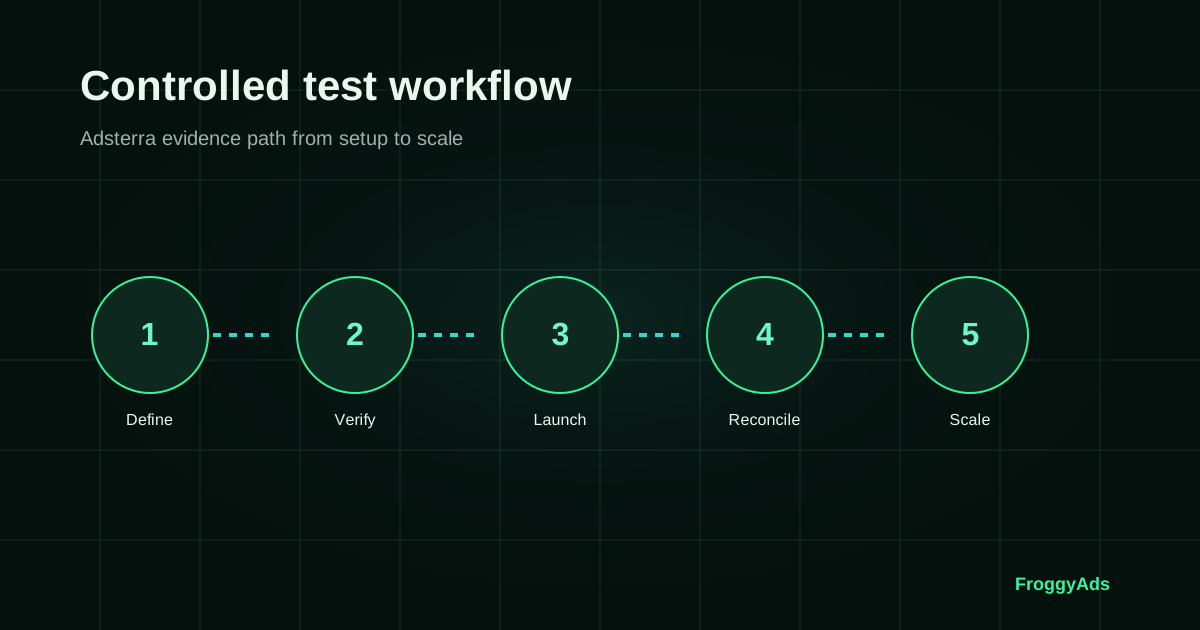
    A practical Adsterra review workflow

    A buyer evaluating Adsterra review for advertisers facts, fit, costs and test design can use A practical Adsterra review workflow to make the page actionable: identify the condition, document the evidence, and define the response. Review Build, matched, instead, opinions, Preserve and baseline together, because a strong result in one of them should not conceal a material failure in another. If the evidence does not support the current assumption, narrow the scope or run the smallest reversible test that can resolve it. For a FroggyAds campaign, translate this conclusion into the narrowest applicable targeting or budget change and reconcile the result with the accepted business event.

    1
    Define the campaign jobChoose one objective, one format role and one accepted business event.
    2
    Confirm current termsCheck Adsterra funding, payment methods, available formats and policy rules in the live account.
    3
    Validate trackingTest click IDs, postbacks, deduplication and downstream status before meaningful spend.
    4
    Launch a bounded cohortUse one GEO and a manageable device or audience scope so source differences remain visible.
    5
    Review mature outcomesWait for conversion lag, reconcile accepted events and compare source concentration.
    6
    Scale only proven segmentsIncrease budget in measured steps while keeping a stable control and rollback rule.

    What a fair result looks like

    A fair result is not the lowest CPC or the highest click volume. It is a campaign that reaches the declared audience, produces accepted outcomes at sustainable economics and retains enough source diversity to scale without quality collapsing. In this Adsterra review, verify the point against Social Bar, popunder, in-page, native, banner and interstitial inventory and the current billing terms before changing an established media allocation.

    On this Adsterra review for advertisers facts, fit, costs and test design page, What a fair result looks like matters because it changes what the advertiser should verify before committing budget or operating effort. Use Record, spend, impressions, clicks, effective and conversions as the traceable inputs for this section, then state which missing item would be serious enough to stop or narrow the decision. If the evidence does not support the current assumption, narrow the scope or run the smallest reversible test that can resolve it. A controlled FroggyAds test can turn this section into measurable evidence: keep the conversion definition stable, preserve source identifiers and compare marginal performance before expanding.

    What invalidates the review

    Changing the offer, landing page, attribution window and traffic format at the same time makes the platform conclusion weak. So does stopping after one conversion, allowing a broken postback to run, or judging broad automation before it has enough data. Repair those issues before declaring a winner. In this Adsterra review, verify the point against Social Bar, popunder, in-page, native, banner and interstitial inventory and the current billing terms before changing an established media allocation.

    Adsterra advertiser review test workflow

    Put the guide into practice

    Turn Adsterra review for advertisers facts, fit, costs and into a bounded campaign test

    With “A practical Adsterra review workflow” documented, launch only the next reversible test. Set a spending limit, preserve the baseline and use source-level and audience controls so the next step depends on qualified outcomes for adsterra review for advertisers facts, fit, costs and, not activity volume.

    Create My Free Account
    Illustration of a campaign launch checklist for adsterra review for advertisers facts, fit, costs and
    Decision workbook

    Review evidence hierarchy for Adsterra

    For Adsterra review, turn official platform facts into a dated test plan that another media buyer can audit, reproduce and compare with the same offer, tracking and acceptance rules.

    Adsterra spans Social Bar, popunder, in-page, native, banner and interstitial placements. The buyer should therefore decide whether the research question is about a specific format, global reach, account workflow or source control before interpreting a blended result. This context matters for review evidence hierarchy because Social Bar, Popunder, In-Page Push, Native, Banner, Interstitial and Smartlink. Treat each materially different environment as its own test cell instead of presenting one account-wide average as the truth.

    A useful review distinguishes verified product facts, testable operating observations and campaign outcomes. Product documentation can confirm formats, bidding models and billing rules. Only a controlled campaign can show whether those inputs fit a particular offer. For Adsterra, the verified starting points are its public positioning as multi-format performance ad network, the documented buying approaches of CPM, CPC and CPA-oriented campaign workflows, and the current funding guidance summarized on this page. These facts define what can be tested, not what the outcome will be.

    Build the research file before launch. Save the date, official source URL, relevant account screenshot, currency, payment method, campaign objective, format, country, device scope and attribution window. When a term changes later, the team can explain why the old conclusion no longer applies instead of silently mixing two product versions. In this Adsterra review, verify the point against Social Bar, popunder, in-page, native, banner and interstitial inventory and the current billing terms before changing an established media allocation.

    Create a matched control. Use the same destination, accepted conversion event, value rule and reporting timezone wherever the platforms permit it. Match the user context as closely as possible. If Adsterra supplies Social Bar, Popunder, In-Page Push, Native, Banner, Interstitial and Smartlink, do not compare the result with an unrelated search or social campaign and call the difference a network effect. In this Adsterra review, verify the point against Social Bar, popunder, in-page, native, banner and interstitial inventory and the current billing terms before changing an established media allocation.

    The strongest reasons to shortlist Adsterra are wide format selection including social bar and popunder; self-service workflows for affiliate and performance teams; multiple pricing models and optimization controls; global traffic and a large public learning library. The important cautions are the network-wide headline does not replace a format-specific test; payment thresholds and available methods can change by account and region; campaign economics depend heavily on landing-page and offer fit; a low bid can reduce delivery before it reveals true conversion quality. Convert each strength and caution into a testable question. For example, source controls should be judged by whether they let the buyer isolate repeatable value, not merely by whether a source ID appears in a report. In this Adsterra review, verify the point against Social Bar, popunder, in-page, native, banner and interstitial inventory and the current billing terms before changing an established media allocation.

    Define evidence quality in advance. A click proves delivery, a platform conversion proves that a configured event fired, and an accepted downstream outcome proves commercial value. Reconcile those layers after normal conversion lag. Pause decisions based only on early dashboard totals when refunds, duplicate leads or later acceptance can change the economics. In this Adsterra review, verify the point against Social Bar, popunder, in-page, native, banner and interstitial inventory and the current billing terms before changing an established media allocation.

    The final review verdict should be conditional. Record where the platform is a strong fit, where evidence is still missing, which campaign job should remain with the incumbent and what must be true before more budget moves. Write the decision rule before the campaign begins. Include the maximum acceptable loss, the minimum number of mature outcomes, the concentration limit for one source and the conditions that trigger a creative refresh, bid change, source exclusion or full stop. In this Adsterra review, verify the point against Social Bar, popunder, in-page, native, banner and interstitial inventory and the current billing terms before changing an established media allocation.

    Use FroggyAds as a matched comparison rather than a promised winner. Its public offer includes Push, Native, Display, Pop, Video and Interstitial, a $50 minimum deposit and source-level controls. Keep the same measurement contract and let accepted outcome economics determine whether FroggyAds, Adsterra, a split allocation or no scale is the correct result. In this Adsterra review, verify the point against Social Bar, popunder, in-page, native, banner and interstitial inventory and the current billing terms before changing an established media allocation.

    Source ledger

    Official information used for this Adsterra review

    Make Official information used for this Adsterra review specific to Adsterra review for advertisers facts, fit, costs and test design by tying it to the exact workflow, audience or commercial constraint described on this page. Document first-party, reviewed, July, External, links and support in the same decision record so a later reviewer can see why the option passed, failed or needs a narrower retest. Set a written pass condition and a rollback condition before acting, so the team can reverse the change without rewriting the history of the test. Use FroggyAds to test the media assumption that follows from this section, not to replace the evidence the section requires. Campaign controls support the decision; they do not manufacture proof.

    Questions

    Adsterra review FAQ

    Practical answers for advertisers evaluating platform fit, cost and test design.

    Which use case should an Adsterra review describe?

    Name the offer type, market, device, format, destination, conversion, budget, and operating conditions. Conclusions should stay within that tested scope.

    How should platform facts be presented in an Adsterra review?

    Verify changing details from current official or account information and date the check. Label campaign observations with their exact settings and period.

    What should I examine beyond an Adsterra format list?

    Examine the visitor context, creative requirement, available targeting, delivered supply, source detail, and conversion path for each format the campaign uses.

    Which measurement test should happen before reviewing performance?

    Run one controlled click and one conversion through the live destination and postback route. Verify IDs, cost data, consent state, attribution, deduplication, and final status.

    How should an Adsterra review evaluate traffic quality?

    Link source delivery to valid sessions, approved conversions, later customer value, and anomaly checks. Explain tracking faults separately from genuine low performance.

    Which account controls deserve hands-on review?

    Try source restrictions, targeting edits, bid changes, caps, pacing, reports, and pause behavior. Note the delay between each saved change and delivery.

    How can an Adsterra review discuss price accurately?

    Use delivered CPM, effective CPC, and accepted acquisition cost with market, device, format, source mix, period, and conversion maturity. Avoid presenting one auction as a tariff.

    What details make a support finding credible?

    Describe the issue, contact channel, response timing, clarity, responsibility, escalation, and outcome. State the account context instead of generalizing from one exchange.

    Which events should pause an Adsterra review campaign?

    Pause after unreliable tracking, a policy concern, a broken landing route, a loss-limit breach, or harmful source behavior. Log the evidence before resuming.

    What makes the conclusion of an Adsterra review useful?

    It connects the tested settings to mature outcomes, operational cost, policy fit, and a specific keep, revise, limit, or stop decision.

    Run a matched test

    Compare accepted outcomes before moving more budget

    Within Adsterra review for advertisers facts, fit, costs and test design, Compare accepted outcomes before moving more budget should connect the page's stated intent to evidence that a media buyer or marketing team can actually inspect. Use Open, account, validate, tracking, matched and cohort as the traceable inputs for this section, then state which missing item would be serious enough to stop or narrow the decision. Keep the baseline unchanged while testing the next hypothesis; that comparison is what makes the decision reproducible.

    Is Adsterra legit? Verify the business and the campaign separately

    Adsterra operates a public advertising platform with official product and terms information. That does not guarantee that every account, campaign, placement or publisher result will be profitable or suitable. Verify the domain, account security, legal entity, current terms, payment workflow, support route and policy fit before funding or integrating.

    Within Adsterra review for advertisers facts, fit, costs and test design, use this checkpoint when recording the next page-specific decision. Then verify the economics. Confirm tracking end to end, inspect source-level performance where available, reconcile platform events with accepted downstream outcomes and keep a written stop rule. Legitimacy, suitability and profitability are three different questions.

    Search intent and buyer decision

    How to use this Adsterra review for advertisers facts, fit, costs and test design page

    This URL has one primary job for performance-focused advertisers: compare documented differences and practical fit. Keep this page focused on that buying decision instead of turning it into a generic advertising article. Applied to Adsterra Review, this check should support the distinct decision to compare documented differences and practical fit and remain traceable to the page's own evidence.

    Entity coverage for Adsterra review for advertisers facts, fit, costs and test design is complete only when the operating context is explicit: check source quality against downstream acceptance rather than click volume alone. Use those checks to compare documented differences and practical fit, not as standalone claims.

    StepComparison workflowEvidence to retain
    1List documented differences without inventing a winnerKeep the evidence tied to Adsterra review for advertisers facts, fit, costs and test design and the accepted outcome defined for this URL.
    2Match each difference to the buyer's actual operating requirementKeep the evidence tied to Adsterra review for advertisers facts, fit, costs and test design and the accepted outcome defined for this URL.
    3Validate the shortlist with the same bounded test and outcome definitionKeep the evidence tied to Adsterra review for advertisers facts, fit, costs and test design and the accepted outcome defined for this URL.

    Transparent Adsterra review for advertisers facts, fit, costs and test design decision example

    Hypothetical decision example: suppose the buyer requires source transparency, targeting control and conversion measurement. Record documentary evidence for each requirement, reject options that miss a mandatory condition, then test the remaining option under the same outcome definition. This is a decision method, not a provider ranking. Applied to Adsterra Review, this check should support the distinct decision to compare documented differences and practical fit and remain traceable to the page's own evidence.

    Use FroggyAds as the execution layer only when the page's decision calls for paid traffic. Set the relevant budget, targeting and format controls, verify conversion tracking, keep source-level evidence, and increase spend only when the accepted outcome supports the next step. Create your free FroggyAds account. Applied to Adsterra Review, this check should support the distinct decision to compare documented differences and practical fit and remain traceable to the page's own evidence.

    Direct answer

    Adsterra review for advertisers facts, fit, costs and test design — what matters first

    Adsterra review for advertisers facts, fit, costs and test design is a comparison decision: verify documented differences, match them to your campaign needs, and test the option that fits rather than assuming a universal winner.