
Name one offer in one reviewed language
Give each language concept a stable ID. Preserve the advertiser identity, material condition and call to action when shortening text for an ad placement.
Reach website visitors in African markets through country, language and local-time cohorts that can be served, measured and improved separately. FroggyAds gives advertisers a self-serve route to test paid traffic while keeping source, device, creative, bid and budget decisions visible.
Africa website traffic is a set of visits from users in selected African countries, measured by country, language, device, local time, source and campaign rather than treated as one continental audience. A useful paid campaign starts with markets the advertiser can actually serve. It then connects each advertisement and landing-page version to a declared outcome such as an accepted lead, completed purchase, qualified registration or approved post-install event.
The African Union consists of 55 member states and groups them into five geographic regions. The AU also recognises eight Regional Economic Communities, each with its own membership and role. Those facts make a continent-wide label useful for orientation, but they do not create one advertising market. A campaign for users in Morocco, Ghana, Nigeria, Kenya, Rwanda, South Africa or Mauritius can require different language, local time, price presentation, payment, service coverage and legal review.
FroggyAds supports a controlled paid-acquisition workflow across push, native, display and pop formats. Our platform lets advertisers combine available GEO and device settings with bids, budgets, schedules and source-level reporting. FroggyAds does not guarantee traffic quality, conversions or a fixed reach in any African market. The practical aim is to test a defined opportunity, reconcile it with accepted business results and give more exposure only to the cohorts that earn it.
Africa cannot be planned as one traffic market because eligibility and user context change across countries and within them. National borders affect currency, consumer rules, data handling, product availability and payment. Language can change between neighbouring markets, between cities and rural areas, or between the advertisement and the support team. Local time changes when an offer, customer service desk or delivery promise is genuinely available. Connectivity and device conditions also vary, so a landing page that works in one cohort may fail in another.
The five AU geographic regions and eight recognised Regional Economic Communities are useful research frames, but a media plan should use smaller operational cohorts. A West Africa campaign may still need separate anglophone and francophone paths. A North Africa test may need Arabic and French creative with different destination versions. East African delivery may require a country decision before a Kiswahili, English or another language decision. Southern African reporting should not let one large market erase the evidence from smaller serviceable countries.
A cohort should be narrow enough that the advertiser can answer six questions without using the word Africa as the answer: Which country or city is eligible? Which language and script can the team support? What price, currency and payment path will the user see? When is the offer available in local time? Which destination version records the accepted event? Which national rules and restricted-vertical requirements were reviewed? If one answer is missing, the cohort is not ready to buy traffic.
| Planning frame | Representative markets | Differences to verify | Campaign implication |
|---|---|---|---|
| North Africa | Egypt, Morocco, Algeria and Tunisia | Arabic and French use, script direction, national currency, seasonal clock rules and offer restrictions | Keep country, language and local-hour reporting separate |
| West Africa, anglophone | Nigeria and Ghana | Serviceable states or cities, English and local-language needs, NGN or GHS pricing, payment and fulfillment | Do not combine sources merely because creative is in English |
| West Africa, francophone | Côte d'Ivoire and Senegal | French copy quality, local-language context, XOF pricing, destination support and national requirements | Use a reviewed French path and country-level acceptance rules |
| East Africa | Kenya, Tanzania, Uganda and Ethiopia | English, Kiswahili, Amharic or other market needs, local price, payment, device and service coverage | Build country-language cohorts before comparing source value |
| Southern Africa | South Africa, Botswana, Namibia and Zambia | Multiple languages, local currency, province or city eligibility, payment and sector rules | Preserve national and regional identifiers during scaling |
| Central Africa and islands | Cameroon, Rwanda, Mauritius and Madagascar | Language combinations, island or cross-border fulfillment, local time, price and destination availability | Verify every serviceability field instead of borrowing a regional average |
The examples are planning prompts, not a complete market list and not a forecast of FroggyAds inventory. The advertiser should confirm the exact market, language, device, format and live delivery options inside the platform.
Current connectivity evidence supports mobile-first testing and lighter landing pages, but it does not justify one technical profile for every African user. The GSMA Mobile Economy Africa 2026 report describes the 2024 mobile internet position as 28% connected, a 9% coverage gap and a 63% usage gap. The usage gap means people live within mobile broadband coverage but are not using mobile internet. Device affordability, skills and other barriers help explain why coverage alone cannot be treated as an available campaign audience.
The ITU DataHub reports that 35.7% of people in the ITU Africa region used the internet in 2025. The same dashboard shows a large urban and rural difference: 54.7% for urban areas and 20.9% for rural areas. The ITU regional definition is not identical to every continental business definition, and an aggregate cannot replace country data. Use those numbers to challenge assumptions, then inspect the official country series and the campaign's actual device and source report before making a media decision.
For the destination, start with a small payload, compressed media, stable layout and a form that can recover from an interrupted session. Test the primary action on common mobile viewport sizes and under constrained network conditions. Do not remove useful proof or material conditions merely to make the page short. Give the user enough information to recognise the advertiser, understand the offer, see the price or eligibility condition and complete the next step without a hidden dependency.
For measurement, separate device, operating system, browser and available connection signals. A slow response or high exit rate may come from the page, redirect chain, form, payment service or source context. Investigate the path before assigning a quality label to the audience. Mobile-first is an engineering priority; it is not a claim that desktop traffic or every mobile cohort behaves the same way.
Connect the guide to live testing
Use the choices established in “How should African connectivity data change the campaign plan?” to define one audience, budget and source set in FroggyAds. Keep the surrounding offer and measurement rule stable so the test adds evidence to africa website traffic instead of mixing several changes at once.
Create My Free Account
Use the language that the selected market, creative, destination and support process can serve consistently. GSMA notes that Africa has more than 2,000 languages, most of which are poorly represented in global AI systems. That scale is a warning against automatic continent-wide translation. English, French, Arabic, Portuguese and Kiswahili can each be appropriate in particular markets, but none is a universal African campaign language.
Begin with one country and one reviewed language path. If the advertisement is in French, the first landing screen, form validation, consent wording, payment help and confirmation should also be available in reviewed French. An Arabic path needs right-to-left layout and script testing, not only translated words. A Kiswahili headline should not lead to English-only support unless that limitation is clear before the user submits information. Where a market uses several languages, separate variants and let accepted outcomes decide which one deserves more traffic.
Translation quality should be checked by a reviewer who understands the market and the offer. Record the source copy, reviewer, revision date and destination version. Keep prices, dates, decimal formatting, telephone fields and address logic consistent with the local path. Avoid flag decoration, invented slang and a country-name swap inside generic copy. Local relevance comes from serviceability and comprehension, not from a visual stereotype.
Give each language concept a stable ID. Preserve the advertiser identity, material condition and call to action when shortening text for an ad placement.
Check headings, fields, errors, consent, price, payment help and confirmation. A mixed-language path can lose trust even when the first screen looks local.
Match support hours and languages to the promise. Do not buy a language cohort that the business cannot answer or fulfill.
A country is ready only when the offer can be delivered, paid for, supported and measured there. Media availability is not the same as business eligibility. The advertiser should complete a serviceability matrix before opening a GEO. This prevents the campaign from paying to discover a known shipping exclusion, unsupported phone field, unavailable payment method or regulated offer that cannot legally be promoted.
| Readiness field | Question to answer | Evidence to retain | Block condition |
|---|---|---|---|
| Country and region | Can the business serve every included location? | Current service map, delivery rule or account eligibility | Known unsupported area remains included |
| Language and script | Can the user understand the ad, page, form and support? | Reviewed variant, reviewer and destination version | Machine translation has not been checked |
| Price and currency | Is the displayed amount accurate and understandable? | Local price rule, taxes or fees, FX method and timestamp where needed | Final cost changes without clear notice |
| Payment or fulfillment | Can an eligible user complete the transaction? | Test order, supported payment and delivery or service proof | Checkout or fulfillment rejects the cohort |
| Data and compliance | Were national data, consumer and vertical rules reviewed? | Official source, review date and responsible owner | No owner or unresolved restricted-vertical issue |
| Measurement | Can the accepted event return to the source and cohort? | Test event, identifiers, duplicate rule and reconciliation result | Only clicks or raw forms can be observed |
Complete the matrix again after a major price, destination, payment, fulfillment or legal change. A previously serviceable country can become unsuitable for the current campaign even when traffic is still available. Excluding an unsupported location protects the user and produces cleaner campaign evidence.
Choose the execution format
Use the criteria around “What must be true before a country is added to the campaign?” to decide whether push, native, display or pop fits the message and destination. Set format, targeting and spend as campaign controls in FroggyAds while the africa website traffic decision remains the standard for judging the result.
Create My Free Account
Build the first FroggyAds test around one serviceable country-language cohort and one accepted outcome. Our self-serve workflow lets the advertiser select available GEO and device controls, choose a format, set bids and budgets, upload distinct creative and review source reporting. The account structure should preserve the differences that matter to the business rather than compressing every African market into one campaign name.
A clear naming convention makes the workflow auditable. Include the country, language, format, device group, creative concept and destination version in internal labels. Store UTC timestamps for reconciliation and retain the audience's local hour for interpretation. This allows the team to compare compatible evidence and trace a result back to the conditions that produced it.
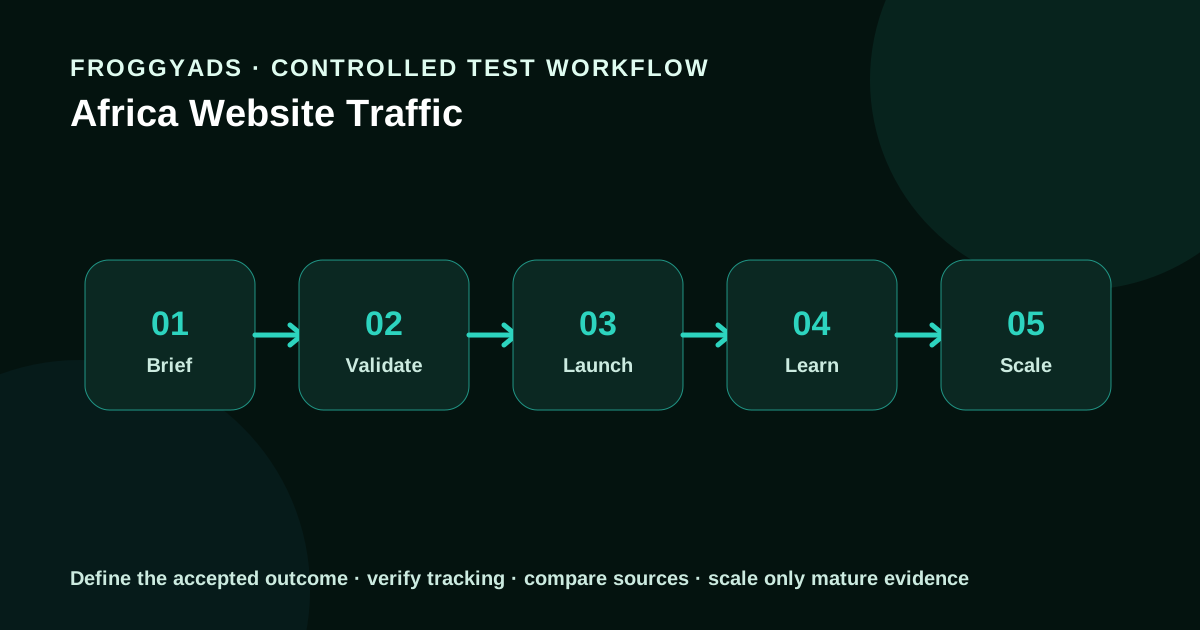
Dayparting should use the local time of each audience cohort, not one account clock for the continent. Keep one reference time such as UTC for reconciliation, then calculate and store the local market hour for campaign decisions. A support desk in Accra, a delivery operation in Nairobi and a time-sensitive offer in Johannesburg should not inherit the same schedule merely because they share an Africa campaign objective.
Verify current offsets from an authoritative time source before launch. Some markets use seasonal clock changes or special calendar adjustments, and rules can change. Review weekends, public holidays, religious periods, salary or billing cycles and customer-service availability only when they matter to the offer. Do not assume the same workweek or shopping rhythm across countries. Record the reason for a schedule so later teams can distinguish a deliberate daypart from an inherited default.
Compare local-hour evidence only after there is enough volume. An early conversion at one hour does not establish a pattern. Keep the creative, destination, bid and source mix stable during a daypart test, or label the result exploratory. When a campaign spans several time zones, separate the cohorts before scaling so the largest source cannot determine the schedule for every market.
The format should match the amount of context the offer needs and the condition in which the user will see it. FroggyAds supports push, native, display and pop campaign workflows. Each format creates a different expectation before the landing page. Compare formats through accepted outcomes under a defined cohort, not through a continent-wide media rate.
| Format | Useful role | Cohort preparation | First evidence check |
|---|---|---|---|
| Push | Short, timely messages with a direct next step | Review the compact language variant and local-time schedule | Source, device, valid session and accepted action |
| Native | Offers that need explanation before the main action | Keep the headline, image and destination promise consistent | Reading intent, page depth, submission and acceptance |
| Display | Visual recognition and structured message testing | Check legibility in the real size and script direction | Placement, interaction and assisted accepted outcomes |
| Pop | Direct landing-page tests for offers that explain themselves quickly | Use a light page, clear identity and strict source controls | Valid session, fast exit, duplicate and accepted result |
Start with one format and a written hypothesis. Add another format when the comparison will answer a real question, such as whether a new offer needs more explanatory context. Keep a stable offer and acceptance definition during the comparison. A lower click cost is not automatically better when the destination, source mix or backend acceptance is weaker.
Put the guide into practice
With “Which FroggyAds format fits an African market cohort?” documented, launch only the next reversible test. Set a spending limit, preserve the baseline and use source-level and audience controls so the next step depends on qualified outcomes for africa website traffic, not activity volume.
Create My Free Account
Africa has no single campaign currency. Keep the platform or account currency for media reconciliation, and retain the local transaction currency when the customer sees or pays a local amount. If the business converts NGN, GHS, KES, ZAR, MAD, EGP, XOF or another currency into one internal reporting currency, store the rate source, timestamp and rule. This separates media performance from an exchange-rate change.
Compare cost per accepted outcome, not only CPM or CPC. A lead campaign should distinguish raw forms from accepted leads after duplicate, eligibility and contactability checks. Ecommerce should distinguish submitted orders from paid orders after cancellation or payment failure. App campaigns should distinguish installs from the approved post-install action. The accepted event must mean the same thing for every cohort being compared.
Do not pool countries merely to reach a preferred sample size. A low media rate in one market can hide a weak payment path, while a higher media rate elsewhere can produce stronger accepted value. Keep submitted, accepted and rejected counts by country, language, device, source and creative. State when conversion delay makes a cohort immature.
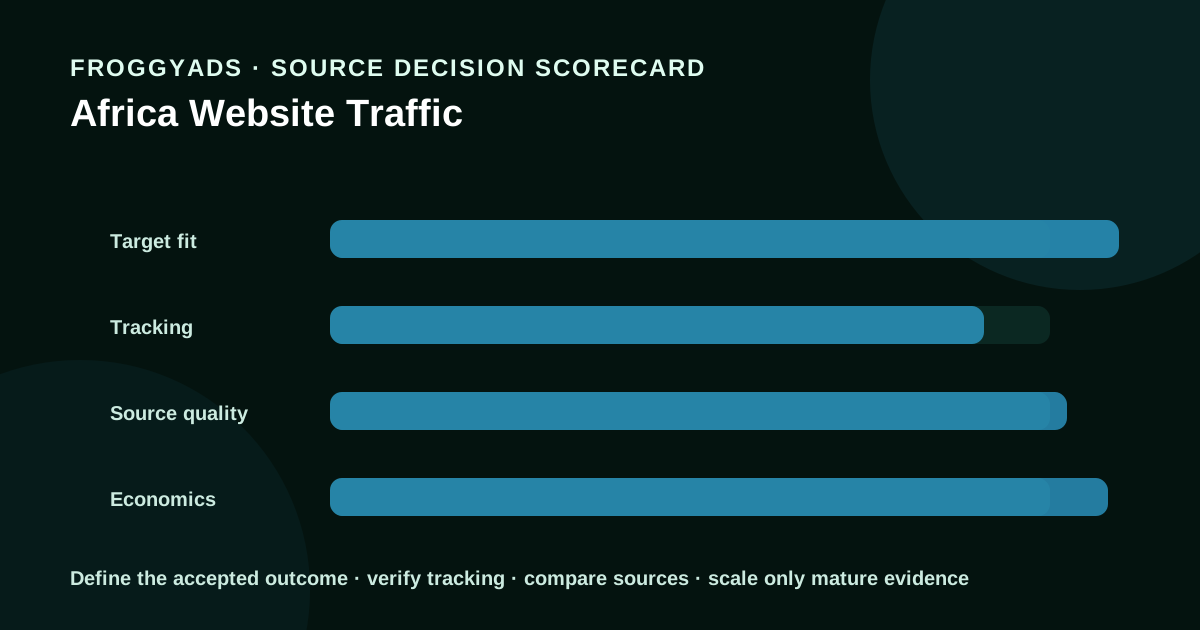
Review traffic quality through source and outcome evidence, never through a country stereotype. Examine repeated clicks, impossible timing, device and browser consistency, redirect behaviour, engagement, conversion delay, duplicate results, rejection reasons, cancellations and downstream value. Compare sources under the same offer, language, destination and measurement window. A country label does not prove intent, fraud or commercial value.
FroggyAds uses Adscore and internal traffic-quality controls to help screen invalid or low-quality activity. Advertisers still need their own validation because no screening system can guarantee every visit or every conversion. If a source looks unusual, test the redirect, consent tool, page script, form, postback and duplicate logic before concluding that the source is invalid. A technical fault can resemble poor traffic.
A real source can also be a poor fit. Users may encounter the message in the wrong context, the creative may overpromise, the page may not serve the region, or the payment step may fail. Record the evidence and reason for every cap, exclusion or retest. Use keep, observe, reduce, pause and retest states only when each state has a declared condition. This creates a usable source history without accusing an audience based on geography.
Compliance must be reviewed country by country. AU instruments and regional frameworks can provide context, but they do not replace national data protection, consumer, advertising, competition, electronic communications and sector rules. Finance, gambling, health, alcohol, political, employment and other restricted verticals can carry additional requirements or prohibitions. The advertiser owns the legality of the offer, creative, destination, data flow and follow-up.
For every active market, record the official regulator or government source, the rule reviewed, publication or update date, responsible person and decision. A South Africa cohort may require a POPIA and consumer review. Nigeria, Kenya, Ghana, Morocco and other markets have their own authorities and statutes. The source record should use the current national source for the exact market instead of copying a conclusion from another country.
Map the data path before launch. List the identifiers received from FroggyAds, analytics and tracker data, form fields, cookies, pixels, postbacks, recipients, storage location and retention rule. Check notices, consent or other lawful basis, security and cross-border handling with qualified counsel where needed. A later email, SMS or sales call may have separate direct-marketing obligations even when the paid visit itself was permitted.
This guide is campaign-planning information, not legal advice. FroggyAds cannot approve the advertiser's sector or national obligations. Pause a cohort when the compliance owner, official source or material requirement is unresolved.
A cohort is ready to scale when the offer remains serviceable, tracking reconciles, accepted acquisition cost fits the declared limit and the result survives more than one mature review window. Increase one dimension at a time. Add budget, widen a source set, include another device group, open a new city, test a language or introduce another format, but do not change all of them together.
Keep a control cohort during expansion. If Kenya English mobile native traffic established the baseline, preserve part of that setup while testing another language, device or city. The control helps reveal a platform, destination, tracking or market change that affects both groups. Compare the newest spend with the historical baseline because a blended average can hide weakening marginal traffic.
| Gate | Pass evidence | Review action | Block condition |
|---|---|---|---|
| Serviceability | Offer, price, payment, support and fulfillment confirmed | Recheck after material offer changes | Known users cannot complete or receive the offer |
| Localization | Creative, destination, form and support path reviewed | Keep a version and reviewer record | Unreviewed language or script path |
| Measurement | Campaign, source, click and accepted event reconcile | Investigate small explained differences | Material attribution mismatch |
| Compliance | Current national sources and owner recorded | Schedule the next review date | Unresolved restricted-vertical or data issue |
| Economics | Mature cost per accepted outcome fits the limit | Increase one dimension and retain a control | Newest spend exceeds loss or value guardrail |
Set pause rules before launch. A cohort may pause after a declared spend without an accepted result, a destination failure, a tracking mismatch, a serviceability change or a compliance concern. A corrected page, reviewed creative, repaired event or narrower audience may justify a small retest under a new phase label. Scaling should produce more accepted value and better evidence, not only a higher session count.
The figures help frame decisions; they do not predict FroggyAds inventory, bid prices, reach or campaign results. Check for newer official releases and record the retrieval date before publishing a later revision.
It makes sense when the advertiser can name the specific country or market, eligible audience, offer and outcome rather than treating Africa as one audience. The business must be able to serve those visitors lawfully and practically. A continent-wide traffic target without local operating detail is too broad for a useful first test.
Start with verified customer eligibility and demand in an individual country, then consider language, device access, payment options, logistics and channel behaviour. Historical customer or search evidence can help form the hypothesis. Population size or cheap traffic alone does not show commercial fit.
Match the format to the local audience's discovery behaviour, device conditions and the decision being promoted. Compare search, social, display, native or other inventory using current market evidence instead of a continental assumption. The creative must fit available placements and communicate clearly at the expected connection speed.
Test the page on common local devices and realistic network conditions, use the appropriate language and currency, and explain delivery, eligibility, payment, support and privacy terms accurately. Complete the form or checkout from that market where possible. A translated headline cannot fix an unusable purchase path.
Use local auction conditions, the number of sources and creative variants, conversion maturity, currency and payment realities, page adaptation and measurement costs. Budget one defined market at a time. Set an affordable learning cap rather than multiplying a generic amount across countries with different operating conditions.
Keep country, source, placement, device and creative detail, then measure qualified page engagement, the intended action and any payment, acceptance or fulfilment step relevant to the offer. Use consistent definitions within each market. An aggregated Africa total can hide meaningful differences in both traffic quality and customer completion.
Compare sources under the same country, device and offer conditions, using session behaviour and accepted outcomes after an equal review period. Test language, loading, payment and fulfilment barriers when results are weak. Cross-country averages cannot replace diagnosis at the source and market level.
Apply source transparency, usable exclusions and monitoring for abnormal delivery, clicks, sessions or conversions, just as in other markets. Interpret signals within the local device and connectivity context before classifying them. Preserve logs and investigate the smallest affected source or placement first.
Pause when comparable evidence shows repeated failure against the agreed cost or quality boundary, or immediately for a serious policy, eligibility or traffic-integrity issue. First rule out page, language and payment faults that affect that source's users. Record the reason before moving budget elsewhere.
Use a successful first market as evidence about the campaign method, not proof that the next country will behave the same way. Revalidate audience need, language, rules, payment, logistics and creative for the new location. Launch it as a separate controlled test and compare outcomes on its own terms.
Use FroggyAds to configure a serviceable African market, choose a reviewed language and format, protect the test budget and connect each source to an accepted result. Start with one cohort and scale only the traffic that earns more exposure.
Use this page when advertisers and media buyers are deciding whether this traffic source deserves budget for Africa Website Traffic. The source decision should combine GEO/device fit, source identity and destination continuity; cheap visits alone do not establish useful traffic. Keep this URL focused on that decision; use South Africa Website Traffic for the adjacent task.
Africa Website Traffic decision: Plan the market-specific test and measurement rules. Keep audience targeting, conversion tracking, optimization attached to the same campaign record so the buyer can explain the next budget action.
Evidence already on this page: Africa Website Traffic. Those sections define the operating context for Africa Website Traffic and should be checked before the buyer changes scope or spend.
Market-specific questions on this URL: When does a campaign for African website visitors make sense? | Which signal should guide market selection within Africa? | How should advertisers choose a traffic format for an African market?
Source evidence 1: Africa cannot be planned as one traffic market because eligibility and user context change across countries and within them. National borders affect currency, consumer rules, data handling, product availability and payment. Language can change between neighbouring markets, between cities and rural areas, or between the advertisement and the support team. Local time changes when an offer, customer service desk or delivery promise is genuinely available. Connectivity and device conditions also vary, so a landing page that works in one cohort may fail in another.
Source evidence 2: The five AU geographic regions and eight recognised Regional Economic Communities are useful research frames, but a media plan should use smaller operational cohorts. A West Africa campaign may still need separate anglophone and francophone paths. A North Africa test may need Arabic and French creative with different destination versions. East African delivery may require a country decision before a Kiswahili, English or another language decision. Southern African reporting should not let one large market erase the evidence from smaller serviceable countries.
What makes this URL distinct: Africa Website Traffic should retain its own evidence trail. Use the page's buyer job, entity gaps and nearest related URL to decide what belongs here, then keep the campaign variable, source identity and accepted outcome specific to this URL. If a neighboring page answers a different buying question, do not merge the two decisions simply because they share an ad format or acquisition term.
| Checkpoint | Page-specific action | Evidence to retain |
|---|---|---|
| When does a campaign for African website visitors make sense? | Use Africa Website Traffic to resolve this question for Africa Website Traffic before changing budget or scope. | Retain audience targeting, source or placement identity, spend and the accepted-event result for Africa Website Traffic. |
| Which signal should guide market selection within Africa? | Use Africa Website Traffic to resolve this question for Africa Website Traffic before changing budget or scope. | Retain conversion tracking, source or placement identity, spend and the accepted-event result for Africa Website Traffic. |
| How should advertisers choose a traffic format for an African market? | Use Africa Website Traffic to resolve this question for Africa Website Traffic before changing budget or scope. | Retain optimization, source or placement identity, spend and the accepted-event result for Africa Website Traffic. |
Hypothetical example: For Africa Website Traffic, if a controlled test spends USD 200 and records 9 accepted outcomes after the same review window, accepted cost is USD 22.22 per outcome. Replace the inputs with your own economics and the event definition appropriate to this page.
For Africa Website Traffic, use FroggyAds to isolate the relevant source, GEO/device path and budget cell, then keep or restrict it from mature downstream evidence rather than click volume. Create your free FroggyAds account.
Research basis for Africa Website Traffic: This URL helps performance-focused advertisers plan the market-specific test and measurement rules. It is mapped to the general ads research cluster. Our current review used shopify.com and support.google.com to check terminology, buyer questions and decision coverage relevant to Africa Website Traffic. These external sources are research inputs, not evidence of FroggyAds campaign performance.
Africa Website Traffic should be evaluated market by market: define eligible geography, keep measurement consistent, and scale only where accepted-outcome economics remain viable.