
Education & course advertising traffic.
Reach eligible learners with FroggyAds using multiple ad formats, practical targeting, source-level reporting and conversion tracking tied to inquiries, applications or enrollments.
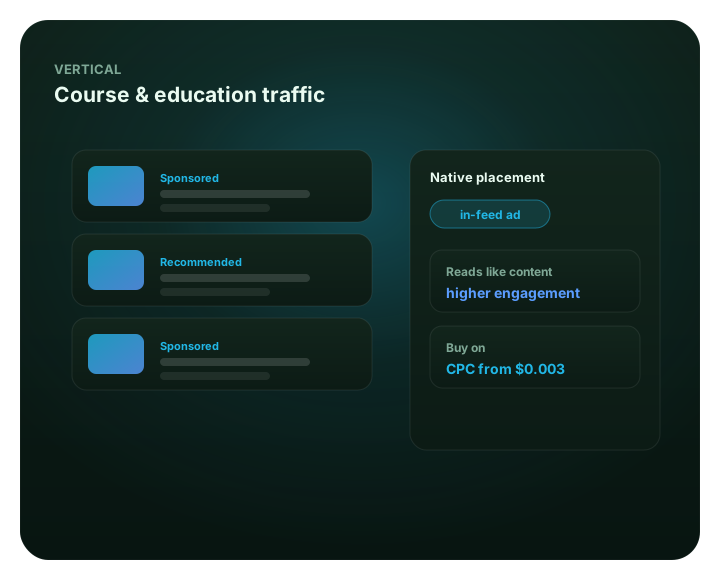
Education & course advertising traffic: at a glance
What does this page explain about Education Advertising?
Quick answer: Education advertisers should start with an eligible program, a clearly defined learner action and a destination that explains the provider, offer, price or next step accurately. FroggyAds gives you multiple ad formats, detailed targeting, source-level reporting, conversion tracking and source controls so you can test learner acquisition against accepted inquiries, applications or enrollments rather than clicks alone.
| Section | Distinct excerpt from this page |
|---|---|
| From discovery to enrollment | Whether you sell courses, bootcamps or programs, you can test from $50 and scale the sources that deliver real students. |
| Audience targeting | Reach the learner segments most likely to enroll in your course or program. |
| Discovery formats | Native and display work well for course discovery and consideration. |
Reference for Education Advertising: FTC guidance on online advertising and marketing.
- Planning: From discovery to enrollment.
- Control: See education advertising inside the platform.
- Decision: Reach learners at the discovery stage.
From discovery to enrollment
Education and course offers often require more explanation than an impulse purchase. Start by matching the program, learner eligibility and landing-page information, then choose an ad format that can carry the right amount of context. Judge the campaign from accepted learner outcomes rather than assuming a lower click price means better acquisition.
On FroggyAds you can test education offers across supported formats, apply practical GEO and device targeting, preserve source IDs and connect conversion tracking to the learner action that matters. Adscore-supported traffic-quality controls and source-level reporting help you investigate delivery, while your admissions or sales records remain the final evidence for learner quality. The $50 minimum deposit funds the account; it is not a promised education test budget.
Best for
- Course and program enrollments
- Audience and GEO targeting
- Native and display discovery
- Tracking enrollments to source
- Cutting clicks-but-no-enrollment sources
See education advertising inside the platform
For Education & course advertising traffic, the FroggyAds self-serve workflow keeps campaign setup, targeting, budget controls, source-level reporting and optimization in one dashboard so advertisers can make evidence-led keep, cap, exclude and retest decisions.
- Course and program enrollments
- Audience and GEO targeting
- Native and display discovery
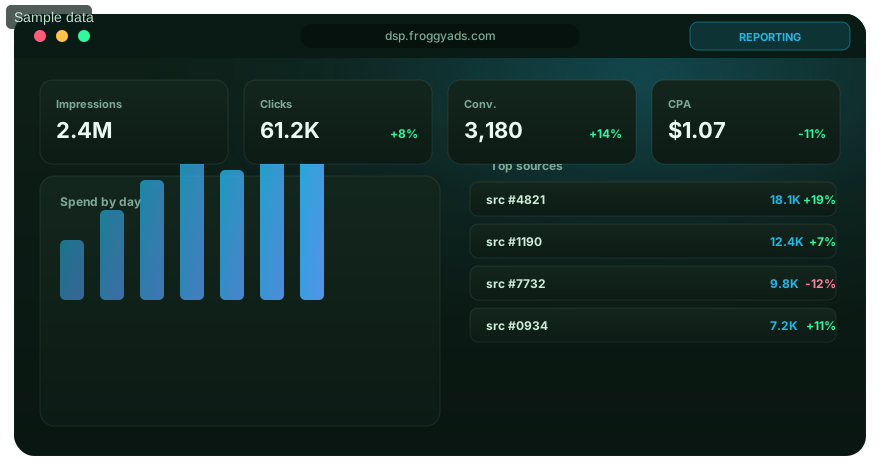
Reach learners at the discovery stage
Content-led formats, real enrollment data.
Audience targeting
Reach the learner segments most likely to enroll in your course or program.
Discovery formats
Native and display work well for course discovery and consideration.
Track enrollments
Attribute enrollments to sources so you optimize to real students.
Source control
Cut sources that drive clicks but no enrollments.
Advertise courses
Open an account and reach learners from $50.
Education advertising FAQ
What education offers can advertisers promote with FroggyAds?
FroggyAds can support eligible education campaigns for courses, training programs, bootcamps, certifications, institutions and other learning offers that meet current platform and market requirements. The campaign should identify the provider, learner action and destination clearly. Before launch, verify the offer, claims, fees, eligibility and any market-specific restrictions that apply to the program.
Which outcome should an education campaign optimize for?
Choose the deepest reliable learner outcome you can measure: for example a qualified inquiry, application, trial lesson, enrollment or paid course purchase. Use clicks and landing-page activity as diagnostics, not as proof of student value. FroggyAds conversion tracking and S2S postbacks can help connect campaign and source IDs with the accepted outcome used by your admissions or sales process.
Which FroggyAds ad formats should an education advertiser test?
Native and Display can give education offers more room for context, while Push, Pop, Interstitial, Video and Telegram can fit other campaign paths where eligible. No format is automatically best for education. Keep unlike formats in separate campaign cells, use a landing page that matches the ad promise and compare them on the same accepted learner outcome.
How should education advertisers target prospective learners?
Start with real eligibility such as country, city, device, operating system, browser, carrier or category when those controls affect the offer. Add narrower targeting only when it tests a clear learner or delivery hypothesis. FroggyAds provides detailed targeting where available, but over-segmenting a small campaign can leave each cell too thin to interpret.
Is the $50 FroggyAds minimum deposit an education campaign budget?
No. The $50 figure is the minimum account deposit, not a recommended education test budget and not a package of traffic. Your campaign allocation should reflect the format, market, bid, conversion delay, value of the accepted learner outcome and the maximum loss you can accept while learning. Keep deposit, starting bid and campaign budget separate.
What should an education landing page make clear?
State the program, provider, learner fit, delivery method, curriculum or scope, price or next step, material eligibility requirements and any important dates or terms accurately. The page should continue the promise made by the ad and work on the targeted devices. A source cannot be judged fairly when the destination is slow, contradictory or incomplete.
How should source IDs be used in education advertising?
Preserve source and campaign identifiers through the inquiry or enrollment path, then compare spend with accepted learner outcomes after the normal review window. Source-level reporting helps you see whether one part of the supply creates useful applications or enrollments while another only creates clicks. FroggyAds whitelists and blacklists let you act on those differences without pausing the whole campaign.
How should education advertisers evaluate traffic quality?
Combine FroggyAds traffic-quality signals with your own downstream evidence. Adscore-supported controls and internal checks can help identify invalid or low-quality activity, but valid traffic can still be a poor fit for a program. Review source behavior, landing-page function, duplicate or rejected leads and accepted learner outcomes before deciding whether the issue is traffic quality or offer fit.
When should an education advertiser exclude a source?
Exclude a source after reliable tracking and a mature conversion window show a repeated source-specific quality or economic problem. First rule out broken forms, missing postbacks, ineligible program information and delayed admissions decisions. Record the reason and evidence for the exclusion so the source can be retested if the offer, destination or market later changes.
When has an education campaign earned more budget?
Increase spend after accepted learner outcomes repeat, tracking remains stable and the next block of traffic still fits the campaign economics. Change one major lever at a time—budget, bid, source group, GEO or format—and compare marginal results with the prior baseline. Keep the last trusted setup available for rollback if the larger traffic mix weakens.
Building education campaigns that reach motivated learners
Education offers range from short courses and bootcamps to degree programs and certifications, so the required explanation and conversion path vary. Use GEO, language, device and category controls only where they reflect real program eligibility or a clear learner hypothesis, then keep the first test broad enough to produce readable source-level evidence.
Native and Display can give education offers more room for context, while other supported formats may fit shorter or more direct messages. Track signups, applications or enrollment events with the documented conversion setup, preserve source IDs and compare mature results by source. SmartCPC can be evaluated as a separate bid-optimization setting where applicable, and Adscore-supported controls add traffic-quality evidence; neither is a guarantee of enrollment quality or campaign economics.
Fill your next cohort
Create your account and run education campaigns across 20B+ daily impressions.
New Education Advertising resources
Build education advertising around an eligible enrollment path
Education campaigns should begin with the exact action the institution wants an eligible prospect to take. A request for information, webinar registration, application start, completed application and paid enrollment represent different levels of intent. Choose one primary event for the campaign and make the ad, landing page and follow-up process support that step. If the institution serves several programs, locations or study modes, avoid sending every visitor to a generic page that forces them to rediscover the offer. A clear match between the message and destination reduces avoidable friction before media quality is judged.
Eligibility is especially important. Document the locations served, language requirements, program prerequisites, age or professional conditions where relevant, start dates, delivery method and any other factor that determines whether a lead can progress. Use targeting only for criteria the campaign can support appropriately and do not infer sensitive personal characteristics. FroggyAds offers country, city, device, operating-system, browser, carrier and category targeting, which can help advertisers narrow delivery to practical campaign conditions without turning every available attribute into an audience assumption.
| Education objective | Useful landing-page information | Primary evidence |
|---|---|---|
| Information request | Program summary, location, format and response expectation | Valid completed inquiry |
| Event or webinar | Date, topic, audience and attendance details | Confirmed eligible registration |
| Application start | Requirements, deadlines and required documents | Qualified application initiation |
| Enrollment | Program terms, next steps and payment process | Accepted enrollment or institution-defined outcome |
Creative should qualify rather than merely attract. State the program, benefit or practical next step clearly enough that a person can decide whether the offer is relevant before clicking. Avoid unsupported employment, income or outcome claims. If a program has specific accreditation, certification or placement facts, use only claims the institution can substantiate and keep them current. A more precise message may generate fewer clicks while producing a stronger proportion of eligible prospects, so compare creative with downstream outcomes instead of optimizing attention in isolation.
Preserve campaign and source identifiers through the inquiry or application path. The education provider should be able to compare spend not only with form completions but with its accepted lead or enrollment definition after obvious duplicates and ineligible submissions are handled. If the conversion takes days or weeks, create an early event for campaign monitoring and a later qualified outcome for business evaluation. Do not treat the early event as proof of final enrollment value. The reporting window should reflect how long the institution normally needs to validate the prospect.
Budget in stages. First verify delivery, destination behavior and event receipt with limited exposure. Then collect enough mature outcomes to compare creative, location, device or source patterns. FroggyAds source-level controls can help advertisers narrow a repeated inventory issue without pausing every part of an otherwise healthy campaign. Define the evidence required for a source decision before launch and keep a change log so exclusions, retests and targeting changes remain explainable later.
Review the post-conversion experience as part of acquisition. A prospect who submits a form but receives no confirmation, confusing next steps or a delayed response may be lost after the media goal is recorded. Test confirmation pages, email or call workflows and application handoffs before increasing spend. A strong education advertising process connects the ad to a clear, eligible next step, measures the institution's real accepted outcome and scales only when the entire enrollment path remains understandable and reliable.
Build separate creative briefs when the decision context changes materially. A short professional course, degree program, language program and continuing-education offer can require different proof, timelines and qualification information even when they belong to the same institution. Keep the campaign structure simple, but do not force unlike programs into one generic message merely to reduce setup work. When the evidence shows that a program needs a different acquisition-cost boundary or landing path, document that distinction and give it enough budget to be evaluated on its own terms.
Include admissions or enrollment stakeholders in the reporting loop. Media teams can see clicks and form events quickly, while staff closer to the applicant can identify invalid inquiries, repeated questions and qualification patterns that analytics alone may miss. Feed that information back into the creative brief and destination. If prospects repeatedly misunderstand a requirement, clarify it before increasing targeting complexity. The strongest optimization often removes uncertainty from the offer rather than simply finding a cheaper source of the same confused traffic.
What should an education advertiser decide before scaling?
Define one accepted learner outcome first, such as a qualified inquiry, application, trial lesson or enrollment. Then make sure the program, learner eligibility, destination and tracking all describe the same campaign. FroggyAds gives you the media controls; the education provider's accepted outcome determines whether more spend is justified.
| Decision | What to verify | FroggyAds action |
|---|---|---|
| Program eligibility | Markets, language, prerequisites, dates and delivery method. | Target only audiences that can realistically complete the program path. |
| Accepted learner outcome | Inquiry, application, enrollment or another documented business event. | Keep the conversion definition stable while the test matures. |
| Source evidence | Spend, source IDs, accepted outcomes and rejection reasons. | Keep, reduce, blacklist, whitelist or retest from source-level evidence. |
| Budget boundary | Bid, campaign allocation, conversion delay and maximum learning loss. | Keep the $50 minimum deposit separate from the actual campaign budget. |
| Scale rule | Marginal accepted outcomes after the next spend increase. | Change one major lever at a time and keep the last stable setup for rollback. |
A practical FroggyAds education test
- Verify the program page, eligibility information and accepted conversion before meaningful spend.
- Choose one format and a readable GEO/device scope for the first campaign cell.
- Preserve source and campaign identifiers through the learner action.
- Wait through the normal admissions or conversion window before making permanent source decisions.
- Scale only the sources and campaign settings that continue to produce accepted learner value.
How to tell whether Education & course advertising traffic. is working
For Education & course advertising traffic., connect media delivery to a qualified inquiry, application or enrollment event or another accepted event that matches the business. Use Education & course advertising traffic: at a glance and program eligibility, lead quality and follow-up to decide whether the education advertising funnel is creating downstream value.
Reconcile Education & course advertising traffic. on one evidence window
For Education & course advertising traffic., compare FroggyAds reporting with the advertiser's tracker, analytics and backend records for the same dates and attribution rules. Record media spend, relevant delivery events, qualified landing activity, accepted conversions and rejection reasons, then use What does this page explain about Education Advertising? to investigate material gaps before they become optimization rules.
Diagnose the smallest failing layer in Education & course advertising traffic.
If education advertising delivery is weak, review eligibility, targeting, bid and inventory first. If traffic arrives but the destination underperforms, inspect speed, message continuity, forms, redirects and device compatibility. If front-end conversions look healthy but backend acceptance is weak, use From discovery to enrollment to isolate audience or source quality after tracking has been verified.
Set the next Education & course advertising traffic. scale and stop rule
Write the exact Education & course advertising traffic. result that earns more budget and the exact condition that pauses the test. Increase one major control at a time and compare marginal education advertising performance with the prior configuration. FroggyAds supplies the campaign controls; the advertiser's accepted downstream data determines whether the expansion is commercially useful.
Education & course advertising traffic.: preserve the evidence behind the next campaign change
For Education & course advertising traffic., keep a dated decision note that records the education advertising campaign scope, the accepted conversion, the evidence window and the maximum additional loss allowed before another review. Tie that note to Education & course advertising traffic: at a glance so the next FroggyAds action remains grounded in this page's actual subject.
Separate observation from explanation for Education & course advertising traffic.. Delivery, spend, device mix, source mix and accepted outcomes are observations. Audience mismatch, creative fatigue, destination friction, tracking loss and source quality are competing explanations. Use From discovery to enrollment to test the narrowest explanation first; changing several education advertising variables together makes the next result difficult to attribute.
Before increasing Education & course advertising traffic. spend, preserve the last stable FroggyAds configuration and write the result that must reproduce after the next volume step. Use See education advertising inside the platform as the review point. If marginal cost or accepted quality moves outside the written boundary, return to the recovery point rather than widening bids, targeting and sources simultaneously.
This evidence record turns education advertising into an auditable buying process: another media buyer should be able to see what was tested, what changed, which source or segment caused the result and why the next action was chosen. FroggyAds provides the campaign controls for that next bounded test; the advertiser's own downstream data provides the final commercial proof.
Education & course advertising traffic: the buyer task this URL owns
Use Education & course advertising traffic when the immediate task is to make a concrete, measurable buying decision. For performance-focused advertisers, the useful output is a documented media decision rather than another broad advertising overview. The nearest related FroggyAds page is Online Advertising For Education; this URL keeps ownership of the distinct task to make a concrete, measurable buying decision.
Anchor the Education & course advertising traffic review to campaign objective, audience and market fit, ad format, budget and bid. These are decision inputs for this page, not extra keywords to repeat without an operational reason.
| Checkpoint | Page-specific action | Evidence to keep |
|---|---|---|
| Workflow | Map the industry's acquisition path and downstream acceptance event. | Retain evidence specific to Education & course advertising traffic and its accepted outcome. |
| Guardrail | Define market, policy, data and economic constraints. | Retain evidence specific to Education & course advertising traffic and its accepted outcome. |
| Outcome | Optimize to the accepted business result, not activity alone. | Retain evidence specific to Education & course advertising traffic and its accepted outcome. |
Hypothetical calculation: if a controlled campaign for education & course advertising traffic spends USD 225 and produces 9 accepted conversions, accepted CPA is USD 225 / 9 = USD 25.0. Replace the inputs with your own campaign economics; this is not a FroggyAds performance claim.
Choose FroggyAds when Education & course advertising traffic calls for a controlled paid-media test. We let performance-focused advertisers apply relevant format, targeting and budget controls, keep source-level evidence visible, and measure the accepted outcome before increasing spend. Create your free FroggyAds account.
What matters first in education advertising?
Start with an eligible program and one learner outcome that the education provider can verify. Then use the campaign format, targeting, budget, source IDs and conversion tracking to test whether paid traffic produces qualified inquiries, applications or enrollments at an acceptable cost.