Funding and test planning

TrafficJunky minimum deposit
what it unlocks and what a test really costs

The TrafficJunky minimum deposit is only the first budget decision. This guide verifies the current public funding information, separates deposit from learning budget, and shows how to protect a first test.

Published fundingfree membership; no universal public advertiser deposit found in current official pages
Test principleFund evidence, not hope
FroggyAds access$50 public minimum
TrafficJunky minimum deposit and test budget dashboard

Direct answer: For TrafficJunky, the current public funding position is free public membership, while no single universal advertiser deposit amount is stated on the current public billing pages reviewed for this release. That threshold is an account-access fact, not proof that the amount can produce a reliable campaign decision. Plan a separate evidence budget for tracking validation, traffic, creative variation and conversion delay, and confirm the live payment screen before sending funds.

Fund the smallest controlled plan that can reach a predeclared stop rule. Do not confuse the minimum payment with a complete test budget.

Platform context

TrafficJunky is a CPM-focused advertising platform associated with high-volume adult-entertainment inventory and source-level campaign buying. For the trafficjunky minimum deposit owner, public documentation describes display placements, native formats, interstitials and in-stream video placements across supported properties and CPM buying with manual or automated bid controls, including Smart CPM and conversion-aware bidder workflows where available.

  • Current funding position: free public membership, while no single universal advertiser deposit amount is stated on the current public billing pages reviewed for this release
  • Control context: location, demographic, keyword, source, device and scheduling controls, subject to the selected placement
  • Live terms and eligibility must be rechecked before funding

Decision boundary

What must be funded, and how much budget is actually required to learn?

The payment threshold opens the account. The evidence budget must separately cover tracking validation, traffic, creative variation and conversion lag.

The search phrase “alternative for publishers” must not be treated as identical to advertiser media buying. A site owner should verify whether the product accepts their inventory and what commercial relationship applies before comparing it with an advertiser account. This boundary is applied specifically to the trafficjunky minimum deposit owner.

Decision table for the trafficjunky minimum deposit owner

LayerQuestionOperational rule
RoleIs this an advertiser buying decision, a publisher monetization decision, or both?Separate dashboards, metrics, agreements and evidence before comparing.
Supply fitDoes TrafficJunky or FroggyAds provide the required format and audience context?Test only platforms that can perform the defined campaign job.
FundingWhat current payment threshold, method and fee applies to TrafficJunky?Verify the live account and reserve a separate learning budget.
MeasurementCan platform, tracker and backend records be reconciled?Do not optimize or scale while material discrepancies remain.
DecisionWhat evidence triggers keep, expand, pause or rollback?Write the rule before launch and apply it after conversion lag matures.

Controlled evaluation workflow

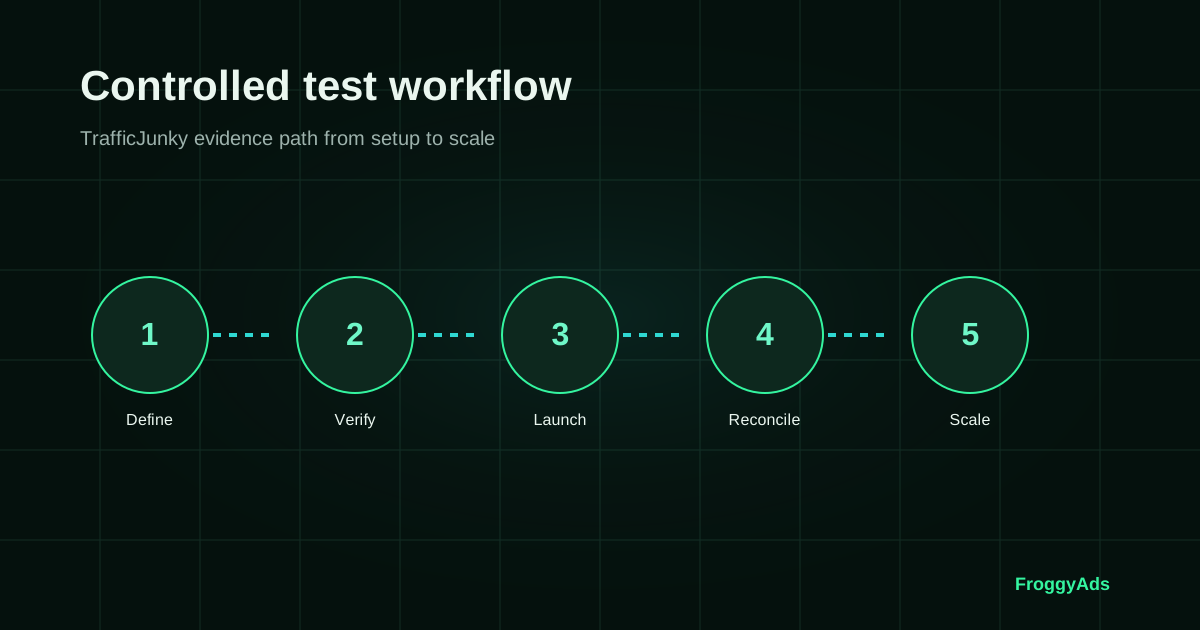
1. VerifyOpen current TrafficJunky first-party documentation and the live account settings.
2. IsolateChoose one format role, market, device class and conversion event.
3. InstrumentValidate click IDs, postback delivery and backend acceptance.
4. DecideWait for conversion lag, reconcile records and apply the written rule.

TrafficJunky is a CPM-focused advertising platform associated with high-volume adult-entertainment inventory and source-level campaign buying. Its documented product context includes display placements, native formats, interstitials and in-stream video placements across supported properties, with CPM buying with manual or automated bid controls, including Smart CPM and conversion-aware bidder workflows where available. These facts define what can be tested, but they do not establish that a campaign will be profitable, approved or scalable. This guidance is specific to the trafficjunky minimum deposit owner.

Role separation is essential for the trafficjunky minimum deposit decision. The search phrase “alternative for publishers” must not be treated as identical to advertiser media buying. A site owner should verify whether the product accepts their inventory and what commercial relationship applies before comparing it with an advertiser account. When a search phrase mixes “for publishers” and “for advertisers,” the correct response is to identify the account role first, then use role-specific metrics and contracts. A publisher payout observation cannot prove advertiser acquisition quality, and an advertiser CPA cannot prove publisher monetization value. This guidance is specific to the trafficjunky minimum deposit owner.

Current operational boundaries also matter on the trafficjunky minimum deposit page. The network has a specialized inventory profile. Advertisers should verify vertical acceptance, identity checks, live source availability, minimum bids and payment requirements before committing a test budget. The buyer should capture a dated screenshot or export of live settings before launch. This preserves the exact format, source options, bid floor, funding method and policy state used in the test, instead of relying on an article after product terms have changed. This guidance is specific to the trafficjunky minimum deposit owner.

The measurement contract for this minimum decision begins before the first impression. Define the accepted conversion event in the backend, pass a stable click or source identifier into the tracker, and document the conversion-lag window. Reconcile platform spend, tracker events and accepted business outcomes at the same cutoff. If the three systems disagree, investigate the discrepancy before changing bids or declaring a winner. This guidance is specific to the trafficjunky minimum deposit owner.

A narrow first cell makes the trafficjunky minimum deposit conclusion more reliable. Use one format role, one market cluster, one device class and a small creative set. Avoid spreading the initial budget across many sites and audiences because each segment may receive too little delivery to support a decision. Expand only after the tracking chain and source-level economics are understood. This guidance is specific to the trafficjunky minimum deposit owner.

The stop rule for trafficjunky minimum deposit should be written as a maximum acceptable loss plus an evidence condition. Pause a source when it reaches the loss ceiling without an accepted event, when compliance changes, when tracking breaks or when traffic quality falls outside the agreed range. Roll back the budget to the prior stable allocation while preserving exports, creative versions and source decisions for review. This guidance is specific to the trafficjunky minimum deposit owner.

The practical result does not need to be a full migration. The correct trafficjunky minimum deposit outcome may be to retain TrafficJunky for a specialized placement, use FroggyAds for another format or geography, run both with separate source controls, or stop both because the offer economics are weak. The evidence should decide the allocation, not the desire to validate a preferred platform. This guidance is specific to the trafficjunky minimum deposit owner.

For this funding owner, separate four budget lines: the payment threshold, a technical validation amount, a bounded learning amount and a reserve for delayed conversions. TrafficJunky currently presents free public membership, while no single universal advertiser deposit amount is stated on the current public billing pages reviewed for this release. Verify currency, fees, refund conditions and settlement timing in the live account. Deposit size should follow the approved experiment design rather than become the experiment design. This guidance is specific to the trafficjunky minimum deposit owner.

Evidence to retain

  • Platform and tracker exports with matching timestamps
  • Format, GEO, device, source or placement identifiers
  • Bid, budget, frequency and creative version
  • Backend acceptance, rejection and revenue records
  • Policy review, funding method and payment evidence

Stop and rollback rule

  • Pause when tracking or postback validation fails
  • Pause sources at the written maximum acceptable loss
  • Do not scale before conversion lag and reconciliation mature
  • Restore the previous stable allocation if the hypothesis fails
  • Preserve exports so the failed test still produces learning

Observed CPM = media spend ÷ delivered impressions × 1,000; accepted CPA = media spend ÷ backend-accepted conversions

Official sources checked July 17, 2026

First-party sources verify product roles and current public settings. They do not guarantee approval, inventory, price, performance or profitability.

Current public answer

TrafficJunky funding threshold and the important qualification

TrafficJunky membership is free according to its public terms, but the current public official pages reviewed for this release do not state one universal advertiser minimum deposit. Advertisers should confirm the live funding threshold and payment method inside the account before depositing. During source-level reconciliation, connect the decision to free membership and the absence of a universal public advertiser deposit, while keeping account access, technical validation, learning spend and scale reserve as separate budget lines.

What the deposit means

A minimum deposit is the smallest amount the platform accepts for the relevant account or payment method. It can unlock campaign spending, but it does not say how many impressions, clicks or accepted conversions the campaign will produce. Before the final platform decision, connect the decision to free membership and the absence of a universal public advertiser deposit, while keeping account access, technical validation, learning spend and scale reserve as separate budget lines.

  • Account funding threshold
  • Payment-method condition
  • Not a performance guarantee

What the deposit does not mean

The minimum does not prove that the campaign can test several GEOs, devices and sources at once. It also does not include creative production, tracking, landing-page work or the cost of waiting for delayed conversions. During account verification, connect the decision to free membership and the absence of a universal public advertiser deposit, while keeping account access, technical validation, learning spend and scale reserve as separate budget lines.

Reviewed July 17, 2026. Payment methods, fees, currencies, thresholds and refund rules can change. Verify the live account before transferring funds.

Budget layers

Deposit, campaign budget and evidence budget are different

Advertisers lose control when they treat these three numbers as interchangeable.

1. Account deposit

The payment that creates spendable balance. It is controlled by platform billing terms and may vary by payment method, currency or account type.

2. Campaign budget

The amount a specific campaign may spend during a day or full flight. It controls exposure but does not define statistical confidence.

3. Evidence budget

The maximum amount you are prepared to spend to answer a specific question, such as whether one format and GEO can meet the accepted CPA after conversion lag.

Funding model

How to calculate a responsible first TrafficJunky budget

Begin with the business outcome rather than the deposit button. Estimate the acceptable CPA or value per conversion, the expected conversion delay and the number of meaningful source groups. Then define the maximum loss allowed before the hypothesis is rejected. Before scaling the winning cell, connect the decision to free membership and the absence of a universal public advertiser deposit, while keeping account access, technical validation, learning spend and scale reserve as separate budget lines.
Start from the stop rule

If the campaign can spend twice the acceptable CPA without an accepted conversion, decide in advance whether that triggers a pause, a landing-page review or a source exclusion. A stop rule prevents a small deposit from being consumed by an open-ended test and prevents a large balance from becoming permission to ignore weak evidence. During the postback audit, connect the decision to free membership and the absence of a universal public advertiser deposit, while keeping account access, technical validation, learning spend and scale reserve as separate budget lines.

Keep the first campaign narrow

A minimum deposit spread across many countries, devices, formats and creatives can create hundreds of tiny segments. None receives enough spend to support a decision. Use one market, one format role, a small creative set and a conversion event that can be validated end to end. At the budget review, connect the decision to free membership and the absence of a universal public advertiser deposit, while keeping account access, technical validation, learning spend and scale reserve as separate budget lines.

Reserve budget for conversion lag

Some outcomes arrive hours or days after the click. Do not spend the entire balance before the first cohort has matured. Hold back a review reserve so the team can wait for delayed events, reconcile duplicates and make a decision without immediately adding funds. Before the final platform decision, connect the decision to free membership and the absence of a universal public advertiser deposit, while keeping account access, technical validation, learning spend and scale reserve as separate budget lines.

Account for payment friction

Check fees, settlement time, currency conversion, card verification and refund rules. A nominally low minimum deposit can be operationally expensive if the payment method adds fees or if unused funds are difficult to recover. During account verification, connect the decision to free membership and the absence of a universal public advertiser deposit, while keeping account access, technical validation, learning spend and scale reserve as separate budget lines.

Compare the full first-test cost

The true first-test cost includes account funding, creatives, landing-page adaptation, tracking implementation, campaign management and the maximum acceptable media loss. Compare that total across TrafficJunky, FroggyAds and any other candidate.

Illustrative planning

Turn the minimum deposit into a bounded learning plan

The figures below are planning examples, not TrafficJunky rate promises.

Budget layerPurposeExample shareControl
Tracking validationConfirm click and conversion transport5 to 10%Pause if events do not reconcile
ExplorationObserve source and creative variation45 to 55%Bound by source and daily caps
ConfirmationRetest promising segments25 to 35%Use matched settings
Lag reserveWait for delayed accepted outcomes10 to 20%Do not redeploy early
Seven-step setup

Fund TrafficJunky only after the campaign contract is ready

A payment should be the final onboarding step, not the first strategy step.

1
Confirm the official thresholdOpen the current billing screen and verify method, currency, fees and account eligibility.
2
Check campaign policyConfirm the offer, creative and destination can be approved in the intended market.
3
Define accepted conversionChoose the downstream event that will decide whether the spend created business value.
4
Test trackingValidate click IDs, postbacks, deduplication and status updates before full delivery.
5
Set capsApply account, campaign, daily and source-level limits where available.
6
Release exploration budgetLaunch one narrow campaign and preserve a reserve for delayed outcomes.
7
Reconcile before refillingAdd funds only when the first cohort produces interpretable accepted-outcome evidence.

When a lower-threshold alternative is useful

A lower entry threshold can be valuable when the buyer wants to validate a new format, payment workflow or tracking integration without committing a larger balance. FroggyAds publicly states a $50 minimum deposit and no monthly minimum, which can make it a practical comparison point. Before creative expansion, connect the decision to free membership and the absence of a universal public advertiser deposit, while keeping account access, technical validation, learning spend and scale reserve as separate budget lines.

The comparison should not end there. The winning platform must also provide relevant inventory, useful source controls and accepted outcomes at sustainable economics. Entry cost is one decision factor, not the final score. At the first optimization checkpoint, connect the decision to free membership and the absence of a universal public advertiser deposit, while keeping account access, technical validation, learning spend and scale reserve as separate budget lines.

TrafficJunky minimum deposit launch workflow
Decision workbook

Funding versus evidence for TrafficJunky

Turn public platform information into a documented test that another media buyer can audit and repeat.

TrafficJunky is placement- and CPM-oriented with inventory concentrated on specific publisher properties. Brand suitability, creative rules and placement concentration should be resolved before interpreting blended CPM or conversion results. This context matters for funding versus evidence because Banner, native, in-stream video, vertical short-video and other placement-specific inventory across supported publisher sites. Treat each materially different environment as its own test cell instead of presenting one account-wide average as the truth.

The minimum deposit answers how an account can be funded. It does not answer how much evidence is needed. A useful plan reserves money for traffic, creative variation, conversion delay and one controlled optimization cycle. For TrafficJunky, the verified starting points are its public positioning as CPM-focused advertising network serving large adult and selected safe-for-work publisher properties, the documented buying approaches of primarily CPM-based auction buying with placement, site, geography and device targeting, and the current funding guidance summarized on this page. These facts define what can be tested, not what the outcome will be.

Build the research file before launch. Save the date, official source URL, relevant account screenshot, currency, payment method, campaign objective, format, country, device scope and attribution window. When a term changes later, the team can explain why the old conclusion no longer applies instead of silently mixing two product versions. At the initial delivery review, connect the decision to free membership and the absence of a universal public advertiser deposit, while keeping account access, technical validation, learning spend and scale reserve as separate budget lines.

Create a matched control. Use the same destination, accepted conversion event, value rule and reporting timezone wherever the platforms permit it. Match the user context as closely as possible. If TrafficJunky supplies Banner, native, in-stream video, vertical short-video and other placement-specific inventory across supported publisher sites, do not compare the result with an unrelated search or social campaign and call the difference a network effect. At the first optimization checkpoint, connect the decision to free membership and the absence of a universal public advertiser deposit, while keeping account access, technical validation, learning spend and scale reserve as separate budget lines.

The strongest reasons to shortlist TrafficJunky are direct access to high-volume publisher properties; placement-specific banner, native and video options; detailed creative specifications and targeting controls; cpm buying suited to placement-level testing. The important cautions are inventory context is not suitable for every brand or policy; a universal public deposit is not documented on the reviewed official pages; placement concentration can dominate blended results; creative compliance and site-level rules require careful review. Convert each strength and caution into a testable question. For example, source controls should be judged by whether they let the buyer isolate repeatable value, not merely by whether a source ID appears in a report. Before scaling the winning cell, connect the decision to free membership and the absence of a universal public advertiser deposit, while keeping account access, technical validation, learning spend and scale reserve as separate budget lines.

Define evidence quality in advance. A click proves delivery, a platform conversion proves that a configured event fired, and an accepted downstream outcome proves commercial value. Reconcile those layers after normal conversion lag. Pause decisions based only on early dashboard totals when refunds, duplicate leads or later acceptance can change the economics. At the first optimization checkpoint, connect the decision to free membership and the absence of a universal public advertiser deposit, while keeping account access, technical validation, learning spend and scale reserve as separate budget lines.

Funding should be staged. Deposit only after policy and tracking checks, release a small technical-validation amount, then unlock the learning budget when click IDs and accepted events reconcile. Keep a reserve for lag rather than spending the full balance immediately. Write the decision rule before the campaign begins. Include the maximum acceptable loss, the minimum number of mature outcomes, the concentration limit for one source and the conditions that trigger a creative refresh, bid change, source exclusion or full stop. During source-level reconciliation, connect the decision to free membership and the absence of a universal public advertiser deposit, while keeping account access, technical validation, learning spend and scale reserve as separate budget lines.

Use FroggyAds as a matched comparison rather than a promised winner. Its public offer includes Push, Native, Display, Pop, Video and Interstitial, a $50 minimum deposit and source-level controls. Keep the same measurement contract and let accepted outcome economics determine whether FroggyAds, TrafficJunky, a split allocation or no scale is the correct result. Before the final platform decision, connect the decision to free membership and the absence of a universal public advertiser deposit, while keeping account access, technical validation, learning spend and scale reserve as separate budget lines.

Questions

TrafficJunky minimum deposit FAQ

Answers about funding, budget control and first-test risk.

What is the TrafficJunky minimum deposit?

TrafficJunky membership is free according to its public terms, but the current public official pages reviewed for this release do not state one universal advertiser minimum deposit. Advertisers should confirm the live funding threshold and payment method inside the account before depositing. During source-level reconciliation, connect the decision to free membership and the absence of a universal public advertiser deposit, while keeping account access, technical validation, learning spend and scale reserve as separate budget lines. This answer applies the published fact to FAQ checkpoint 2, where the live account term should be verified before budget is committed.

Is the TrafficJunky minimum deposit enough for a full test?

Not necessarily. The funding threshold opens or replenishes the account, while a useful test budget must cover enough sources and conversion lag to support a decision.

Does the TrafficJunky minimum deposit change by payment method?

It can. Use the live account and current official billing documentation as the source of truth because methods, fees, currencies and thresholds can change.

What should I check before depositing into TrafficJunky?

Confirm campaign eligibility, creative policy, destination rules, supported formats, available GEOs, tracking parameters, refund terms and the exact payment method.

How should I set a TrafficJunky test budget?

Start with the maximum acceptable loss, expected CPA, conversion lag and number of source groups. Keep the first campaign narrow enough to create interpretable evidence.

Is a lower minimum deposit always better?

No. A lower threshold reduces entry friction, but inventory fit, source visibility, conversion quality and support can matter more than the first payment.

What is the FroggyAds minimum deposit?

FroggyAds publicly states a $50 minimum deposit and no monthly minimum. That is an access threshold, not a promise that every campaign can be evaluated with $50.

Can I get a refund of unused TrafficJunky funds?

Refund and withdrawal rules are platform-specific. Review the current official terms before payment and contact the platform directly for account-specific eligibility.

Should I deposit the full monthly budget at once?

Usually a staged funding plan is safer when testing a new platform. Fund enough for the declared learning window, then add budget only after tracking and policy checks pass.

Can any deposit level guarantee campaign performance?

No. Deposit size affects available spend, not offer economics, creative quality, landing-page fit or conversion tracking.

Lower-friction comparison

Start a controlled FroggyAds test from a $50 public minimum deposit

Use a narrow campaign, verified tracking and a maximum acceptable loss. Results depend on the offer, market, creative, format and optimization.