
SEO and GEO-ready buyer guide

Media Buying For Affiliates

Buy affiliate media with a plan for the next spending decision. With FroggyAds, you can choose an available ad format, apply relevant targeting, manage bids and campaign budget and inspect source delivery in one self-serve workflow. We recommend tying those controls to your merchant-approved commission, so you can tell which additional traffic deserves your money rather than judge a campaign by clicks alone.

Materially updated 23 October 2026: this guide now separates affiliate bid estimates, campaign pacing, approval delay and incremental budget decisions. Check the current offer terms and account settings before buying delivery.

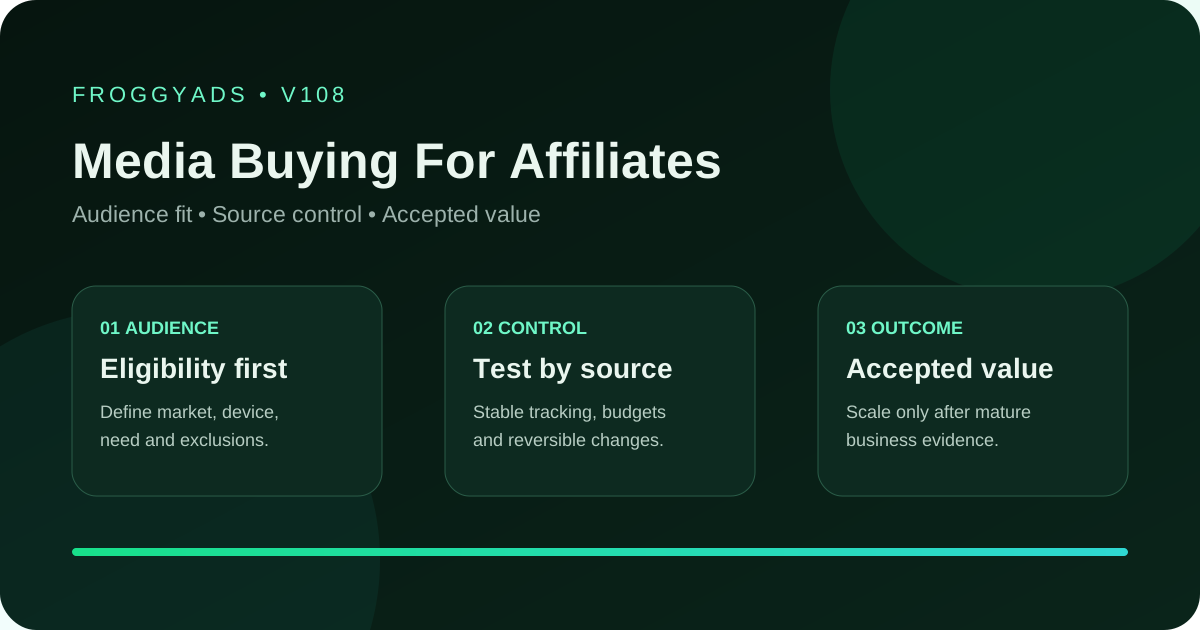
Media Buying For Affiliates planning visual
Key takeaways

Three affiliate buying decisions before you spend

  • Set a realistic acquisition allowance from approved commission, fees, expected reversals and the margin you want to retain.
  • Start with a trackable offer route and a limited campaign allocation, then compare delivery and merchant outcomes for the same click cohort.
  • Increase the allocation to a promising source deliberately, measuring the extra spend and extra accepted value rather than relying on an account average.

Our recommendation is to begin with a buying question small enough to answer: for example, whether one eligible audience and creative can acquire approved trials within your allowance. A clear question makes the bid, budget and review date easier to choose. Any numerical example here is illustrative, not an expected campaign result.

What media buying for affiliates means

Definition: Media buying for affiliates is the planned purchase and allocation of advertising delivery across formats, sources, markets and creatives using one measurement and decision framework.

An affiliate media buyer purchases advertising that sends potential customers to an authorised affiliate journey. The buyer pays for delivery under the traffic platform's current billing model, while commission depends on the merchant's event and validation rules. That difference matters: the platform can deliver the advertising you bought even when a later signup does not qualify for payment.

The practical job is to choose how much to offer for delivery, how quickly to spend, which sources to keep and when another allocation is justified. We focus here on those operating decisions. Creative guides can help you build the message; this guide helps you turn the resulting campaign evidence into a bid and budget decision.

Keep the advertised payout separate from money you can use again. A merchant may validate actions later, reverse transactions or pay on a delayed schedule. If you spend the next allocation before understanding those conditions, a seemingly successful campaign can create a cash shortfall. Set aside working capital and keep pending commission visible in your buying report.

Plan bids, pacing and approved commission

Build your affiliate buying model from three connected records: what you paid the traffic platform, which customer actions your tracking recorded and what the merchant accepted. A joined record lets you investigate a source without losing the original cost. FroggyAds reporting supplies the delivery side; your affiliate tracker and programme records supply the later commercial result.

Turn those cost, tracking and merchant-outcome records into the buying brief below. Write down the values before launch so you can make a consistent decision when delivery starts. Use a separate brief when the offer, billing unit or customer qualification changes enough to make the old comparison misleading.

Decision areaWhat to defineEvidence before scale
Offer allowanceNet commission available for acquisition after the costs and margin you must retain.Use the actual programme terms and a clearly labelled estimate where approval history is unavailable.
Buying unitThe current chargeable delivery unit and the bid settings available for the chosen campaign.Read the campaign setup; do not treat CPA as the billing model merely because it is your performance target.
Spend scheduleCampaign allocation, intended review date and capacity to fund the next test before merchant payment.Check account funding separately from the budget you assign to this particular offer.
Merchant resultThe paid action, acceptance status and applicable validation or reversal window.Keep pending and declined events separate from the approved commission used for decisions.
Next incrementThe additional budget or bid change you are considering and the outcome that would justify it.Compare the incremental cohort with the previous setup under the same accounting rules.
Decision rule: Do not choose or scale media buying for affiliates from headline reach, a low CPM, early clicks or isolated conversions. Require stable tracking, source evidence and mature accepted value.

Write a spending boundary you can actually act on. State the maximum media allocation for the question, the point at which missing tracking pauses the test and the merchant window required for an economic review. Avoid a universal rule such as excluding every source after a fixed number of clicks: the useful evidence depends on the offer, response rate and cost of being wrong.
Controlled workflow for media buying for affiliates

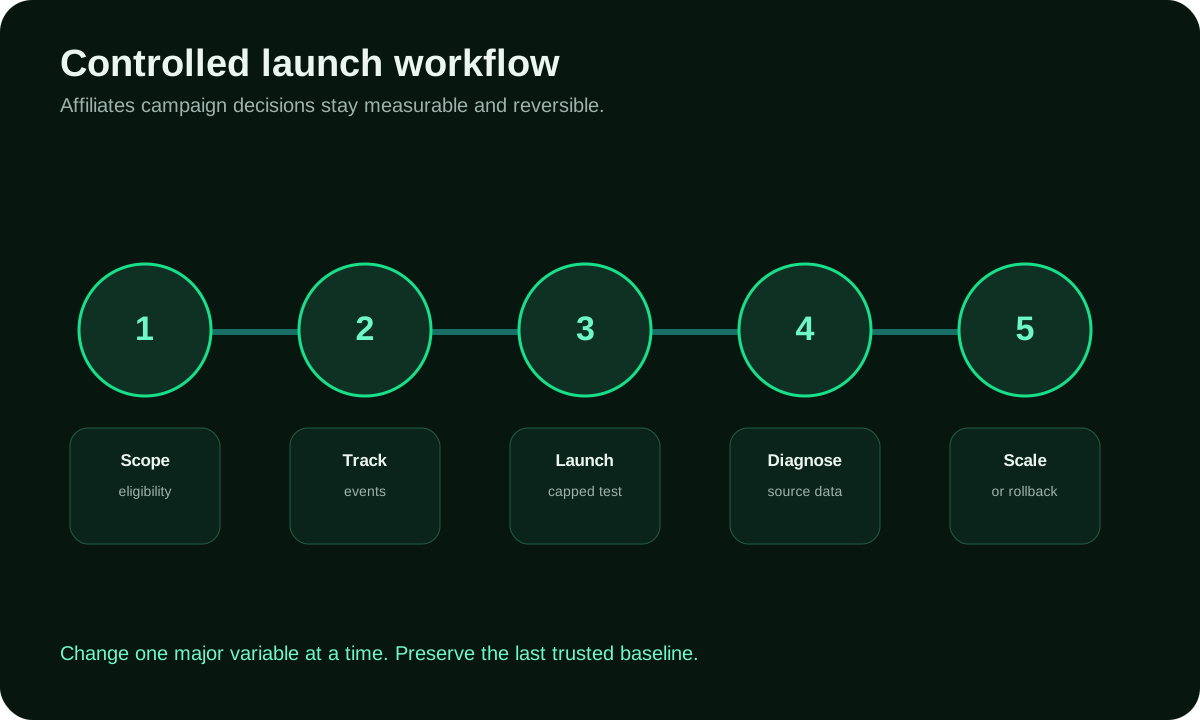
Use a repeatable buying routine without turning every campaign into the same campaign. Start with the commercial brief, prove the path, buy a limited cohort, review the costs and choose the next increment. Save the previous settings whenever you change a material control so a later result can be attributed to the change.

1

Define the operating brief

Give the first campaign a concise brief: offer and programme permission, intended customer, market, available format, destination version, expected approval delay and acquisition allowance. Add the current payout cap or daily lead limit if the merchant applies one. This prevents delivery from continuing against an exhausted or unsuitable offer.

2

Validate the complete path

Follow a controlled click through the affiliate redirect to the relevant merchant event. Confirm the campaign, creative and source references survive, the merchant records the intended action and duplicate events are handled by your tracking setup. Resolve missing identifiers before paying for a larger cohort; otherwise a good source can become indistinguishable from a poor one.

3

Launch a protected test

Launch a campaign that your allocation can support. Choose a manageable audience and a few meaningfully different messages, with the important conditions held steady. Use our bid and budget controls to define exposure rather than leave spend open while a new route is being proved. Allow for the offer's actual time to convert and be validated.

4

Diagnose by source and concept

Read the source result in two steps. First ask whether the bought delivery reached the intended market and destination with intact identifiers. Then ask whether the linked merchant actions were accepted and earned enough commission for the cost. A tracking break calls for a repair; a well-tracked but uneconomic source calls for a different buying decision.

5

Scale or restore the baseline

Change the lever that answers the next question. If you increase budget, avoid also replacing the destination and broadening targeting in the same cohort. If the extra traffic performs poorly, restore the earlier setting where appropriate and inspect its source mix. A clear comparison is more useful than a large volume increase you cannot explain.

Media Buying For Affiliates controlled workflow

Budget and measurement model

Size the first affiliate media allocation to answer a useful commercial question while protecting working capital. Include the delivery you can afford to lose, any creative and tracking cost and time for the merchant to review outcomes. Reserve money for a confirmation test rather than commit everything to the first promising report.

Test budget

Separate our published $50 minimum account deposit from your campaign test allocation. The amount needed for a useful comparison depends on the chargeable unit, bid, eligible audience, response and merchant approval rate. A smaller, coherent test is easier to interpret than many underfunded cells.

Maturity window

Review a click cohort after the event and merchant decision relevant to your commission have had time to arrive. A recent source can look weak simply because its leads are pending. Conversely, an early gross order count can look strong before cancellations. Display click date, event date and acceptance status together so the review does not confuse delay with quality.

Calculate cost per merchant-approved action

Calculate accepted acquisition cost as the media spend for a defined cohort divided by its merchant-approved actions. Compare it with the net commission available for acquisition, using the same currency and outcome definition. Keep creative, tracking and other costs visible alongside media so the campaign's total contribution is not overstated.

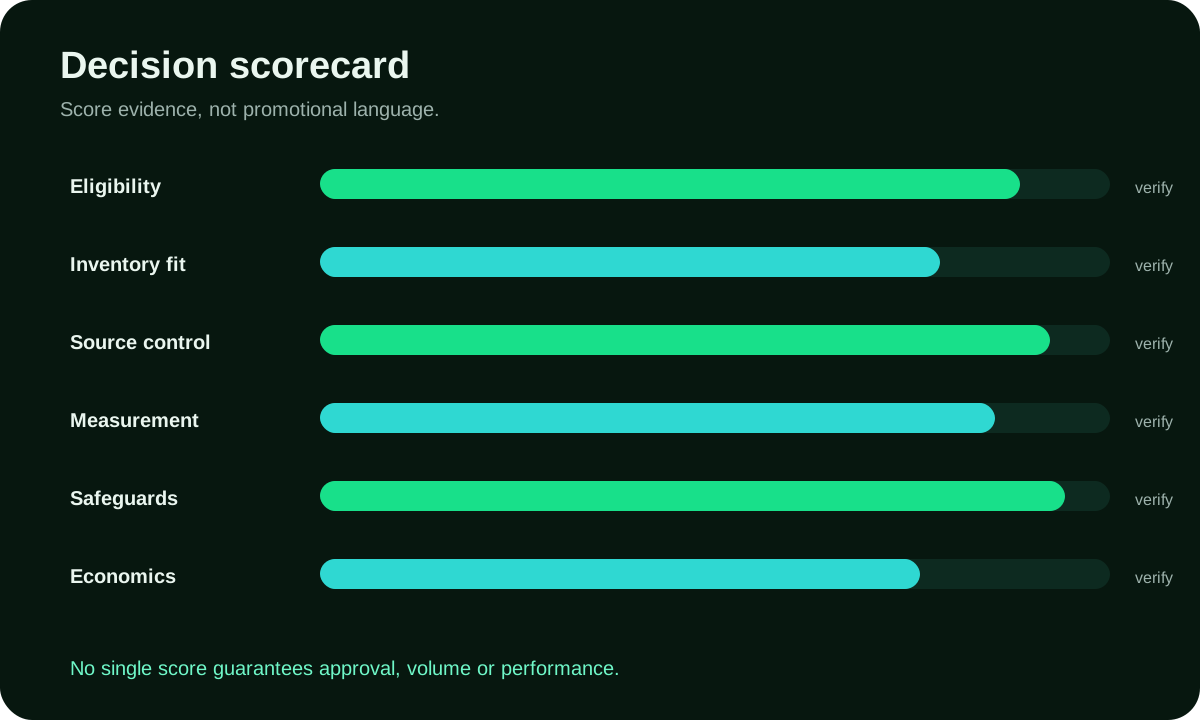
Media Buying For Affiliates evaluation scorecard
SignalUseDo not assume
Spend and pacingCompare actual delivery cost with the allocation and remaining review window.Fast spend can reflect broader supply without better customer qualification.
Click costInspect how much each tracked visit costs within the campaign's current billing conditions.A low CPC is not automatically a low approved acquisition cost.
Tracked actionsCheck the route from paid delivery to the merchant event using retained identifiers.An analytics event may still be pending or rejected by the programme.
Approved actionsCount the outcomes the merchant accepts for the cohort under review.Separate missing data from genuine rejection before changing a bid.
Net commissionCompare approved earnings after relevant deductions with media and operating costs.Pending payouts and blended revenue can conceal a weak new allocation.

Estimate a workable bid for the offer journey

Choose a format for the offer journey, then interpret its delivery cost correctly. A concise Push message and a Native explanation can create different expectations before the merchant step. Evaluate them in separate cohorts rather than call the cheaper visit the winner. Check the actual billing settings shown for each campaign instead of assuming every format uses the same charging unit.

A useful bid estimate begins with an acquisition allowance and a plausible approved response rate. Multiplying the allowance per approved action by the estimated approved actions per click gives an illustrative click-cost ceiling before uncertainty and other costs. Treat a rate from another offer as an assumption to test, not a fact about your next campaign.

Hold the destination steady while estimating the offer’s buying economics. If you replace a short merchant route with a longer comparison page, the response and delay may change. Label that destination version and assess it as a new cohort. A bid that suited the earlier route is a starting hypothesis rather than an instruction to spend at the same level indefinitely.

Audience boundary

Buyer: an affiliate with an authorised offer, measurable merchant outcome and money allocated to a defined test.

Destination continuity

Route: a permitted affiliate link or useful pre-lander that preserves the ad promise and tracking references.

Accepted outcome

Result: approved commission that can be reconciled with the particular media cohort that generated it.

Source optimization, scale and rollback

Judge source value from approved acquisition cost and net commission. A higher click price can be the better purchase when enough additional visitors complete accepted actions. Our source reporting helps you isolate the delivery; your merchant records explain whether that delivery earned useful value.

Focus spend on a source set when its performance has repeated under comparable conditions. Keep enough context to understand how it qualified, including creative, audience and cohort date. An early allowlist based on one isolated commission can remove useful exploration while giving too much weight to chance.

Expand with a budget or bid adjustment you can evaluate. Watch whether the additional delivery changes source distribution, accepted cost or merchant rejection. If the extra allocation earns less useful value than the original cohort, the blended campaign average should not hide that deterioration. Reduce the weak increment while investigating its cause.

Record enough detail for another buyer to continue tomorrow: campaign and source IDs, old and new settings, change time, spend, merchant status and the reason for the next decision. Include the offer cap and destination version. This record lets you distinguish a real bid improvement from a change in the audience or in merchant acceptance.

Check the integrity of a weak result before making an economic decision. Missing source tags, duplicate events or a merchant reporting delay can distort acquisition cost. Once the records reconcile, review commission, media, deductions and relevant operating costs together. Do not solve a reporting failure by increasing bids or solve a genuine margin problem by simply waiting for more clicks.

Rollback rule: Restore the last trusted configuration when accepted-event cost, rejection, refund, qualification or retention moves outside the approved range after a scale change.

Limitations, safeguards and responsible use

Prepare the buying brief with the permissions and accurate claims the offer requires. Check the programme's allowed traffic methods, markets, destination rules and required disclosures, then prepare a campaign that fits them. Where the offer has legal or sector-specific requirements, obtain the appropriate review for that market. A platform setting cannot establish the offer's eligibility on its own.

FroggyAds SmartCPC supports bid optimisation using campaign signals, and our Adscore-supported quality controls help screen traffic risks. Use these tools alongside source review and affiliate outcome tracking. They do not replace merchant approval or establish a guaranteed acquisition cost, but they can support a more informed buying process.

Run your prepared affiliate purchase in FroggyAds: select the format, apply available targeting, manage bids and budget, and inspect delivery sources. We give you the campaign controls; your approved conversion records show how those choices work for your particular offer. That combination makes the next spending decision more concrete.

Useful FroggyAds source pages

Verify our account entry and pricing information before funding, then choose from the available formats and prepare conversion tracking. Consult traffic-quality controls, brand-safety guidance and our editorial policy when building the buying brief.

Verification resources

Sources and standards to verify before launch

Identify the offer and channel rules that apply to the media you intend to buy. An affiliate media plan should name the required permission, accurate claim, destination and tracking arrangement before delivery starts.

FTC advertising and marketing guidance

Consult current FTC advertising and marketing guidance for US advertising or disclosure requirements that apply to the offer. Review the actual claims and affiliate relationship in the visitor's experience. General guidance does not approve a particular campaign or replace advice on a regulated product.

Google Ads policies

Google Ads policies govern campaigns on Google's own platform. Consult them if your affiliate plan includes that channel, and follow FroggyAds and programme requirements for the campaigns you buy through us. A rule from another network is useful context, not a substitute for the applicable terms.

Microsoft Advertising Help Center

Refer to Microsoft Advertising documentation when evaluating a Microsoft campaign or its measurement setup. Keep any channel-specific requirements with that campaign brief. Do not transfer a permission from one network to another without checking the actual offer and destination rules.

IAB Tech Lab standards

IAB Tech Lab material can clarify advertising identifiers, measurement vocabulary and supply-chain standards. Verify which specifications your actual tools implement before relying on them. A reference to an industry standard is not a certification of the campaign or the offer.

Questions about media buying for affiliates

What offer terms should an affiliate media buyer confirm?

Confirm permitted markets and traffic methods, the commissionable event, approval and reversal rules, payment timing and any volume cap. Check creative and destination permission as well. A useful buying allowance comes from those terms rather than the largest advertised payout.

Which tracking setup does affiliate media buying require?

Connect the paid click and source reference to the merchant event, then distinguish pending, accepted and declined actions. Test redirects, identifier retention, attribution settings and duplicate handling using your actual tracker. Keep the platform delivery report so media cost can be reconciled with the same cohort.

How should affiliates review advertising creative?

Approve creative only after checking its supported benefit, material qualifications and promised destination. Retain the approved version and its campaign identifier. If a new message changes who responds, review the resulting merchant acceptance rather than judge the creative by click rate alone.

Why must affiliate traffic sources remain identifiable?

Source references let you investigate where delivery cost and accepted commission came from. They also make an exclusion or focused retest specific enough to repeat. Losing those identifiers forces different sources into one average and weakens both quality investigations and budget decisions.

When can an affiliate bridge page add value?

Explain a product, compare suitable options or help visitors assess eligibility on a bridge page when the programme permits that route. Give it useful information and an obvious next action. Avoid inserting a page merely to disguise the commercial relationship or add another redirect.

Does program approval complete an affiliate's compliance review?

Programme approval is one part of preparation. Check the advertising, disclosure, privacy and offer requirements that apply to the channel and audience as well. Keep any necessary specialist review with the brief, particularly for restricted or regulated products.

How should an affiliate bound the first media test?

Limit the first allocation to an affordable potential loss and a buying question it can answer. Set the campaign budget and review conditions, prove tracking and avoid spreading the money across too many new variables. Make the next allocation after reviewing comparable merchant outcomes rather than automatically refilling the first test.

Which numbers belong in affiliate campaign economics?

Include media, creative, tracking and relevant fees alongside approved commission, reversals and payment timing. Separate pending earnings from available cash. A campaign can show promising eventual margin while still requiring working capital to fund delivery before the merchant pays.

What should happen when affiliate activity appears suspicious?

Retain click and source identifiers, timestamps, event records and merchant feedback, then check for implementation errors before drawing conclusions. Follow the relevant programme and platform investigation process. A suspicious pattern calls for evidence and a proportionate pause or exclusion, not an unsupported accusation.

Why use FroggyAds for Media Buying For Affiliates?

Control your affiliate test in FroggyAds through self-serve format selection, available targeting, bids, campaign budgets and source reporting. Those controls help you test a prepared affiliate offer with a defined allocation and connect the purchased delivery to your tracker and merchant outcomes. Create your free FroggyAds account.

Controlled self-serve media buying

Put your affiliate media plan into action

Bring an authorised offer, a tested destination and an acquisition allowance to FroggyAds. We help you put the plan into a campaign with controllable delivery and identifiable sources. Start with a defined allocation, review the accepted commission and make the next purchase from evidence you can explain.

Advertiser decision framework

Should you change the bid, budget or source?

Should your next change be a bid increase, a budget increase or a different source? A budget increase provides room for more delivery under the current setup. A bid change can alter the inventory you compete for. A source change alters the mix you buy. Choose the lever that addresses the observed constraint and keep the others steady for a useful comparison.

Treat bid, budget and source mix as different decisions. A delivery shortfall, weak acquisition margin and exhausted merchant cap need different responses. The table below helps you diagnose the constraint before spending more, so the next campaign change has a clear commercial purpose.

DecisionWhat to verifyFroggyAds action
Delivery below planCheck eligibility, available inventory, funding and the current bid before assuming the offer needs a broader audience.Review the limiting setting in FroggyAds and make one appropriate adjustment.
Budget exhausted earlyCompare actual pacing with the intended test window and pending merchant outcomes.Reset the allocation or review schedule so spend does not outrun the evidence you need.
High click volumeReconcile source clicks with tracked merchant actions and their acceptance status.Investigate the specific source or destination gap before buying a larger cohort.
Weak acquisition marginCompare media and other costs with net approved commission in one currency.Reduce exposure to the uneconomic segment while testing a justified alternative.
Promising repeat resultCheck whether the added delivery can still meet the acquisition allowance after validation.Increase one allocation or eligible segment and assess its incremental outcome.

Your first affiliate media purchase

  1. Allowance: calculate the amount available for acquisition after commission deductions, other costs and the margin you want to retain.
  2. Tracking path: prove that the permitted destination and merchant event remain linked to campaign and source delivery.
  3. Purchase: set a campaign allocation and bid that fit the test question and available cash.
  4. Cohort review: separate recent pending actions from approved outcomes before comparing source economics.
  5. Expansion: assess the extra spend and accepted commission after a meaningful change, preserving the earlier setup.

Why buy affiliate media with FroggyAds?

We offer affiliate buyers a self-serve DSP and ad-network workflow with supported formats, campaign budgets, bidding and targeting controls. Depending on the campaign, you can select relevant GEO, device, operating-system, browser, carrier, category and source settings. Use these choices to match delivery to the offer and isolate the audiences you want to evaluate. Check the options available in your current account before launch.

Enter the test with an offer you can explain and a landing-page path you can measure. Our controls let you turn that preparation into a bounded campaign and adjust the purchase as useful evidence arrives. When a new allocation disappoints, keep the earlier comparison available so you can revise the buying decision without losing what you learned.

Create your free FroggyAds account

Search intent and buyer decision

Run a useful daily buying review

Answer three questions in each daily buying review: how much has been spent, how much resulting commission is still pending and which change the evidence supports. Keep the report short enough to use. Put the detailed source and event records behind it so the decision remains traceable.

Spend: compare the actual platform charge with the campaign allocation and intended review period. Include exhausted funding or merchant caps in the explanation for underdelivery rather than interpret every shortfall as a bid problem.

Cash: estimate when commission can become available after validation and payment. Ring-fence the money required for delivery already planned. Do not treat an unapproved event value as cash you can immediately reinvest.

Bid: use the offer allowance and observed approved response to assess whether the next click-cost estimate is workable. A more competitive bid is useful only when the additional delivery can still make commercial sense.

Pacing: decide whether current spend leaves time and money for the merchant review you need. A rapidly exhausted allocation can shorten the learning window even when the individual clicks appear affordable.

Mix: inspect whether the next budget increment reaches the same useful sources or buys a different audience. Preserve a separate result for the addition so a strong earlier cohort does not cover up weaker marginal value.

Buying reviewPractical questionRecord to keep
Before spendIs the offer permitted, the route tested and the acquisition allowance affordable?Programme terms, test reference, intended bid and campaign allocation.
During deliveryIs spending following the plan and can paid visits be joined to merchant actions?Delivery cost, source references, event status and any reporting delay.
Before expansionDoes the next allocation make sense after approvals, deductions and working-capital needs?Net commission comparison, change amount and a date for its review.

A transparent acquisition allowance example

Hypothetical example: an offer pays $40 per approved action. If you reserve $8 for other variable costs and desired contribution, $32 remains available for media per approved action. At an assumed 1% approved action rate per click, $32 multiplied by 0.01 gives a $0.32 click-cost estimate before an uncertainty buffer. This is planning arithmetic, not a FroggyAds price or a forecast; revise it when your own accepted results arrive.

Why use FroggyAds here?

Put your affiliate buying plan into practice with FroggyAds targeting, controllable bids and budgets, and source-level delivery evidence. Bring your approved event tracking so the purchase can be evaluated against actual merchant outcomes. Create your free FroggyAds account.

Direct answer

Begin with a funded, measurable buying plan

Begin with a funded affiliate media plan and a defined purchase you can evaluate. Prepare the offer allowance, prove the tracking route and use FroggyAds to buy a defined cohort. Compare what you paid with what the merchant accepted, then choose the next bid, allocation or source test with confidence in the underlying records.