Localised market buying guide

Advertising Network Tier 2

Choose an advertising network for a Tier 2 plan by the exact markets and customer journey you intend to support. We help you manage available formats, targeting, bids, budgets and source choices in FroggyAds. Compare localised offers and accepted customer value country by country before treating a blended campaign cost as a reason to expand.

Build the market comparison from current account options, actual offer eligibility and your own customer records. A tier label is a planning shortcut; it does not promise a price, available audience or commercial result.

Advertising Network Tier 2 campaign planning visual
Key takeaways

Make three decisions before comparing Tier 2 networks

  • Name the countries and the localised offer each campaign can actually fulfil.
  • Verify customer acceptance and expense definitions before comparing market reports.
  • Allocate the next purchase by market-level value and readiness, rather than the cheapest blended response.

Decide which localised offer each country purchase will deliver, what makes a customer accepted and which value measure can fund another allocation. Keep language, price and access differences with those three decisions so the comparison does not conceal a broken offer behind its average cost.

What does Tier 2 mean in an advertising network brief?

Definition: Tier 2 is provider or buyer shorthand. Confirm the exact countries and current purchase conditions; the label does not establish a universal country list, auction discount or customer value.

A Tier 2 advertising brief should identify a real set of countries, not merely repeat a network category. Providers use tier classifications differently, so ask which markets the proposed purchase includes and which current formats and targeting options are available. Keep that list with the offer and commercial objective. Our self-serve campaign controls help you implement supported country and device decisions. They do not decide whether your product is usable, priced appropriately or eligible for a particular customer.

Treat Tier 2 as provider or buyer shorthand rather than an official country classification. The label cannot establish purchasing power, legal requirements, auction cost or likely conversions for your offer. For a fictional planning exercise, a digital sketching-course seller might group Poland and Brazil in its own Tier 2 expansion brief. That is the seller's chosen test scope, not a universal list or a prediction about either country. The important comparison is between the localised offers and customer records that the seller can actually assess.

Which market differences should determine network fit?

Compare available inventory and supported buying controls against the needs of each localised offer. Confirm the format, served locations, intended device route, expense limits and source observations you can use. A Portuguese introduction and a Polish introduction should lead to the correct course information and purchase terms for that version. Network access is only useful when the destination can fulfil the promise. Choose FroggyAds when our current campaign settings fit those conditions and you are ready to review the customer response.

Write the differences before comparing prices. The course seller may choose different local prices, checkout routes or support arrangements; these are business decisions that must be checked, rather than assumptions about a tier. Keep the offered language and actual deliverable clear. When the setup differs, the comparison answers which purchase is commercially suitable under those conditions, not which country has intrinsically better traffic. A common reporting currency helps compare expense, but it does not remove differences in the offer.

Decision layerWhat to verifyWhy it matters
ScopeActual countries, devices, format and audienceThe label alone does not define campaign settings.
AccessAvailable inventory and practical reachConfirm the required markets and format are available.
ControlBudget, bid, frequency, source and targeting controlsProtect the test and create reversible decisions.
MeasurementAvailable campaign references and accepted customer recordsVerify the actual record connection and retain unmatched outcomes.
EconomicsAccepted acquisition cost and contribution marginScale value rather than raw traffic volume.
RiskPolicy, destination, payment and fulfillment checksStop avoidable failures before buying more traffic.
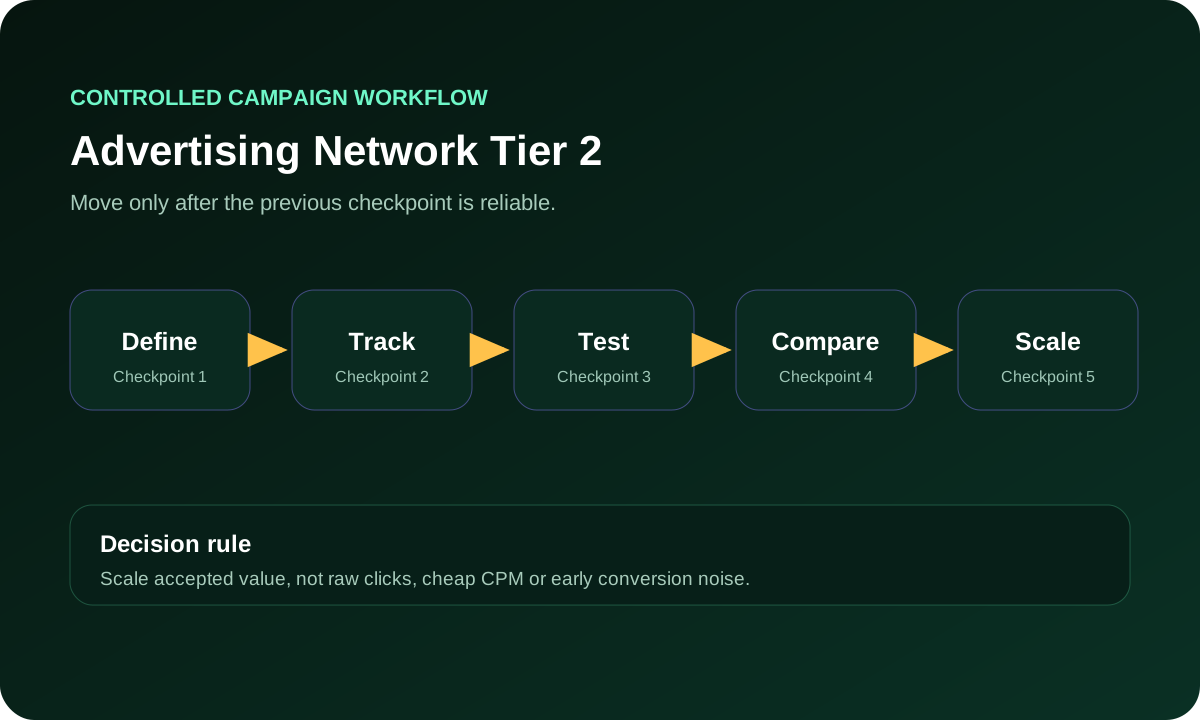
Decision rule: Compare the supported media purchase with accepted customer value for the actual localised offer. Keep incomplete records and assumptions visible.

How should a Tier 2 market comparison be launched?

A Tier 2 market launch starts with a controlled purchase of each localised course version. Verify the payment response, actual access and permitted campaign references the implementation retains. Confirm any advertiser-tracker setup in use. Keep unmatched, pending and reversed records visible; the media event and customer acceptance period must describe the same purchase before their totals support a comparison.

Keep the campaign setup and localised offer version together. Record the creative, destination, permitted references, buying settings and dates, along with any price or checkout change. The course seller should be able to tell whether a new result followed a different native explanation, translated product page or payment condition. This is a practical buying comparison with limitations. It does not become a causal experiment merely because the team changes one setting at a time.

Write the market and customer definitions

List the countries in the actual brief and the offer version delivered to each. Define an accepted paid course customer, the review period, expense basis and affordable learning allowance. Keep the buyer responsible for each localised journey clear. Use the same commercial question across the comparison without pretending that the prices, support and purchasing conditions are identical.

Check each localised purchase route

Open each destination on the intended devices and complete a controlled customer check. Verify the course language, price, terms, checkout response and access instructions. Inspect the permitted campaign references the setup actually retains. Correct a wrong-language page or failed receipt before comparing media costs; a lower click price cannot make an unavailable course purchase useful.

Authorise separate limited purchases

Confirm current FroggyAds formats, bid requirements and available expense controls for the selected setup. Keep each market purchase identifiable and within an affordable allowance. Our USD 50 minimum deposit is an account funding requirement, separate from your chosen campaign allowance and accepted-customer cost. Purchase enough to assess the stated question without committing money the business cannot afford to lose.

Reconcile comparable customer records

Wait for the written customer-review period, then compare each purchase with the accepted course records it can actually be connected to. Retain pending and unmatched outcomes. Apply a documented currency conversion method to the expense and value figures used in the comparison. Do not mix a gross price in one market with value after refunds and variable costs in another.

Choose the next market commitment

Keep, repair, limit or expand the individual purchase according to accepted customer value, actual expense and the ability to deliver the localised offer. Record the reason and the conditions that would change it. Where the evidence is incomplete, authorise only the next useful investigation. A combined campaign average should not hide a market whose customer journey still needs correction.

Five-step workflow for Advertising Network Tier 2

How should the learning allowance reflect market value?

Set an allowance around the commercial uncertainty you need to resolve. For the course seller, the question may be whether the translated offer produces accepted paying customers at an expense compatible with its local price and delivery costs. Consider the review delay and how many unresolved records the team can handle. Avoid dividing a small allowance into so many countries, formats and creative variants that none can support a useful conclusion. Keep the spending boundary explicit before the first purchase.

Review expense and value on the same basis. A bid, account deposit, media spend, gross customer payment and contribution after variable costs are different figures. Record any fees, refunds and conversion method that affect the accepted value used for allocation. A market with a cheaper accepted-customer cost may still contribute less if the actual offer produces less value per customer. Fund the purchase that fits your written economics, rather than assuming that a Tier 2 label creates an automatic discount.

Accepted paid customer

Use the customer status established by your course operation: a valid accepted payment and the promised access under the written review rule. Keep a trial, checkout attempt and failed charge distinct. Compare that accepted count with the media expense actually attributed under the available record connection, retaining its limitations.

Available buying observations

Inspect the buying observations available in the actual account alongside the course records you control. A changed creative response, destination error or source pattern can identify a useful investigation. Confirm the report definition before using it; customer access and later refunds may require records from the advertiser rather than a field in the media dashboard.

How do source records and customer value guide another purchase?

Compare the defined customer contribution with media expense after applying consistent acceptance and currency rules. Include the variable costs appropriate to your product before calling a value figure contribution. Keep fixed expenses, unobserved later value and other commercial risks separate. A positive amount after media in a hypothetical calculation is not evidence of campaign profit.

Source records can guide another purchase when the permitted campaign connection supports customer reconciliation. Compare accepted outcomes after the same review period, retaining unjoined records. Check whether the offer, destination or price changed before treating a different source result as a media improvement. Limit uncertain exposure while the responsible team investigates the actual gap.

Retain market-level reports when price, language, checkout or access differ enough to change the commercial decision. The course seller can compare its two localised journeys without averaging away a failed receipt or support backlog in one of them. Segment only when the purchase can answer a real question. Separate records improve interpretation, but they do not turn a very small number of accepted customers into a reliable forecast.

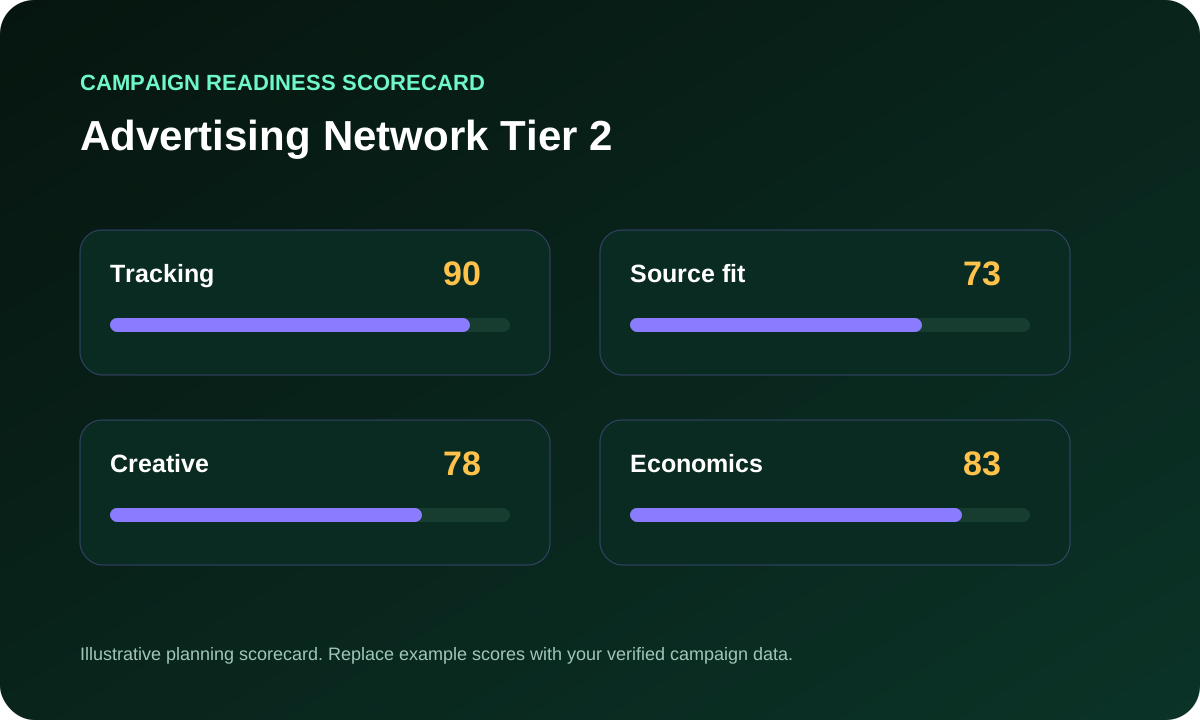
Readiness scorecard for Advertising Network Tier 2

How should creative explain the localised offer?

Prepare distinct reasons to consider the course, such as the actual lesson approach or a real sample of the work taught. Keep those claims accurate for the localised version. A translated headline should match the destination and course access the customer receives. We recommend a clear explanation of the product over simply translating a broad promise that the underlying offer cannot fulfil.

Compare response with accepted purchase and access evidence. A creative that attracts readers seeking a free drawing sample may behave differently from one explaining a paid structured course. Neither a higher click-through rate nor a lower click cost settles which purchase deserves more money. Check whether the message created an informed expectation about what was included and what the customer needed to pay.

Check the destination as the actual localised course offer. Make the available language, lesson format, price, access period and support route understandable before commitment. Complete the purchase on the intended device path and verify the receipt. When a business changes its translation, checkout or access instructions, keep that version with the campaign dates before attributing a result to a new source.

Resolve a demonstrated market constraint before broadening the purchase. A wrong-language page needs a content correction; an unavailable payment route needs an operational correction; an unprofitable accepted-customer cost may require a different media or offer decision. Keep these causes separate. The tier category cannot diagnose why a particular journey failed, and another bid does not repair the customer experience.

Practical example: In the fictional course comparison, test a truthful lesson sample against a clear explanation of the paid course. Keep the localised price and access terms stable while reviewing accepted customers.

When should allocation move between market purchases?

Adjust the supported buying setting that addresses the observation, after checking the customer journey and record connection. Retain the earlier configuration while introducing a new creative, source choice or expense level. Compare the new purchase after the same customer-review period and note changed business conditions. We help you manage the media controls; your product and customer records establish whether the localised offer remains commercially suitable.

Avoid reallocating from an immature report merely because another market has recorded more early events. The seller may still be reviewing charges or access problems. Keep those records pending rather than silently counting them as accepted or rejected. If the delay is operational, resolve it before interpreting the latest raw media conversion count as a market preference.

Expand the individual purchase only when its accepted value and expense support another commitment. Keep localised creative, support and course-access capacity ready for the added customers. Review the marginal purchase under its actual conditions, including changed source mix. A successful earlier test does not promise the same acquisition cost after the offer, auction or destination changes.

Reduce or pause the affected purchase when the agreed expense limit is reached, the course cannot be delivered, customer events fail or the offer no longer meets the purchase conditions. Retain settings and relevant records before correcting it. Define what must be checked before restarting, so an operator does not resume the same broken journey merely because funds remain in the account.

SignalRecommended actionEvidence required
Tracking mismatchPause and repair measurementReconciled test events across systems
Promising but immature sourceObserve or limitMore mature accepted outcomes
Repeated negative source economicsReduce, exclude or lower bidAdequate spend, maturity and stable tracking
Stable accepted valueIncrease one dimension graduallyEconomics survive the previous increase
Performance breaks after scaleRoll back to last stable setupDocumented baseline and change log

Limitations and responsible use

Advertising Network Tier 2 does not guarantee impressions, clicks, accepted conversions, revenue or profitability. Auction availability, competition, user behavior, source mix, offer fit, creative, destination quality, tracking and optimization all affect results. FroggyAds can provide self-serve buying controls and reporting, but the advertiser remains responsible for the offer, campaign settings, compliance and business decisions.

Keep estimates and earlier reports attached to their assumptions. Replace a planning allowance with actual expense as it becomes available, and keep unresolved customer value clearly labelled. Paid media cannot establish future retention, sales or organic rankings. A useful market comparison identifies what the next purchase can test without presenting the earlier sample as a universal result.

  • Confirm campaign policy and legal requirements for every selected country and offer.
  • Show the actual localised offer and price clearly, sending readers only to the version the business can fulfil.
  • Retain permitted campaign references and customer information under the practices appropriate to the actual offer and market.
  • Separate published account entry requirements, auction bids, test allowances and observed customer costs in every buying review.

Which FroggyAds resources confirm purchase requirements?

Use the current FroggyAds format, account entry and campaign setup resources to confirm the purchase requirements. Choose our self-serve platform for supported buying controls that match the localised plan. Keep implementation instructions with the actual tracker or customer system responsible for those records; general guidance does not establish an automatic integration.

Questions about advertising network tier 2

Why should a Tier 2 label be replaced with an exact campaign scope?

The label alone does not establish countries, devices or audience fit. Name the active markets, format, offer, destination, accepted conversion, attribution window, budget ceiling and owner.

What should be tested before comparing Tier 2 media costs?

Compare media costs after checking usable inventory, supported controls and the actual localised customer route. The sketching-course buyer should verify payment receipt and access before treating a cheaper purchase as commercially suitable. Use accepted customer records under a consistent review period, keeping missing connections visible.

How should a Tier 2 learning budget be bounded?

Bound the Tier 2 learning budget with an affordable media allowance and a review date linked to customer acceptance. Account funding and a published entry bid answer different questions from the amount authorised for this test. Choose a market comparison the allowance can support, and review pending customers before deciding whether another purchase is justified.

Which economics belong in a source decision?

Use accepted conversion cost, approval or rejection, contribution and delayed value where relevant. A low auction or click cost cannot establish that the offer and customer path are commercially suitable.

How should a Tier 2 creative test reveal a real preference?

Compare meaningfully different promises with stable IDs, not small color or punctuation edits. Read click response alongside landing engagement, conversion delay and downstream acceptance before choosing a concept.

What destination details must be confirmed for each selected market?

Check language, device operation, forms, payment, fulfilment, contact information, consent and required disclosures. Split delivery when different country or device experiences prevent a clean comparison.

Why should raw traffic not control Tier 2 optimization?

The business result may mature later or reject early events. Use leading signals cautiously and confirm them against accepted outcomes before they are allowed to move budget or sources.

How should an optimisation comparison be recorded?

Record the setting changed, its date and the offer and customer definitions kept stable. Note changes in auction conditions, source mix or customer operations that could also affect the result. Use that comparison to guide the next purchase without calling it proof that one setting caused the observed change.

When should a Tier 2 campaign return to its last stable setup?

Restore the baseline when a measured increase weakens source mix, accepted acquisition cost, validation delay or rejection. Reduce scope when the newer delivery cannot satisfy the written economics.

Which conditions justify stopping the campaign?

Pause for broken tracking, an unavailable destination, accepted value outside the limit, unsafe source concentration or changed policy conditions. Record the responsible person and exact restart requirement.

Controlled self-serve media buying

Start the next localised market purchase with FroggyAds

Bring a serviceable offer, tested customer journey and written market-level economics to your FroggyAds account. We provide supported targeting, format, bid, budget and source controls for the purchase. Start with the localised version you are ready to deliver, review accepted customers after the stated period and use that evidence to choose the next commitment.

Advertiser decision framework

Which comparison should decide the next allocation?

Compare the localised purchases by the commercial decision each can support. Keep the actual market, offer version, language, price, accepted customer definition and expense period visible. If one journey is broken or many charges are unresolved, repair that constraint before describing the difference as traffic quality. The useful output is an authorised next purchase with a clear reason, rather than a league table of countries.

Use the matrix to connect market readiness, localised customer acceptance and value after defined costs. It records the evidence a buyer needs before choosing the next allocation. Keep missing source observations or customer references explicit instead of filling them with assumptions.

DecisionWhat to verifyFroggyAds action
Paid customer definitionSpecify accepted payment and course access under the same written review period.Keep that definition attached to each supported campaign purchase.
Localised journeyCheck the correct language, price, terms and course access on intended devices.Apply available country and device settings matching the version actually served.
Source connectionConfirm the permitted campaign references and customer statuses that can be reconciled.Limit an uncertain purchase while investigating the actual record gap.
Comparable economicsUse the same currency method and consistent variable-cost deductions for the value comparison.Authorise an affordable allowance rather than assuming a tier sets acquisition cost.
Further allocationCompare the added purchase after customer review, noting changed offer and buying conditions.Increase only the market purchase supported by value and delivery capacity.

Record a useful Tier 2 purchase brief

  1. Markets: list the countries and localised offer versions included in the authorised comparison.
  2. Journey: test the actual language, price, checkout response and customer access for each version.
  3. Allowance: keep account funding, auction requirements and permitted media expense separate.
  4. Reconciliation: retain accepted, pending, reversed and unjoined customer records under one review rule.
  5. Allocation: choose the next supported purchase by comparable value and operational readiness.

Why FroggyAds is relevant to Advertising Network Tier 2

Choose FroggyAds to organise supported media purchases around the market decisions your business can assess. Available GEO, city, device, operating-system, browser, carrier, category and source settings can help match the buying conditions to the localised offer. Confirm current format requirements before funding the purchase. Our self-serve controls and Adscore-supported quality measures complement your own payment, access and customer-value review; they do not replace it.

Keep the earlier configuration and localised offer record when authorising an increase. If customer acceptance weakens, investigate the actual difference before widening several controls. A translation, price or checkout change can matter as much as a media setting. Resolve the demonstrated constraint and review the next purchase on the same commercial basis.

Create your free FroggyAds account

Search intent and buyer decision

How can localised value change an apparent cost advantage?

Market-level review: compare the real offer and accepted customer records for each purchase. A lower acquisition cost is useful only in relation to what those customers contribute under the actual local price and delivery conditions. Keep unrelated countries and offer versions out of an undifferentiated tier average.

The fictional sketching-course example illustrates a value comparison, not a recommended country ranking. Suppose the buyer labels its Poland and Brazil purchases Tier 2 internally, with different localised prices and course-support costs. Convert the defined figures to USD using one recorded method. The comparison below uses contribution after relevant variable costs but before media; it leaves fixed expenses and later unobserved value outside the calculation.

Value inputs: retain the defined media expense, accepted paid customers, localised offer version and contribution before media. Check that refunds, fees and delivery costs are treated consistently. A gross customer price should not be compared with a net value figure from the other purchase.

Acceptance period should be the same before the buyer evaluates the fictional market results. Pending charges or unresolved course-access problems remain visible. If one purchase has not reached that point, continue the customer review rather than reallocating simply because the other report looks more complete.

Customer access is part of the actual offer. A paid seat that the customer cannot use needs investigation before it can support a further media commitment. Keep that operational fact with the course version and report period, without assuming the advertising network receives the access status automatically.

Expense comparison needs the actual billing unit and reporting period. Keep the campaign allowance separate from money already spent, and record the conversion method for any local-currency figures. These checks make the arithmetic inspectable without implying a fixed price for Tier 2 traffic.

Purchase decision: retain or expand the localised journey that meets the written value and capacity limits; repair or limit the one that does not. This is a business decision about observed purchases, not proof of permanent country or source quality.

Next review: record the added expense, offer changes and accepted-customer period before assessing another allocation. Keep the earlier comparison available so an operator can explain why the decision changed rather than relying on a tier label.

Market reviewHow to use itEvidence to retain
Localised offerConfirm the actual language, price, terms and customer access the business can deliver.Retain the course version and controlled journey-check result.
Comparable recordsUse the same acceptance period and defined currency and variable-cost treatment.Keep expense, accepted statuses and unresolved records visible.
Next allocationCompare contribution before media with the expense of the actual purchase.Record the approved amount, reason and condition for a new review.

A hypothetical two-market value comparison

Hypothetical example: the course seller spends USD 180 on the purchase labelled Poland and accepts 12 paid customers, giving media cost of USD 15 each. Their assumed contribution before media is USD 14 each: 12 times 14 minus 180 equals negative USD 12. The purchase labelled Brazil spends USD 240 for ten accepted customers, or USD 24 each. At an assumed USD 29 contribution before media, ten times 29 minus 240 leaves USD 50. All figures and local offer conditions are fictional. The cheaper acquisition cost is not the stronger value result in this example; neither amount establishes profit after fixed and other excluded costs.

Why use FroggyAds here?

Use FroggyAds to manage the supported media purchase while your own customer and value records guide allocation. Bring the actual market scope, a working localised destination and an affordable allowance, then Create your free FroggyAds account.

Provider reference scope: consult Shopify paid-advertising guidance and Google Ads guidance for the relevant provider's terminology and implementation context. Their features and examples do not establish identical FroggyAds functions or market performance. Confirm the current setup in the system responsible for the actual task.

Direct answer

What should a Tier 2 buyer verify first?

Verify the exact countries and localised offers, then test customer access and the records used for acceptance. Confirm current FroggyAds options and authorise the first affordable purchase. Compare market-level value on a consistent basis after customer review, keeping unresolved records and offer differences visible before allocating more money.