
Define the impression event
Confirm when an impression is counted, whether reporting distinguishes served and viewable impressions, and which formats are included. A thousand technical ad calls are not automatically a thousand useful exposures.
Buy Display impressions with FroggyAds from a published $0.10 CPM starting bid. Choose eligible markets, devices and sources, then compare the resulting visits and customer actions. Actual rates and delivery depend on the campaign's buying conditions.
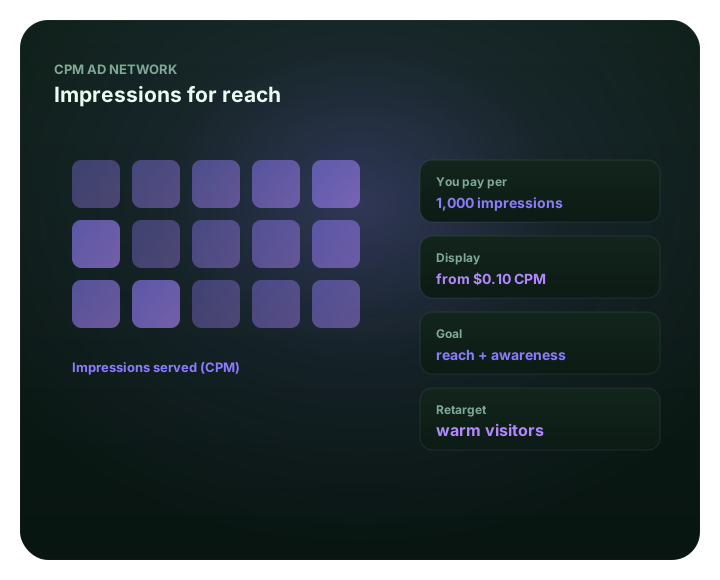
Quick answer: A CPM ad network prices advertising per 1,000 counted impressions. FroggyAds publishes Display starting bids from $0.10 CPM, with targeting, budgets and source controls to shape the traffic purchase. The entry price is not a guaranteed average or a promise of visitors. Compare the inventory, measurement coverage and resulting customer actions so the impression buy supports your business objective.
| Section | Distinct excerpt from this page |
|---|---|
| Buy impressions for reach and presence | Cost-per-mille pricing charges you per thousand impressions, which makes it the right model when your goal is visibility, reach or awareness rather than a single click. |
| See cpm ad network inside the platform | E-commerce reach across desktop and mobile web — See cpm ad network inside the platform. |
| Banner inventory | Run standard banner and rich-media sizes across desktop and mobile web. |
Reference for CPM Ad Network: Global Traffic for Advertisers: Google Ads CPM definition.
This page covers FroggyAds as a CPM display network. To buy display traffic directly, see Buy display traffic.
Cost-per-mille pricing charges you per thousand impressions, which makes it the right model when your goal is visibility, reach or awareness rather than a single click. On FroggyAds, Display banner and rich-media placements start from $0.10 CPM across desktop and mobile web, so you can stay in front of your audience at scale and at a predictable cost.
Impression-based buying pairs naturally with retargeting: run Display for broad reach, then use Audience targeting to re-engage the warm visitors who did not convert the first time. As with every format, you control GEO, device and source targeting, and FroggyAds uses Adscore and internal controls to help identify and filter invalid or low-quality traffic.
For A CPM ad network from $0.10, the FroggyAds self-serve workflow keeps campaign setup, targeting, budget controls, source-level reporting and optimization in one dashboard so advertisers can make evidence-led keep, cap, exclude and retest decisions.
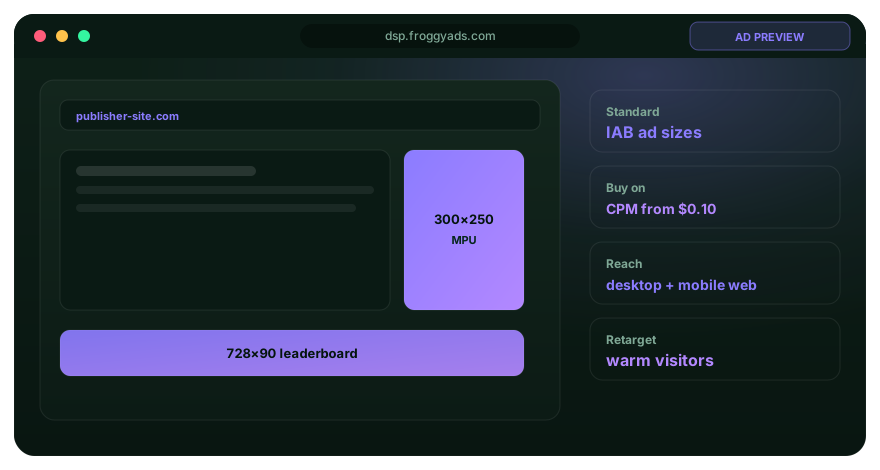
Impression-based pricing for visibility and brand presence.
Run standard banner and rich-media sizes across desktop and mobile web.
Transparent cost per thousand impressions that you control.
Stay visible across GEOs and devices across 750+ SSP integrations.
Combine Display with Audience targeting to re-engage warm users.
Buy CPM traffic on FroggyAds
Open an account and run impression-based campaigns from $50.
A CPM price applies to 1,000 counted impressions, not to 1,000 unique visitors. Use that unit when estimating the media allocation.
Choose the banner dimensions and file type your intended placement accepts, then preview the final export at its delivered size.
Use reach or visibility measures for a stated awareness objective, and customer outcomes for an acquisition objective. Neither follows automatically from a low CPM.
Create your account and buy impressions across 20B+ daily impressions.
A CPM ad network bills for each one thousand impressions delivered under its counting rules. FroggyAds offers self-serve display inventory from $0.10 CPM with targeting, source controls and campaign reporting. The best CPM network is not the one with the lowest impression price; it is the one that can deliver measurable, viewable and appropriately targeted exposure at an effective click or acquisition cost the campaign can support.
This page owns the decision around impression-billed inventory, viewability, frequency, creative exposure and effective outcome cost. Related modifiers are consolidated here only when they describe the same underlying user problem.
Confirm when an impression is counted, whether reporting distinguishes served and viewable impressions, and which formats are included. A thousand technical ad calls are not automatically a thousand useful exposures.
Standard CPM bills impressions, while viewable CPM focuses on impressions measured as viewable. Understand the platform’s definition and measurement method before comparing rates.
Impression buying can waste budget when the same user receives excessive exposure. Set frequency limits where available and review unique reach, repetition and time between exposures.
Preserve source, placement, format, creative, GEO, device and time. Compare viewability, CTR, valid sessions and accepted outcomes. Transparent source data enables allowlists, exclusions and bid decisions.
Effective CPC can be estimated as spend divided by clicks. At a fixed CPM, CTR strongly affects effective click cost, but click quality still determines acquisition value.
Calculate cost per accepted conversion after validation. A cheap CPM can be expensive when visibility, message fit or conversion rate is poor.
Display creative must communicate quickly without relying on a click to reveal the real offer. Use readable text, clear branding and a truthful destination. Avoid misleading animation or false interface elements.
Monitor viewability where available and compare unusual impression patterns, click timing and source concentration. Use platform and independent evidence when possible.
Define the audience, source set, CPM bid, creative rotation, frequency cap, target events and loss ceiling before launch. Keep one control creative and one stable landing path.
Increase reach, sources or budget gradually. Watch marginal frequency, CTR decay, viewability and source mix. Roll back when additional impressions no longer produce acceptable incremental value.
| Control | Operating requirement |
|---|---|
| Billing or permission | Document the current platform, campaign, traffic-source and billable-event rules before launch. |
| Tracking contract | Preserve click or impression identifiers, source, placement, creative, cost and the final accepted outcome. |
| Evidence threshold | Set the minimum amount of mature source-level evidence required before a keep, limit or stop decision. |
| Scale rule | Increase one major variable only after value repeats with stable quality and a known source mix. |
| Stop rule | Pause when policy, loss, discrepancy, invalid-traffic, rejection or quality limits are breached. |
| Rollback | Retain the last stable bid, source list, creative and destination so a failed change can be reversed. |
CPM means cost per 1,000 impressions counted under the campaign's buying rules. It is not a charge for 1,000 unique visitors or confirmed customers. Our published Display option uses this model, so you should prepare both the creative and the destination before buying exposure. FroggyAds targeting and source controls help you assess which parts of that impression purchase are useful.
We publish Display starting bids from $0.10 CPM. Actual buying conditions depend on your selected market, devices, inventory and competition. Treat the entry point as a price to investigate, not a guaranteed average across the campaign. Our $50 minimum deposit is a separate account-funding threshold. Neither number establishes the quantity of customers a particular impression purchase will produce.
Multiply planned impressions by the assumed CPM and divide by 1,000. A hypothetical plan for 200,000 impressions at $1.50 CPM would require $300 in media. This is arithmetic, not a FroggyAds quote or inventory forecast. Allow separately for production and measurement expenses, then set the actual campaign allocation around an audience and customer goal you can evaluate.
Not necessarily. An impression is a counted delivery or display event; viewability asks whether measurable delivery met a specified opportunity-to-see rule. Neither establishes attention, understanding or a sale. Where viewability data is available, inspect the measured share of traffic as well as the rate. Compare that context with source spend and customer outcomes instead of treating every served impression as a confirmed person who noticed the message.
It can be, provided the audience, creative and destination produce those outcomes at an acceptable cost. The billing model does not prevent you from measuring orders or qualified enquiries. Keep the impression charge separate from the resulting acquisition cost. With FroggyAds, source-level buying decisions let you refine a CPM campaign using your customer records rather than judging it only by how many banners were served.
Translate both into the same customer goal, using clearly stated assumptions. For example, a hypothetical $2 CPM at a 0.4% click-through rate implies four clicks per 1,000 impressions and a $0.50 effective click cost. That estimate is not a second charge or a promised response rate. The later conversion rate still matters, and different formats may attract customers in different contexts.
Low-priced impressions may reach an unsuitable audience, receive little useful visibility or use creative that does not explain the offer. They can also produce genuine clicks that abandon a difficult destination. Investigate these stages before buying more of the cheap inventory. Our source and targeting controls help you isolate the weak combination, while confirmed leads or orders show whether the lower media price actually saved money.
Use frequency settings to manage repeated delivery under the selected scope and period, and a spending limit to manage money. Review whether additional exposure supports your goal or mainly repeats the message without useful response. Do not assume the cap identifies one person perfectly across every device. Check the campaign's current frequency definition and compare the resulting source mix before deciding that a tighter setting improved value.
Look for a clear billable event, eligible formats and markets, practical budget controls, source reporting and a way to connect delivery with your chosen customer outcome. Confirm what is actually available in the campaign rather than infer it from a broad inventory total. FroggyAds combines these buying decisions in a self-serve workflow, so the next allocation can follow specific placement and audience evidence.
Expand when the current customer results justify the cost and the destination can serve more demand. Increase one meaningful dimension, such as budget or an eligible source group, and inspect the additional traffic separately where possible. Keep the prior settings available because larger purchases can change the inventory mix. Choose FroggyAds for impression buying that you can review and adjust, not for an assumption that more exposure automatically creates more sales.
Sources checked July 17, 2026. They are verification inputs, not permanent guarantees of future pricing, policy, approval, inventory or performance.
A CPM campaign can report a large number of delivered impressions even when only part of the inventory had a strong chance to be seen. Understand whether the network reports served, rendered or viewable impressions and how viewability is measured. Compare placement-level viewability where available, but also inspect page context, device and creative size. A low CPM can lose its advantage when the ad appears below the fold, loads late or is repeatedly shown to users who have already ignored it.
Impression buying requires a deliberate balance between reaching more people and repeating the message. Define the target audience, desired exposure range and time window before setting the budget. Use frequency caps where available, and review unique reach rather than assuming every impression reaches a new user. Different formats and campaign objectives tolerate different repetition levels. Retargeting may justify more frequency than broad prospecting, but both should have a point where additional exposure is considered waste.
CPM is a media price, so translate it into effective CPC, cost per valid session and cost per accepted outcome. Effective CPC equals spend divided by clicks, while accepted acquisition cost includes the final validated result. These measures allow CPM inventory to be compared with click-priced media under one business framework. Keep the attribution window and event definitions consistent. A high CTR can lower effective CPC, but it does not guarantee that the clicks are qualified or that the destination produces value.
The ad must communicate the core proposition during the impression because many viewers will never click. Use clear branding, readable contrast, a truthful product category and one understandable action. Avoid false buttons, system warnings or animation that creates accidental engagement. Rotate creative before fatigue becomes severe, but keep a control version so changes can be measured. Test size and mobile rendering in the actual placement environment, not only in a design preview.
A CPM network should expose enough source or placement detail to identify where impressions are delivered. Review the share of spend and impressions coming from the largest sources. Heavy concentration can make a campaign dependent on one placement and can distort averages when that source changes. Build allowlists and exclusions from viewability, valid-session behavior and accepted value, and retain the evidence behind every list decision. Aggregated campaign totals are insufficient for quality control.
Invalid traffic can affect impressions as well as clicks. Watch for impossible delivery speed, repeated device or network patterns, sudden source spikes, near-zero dwell time after clicks and discrepancies between platform and independent measurement. A single anomaly does not prove fraud, but it should trigger a pause or investigation when it exceeds the approved threshold. Preserve raw reports and timestamps so the platform can review the same source window. Do not attempt to recover a suspected loss by increasing volume.
If a network offers both standard CPM and viewable CPM, compare them using the event each model purchases and the outcome the campaign needs. A higher vCPM can still be efficient if more impressions are actually seen and produce stronger downstream behavior. Keep audience, creative and destination stable during the test. Report served impressions, viewable impressions, clicks, valid sessions and accepted outcomes separately so the team can understand where the value difference occurs.
As budget rises, additional impressions may come from weaker placements or repeat exposure to the same users. Monitor marginal reach, frequency distribution, viewability, CTR decay and accepted outcome cost after each increase. Keep a control allocation and a maximum concentration rule. If the expansion adds impressions but not incremental value, return to the previous bid, source set or budget. Scaling CPM should increase useful exposure, not merely inflate the impression counter.
Estimate the impressions the budget can purchase by dividing spend by CPM and multiplying by one thousand. Then apply realistic ranges for viewability, CTR, valid-session rate and accepted conversion rate. This turns a media budget into an expected evidence range. If the test is unlikely to generate enough clicks or accepted events, narrow the audience or choose a more frequent diagnostic outcome rather than pretending that a large impression count alone will answer the business question.
Different sizes and placements can have different viewability, user attention and click behavior. Keep them identifiable in reporting and avoid averaging all display inventory into one result. Test whether the creative remains readable at the actual rendered size, especially on mobile. A placement that delivers a low CPM but crops the message or appears in a weak page position may create less useful exposure than a higher-priced placement with clear visibility.
Review the content categories and environments where the ad may appear, then exclude contexts that conflict with the campaign, brand or legal requirements. Brand-safety controls should be paired with source reporting because category labels are not a substitute for placement evidence. Document exclusions and review the effect on reach, CPM and source concentration. A narrower safe inventory pool may cost more, but the comparison should include reputation and audience fit rather than media price alone.
CTR can reveal whether the creative attracts interaction, but a very high rate may also come from misleading design, accidental clicks or a narrow source. Compare CTR with valid-session rate, time to first action and accepted outcomes. Require enough impressions before declaring a variant better, and preserve a control. Optimize the message for qualified response rather than maximizing clicks at any cost, because CPM buying can make curiosity-driven creative look efficient while weakening the final funnel.
Platform, ad server and analytics reports can disagree because they count different stages of delivery, use different timezones or filter invalid activity differently. Define the expected relationship between served impressions, rendered ads, viewable impressions, clicks and valid sessions. Reconcile by date, source and creative, and set an investigation threshold. A discrepancy should be diagnosed before changing bids, because a measurement mismatch can make a healthy placement look weak or a low-quality placement look efficient.
Before approving the final allocation, compare the marginal block of impressions with the original control. Review whether the extra budget increased unique reach, shifted into lower-viewability sources, raised frequency or weakened accepted outcome cost. Record the point where incremental exposure stopped adding value, because that boundary is more useful for future pacing than the lifetime campaign average. Keep the same creative, attribution window and accepted-event definition during this review. If the campaign changed several variables, run a smaller confirmation test before treating the result as a network-level conclusion. Store the source export and settings beside the decision so the next team member can reproduce the comparison accurately and safely.
Practical planning note: compare CPM inventory with downstream visit quality, qualified-action rate, conversion delay, placement transparency, and repeatable scale before increasing spend. A low impression price is useful only when the resulting audience advances the campaign objective within the agreed testing limits.
Direct answer: Cpm Ad Network should be evaluated by the exact billable event, inventory transparency, conversion tracking, source-level controls and the value produced after validation. A low headline rate is not automatically efficient. Compare qualified outcomes, not only the platform charge.
Within A CPM ad network from $0.10., use this checkpoint when recording the next page-specific decision. Write down what triggers a charge, which events count as qualified, how duplicates and invalid activity are handled, and which reporting window will be used. Keep the media metric separate from the commercial outcome. CPM measures impressions, CPV measures views, CPL measures leads, CPI measures installs and CPA measures an agreed action.
For A CPM ad network from $0.10., apply this control to the page's stated scope and evidence window. Use one offer, one landing path, a limited GEO and device scope, consistent conversion tracking and a written stop rule. Review source-level performance before increasing spend. Pause placements that create volume without downstream value, and retain a clean control group so creative, bid and audience changes can be compared.
For A CPM ad network from $0.10., apply this control to the page's stated scope and evidence window. Calculate cost per validated outcome, approval rate, conversion lag, refund or rejection rate, and mature revenue where available. For impression or view pricing, translate spend into the business event that matters. For action pricing, verify the action definition and attribution logic before treating the nominal rate as comparable.
| Decision area | Question to answer | Practical control |
|---|---|---|
| Billing | What exact event creates cost? | Document the charge definition and reconcile platform logs. |
| Quality | Does traffic produce validated outcomes? | Use postback or server-side tracking and source reports. |
| Economics | What is the mature cost per useful result? | Include approval, retention, refund and revenue signals. |
| Scale | Can spend grow without efficiency collapse? | Raise budgets gradually and preserve stop thresholds. |
On A CPM ad network from $0.10., use this control to keep the page's evidence and action traceable. Stop a source when it exceeds the agreed spend cap without enough validated outcomes, when tracking cannot be reconciled, or when downstream quality falls below the business threshold. Roll back to the last stable bid, creative and targeting combination. Do not compensate for weak quality by scaling volume.
Keyword coverage: cpm advertising network.
Use this page when advertisers and media buyers are evaluating A CPM ad network from $0.10. as a buying environment. Compare supply fit, targeting, budget control, source transparency and conversion measurement before treating a low bid, deposit threshold or format list as proof of fit. Keep this URL focused on that decision; use CPM Rates In Uk for the adjacent task.
Decision inputs for A CPM ad network from $0.10.: source quality. On this URL, use those inputs to evaluate the buying environment against explicit media controls and keep each one tied to the same accepted-event definition.
Page-specific evidence path: Use the visible sections A CPM ad network from $0.10. as evidence for A CPM ad network from $0.10.. They should answer the page's own buying question before budget is increased; they are not interchangeable with the neighboring URL or with a generic traffic checklist.
What makes this URL distinct: A CPM network prices impression delivery, so the buyer must connect impression cost to viewability or delivery context, click-through behavior and the final accepted outcome. Separate a cheap thousand impressions from an efficient acquisition cell. Preserve source and placement IDs so weak exposure can be removed without assuming the CPM model itself caused the result.
| Checkpoint | Page-specific action | Evidence to retain |
|---|---|---|
| Commercial fit | Define how the CPM buying model connects to your accepted campaign outcome. | Bid/budget rule, loss limit and accepted-event economics. |
| Supply fit | Confirm the available format, GEO/device path and destination policy support the campaign. | Inventory/format context and eligibility notes. |
| Optimization fit | Require enough source-level reporting to explain where accepted value comes from. | Source IDs, spend, accepted outcomes and keep/exclude actions. |
Hypothetical example: For A CPM ad network from $0.10., if a controlled test spends USD 225 and records 6 accepted outcomes after the same review window, accepted cost is USD 37.50 per outcome. Replace the inputs with your own economics and the event definition appropriate to this page.
For A CPM ad network from $0.10., FroggyAds gives advertisers a self-serve benchmark for format access, targeting, budgets, conversion tracking and source-level controls within one buying workflow. Create your free FroggyAds account.
A CPM ad network from $0.10 is most useful when it helps a buyer decide whether this option fits the buyer's acquisition workflow. Define the accepted outcome first, then use targeting, budget and source-level evidence to decide what deserves more spend.