
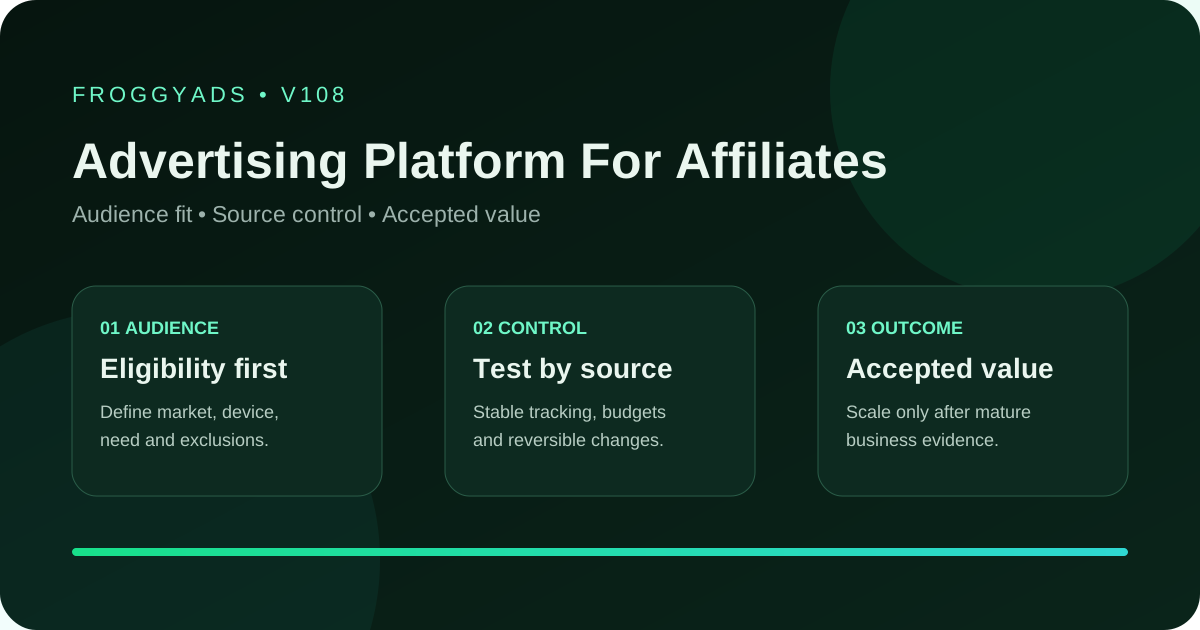
What does an advertising platform need to do for an affiliate?
It must turn media spend into a traceable test of a specific affiliate offer. The platform supplies delivery, supported campaign controls and reporting. Your tracker carries click and conversion identifiers. The advertiser or affiliate program decides whether an action is valid and payable. A useful platform keeps those layers connectable without pretending that a click is the final business result.
Before you buy, write the offer constraints: eligible countries, devices, audience conditions, permitted creative, destination, conversion event, validation delay, payout rule and traffic restrictions. Then choose the platform settings that express that brief. This protects your account from buying volume the offer cannot accept.
With FroggyAds, you can choose relevant country, city, device, operating-system, browser, carrier, category and source options where available for the campaign. Our controls let you express real offer conditions and investigate a useful source question. Add segmentation when it has a practical buying purpose rather than dividing the purchase into tiny groups that cannot support a clear conclusion.
How should an affiliate evaluate a traffic-buying platform?
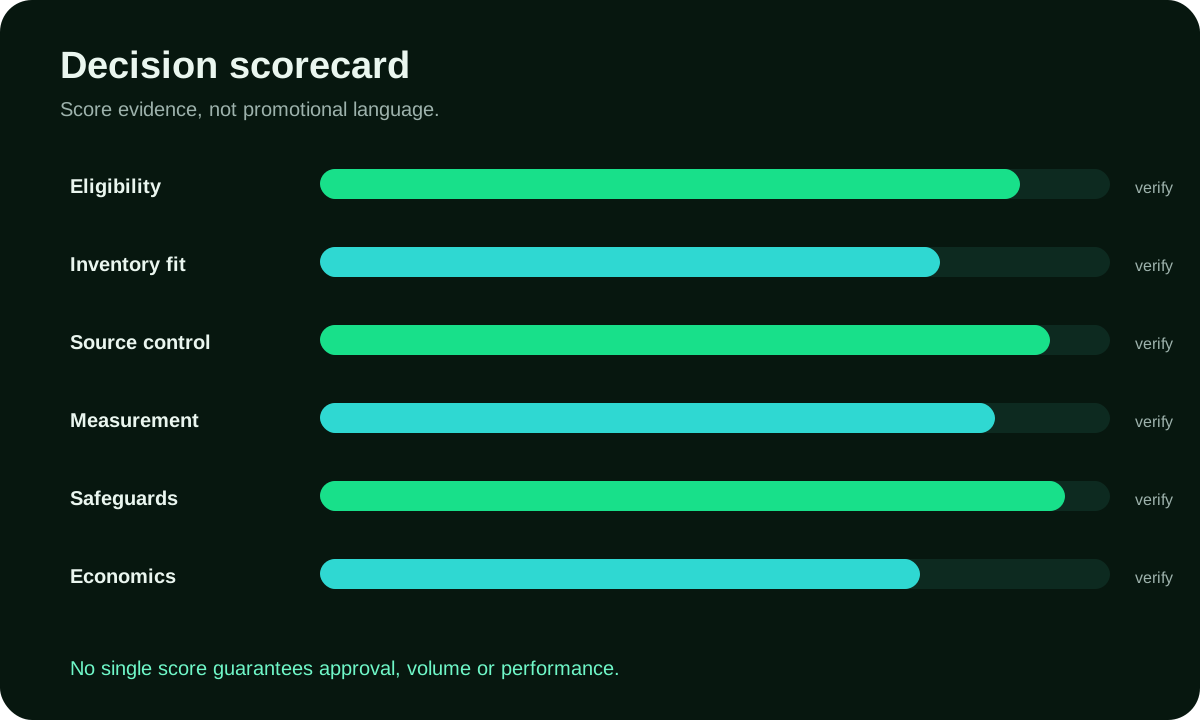
Start from the offer and work outward. Inventory access matters only when the format can present the offer, the landing page can continue it and the program permits the resulting traffic. Source volume matters only when the tracker can connect that delivery to accepted conversions. A low click price matters only when settled payout covers media and operating cost.
| Platform question | Affiliate evidence | Reason it changes the choice |
|---|---|---|
| Can the offer run? | Permitted GEOs, devices, traffic types, claims and landing pages. | Prevents ineligible traffic and avoidable program rejection. |
| Can the test be bounded? | Bid, daily budget, total ceiling, audience settings and launch record. | Limits learning loss while the funnel and tracking are proved. |
| Can results be attributed? | Campaign, source, creative, landing-page, click and sub IDs. | Connects approved or rejected actions to the buying decision. |
| Can sources be acted on? | Mature cost, approval, reversal and payout by source cell. | Supports keep, cap, exclude or retest without rebuilding everything. |
| Can growth be reversed? | Saved baseline, marginal performance and rollback condition. | Protects the campaign when expansion changes source mix. |
Compare platforms using an understandable offer and destination context. Use the merchant state and observation opportunity appropriate to the programme, with cost definitions declared for each purchase. If source, message and destination all change together, explain that limitation instead of attributing the whole result to the platform alone.
Keep a buying brief for the platform comparison
Keep a usable buying brief with the offer version, permitted traffic method, actual destination and creative, relevant source references, allocation and dates. Include the programme acceptance and reversal conditions needed for the review. With FroggyAds, that brief turns directly into campaign choices you can manage, while the retained context helps another buyer understand why a source or message was tested.
Define the decision before delivery begins. For example, the buyer may keep a source when a stated minimum of mature actions remains inside an accepted-cost boundary, cap it while approval evidence is incomplete, or hold it when tracking coverage falls below the documented requirement. These are operating examples, not universal thresholds. Choose values from your payout, risk tolerance and validation cycle, and apply the same rule to both comparison cohorts.
Separate source status from source value
Use clear lifecycle labels. A new source has delivery evidence but too little mature outcome data. A probation source has a defined concern and a limited additional test. A proven source has repeated settled evidence under the current offer and funnel. A held source is paused with the observed reason and the condition needed for a future retest. The label should never substitute for the underlying numbers, but it prevents teams from treating every active placement as equally reliable.
When comparing FroggyAds with another buying route, retain the platform references and the supported fields in your tracker or programme. Align relevant currency, attribution and merchant states before computing the commercial result. A delivery change may suggest a bid adjustment; weak qualification may suggest a clearer message. Investigate a material tracking gap when it could alter which purchase appears worthwhile.
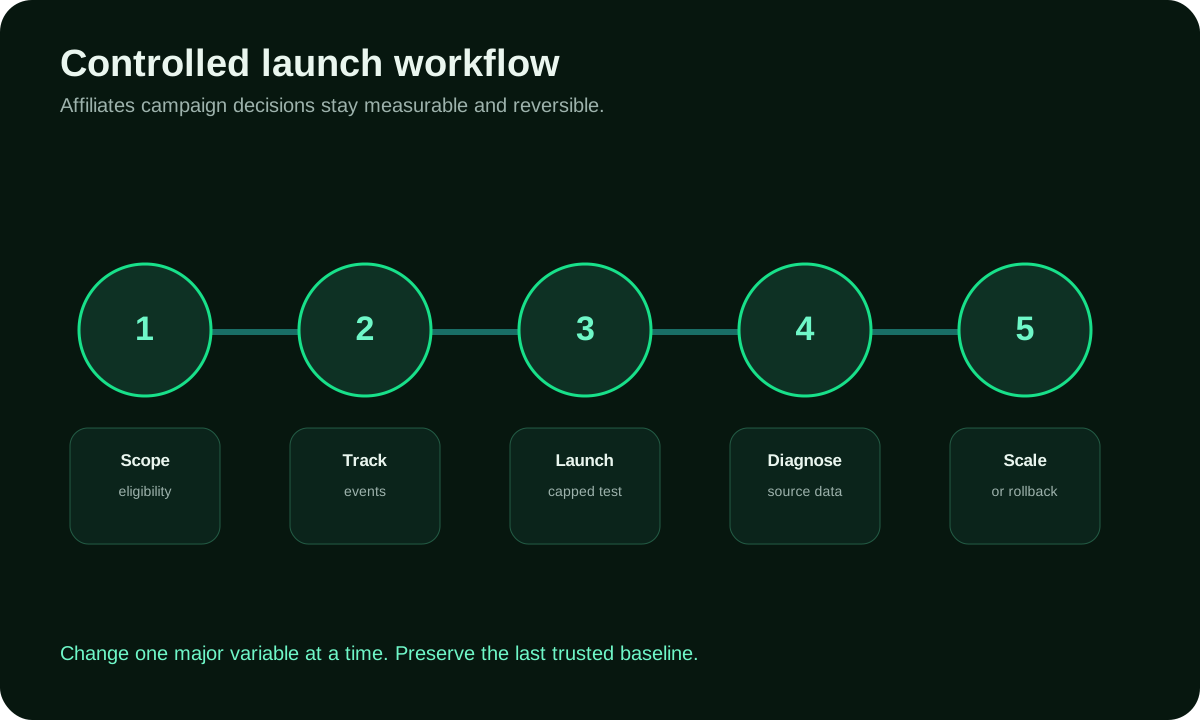
What is a controlled affiliate campaign workflow?
- Confirm the offer contract. Record allowed traffic, locations, devices, prohibited claims, conversion definition, payout and validation or reversal terms.
- Test the supported referral route. Use an authorised method through the intended destination, tracker and receiving programme record. Confirm the expected references without manufacturing payable customer actions.
- Build one campaign cell. Start with one offer, one principal audience boundary, labelled creative and landing versions, and a written spend limit.
- Allow decisions to mature. Monitor broken paths immediately, but wait for approvals or reversals before judging commercial quality.
- Take a relevant source action. Use the accepted outcome and appropriate uncertainty to retain, contain, exclude or repeat the affected purchase. Keep the previous configuration and the reason for a material change.
- Define the added purchase. Choose a new allocation, source or customer question when the relevant result and operating capacity justify it. Inspect the added cohort rather than assuming it inherits the earlier value.
Keep a campaign diary with every material edit. Affiliates often run several offers, trackers and landing pages at once; without a dated record, a performance change can be assigned to the wrong cause. Store the person responsible and the evidence required for the next decision.
Compare delivery, merchant value and acquisition cost
Separate delivery, tracker and settlement facts. Delivery fields include spend, impressions, clicks, source, device, creative and destination version. Tracker fields include unique clicks, reported conversions, event time and attribution. Settlement fields include approved actions, rejected actions, reversals, payable revenue and the date on which the cohort became mature.
Calculate economics from the corresponding acquired cohort and merchant state. Keep recent pending actions provisional and use an appropriate review opportunity for the programme. Comparing yesterday’s unresolved actions with last week’s approved value can make the newer purchase appear stronger or weaker for reasons unrelated to source fit.
Media cost per approved outcome
Divide media spend by advertiser-approved outcomes. State whether operational costs are included.
Revenue per click (settled EPC)
Divide payable revenue by the relevant click population after the stated validation period.
Contribution: compare revenue and acquisition costs
Compare settled revenue with media and other decision-relevant costs using a defined formula.
Hypothetical calculation: a purchase spends $400 on media, produces 25 recorded actions and receives 16 approvals worth $32 each. Approved value is $512 and media CPA is $25. If $40 in other assigned acquisition work belongs to the comparison, total cost is $440 and the amount remaining is $72. These illustrative inputs are not FroggyAds prices or results; replace them with the actual programme state, value and costs.
How should format, message and destination support the affiliate offer?
Choose a format that can set the correct expectation before the click. A concise placement needs one clear benefit and a qualified next action. A format with more visual or contextual space can explain a considered proposition. In every case, the creative must comply with the offer and describe what the destination actually provides.
Test different propositions, not token edits. Assign each concept a stable ID and follow it through engagement, conversion, approval and payout. A version that attracts more clicks may be weaker when it creates low-intent or ineligible actions.
The destination should continue the same promise, load on targeted devices and state material price, eligibility, subscription or fulfillment conditions. Version the landing page and retain the release time. When a site change coincides with a media change, separate the cohorts before drawing a source conclusion.
For a prepared affiliate proposition, our self-serve workflow turns the chosen format and customer conditions into a direct paid comparison. We recommend the relevant campaign options after the offer permission and destination job are clear. Our controls make the purchase adjustable while your programme record explains whether the acquired outcome supports the next allocation.
How can an affiliate optimize sources without damaging attribution?
Diagnose the layer before changing allocation. A click-ID gap is a tracking problem. Many ineligible conversions may reveal targeting or landing qualification. A high reversal rate belongs to settlement analysis. Suspicious delivery needs traffic-quality evidence. These patterns may appear together, but they require different remedies.
| Observed pattern | Check first | Possible action |
|---|---|---|
| Tracker and platform clicks disagree | Redirects, macros, duplicate rules, time zone and click-ID storage. | Repair measurement before excluding inventory. |
| Reported conversions fail approval | Offer eligibility, creative expectation and advertiser rejection reasons. | Narrow the audience or correct the message and landing page. |
| One source has settled negative margin | Sample size, maturity, stable tracking and source concentration. | Limit, exclude or reduce the source under a documented rule. |
| Margin survives the learning cell | Whether the result repeats across enough volume and time. | Increase one constraint and monitor marginal rather than lifetime value. |
Use the evidence to locate the affected route rather than judging an entire format from one source failure or protecting a source because its click price is low. Retain the reason for the adjustment and a useful repeat condition when the offer or destination changes. Our source controls help you act on a defined finding without discarding the rest of the acquisition context.
What limits and safeguards should affiliates document?
Use the platform controls to manage the paid purchase and the programme record to review accepted commission. Offer relevance, destination function, supported tracking and merchant rules all influence the commercial comparison. Treat estimates as planning inputs and use the actual acquired cohort to choose the next useful allocation.
- Follow the offer owner’s traffic, creative, brand and landing-page conditions.
- Use truthful claims and disclose material terms before the visitor commits.
- Keep bid, deposit or funding, media cost and learning budget clearly separated.
- Protect personal data and apply consent and retention rules appropriate to the user journey.
- Preserve enough campaign and source evidence for support, reconciliation and rollback.
Review the current FroggyAds pricing and entry information, ad formats, conversion tracking setup, traffic-quality controls, brand-safety guidance and editorial policy as relevant to the campaign. Page content does not override the final platform and offer terms.
Which external rules should an affiliate verify before launch?
Check the jurisdictions, platforms, advertiser program and product category that apply to the actual campaign. Official requirements can change, and a network comparison does not replace legal or program review. Keep the version and review date in the launch record.
- FTC advertising and marketing guidance can help US-facing advertisers review endorsements, disclosures and truthful claims.
- Google advertising policies are a useful comparison source when a wider funnel also uses Google inventory.
- Microsoft Advertising help provides another platform’s current policy and setup documentation.
- IAB Tech Lab standards provide technical context for parts of the digital advertising supply chain.
These sources support compliance and terminology checks. They are not evidence of FroggyAds campaign performance, and their inclusion does not imply that every rule applies to every affiliate offer.
Questions about advertising platforms for affiliates
What should an affiliate marketer look for in an advertising platform?
Look for supported traffic and formats that fit the offer, practical targeting and budget controls, source evidence, dependable click-ID handling and a workflow that lets you optimize from advertiser-accepted conversions rather than clicks alone.
Can FroggyAds guarantee that an affiliate campaign will be profitable?
We provide the self-serve traffic controls and reporting that make an identifiable affiliate purchase practical. Commission and profit depend on the offer, customer response, programme acceptance and relevant costs as well as the traffic. Choose FroggyAds for direct buying control and use the complete commercial comparison to decide what deserves another allocation.
How should an affiliate compare traffic sources?
Compare settled cohorts with the same offer, landing page, attribution window and accepted-conversion rule. Retain spend, source IDs, clicks, tracked events, approvals, reversals and payout value.
Which conversion should control affiliate budget?
Use the event the advertiser or affiliate program finally accepts and pays according to its terms. A tracker event is diagnostic until it reconciles with the approved business outcome.
How much should an affiliate spend on the first test?
Choose a finite learning amount based on your payout, expected validation delay, acceptable loss and the volume needed for a useful source decision. Keep the test ceiling separate from bid and account funding.
Why are click IDs and sub IDs important for affiliates?
Click and sub-identifiers can help connect a paid campaign with its receiving tracker or programme record when the actual tools support that route. Verify the expected handoff rather than assuming every field passes automatically. Keep a material unmatched population visible when it could change the source conclusion.
When should an affiliate exclude a source?
Exclude after stable tracking, sufficient matured volume and repeated negative accepted-value evidence support the decision. Keep the reason and a retest condition so useful reach is not lost permanently without review.
How do traffic-quality controls fit affiliate optimization?
Adscore and our internal controls help identify and filter invalid traffic. A valid visit still needs to match the offer, and programme acceptance and relevant value determine its commercial usefulness. Combine traffic screening with supported source reports and your own customer records when choosing what to purchase next.
Should affiliates optimize for EPC or ROI?
Use the metric that reflects your actual decision, calculated from settled payout and media cost. EPC can describe revenue per click, while ROI or contribution can include wider costs; define each input and maturity window.
How can an affiliate scale a winning campaign?
Increase one major constraint at a time, preserve the original conversion and approval rules, and compare marginal accepted value with the previous cohort. Roll back if the new source mix leaves your boundary.
Related resources for affiliates
Use the related resources for the specific buying task still unresolved: choosing traffic, preparing the customer message, connecting the supported referral route or interpreting source evidence. Keep the current offer conditions in view while moving from one guide to the next.
Build an affiliate purchase you can operate
Prepare one permitted offer, eligible customer and useful destination. Choose FroggyAds for the relevant format, targeting, bid, budget and source controls, then compare the acquisition record with the programme outcome that answers your buying question.
What should an affiliate prove before choosing an advertising platform?
Confirm that the offer permits the actual traffic route, the destination can explain it and the supported referral method reaches the relevant receiving record. Then check that the campaign controls express the intended audience and allocation. An available feature becomes useful when it supports a real customer condition or buying action.
| Proof | Minimum record | Buying consequence |
|---|---|---|
| Offer eligibility | Allowed traffic, GEO, devices, claims, conversion and payout terms. | Defines the inventory and message boundary. |
| Attribution integrity | Click ID, sub IDs, event, timestamp and advertiser acceptance. | Allows source economics to be reconciled. |
| Learning control | Bid, daily budget, total ceiling and authorized stop owner. | Caps exposure while the campaign is uncertain. |
| Source action | Settled cost, payout and approval by a stable source cell. | Supports a narrow keep, limit, exclusion or retest. |
When the offer, destination and supported records are prepared, we help you turn the brief into a direct paid comparison. Create your free FroggyAds account.
Use the platform for the paid-buying task it supplies
An advertising platform supplies the traffic purchase and its supported controls; it does not replace the merchant programme or determine every commission state. Consider a hypothetical offer paying for an approved trial: the platform can report media activity and let you adjust sources, the destination explains the product, and the programme determines whether the trial qualifies. A recorded click or form therefore cannot substitute for programme approval. Choose a platform when those stages can be made sufficiently traceable for the actual buying question, and keep a material limitation visible rather than inventing a native integration or guaranteed result.
Use the traffic for affiliates guide to compare the acquisition choices, then choose the platform workflow and controls needed to operate that purchase.
| Decision | Question | Retained evidence |
|---|---|---|
| Select | Can the platform express the offer’s actual traffic and customer conditions? | Offer brief, supported format and targeting configuration. |
| Attribute | Can the supported records explain a material difference in the acquired outcome? | Campaign/source IDs, click and sub IDs, creative and landing versions. |
| Value | Does approved payout exceed the costs included in the model? | Mature approvals, reversals, payable revenue and spend. |
| Act | Which narrow change has evidence and a rollback condition? | Dated decision, owner, affected cell and next review rule. |
Why choose FroggyAds for affiliate media buying?
We give affiliate buyers self-serve campaign setup, relevant targeting, bid and budget decisions and supported source reporting. You can test the prepared proposition, investigate a specific weak route and choose the next purchase from the relevant accepted result. Start your affiliate campaign with FroggyAds.
What should an affiliate prepare before choosing the platform?
Start with a current permitted offer, a useful destination and a supported referral route. Use FroggyAds to buy an identifiable campaign with relevant targeting, bids, budget and source controls, then use the programme state and acquisition costs to choose the next practical purchase.