
One DSP for every client campaign.
Choose FroggyAds when your agency needs to buy traffic for several clients while keeping each campaign's objective, budget and source decisions clear. Our self-serve DSP brings supported formats, targeting, bidding and campaign reporting into one buying workflow. You provide the client brief and the rules for accepting results. We provide the campaign controls to put that brief into practice.
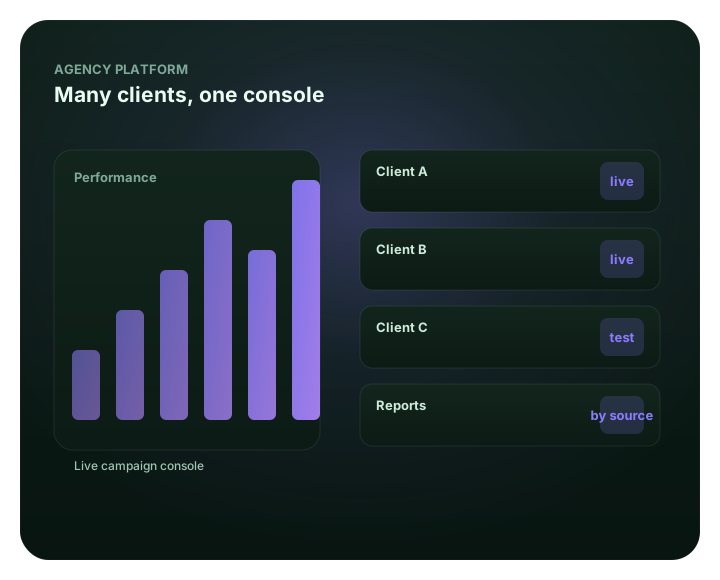
Client campaigns need separate decisions
What should an agency advertising platform help you control?
Quick answer: An agency advertising platform should help you operate client campaigns without confusing their goals or spending authority. With FroggyAds, you can set campaign targeting, bids and budgets, review source-level reporting and adjust source lists. Build the agency process around those controls: name the client and campaign, agree the conversion definition, test the destination and record who can approve another allocation. The same dashboard can support different buying decisions; a good result for one client does not automatically justify more spend for another.
| Agency requirement | Practical buying decision |
|---|---|
| Campaign separation | Give each client objective its own campaign record, spending allowance and conversion definition. |
| Source evidence | Review a source against the particular client's offer and mature outcomes before changing its campaign list. |
| Client reporting | Explain media spend, validated business outcomes and the next authorized action together. |
Advertising guidance: FTC guidance on online advertising and marketing. Keep the evidence behind client advertising claims available before launch.
- Brief: Agree what this client wants the campaign to achieve and who will validate the outcome.
- Buying: Apply the relevant campaign settings and give the test a written spending limit.
- Review: Recommend the next allocation from that client's evidence, with a named approver.
Agency media buying across a client roster
We give agencies a practical way to run paid traffic through one self-serve DSP. You can work with campaign formats, targeting, bids, budgets and source reports in the same environment, which helps the buyer act while the account team explains the decision to the client. Keep the client's commercial question visible throughout: a retailer may need verified orders, an app advertiser may need a defined activation, and a service business may need qualified enquiries. Those outcomes require different acceptance checks even when the campaigns buy similar traffic.
Use FroggyAds to make the media decision specific. Choose the format and available targeting that fit the approved offer, then review reporting at the source level instead of relying only on a total across campaigns. SmartCPC can support bid adjustments from available campaign signals, while Adscore and our internal controls help identify invalid or low-quality traffic. Your agency still needs the client's downstream records to assess commercial value. The dashboard illustrations on this page contain sample data; they are not client results or a performance forecast.
Built for agency buying teams
Our buying workflow suits agency teams that want to act on campaign evidence and explain the decision to a client. Keep the approval record, outcome definition and receiving responsibilities clear as you add accounts. Each new client needs its own commercial brief, even when your team reuses the same launch checklist.
- Keeping different client objectives and campaign records recognizable
- Testing suitable formats and markets against each client's offer
- Explaining campaign spend alongside validated client outcomes
- Making source decisions within an individual campaign's evidence
- Adding client work with a clear launch and review process
Put the approved client brief into the campaign
The useful platform demonstration is a real buying task. Take one approved client brief, choose an available format, configure the relevant targeting and set a campaign budget. Check that the creative and destination tell the same story, then validate the intended conversion path before submitting the campaign for review. Our campaign controls let the buyer act directly; a shared agency checklist helps another colleague understand the settings and the reason for them. Confirm account access and any client billing requirements with us before moving work into a new arrangement.
- Map the client objective to a clearly named campaign
- Keep market and format choices within the approved brief
- Review the campaign's source evidence before reallocating spend
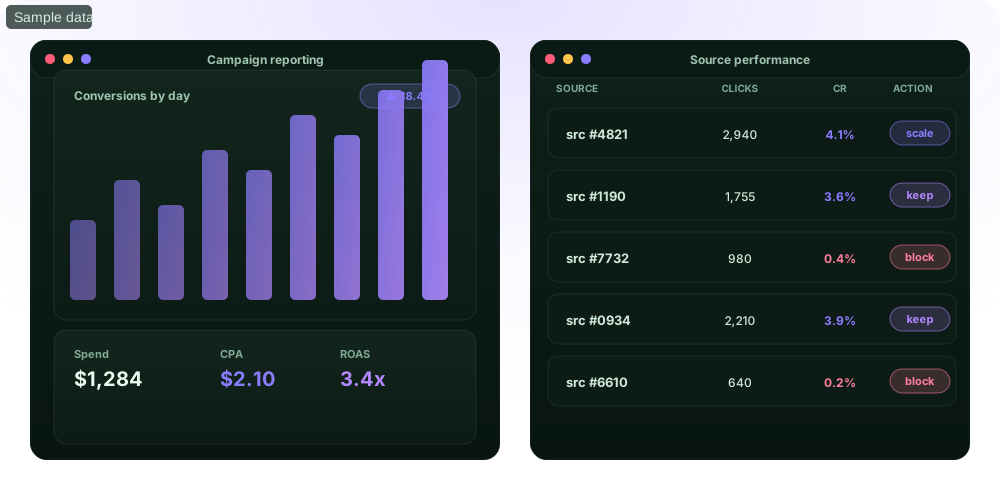
Give account teams a campaign record they can explain
A client report should answer a buying question, not simply reproduce a screen. FroggyAds supplies campaign and source reporting that your team can connect with the client's own outcome checks. Use that connection to explain what the media budget bought, what the business accepted and what you propose to do next. Keep the working record small enough that a covering buyer can act on it without guessing which client's rules apply.
Separate campaign instructions
Create a recognizable naming convention for the client, objective and test. Keep the approved market, destination, creative version and spending authority in the agency's working record. When several people cover an account, that record helps them distinguish a deliberate campaign split from an accidental duplicate. Confirm the actual account arrangement before promising a client a particular access or administrative feature.
Reporting with a business definition
Report impressions, clicks and spend as delivery measures, then add the client's validated outcomes. State what a conversion means and when it is considered final. A form submission, qualified enquiry and completed sale represent different stages. Showing those stages separately helps an account manager explain why an encouraging dashboard count may still require more client validation before a budget increase.
Formats matched to the client offer
We support Push, Native, Display, Pop, Video and Interstitial campaigns. Start with a format that fits the creative assets and the destination experience the client can actually deliver. Audience targeting is an additional capability, rather than another core ad format. Confirm the available inventory and settings for the planned campaign; broad platform supply does not make every format suitable for every client brief.
Campaign-specific source decisions
Keep source allowlists and blocklists tied to the campaign and the reason for the decision. A source that misses one client's requirements may suit another offer with a different price, destination or customer task. Record the evidence behind an exclusion and what would justify a retest. This lets the agency reuse its investigative method while keeping the actual buying conclusion specific.
Prepare your first client campaign with FroggyAds
Create your free account, bring one approved brief and configure a bounded test. Our published minimum account deposit is $50. Set the campaign allocation separately, according to the client's objective, measurement readiness and permitted learning spend.
Agency buying questions
Prepare the account, campaign and client handoff before committing the next allocation. These answers explain how our buying controls fit with the agency responsibilities that make a client campaign interpretable.
Can we manage several client campaigns with FroggyAds?
Yes. Our self-serve workflow supports running and reviewing multiple campaigns with their own settings. Use separate campaign instructions for different client objectives and keep an agency record that maps each campaign to its client. Confirm any required client access, billing or administrative arrangement with us before treating it as part of your service commitment.
What should we include in a client campaign report?
Show the reporting period, media spend, delivery measures and the client's validated business outcomes. Include the conversion definition, outcome maturity and the next proposed action. Our source-level reporting helps you investigate where spend went; your client records establish whether an enquiry, order or other reported event met the agreed business requirements.
Which formats should an agency test first?
Choose from our supported Push, Native, Display, Pop, Video and Interstitial formats according to the client's offer, available creative and destination. Begin with a test your team can interpret. Adding several formats immediately can make a weak result harder to diagnose when the creative, buying model and visitor experience all change together.
How should client eligibility affect targeting?
Translate the brief into relevant available controls, such as country, city, device, operating system, browser, carrier, category and source. Check the actual campaign options before launch. Restrict delivery to the markets and devices the client can serve, then test the destination on that route. Targeting choices should reflect real eligibility and customer experience.
Should we copy a source blacklist between clients?
Use earlier findings as an investigation lead, then check whether the same reason applies to the new campaign. Offer value, market, device experience and conversion requirements can differ. FroggyAds source controls let you act at campaign level, so an agency can retain the evidence behind a decision without turning every previous exclusion into a universal rule.
Is the $50 minimum deposit a client campaign budget?
The published $50 minimum is an account-funding threshold. It is separate from the amount you authorize for an individual campaign and from an auction bid. Set the test budget around the client's buying question, expected outcome frequency and learning limit. Our pricing page explains the published buying models and starting bids; actual auction costs and delivery vary.
Who should approve changes during a client test?
Agree that responsibility within the agency-client relationship before launch. Name the buyer who can adjust the campaign, the person who can pause it and the approver for extra spending or a changed offer. Keep the approval record with the brief. These are your operating responsibilities; confirm the platform account arrangements needed to support your team.
How do we assess traffic quality for a client?
Combine our Adscore and internal traffic-quality controls with campaign source reports, destination checks and the client's outcome validation. Screening helps identify invalid or low-quality traffic; it does not establish that every visitor will become a suitable customer. Investigate a recurring problem at the source and campaign level before deciding whether to restrict or retest that traffic.
Does platform-wide supply predict a client's volume?
No. Our published platform figures include 750+ SSP integrations, 20B+ daily impressions and coverage across 300+ verticals. They describe broad platform scale. The traffic eligible for a particular client depends on the campaign format, market, targeting, auction bid, budget and available inventory. Plan the client's allocation from observed delivery and business outcomes.
When should an agency ask for more client budget?
Ask when the client's agreed evidence supports a defined next test. Explain the current spend, mature outcomes, remaining uncertainties and the setting you intend to change. Check that the client can handle more enquiries or orders. Increase exposure within the agreed authority, then review the additional allocation separately so earlier results do not conceal a weaker expansion.
Continue the campaign planning work
For media buyers
Review the buying controls and evidence your team needs for the next traffic decision.
Ad formats
Match the creative and destination requirements to a supported campaign format.
Pricing
Separate account funding, published starting bids and the amount authorized for a client campaign.
Campaign optimization
Prepare the source, creative and budget question that the next campaign adjustment should answer.
Start with one approved client brief
Choose FroggyAds for direct control over your next client traffic campaign. Prepare the offer, destination, conversion checks and spending authority, then create your account and build the test. Use the first review to establish what this client should fund next.
Agency traffic-buying guides
Agency work connects the account manager, media buyer and client's receiving team. Give each person a defined question: which customer action is valuable, which traffic can reach an eligible visitor, and which business record confirms the result? The links below support those conversations. Keep the agency's own client authorization alongside the campaign settings so a useful general guide never replaces a specific commercial agreement.
Online advertising with client-specific outcomes
Use a common operating standard while keeping the client decisions separate. The account team agrees the business event and acceptable cost; the buyer configures the campaign and investigates sources; the client confirms whether the resulting activity met its requirements. Decide how those teams will exchange information before the campaign begins. A missing rejection reason or delayed order update can change the recommendation as much as a bid adjustment. FroggyAds gives your buyer the media controls, while that agreed handoff makes the client's decision usable.
Agency Advertising Platform: keep each client's authorization clear
The client mandate is the starting record for a campaign. Write the objective, offer, destination, serviceable market and person responsible for validating results. Add the initial media allowance, the review point and the person who may authorize more spending. Describe the event precisely: for example, an enquiry must include valid contact details and match the client's service area before it counts as qualified. This gives the buyer something firmer than an instruction to deliver more leads. It also gives the account manager a clear explanation when volume and useful outcomes diverge.
Within FroggyAds, translate that mandate into the available campaign settings. Your team can choose relevant targeting, bids, budgets and source controls, then review delivery from the same buying environment. Keep a mapping between the campaign name and the agency's client record. If one client has two offers or two materially different acceptance rules, document the split so the results remain interpretable. Treat account administration as a separate setup question and confirm the actual arrangement with us; campaign naming is an agency practice, not a claim about a particular permission feature.
| Agency decision | Client record | Reason for keeping it |
|---|---|---|
| Business event | Definition and person who validates it | Prevents an early form submission being reported as an accepted customer |
| Media authority | Initial allocation, review point and spending approver | Keeps a promising result from becoming an unauthorized budget change |
| Measurement join | Client, campaign, creative and source references where available | Lets the account team investigate the right journey and outcome |
| Campaign change | Setting, reason, time and responsible buyer | Explains which instruction produced the next period of evidence |
| Client recommendation | Mature outcomes, remaining uncertainty and next requested allocation | Makes approval a specific decision instead of an open-ended request |
Before launch, walk the client's actual route. Check the creative claim, destination, offer conditions, contact or checkout path and the event recorded after completion. Test on the devices and in the market conditions you intend to target. Ask the client's receiving team what makes an outcome invalid, duplicated or unsuitable, and arrange a way to receive those reasons. Keep supporting evidence for advertising claims available for review. Our campaign approval process is part of launch preparation; it does not replace the agency's responsibility for the accuracy of the client's offer.
After traffic begins, keep the reporting period and outcome maturity visible. An enquiry may need a follow-up call, and an order may need an agreed validation period. Compare sources using outcomes that have had a comparable opportunity to become final. If a client sends a late acceptance update, retain the period it belongs to instead of silently treating it as a fresh campaign result. That practice makes the next source decision easier to explain and reduces the chance that a delayed business process is mistaken for deteriorating traffic.
Client reports become more useful when they separate observation from recommendation. State what the campaign delivered, what the client accepted and what the buyer thinks should happen next. Include material changes and any unresolved measurement issue. A report can recommend a pause because the destination is failing, even when traffic is arriving as configured. It can recommend a bounded extension when the business evidence is promising but still limited. Give the client the reason, proposed exposure and next review point so approval has a clear scope.
Choose FroggyAds for agency work that benefits from direct campaign control and source visibility. You can act on an individual campaign's targeting, bid, budget and source lists while keeping its client objective in view. Our broad connected supply gives you traffic opportunities to evaluate across suitable formats and markets. The agency adds the judgement: whether an observed pattern is useful for this offer, whether the destination needs attention, and whether another allocation is justified. That combination gives the account team a concrete buying service to explain and the buyer controls with which to deliver it.
When a colleague covers an account, hand over the working instruction rather than a list of disconnected figures. Include the current campaign, approved creative and destination, remaining allowance, last material change, unresolved issue and next review time. Name the person to contact if a pause or additional spending is needed. Keep client information within the agency's agreed access and handling arrangements. A covering buyer should be able to understand why the current settings exist and which decisions remain outside their authority before changing live work.
Keep source knowledge useful without making it indiscriminate. Record which client, offer, format, market, device context and period produced a finding. A repeat invalid-traffic concern and a weak commercial response are different observations and can require different investigations. If a source list is reused as a starting point, check whether the original reason still applies. Document any campaign-specific exception. This helps the agency learn across accounts while avoiding a blanket blacklist that removes potentially suitable traffic simply because another client's economics were different.
At the end of an engagement, prepare a readable campaign handoff. Agree which creative, settings, measurement records and explanations the client should receive, and confirm the available account or data-transfer arrangements before promising them. Separate media spend from agency service fees, creative production and measurement work under the client's actual commercial agreement. Our self-serve buying environment can support your agency's execution, but the service you sell also depends on clear responsibilities and a record the client can understand when a different team takes over.
Turn a client meeting into an authorized campaign action
An account meeting should end with a specific instruction. Is the client approving the initial test, extending an existing allocation, changing the offer or asking for an investigation? Write the decision before the buyer edits the campaign. A general request for more leads can hide a changed service area, a new price or a slower follow-up process. Clarifying those details helps your agency choose the right control and avoids comparing a changed business proposition with the old campaign as though nothing happened.
Bring three working records into that discussion: the client mandate, the outcome definition and the current campaign instruction. The mandate defines the commercial boundary. The outcome definition explains what the receiving team will accept. The campaign instruction shows what the buyer is running now. If one record changes, identify the effect on the other two before using earlier performance to justify another allocation. This gives the client a clear reason for the recommendation and the buyer an actionable next step.
| Client request | Clarify before buying | Campaign response |
|---|---|---|
| More qualified enquiries | Confirm service area, qualification rules and who will follow up | Use suitable targeting and a campaign budget tied to that client's accepted enquiry |
| A new offer | Verify the claim, destination, value and acceptance definition for the new proposition | Prepare a distinct, recognizable test so the changed offer can be evaluated |
| A weak traffic source | Check tracking, outcome maturity and the client-specific reason for concern | Apply a focused campaign source decision and record the evidence behind it |
| Additional budget | Agree the new exposure, receiving capacity, approver and review point | Change the authorized allocation and inspect the additional outcomes separately |
| A change of buyer | Confirm the current instruction, remaining allowance and unresolved questions | Hand over the working record before the covering buyer changes settings |
Move a new client through five launch checks
- Agree the client mandate. Name the objective, accepted outcome, initial allowance and spending approver. Ask the receiving team to explain rejection reasons and the time needed to validate activity. Give the buyer a written instruction that can be used during the first campaign review.
- Walk the customer route. Check the creative, targeted market and device, destination and completion event together. Confirm that useful campaign references survive the journey where the measurement setup supports them. Resolve a broken route or missing event before treating paid delivery as a meaningful test.
- Configure the approved campaign. Choose a supported format and the relevant available targeting, bid and budget settings in FroggyAds. Check the creative version and destination against the brief, then submit the campaign for review. Keep the agency's approval record and live campaign instruction consistent.
- Review one client's mature evidence. Compare delivery, spend, validated outcomes and rejection reasons for a defined period. Investigate important source differences within the campaign's offer and measurement context. Record the next source or creative question without importing another client's success threshold.
- Authorize the next allocation. Explain what the first test established and what remains uncertain. Obtain the agreed approval for more exposure or a changed offer, check receiving capacity and define the next review point. Preserve the previous configuration so the team can explain the change.
Why FroggyAds fits accountable agency execution
Our self-serve DSP gives the buyer a place to turn an approved brief into campaign settings and source decisions. Bids, budgets, targeting and reporting stay close to the traffic purchase, while SmartCPC and our traffic-quality controls can support the optimization work. The agency can focus its service on the client objective, creative, measurement and next recommendation. Choose FroggyAds when you want that practical connection between direct buying control and an account team that can explain the work.
Use the first client campaign to establish a workable operating rhythm. Confirm how the buyer, account manager and receiving team exchange instructions and evidence. A useful launch process should remain understandable when someone is away or the client changes an offer. Extend that process to another client with a fresh brief and acceptance definition.
Explain a campaign problem before changing the budget
Start with the layer that is failing for the particular client. Delivery, destination response and business acceptance answer different questions. If the campaign is not buying enough eligible traffic, examine buying conditions. If visitors cannot complete the intended action, inspect the route. If recorded actions fail client qualification, investigate the offer, audience and acceptance process. Keep the finding attached to the campaign so a problem in one account does not become a rule for the whole client roster.
Reconcile the client's reporting period
Compare FroggyAds delivery and spend with the client's tracker, analytics and business records using agreed dates, time zones, outcome definitions and attribution rules. Keep campaign references consistent where the measurement setup allows it. Your client outcome definition should explain how duplicates, delayed updates and rejected activity are handled. Reports can serve different purposes and need not contain identical counts; investigate a material gap before using it to change a source list or justify additional spending.
Separate a buying issue from a client-side failure
Check eligibility, bid, available inventory and campaign settings when delivery is limited. Inspect message continuity, page behavior and the form or checkout route when traffic arrives but response is weak. When submissions look healthy but qualification falls, ask the receiving team for reasons and review the relevant sources after tracking has been checked. The aim of keeping client objectives separate is to change the smallest useful part of that client's campaign instead of copying an agency-wide response.
Review the additional allocation on its own evidence
After a client approves more spending, keep the extra exposure identifiable in the working record. Compare its outcomes when they have matured and check whether the receiving team handled the added volume. Earlier successful activity can make a total look healthy even when the expansion is less useful. If the next allocation misses the agreed boundary, pause the affected change, investigate the cause and return to the approved instruction before extending it again.
Keep agency platform operations distinct from network selection
This guide concentrates on operating client briefs through our campaign controls: who authorizes the media, how a result is validated and what the buyer should do next. The related Ad Networks for Agencies guide addresses the adjacent network question. Use the distinction when briefing your team. A platform can expose useful controls, but the agency still needs to connect those controls with the client's offer and commercial responsibilities.
Your client record should make the campaign objective, audience and market fit, ad format, budget and bid understandable together. Include only details that affect the buying decision or explain the result. A compact record with a clear owner is easier to use than a long document full of generic platform descriptions. Bring the unresolved account, tracking or campaign question to us before launch so the team can prepare the right setup.
| Review point | Agency action | Client evidence |
|---|---|---|
| Before launch | Approve the offer, destination, campaign allocation and outcome definition | A dated brief with named buying and acceptance responsibilities |
| First review | Reconcile campaign spend with mature activity and investigate important source differences | A report that separates delivery measures from the client's validated outcomes |
| Next allocation | Request a defined extension, pause or changed test with a clear reason | The approver, permitted exposure, remaining uncertainty and next review point |
Hypothetical two-client example: Client A spends USD 240 and accepts 12 qualified enquiries, giving a media cost of USD 20 per accepted enquiry. Its invented target is USD 25. Client B spends USD 360 and verifies 6 orders, giving USD 60 per verified order against an invented USD 50 target. Adding the spend and dividing by all 18 outcomes produces USD 33.33 per mixed outcome, but that combines enquiries and orders with different values. It cannot decide whether either client should increase spending. Keep the two denominators and targets separate: A may justify a defined next test, while B needs investigation. These invented inputs illustrate agency reporting discipline, not FroggyAds prices, customer results, statistical proof or a promised return. Include the client's other relevant costs when evaluating commercial value.
Bring your next approved client brief to FroggyAds. We give your buyer self-serve campaign control and source visibility; your agency connects those tools with the client's creative, acceptance checks and spending authority. Start with a test you can explain, then use its evidence to propose the next step. Create your free FroggyAds account.
Make the first client campaign ready to review
Start by agreeing the client's objective, available assets, serviceable market, destination and person responsible for validating outcomes. Decide what the first allocation may spend and when the team will review it. With those instructions prepared, our self-serve workflow gives you a practical place to configure and manage the traffic purchase. Choose FroggyAds for your next agency campaign and build a buying process that remains clear when clients, offers and team members change.